Showing posts with label Madrid. Show all posts

Saturday, 9 May 2020

Lockdown disappointment, or why the truth is sometimes hard to bear

What a terrible disappointment those of us who live near Valencia had to suffer on Friday night.

We’re near the end of the eighth week of our lockdown in Spain. Reputedly the toughest in Europe.

As it happens, we’re now in phase zero of lockdown relaxation. That means we’re allowed out for exercise once a day, at specific times, alone, or for walks with one other person from the same household. You can get your hair cut, though only with an appointment. Chlldren can go out with their parents and dog owners can walk their dogs, close to home. Otherwise, we’re only allowed out to shop for food or medication, or attend healthcare centres.

Phase 1 is due to start on Monday, 11 May. That would allow us to travel together by car, and to go anywhere within the three provinces that make up the Valencia Community. We could go to the mountains! Or to the sea!

Cafes and restaurants and more shops would also reopen, with strict social distancing restrictions, and groups of up to ten people could even get together.

It was something to look forward to. We felt sorry for the other Communities, in particular Catalonia, which had decided not to ask for permission to move to phase 1, because they didn’t feel their health situation warranted it yet. As we were astonished to discover that the Madrid Community had asked to transition, despite being the place worst hit. The Madrid director of Public Health even resigned in protest over the local government’s drive for further relaxation.

Then the lightning bolt struck.

Ultimately it was up to the Ministry of Health at national level to decide which areas might be allowed to move to phase 1 and which would have to wait. In the end, only 51% of Spanish residents will be making the transition. Madrid certainly won’t. But even within the Valencian Community, only a few smaller regions will be allowed to, but most won’t, including the city of Valencia itself. That covers us.

Why won’t we be allowed to move to the next phase?

The Health ministry has looked at the trends in infections and compared them with the number of general and intensive care unit beds in the hospitals. They’ve looked at testing and infection monitoring facilities. They’ve looked at a range of factors. Their conclusion? Like Madrid, we’re not yet ready to manage the risks, or to handle a resurgence of cases if one occurs.

That’s not a popular decision. A lot of anger, above all from the Conservative and hard right opposition, has been directed at Prime Minister Pedro Sánchez, and the Left-leaning coalition government. Even with two parties, it’s in a minority in Parliament and has to depend on smaller groups to get its measures adopted.

That includes the continuation of the state of emergency that’s being used to impose the lockdown. They had the guts to back him when it came up for renewal this week.
Pedro Sánchez battling for his strategy in the Spanish Parliament
It’s not quite clear what his critics expect. Presumably they realise he doesn’t have a magic wand to end the pandemic. Have they perhaps decided that the economic damage of the lockdown isn’t worth the health benefit it’s delivered? That benefit has been considerable, with new cases and deaths both dropping steadily. So do the critics think that money matters more than lives?
The strategy seems to be working
They’re not alone. State after state in the US is opening up. Some, like Nebraska, are doing so at a time when it’s obviously extremely risky. Not only are infections and deaths in Nebraska not falling, they’re rising steeply. But the governor is a strong supporter of Donald Trump, who wants the economy going again to strength his chance of re-election, whatever the cost in lives.

Last week, I wrote about the way lies flourish when people choose to believe them.

The attacks on Sánchez show the reverse side of that same coin. When the truth is unpalatable, people prefer to reject it and attack the bearer of the message. In my earlier piece, I quoted the American journalist H L Mencken. Here’s another view of his which applies just as well outside the US:

The men the American people admire most extravagantly are the most daring liars; the men they detest most violently are those who try to tell them the truth.

The truth is that a lot of Spain isn’t ready to move from phase 0 to phase 1 of lockdown relaxation. At least, not without putting far too many lives at risk. Our disappointment is real, but we just have to swallow it.

Otherwise we simply run from the truth. And we belittle human life, like Pete Ricketts, the governor of Nebraska. A far more enlightened governor, Andrew Cuomo of New York, asked recently, “how much is a human life worth?”

Those backing Trump and Ricketts, or attacking Sánchez, probably won’t admit it, but I suspect their answer would be pretty low.

At least, for any life but their own.

Monday, 16 March 2020

Coronavirus lockdown and last time enjoyments

Our local sports club, usually a centre for people and pleasure
Now abandoned for the duration
The streets are emptying here in Spain.

We had two friends from France staying with us last week and took them to Valencia’s main station on Sunday, for the first leg of their trip home. That was the day before the start of the full Coronavirus lockdown across the country, but already the streets were deserted.
Valencia, capital of the fiesta, now nearly a ghost tow
Particularly striking was the five-mile long park that runs along the old riverbed. It is one of the city’s most impressive resources, with its football pitches, its rugby ground, its baseball diamond, its running tracks, its cycling paths, its athletics stadium and, above all, its green spaces where people meet to dance or to chat, to party or to sunbathe.

This time there was no one.

That was the culmination of a strange week. Circumstances changed gradually, day by day, but anything but slowly. And we had to adapt to stay in step.

On Monday, we were still expecting the great Fallas fiesta to start on the following Sunday, though anxiety and anger was climbing against the authorities for not cancelling it. Hundreds of thousands thronging the streets? It seemed irresponsible at best.

On Tuesday, the fiesta was cancelled.

Then we had a whole string of ‘last time’ moments. Obviously, we hope they won’t be truly last times, that the epidemic will end and we’ll get through it, so that we can start doing all these things again. But these were the last times before the lockdown.

At that time, Danielle was in the Madrid region. Shes been travelling there weekly for some time now, to look after our new granddaughter Matilda so that her parents could go back to work. What we didn’t know was that last week would be the last time she’d do that until the end of pandemic.

She came home on Wednesday with our French friends. Her last railway trip for the foreseeable future.

On Thursday, we took our friends around Valencia, wandering the streets and popping into various places we felt they ought to see. That might mean somewhere cultural or just pleasurable, such as the Museum of Modern Art, or a restaurant we’ve come to know and love, or the main square with its masked Fallas sculpture, or our final port of call, the glorious Café de la Horas which serves the best Agua de Valencia in the city.
Fallas sculpture dedicated to women
now with an anti-virus mask
Danielle disagrees that it’s the best, but she admits it’s pretty close to the top. And, for those who may not know this fine beverage, let me say that the word ‘agua’ (water) is misleading, as is the fact that it’s made mostly of orange juice. It isn’t the orange juice that provides the kick.
The Cafe de las Horas
Not just splendid for its kitsch but for its outstanding Agua de Valencia
All these visits were last times.

On Friday, we took our friends on a walk with the Community Walks group we belong to, partly for the exercise though mostly for the company. We even began planning another walk for the following Friday, not realising that this too had been a last-time occurrence.

On the way back, we decided to have lunch in a local restaurant. I phoned ahead to book a table. “For now?” they asked and when I confirmed that it was, “oh, then, no problem,” they replied. I realised later why they’d hesitated. The local government authorities had closed all bars, cafes and restaurants throughout the region, from that evening. Lunch had been our last chance to eat out.

And finally, on Saturday we took our friends to one of the local beaches. That was something I didn’t expect to be forbidden any time soon. I was so wrong. The axe of the nationwide lockdown fell the following day, so our walk along the beach – which I’m delighted we enjoyed – turned out to be the last of our last time pleasures.
Last beach walk.
We even had a pair of acrobats to admire
Our friends are back home in France, just in time to beat the lockdown. We took advantage of taking them to the station to pause a moment in the old city. For the last time.

We’re now adapting to an indefinite period of confinement. Apart from work, medical needs or basic shopping including food, the only reason we’re allowed out at all is to walk the dogs, and we’ve even had a loudspeaker van touring the area to warn us that it’s one person with dogs, and it’s take them out, take them back, no more.

It looks like we’ll be catching up on a lot of reading over the next few weeks, and binge-watching a few series. We just have to hope we don’t go stir crazy.

Still, if it minimises the impact of the pandemic and helps us through it, that’ll be a price worth paying. 

Even though it’s a pretty high price.

Friday, 1 November 2019

Poignancy

All Saints Day. The day after Halloween. You could tell here in Madrid, if only because some of the people we saw had clearly not finished celebrating from the night before.
Halloween revellers in the Madrid metro
Heading home late the morning after
We were in Madrid because that’s where my company’s offices are. My ex-company. That ‘ex’ is the reason I had to visit the office at all. Because, while an event that should have happened on Halloween didn’t, one that shouldn’t have, did.

31 October was the latest date that Britain was to leave the EU. This was absolutely clear. To Boris Johnson, Prime Minister, it was a matter of ‘do or die’. Indeed, he said he would rather die in a ditch than accept that he had to get a further extension to the Brexit timetable.

But he didn’t do Brexit by the deadline he set. Nor did he die. A ditch? No trace of one in his existence yet. It’s enough to make one wonder whether one can entirely trust his word. Many tell me that you know that Boris is lying by the fact that he’s breathing. However, as my American friends can no doubt testify, you just don’t get pathological liars leading major nations.

Do you?

So no Brexit. Or at least not yet.

On the other hand, the event that wasn’t supposed to happen was my brusque and involuntary departure from the company. Halloween was the day of my latest redundancy. But at least, on this occasion, I’m going out on a high. This was undoubtedly the best job I’ve had, with the best boss and the best team. What’s more, a great many people with whom the team worked have written to say how much they’re going to miss us. My quarrel isn’t with anyone I know but only with people who haven’t the faintest idea about what the team was doing. Just a pity that, despite knowing so little, they were the ones taking the decisions.

Good memories accompany my departure, and contacts I hope will endure, with former colleagues who are also good friends.

We took advantage of our presence in Madrid to see our sons and their partners and, in particular, our new granddaughter Matilda.
Matilda appreciating life
It was on our way to one of those visits that I was struck by a statue near the metro station we were using. It’s dedicated to the “Atocha lawyers”. They were members of a group involved in the defence of workers’ rights in the early years of democracy, after the death of the dictator Franco. On 24 January 1977, far right terrorists attacked them, leaving five dead and four injured.
Monument to the Atocha Lawyers
The main targets of the attackers were trades union leaders from the Communist Party, at that time still banned. Ironically, its legalisation was accelerated by the attack. That’s the response we should all have to terrorism: when our rights are attacked, we should respond by strengthening of those rights. That’s not always the case: since the murder of Labour MP Jo Cox in England, the momentum for Brexit, which she loathed, has if anything increased.

The statue in Madrid is a moving reminder of how costly it can sometimes be to defend rights. And how important.

Equally touching was a pair of paintings I saw in one of my favourite galleries, the Thyssen-Bornemisza. The first was a portrait of Quappi in a Pink Jumper, full of affection but also of forceful personality. 
Powerful, intriguing portrait by Beckmann
Quappi in a Pink Jumper
I hadn’t previously come across the painter, Max Beckmann. He was German, but he died in the US, and the painting was dated 1932-1934. Which places it in just the time Hitler was coming to power.
Max Beckmann in one of his many self-portraits
Later, I looked him up. When Hitler denounced ‘degenerate art’ in 1937, many of Beckmann’s canvasses were seized and some were included in the degenerate art exhibition of that year. He fled with his wife to Amsterdam, where he somehow managed to survive the war and German occupation, in the course of which the attempt was made to force him into the German Army, even though he was 60.

In 1948, they left Europe for the US where he renewed a successful career not just as an artist, but as a teacher. Far too short a career, as longstanding heart disease killed him in 1950 at the age of 66 (my own age, so I can testify that it’s far too young to die).

According to his widow, he had been on his way to see one of his paintings in an exhibition at the Metropolitan Museum of Art in New York.

And who was that widow? Why, the Quappi of the painting. It seems that the affection it radiates isn’t simply art. It reflects a real sentiment.

Degenerate art? How could the failed painter Hitler have any idea of what was good or what wasn’t? And what a disgraceful abuse of power it was to oppress men like Beckmann, as it was to murder the Atocha lawyers.

The US gained by Germany’s attempt to crush Beckmann. As the Spanish Communist Party benefited from the right-wing attempt on some of its leaders. A lesson worth remembering at a time when many in America, or Britain, seem indifferent to the value of tolerating opposing views to one’s own.

My Halloween trip was full of poignant moments. Leaving a much-loved job. Seeing some much-loved family members. And admiring two works of art dedicated to the protection of much-loved freedoms.

Tuesday, 1 October 2019

The cat who travelled to Spain

I thought it would be hell.

Back in March, when we moved from England to Spain, we took our dogs but not our cat Misty. We were moving into a flat and, the poor chap, he’d never lived in a place he couldn’t get in and out of easily – and boy he’s lived in a lot of places: as of today, eleven addresses in four countries, not the kind of existence a cat generally finds congenial.

Misty in Luton
where, sadly, we left him behind for far too long
Fortunately, we sold our house to friends and they agreed to look after him until we had a more suitable place for him. A great arrangement: he was with people he liked, in a house he knew, with the same easy garden access as ever.

But then the months rolled on. We began to feel guilty towards our friends – they said they were enjoying having Misty with them, but how long can you really demand that other people look after your cat? – and we began to feel guilty towards Misty himself, after losing contact with him so completely for such a time.

Finally, a couple of weeks ago, all the circumstances aligned. We’d moved out of the flat and into a house, with a garden at the back and a bit of parkland beyond that – just the kind of place likely to appeal to Misty. We’d opened a gap in the fence at the front so he could get out easily and visit the neighbouring cats if he wanted. And I had a business trip to England which I could combine with fetching him.

That’s when I began to dread what I foresaw to be a likely trip from hell.

First, I had to get from London to Luton, where we used to live. That wasn’t a big deal and I completed that stage without much difficulty.
In the BA Lounge at Heathrow
Misty hates the carrier...
Second, I had to get Misty into a zippable pet carrier, which he loathes. The vet had given me something to calm him, which I had to scatter over some of his food, but he’s too savvy for that: he took one smell of the meat, realised it had been adulterated, and wouldn’t touch it. I also had some sprayable happy-cat pheromones with which I liberally anointed the inside of the carrier, and that may have worked: he didn’t complain too much once inside it.

Stage 3 was getting from Luton to the airport. That was OK because we went by cab, which cost a fortune but at least was comfortable and relatively quick. The good thing is that the driver asked whether I had his passport. He thought he was joking, but there really are pet passports, and other documents he needed to fly, and I had indeed forgotten them. The driver’s irony rather saved the day for me, or more to the point, saved the trip.

On the way to Heathrow, Misty peed on me, but I couldn’t hold that against him. He was, after all, badly pissed off so it was probably entirely appropriate. A little emergency washing in an airport toilet dealt with the worst of the problem.

Stage 4 started at check in. Carrier and pet together had to weigh under 8 kilos, but Iberia, one of the only airlines that allows pets in the cabin, has a beautifully Spanish view of that kind of regulation: “8.2 kg,” the man said, “that’s close enough,” and through I went.

Then came security which was where I was terrified that things would fall apart. Fortunately, thanks to the cab driver, I had all the papers. They checked them carefully. They had me take Misty out of the carrier while they searched it – he wasn’t pleased, because I held him firmly and he wanted to wander off – but at any rate, everything turned out to be in order. So I got to the other side of security, breathing a sigh of relief. The most worrying part of the trip was behind me.
I took him out in the plane, briefly
He wanted to go wandering, so had to go back in the carrier...
All that was left was stage 4, the two and a quarter hour flight to Madrid, followed by stage 5, the three and a half hour drive to Valencia. Which turned into something more like five hours because of the storm that lashed us nearly the whole way.
Taking a look around the new place and taking possession
But finally we were home. Misty explored the place with great enthusiasm and slept on our bed that night, since he had us to himself. The next day, we picked up the dogs from where they’d been looked after, and at last all the animals could get together again. There was some slight awkwardness as they got used to each other once more, but they knew each other at once and realised that they were going to be sharing a house again.
Reunited with Toffee and Luci
So the household was complete after a long gap. Misty has settled in straight away and seems to enjoy the place, just as we do. Cat, dogs, humans: we’re set for a life together in Valencia which I hope we’ll all enjoy.

Misty fully settled in
Getting him here hadn’t been anything like the hell I’d feared.

Tuesday, 17 September 2019

The magic words of Spain's bureaucracy

“Sin cita”: the magic words of Spanish bureaucracy. 

They mean “without an appointment”.

The words are music to the ears because, as I’ve pointed out before, it never takes less than two visits to a Spanish administrative office to get any one job done. And frequently that means making one appointment after another, usually online with systems that creak at best and breakdown as often as not. Usually for a week or two ahead, when you know you’ll only be told to make another appointment and be forced to wait again, to see someone else in another department.

In our case, our most recent experience involved the payment of some tax. We rent out a flat in Valencia and, as non-residents, a special rate of tax applies to us.

‘Special’, as with any kind of charge, naturally means higher.

You may have spotted the first minor discrepancy with this matter. We aren’t non-residents. But it’s true that we once were, so it’s not unreasonable that we should pay the extra tax. However, we really don’t want to go on paying it, if at all possible.

The tax authorities’ first trick was to write to us at our old address in Luton. In England, in other words. From there the letter made its way to the flat in Valencia, the one we’re renting out. We collected it there and took it to the house where we now live, further out in the suburbs.

There were five pages of closely typed Spanish. I have to admit that I couldn’t fully make out what it wanted, but I saw a monetary figure: €54.83 plus 41 cents of interest, making €55.24.

That reference to interest got me worried. It suggested lateness. And lateness with taxes tends to be frowned upon in most jurisdictions. 41 cents now but what might happen later, when they started applying penalties? A lawyer we consulted told us that, yes, the penalty might be several times the original debt.

My problem? However carefully I read and re-read the document, I couldn’t find any means to pay the sum outstanding. There were even some bank account details, so I tried to transfer the sum there.

“That’s our account,” Danielle told me, after the payment had been refused by the bank. Yep. Banks don’t like payments from an account into the same account.

I phoned the office that had written to us. It was in Madrid. Of course. Why should it be anywhere convenient? Dealing with non-residents is a capital matter, it seems.

“Ah, yes,” the friendly and helpful man dealing with my call told me, “you must make the payment.”

He gave me an address I should visit, and I carefully wrote it down. But then the postcode rang a bell with me.

“That’s in Madrid, isn’t it?”

“Of course,” he said, “that’s where we’re based.”

“But I live in Valencia.”

“Ah, OK,” he said, “That does indeed make a difference. But I hadn’t realised. Erase that address. Look up tax offices and go to your local one.”

Danielle kindly made an appointment for us. Well, two appointments, one for her and one for me. This is something we’ve frequently had to do: two separate appointments, but when we get to the office we go in together and they say, “of course, we’ll deal with both of you at the same time”. But the on-line system obliges us to make two appointments.

It was the same today. We arrived. We got lost in the labyrinth of the offices. We turned up at the desk of the woman we needed to see. She greeted us with a smile and remarked, in a friendly tone, “really difficult to find us, isn’t it?”

She looked through the papers.

“This was sent to you in England?”

“Yes,” I said.

“But you live here?”

“Indeed.”

“So when did you get the letter?”

“Last week.”

She laughed.

“Incidentally,” I went on, “we are now resident here.”

I showed her a payslip from the Spanish company that now employs me.

“OK,” she said, “this is just silly. Let me make a couple of calls.”

Ten minutes later she was back.

“That’s all sorted. You just have to pay the amount shown here and everything will be cleared up.”

Danielle and I both breathed a sigh of relief. It’s always like that out here. Get past the ghastly online services, get past the painful telephone conversations, and actually see a person face-to-face, and generally things go well and satisfactorily – and, above all, sensibly. Not always: we’ve met some awful jobsworths of civil servants, but generally you can find someone else to talk to, and in almost every case they’re not just efficient but fun to deal with.

But I said nothing can be done in just one visit, and this was no exception.

“I still have to pay this amount,” I said, “and I can’t see any way to do it.”

“They can do that at the other office, can’t they?” she called to her boss.

“Yes,” he replied. “Sin cita.”

Without an appointment! The magic words. We could just turn up and do it.

“Yes,” he went on, addressing us directly, “when it comes to paying us money, you don’t need to make an appointment in advance.”

It still wasn’t quite as simple as it sounded. We visited another office. We were seen at once by a friendly, pleasant and polite man who immediately agreed to see us together though we’d both had to take a ticket. He issued each of us with a little slip with which to make the payment (yes, we each had to pay the €55.24).

“It has to be paid today,” he warned us, “this slip won’t be valid tomorrow.”

“We’re going straight to the bank,” I assured him.
The bar code was read, the print was overtype
above all the whole thing was stamped. We're in the clear!
We did. We paid the money. And the matter is now closed.

With no penalty. With no further interest charged. And all because we took the trouble to visit real human beings in their offices.

That’s what it takes in Spain. And if you do it, you can sometimes hear those magic words, “sin cita”. And feel the iron leave your soul.

Monday, 19 August 2019

Policing as it should be done

It was great, for the young foreign couple in Valencia, to see an ad on a local website for a second-hand kitchen island. It was exactly what they’d been looking for. All they had to do was pay the money and collect the piece of furniture.

Alas, that turned out to be less easy than they’d imagined. The thing had been firmly glued together. There was no way to take it apart without breaking it. So they couldn’t carry down the five flights of stairs in disassembled pieces. It would have to be carried down bodily, as a whole

They tried the lift. But it didn’t matter which way they turned the piece of furniture. It was two centimetres too big. The lift doors wouldn’t close.

So they started on the massive job of manhandling it down the stairs.

Unfortunately, their progress wasn’t unobserved. A neighbour decided they must be burglars, stealing the prized possessions of the family on the fifth floor. No sooner had he had the thought than he acted on it. The police were summoned.

They arrived as the couple had finally reached the second floor. She was done in. She couldn’t have carried the colossal piece of furniture down another floor if her life had depended on it. When the police arrived, she made no attempt at all to resist what was coming next.

What was coming, however, surprised her. The police took a look at her, exhausted on the landing, and her husband, drenched in sweat and gasping to get his breath back, and decided no one less like a pair of burglars could possibly be imagined.

“Wait here,” they said, an injunction which, in their weary state, they had no trouble at all obeying.

The police climbed up the stairs to the apartment of the man who’d phoned them.

“What on earth do you mean by wasting police time in this way?” they asked him when he opened the door.

With a few neatly constructed sentences they expressed to him the extent of their displeasure at being summoned to deal with people who were clearly not engaged in any kind of criminal endeavour, but carrying out an entirely legal and understandable task. Then they returned to the second floor.

There they metaphorically rolled up their sleeves and helped the couple get the kitchen island down to the ground floor and loaded into their car.
Local police in Valencia
They can be tough but they can also be helpful
Our own experience in Madrid a few weeks ago was similar. Danielle had her purse filched from the backpack. We flagged down a police car to report the theft and, not only did they take a note of the event, they offered us a lift to a police station where the city has someone on duty to help tourists make their statements about crimes they’d suffered.

This contrasted to an experience I had as a student when I was stopped while heading home from a film-showing in college. I was carrying the three canisters of film for, if I remember, The Battleship Potemkin.

It was midnight. The cops had seen a young man with a heavy rucksack. There had been a lot of breakins recently. They were clearly just doing their job when they stopped me and I didn’t resent it at all.

What I did resent, on the other hand, is that once they’d established my bona fides, including my address – another ten minutes’ walk up the street where they’d stopped me and were interrogating me in the back of their van – they asked me to get out and drove off – straight past my front door.

To this day, I’ve never understood why they didn’t at least run me up the road in the van. What skin would it have been off their noses? And they knew how heavy my bag was.

Two styles of policing. And I know which I prefer.

Thursday, 1 August 2019

The mystery of the vanishing Vermouth

Vermouth, I always thought, was rather a banal mixer, used with gin, and predominantly by people in spy movies saying pretentious things like ‘shaken not stirred’. Or, as a spoof film we recently saw had it, ‘pour a stiff gin and show it to a bottle of Martini but so it can’t see the label, and without even taking the top off’.

In fact, I didn’t make much of a distinction between Vermouth in general and Martini in particular. And since I associated it with large quantities of gin, far from my favourite tipple, I really didn’t think that much of it.

It turns out that in our new home city, Valencia, Vermouth is a matter of local pride. Not the kind produced by Martini, though. Here, many bars and restaurants pride themselves on producing their own home-made variety. It’s made of reinforced wines in which various spices and herbs have been allowed to steep. It’s sweet, too, so if, unlike me with my every-so-slightly excessive weight, you have no sweet tooth, then you may not like Valencian Vermouth as much as I do. But I reckon it’s still worth trying.
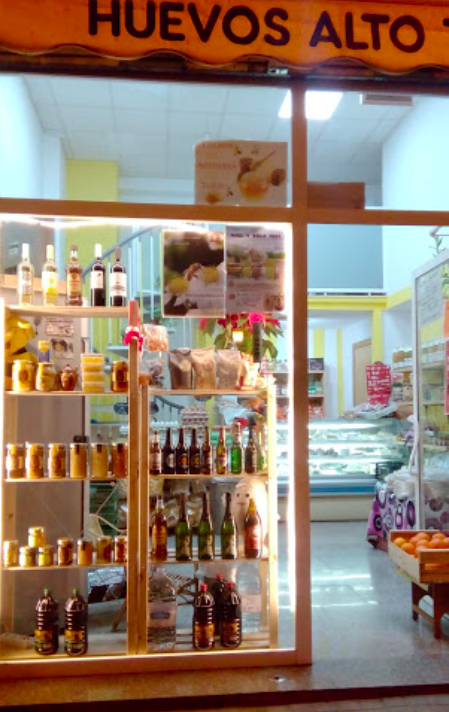
Huevos Alto Turia, our local organic shop
It has an enticing feel to it
Around the corner from us is an organic food shop which does great local produce. You know – all sorts of nuts and seeds and special breads and free-range eggs. They – I don’t know why I say ‘they’ since it’s very much a one-woman show – she will also order bottles of a local Vermouth from a friendly supplier. Tell her in the morning and she’ll have them by the evening at the latest.

I told her yesterday, because her Vermouth is one I particularly enjoy. But I left it overnight before I went to collect the three bottles I’d asked her for.

“They were here just an hour and a half after you asked for them,” she told me with a note of unmistakeable pride in her voice.

I thanked her and paid for the bottles, then loaded them into the rucksack I’d brought for the purpose. Back home, I dumped the rucksack on a chair by the dining table and took two bottle out to transfer to the storage room where we keep such things. Then I went back to the dining table and noticed, to my horror, that the rucksack was empty.
The rucksack. And just two bottles

What could have happened?

Danielle was recently robbed in Madrid. She was wearing one of those rucksack-style handbags and two young women had come up close behind her, whipped the rucksack open and grabbed her purse. We noticed them in time to stop them taking anything else, but the purse was gone, never to be heard of again.

Had the same thing happened to me?

Valencia always strikes me as a relatively safe place, with little crime. But that’s not the same as no crime. Perhaps I hadn’t been careful enough about zipping up the rucksack and someone, sneaking up behind me, had seen the single bottle in its compartment and got it out without my noticing.

Then again, I might have left it in the shop.

I shot back there and asked whether I’d left a bottle behind.

“No,” she said, “you took all three with you. I saw you pack them.”

She looked at me, concerned.

“Perhaps you took the other bottle out without really paying attention and you just don’t remember doing so?”

That must have been it, I thought. It was certainly true to character. I thanked her again – I didn’t want her to think I was accusing her of anything – and headed back home. But, no, I’d put away just two bottles, not three.

I went back to the dining table. There was a rucksack on it, completely empty. No third bottle.

And then I remembered that I’d put the rucksack I’d had with me on a chair by the dining table, not on the table itself. I took a look at that chair. And there, indeed, was a different rucksack. And, yes, it wasn’t empty.

I’ll leave you to complete the story from that point. All I’m going to add is that I was quite glad to discover that I was out of eggs, so I could go back to the shop and explain that really, truly, sincerely I had nothing to accuse her of. I did indeed have all three bottles. It was my absent-mindedness that had ever let me doubt it, nothing to do with her.

She seemed quite relieved.

As was I.

Friday, 19 July 2019

What makes a summer

One swallow, they say, does not a summer make.

Its pretty hot here, in Valencia as in most of Spain, and yet it doesn't seem to be just the heat that tells me its summer. Theres something else, and for some time I couldn’t make up my mind what

So I’ve been wondering just what does make a summer.

Not the swallows, I’d say. They turned up here in their masses – I never got a chance to spot the one that didn’t make a summer. Besides, my wife tells me they were swifts not swallows anyway. The swallows showed up a while later and, confusingly, looked exactly the same to me. In any case, one swallow or one swift certainly didn't make our summer, and even the huge numbers that eventually arrived affected our comfort much more than the season.

For a few days before they arrived, we were being irritated by flies coming into the house when we had the windows open. But then the swifts showed up in their hundreds, flying around behind our flat at sunrise and sunset, like vacuum cleaners of the air, scooping up any insect with the temerity to come anywhere near them. The fly problem vanished.

I have a lot of affection for the swallows. Indeed, I’m delighted that the house we plan to move to shortly has a pair in residence and they even have fledglings at the moment. But that doesn’t mean that it’s they who make my summer.
Swallow fledglings in our new place
So, I kept asking myself, what does?

Certainly not the date. How many British residents, including me when I still was one, have enjoyed a glorious, sunny, warm May only to shiver through a dank and cold June?

It wasn’t really the temperature either. It gets hot in Spain. We’ve even had temperatures in the low thirties in Valencia (no, no, that isn’t freezing cold, you poor benighted users of that outdated temperature system), despite the nearness of the sea and the breeze blowing off it. But it’s far worse in Madrid, where I go fairly frequently to visit my sons and their partners (and soon my second grandchild), where the high thirties or even low forties are not unknown.

It took me a while to work out just what it was that made a summer for me. And the enlightenment came in the form of a memory from my distant childhood.

For my first thirteen years, I lived in my native city, Rome. Throughout my childhood, I’d always felt profoundly English, to the extent of experiencing nostalgia for a country I’d visited frequently but never lived in. I remember catching my breath, and feeling a flood of emotion, over a geography book in my (English) school in Rome, when I came across a picture of a typical London street with a sodium streetlamp. My nation. In some sense, my home. Spiritually.

Then my parents sent my brother and me to boarding school in England. One evening some months after that wrenching move, I was at my grandparents’ house, watching TV with them. You know, black and white, and we felt at the cutting edge of technology because we had three channels instead of the two we’d got used to.

The programme was about an archaeological expedition in Greece. I remember nothing about its findings. All that sticks in my mind is a sound. Like the picture of the sodium lamp, it brought a lump to my throat and made me catch my breath.

Cicadas. Grinding away. I could almost feel the heat and smell the pine needles.

That’s summer. Hear that sound and you know you’re out of the grip of the winter and the cold. You know you’re safe in shirtsleeves, and short ones at that. Sunset doesn’t mean a chill that forces you indoors, it means the warmth becomes comfortable and that, even at night, you can sit outside with a drink and enjoy the smells and the easy living.

Just a few minutes’ walk from where we live at the moment (before we move in with the swallows) is the long park that winds through Valencia in what used to be the bed of the Turia river. Right now, it's full of that beguiling sound day and night. Reminding me again and again that summer is here. Just like when I was a kid.


Summer floods the Turia park
Just imagine the cicadas providing the accompanying sound track
It’s as nostalgic as it’s wonderful to hear the cicadas telling me I’m back in a land of real summer again…

Friday, 17 May 2019

The fallen angel: not an example to follow

“This is the only city in the world,” our Madrid taxi driver told us a few weeks ago, “which has a statue of the Fallen Angel.”

Well. Taxi drivers don’t deliver their sententious statements under oath. And they’re not known for their strict impartiality when talking about their cities. Even so, it does seem true that Madrid is the only major city with a statue to this particular fallen figure, and it is only one of a handful of any such statues around the world.
The Fallen Angel: a beautiful spot on a fine day
Having an hour to spare in Madrid, in glorious weather, I decided not to resist the temptation to wander around the Retiro Park and track down the statue.

And there indeed it was.

He still has his wings, although the myth has God tearing them from him. But he’s falling fast, and far from happy about it. Especially as a snake is about to haul him downwards into the nether regions where he is to spend eternity. A sad fate for the greatest of the angels.

Detail of the Angel: not having a good day
For he was the bearer of light, or Lucifer to give the name in Latin. 

The story isn’t entirely logical. I mean, it claims he led a rebellion against the Almighty. It’s not quite clear to me why anyone would. How do you delude yourself sufficiently to believe that such a rebellion might succeed? Surely the clue is in the word. Almighty. All mighty. Not much point trying your luck against that, is there?

Besides which, how do you even get the conspiracy going? You’re talking about an all-knowing being. You could hardly chat to a fellow disgruntled member of the entourage without the principal knowing. All knowing. Again, the clue’s in the words. Why, you couldn’t even think about it yourself without his being entirely informed of your intentions.

Before you’d even formed them.

No, I reckon Lucifer should have just said to himself, “I’m the greatest of the angels, the bearer of light. That’s pretty impressive gig, quite honestly. And I want for nothing. What would I jeopardise all that for?”

Naturally, one could come up with all sorts of down-to-earth explanations of the myth. That the story is designed to demonstrate that greed for power is a passion that drives us all, maybe. And that there’s no greater sin than to rise up against the ruler. You can imagine how those might be messages that it suited powerful elites to communicate to their subjects, above all their over-mighty ones.

But that’s all psycho-babble, or socio-babble, and I had no intention of getting into that kind of thing on a fine morning in a lovely park.

In any case, we owe Lucifer thanks on at least one count. He did provide the Madrid sculptor Ricardo Bellver with the theme for a pretty good statue. Not too big, delicately carved, full of movement and emotion. On a sunny day, well worth seeing.

And maybe more people should. Because today too far too many people seem to be inclined to delude themselves that powerful forces can be overcome just by wishing it were so. And maybe we need a few more statues of the Lord of the Underworld, only to warn us not to elect too many of his followers into powerful positions. A lesson we need to think about in the US, Russia, Brexitland and other places.

Remember. Their role model may have been an angel, but he fell. It’s a long way down and not a comfortable ride to get there.

As the statue shows.

Sunday, 5 May 2019

My cockup, their conspiracy

It’s not easy being relatively chaotic if you’re trying to live an organised life.

That was confirmed on a recent trip to Germany. I couldn’t find a direct flight from Valencia, where I now live, to Frankfurt. That isn’t quite the same thing as saying that there is no such flight, only that if there is, I haven’t found it yet. So instead I decided to take the train to Madrid and fly from there.

The train service is remarkable. An hour and forty minutes for a trip that takes three to three-and-a-half hours by car. Far, far beyond anything being achieved in Britain, the nation that pioneered railway travel in Europe.

The other great thing about travelling via Madrid was that I could go up the evening before and have dinner with my sons, who live there, and my daughter-in-law and my daughter-out-law. Who live there too.

The plan was to travel at 4:15, to have drinks and dinner in the evening.

I bought the ticket on line. Sadly, I must have been thinking too hard about the flight because when I came to travel, I discovered that I’d booked myself onto a train for the same day as the flight – which would have meant missing the plane – and not for the evening before.

“Thinking too hard about the flight?” my son Nicky interjects. “You mean not thinking at all.”

Ah, well. His judgement is harsher but perhaps more accurate than mine. Which is a little kinder.

In any case, I decided there wasn’t really a problem. I’d taken a flexible ticket, perhaps unconsciously aware that I was screwing up, so I had only to go to the station early and change the reservation.

It wasn’t that simple. There wasn’t a 4:15 that day, so the first train I could get on was the 5:10. But then the ticket agent corrected himself.

“Sorry – no. That train’s fully booked. And – oh, dear – so’s the 7:15. The first I can get you on is the 8:15. The last seat.”

“OK,” I said, “but every train I’ve ever caught in Spain has no-shows. Could I wait by an earlier train and if, just before it’s due to leave, there’s a spare seat, grab it?”

He shrugged.

“If they let you onto the platform, you can try.”

That wasn’t going to happen. Renfe, the national railway operator in Spain, posts staff at the entrance to platforms to check tickets, and there was no way they were going to let me near a train I wasn’t booked on. I’m not sure how to say “more than my job’s worth” in Spanish, or whether there is any such expression in the language, but that was absolutely the attitude they were taking.

It seems that against me all fate had conspired. Or at least, all Renfe.

In the end I had to take the 8:15.
Renfe's high-speed AVE trains
Fast, efficient, comfortable. With flexible service? Not so much
Now I know that the cockup was entirely my fault. But I find there’s something attractive about company employees trying to help out even someone who’s created his problems himself. You know, the “let’s see if we can find a solution” attitude as opposed to the jobsworth mentality.

After all, what does it cost them?

They could have helped had they wanted to. You’ll remember that I’d been assigned the last available seat on the 8:15. And yet, when I got on, I found a dozen seats, just in my carriage and the next, which stayed empty for the whole trip. I’m sure there were empty seats on the 5:10 and the 7:15 too.

It’s funny. A French high-speed train once stopped at a station it wasn’t due to call at, just to help my wife Danielle by allowing her to leave it there. A friend of mine who got on the wrong high-speed train in Germany was allowed off at an abandoned station, and was picked up there by the next high-speed train – the one he should have been on – although the station had been out of use for years.

Ah, well. Not everyone has the same view of customer service.

At least the sons and the partners stood by me. They turned out to meet me, not at 6:00 as intended, but at 10:00, which in Spain is the traditional time for dinner anyway. So we ate well in a restaurant near the station. Their warmth and sympathy made me feel a lot less foolish and a lot less annoyed. In any case, hanging around at the station in Valencia for four hours had been less painful than might be imagined – Danielle stayed with me until she had to go and walk the dogs, and I did some work afterwards. A longer wait in the station than I’d planned, but not a waste of time.

Still. I’ve got to learn to overcome my chaotic inclinations and live the organised existence I crave. Especially in Spain, where Renfe conspires so majestically against such sad little cockup merchants as me.