Friday, 29 April 2016

Labour anti-Semitic crisis? What crisis?

My mother being Jewish makes me, naturally, Jewish. God-fearing or not. In Israel or in the diaspora.

It’s a law nearly as inescapable as the law of gravity.

That meant I was, from childhood, regularly exposed to Jewish humour. Broadly, there are two great categories of jokes about Jews. On the one hand, there are those told by anti-Semites which target the supposed meanness and deviousness of Jews, and are desperately unfunny because they are so heavily marked by hatred. I shan’t be repeating any of them.

On the other hand, there are the jokes told by Jews about themselves. They highlight supposed characteristics of the Jew in a stereotype to which, I’m sure, no Jew really corresponds, but they are often brilliantly witty precisely because they are marked above all by wryness and a certain love.

For instance, a woman meets a young mother pushing a double buggy.

“Oh, what a lovely baby,” she says.

“Which one?” asks the mother, “the lawyer or the doctor?”

But one of my favourites concerns a mother with her son on a Tel Aviv bus. She keeps talking to her son in Yiddish even though the son always replies in Hebrew. Eventually, one of the other passengers turns to the mother and points out:

“Madam, your son is a citizen of the state of Israel. Our official language is Hebrew. You should be encouraging him to speak it.”

“Yes,” she replies, “but I don’t want him to forget he’s Jewish.”

I like that joke because of a profound truth at its core. There is a particular kind of Jewishness characterised, above all, by European Jewry with its Yiddish-speaking roots. That community reacted to persecution by loathing all persecution. It voted massively left of centre, it proclaimed a doctrine of tolerance, it was in the best and deepest sense of the word, liberal.

It would not have dreamed of believing that a Palestinian, as a Palestinian, was entitled to fewer rights than anyone else. It would have laughed to scorn the idea that such a Palestinian might be persecuted by a Jew. “We, the perpetual victims of racism, to be perpetrators of racism ourselves?” 

Sadly, that is a set of attitudes that seems out of vogue in Israel. The nation that speaks Hebrew is far less imbued with those values, which I cherish, than the nation that spoke Yiddish once was. It makes Israel far less the home of certain kinds of Jews than it might have been.

But not all Jews find their home in Israel anyway. The Jewish Agency apparently believes that something like 5.3m Jews, just 100,000 fewer than in Israel, live in the US. It used to be said that many American Jewish families would of course eventually settle in Israel, showing solidarity with their brethren there – but only once the sons were past military age.

There was also a story in the community about a suggestion that American Jews might be given their own soveriegn state within US territory, but it had to be turned down when no one could be found to agree to serve as Ambassador to Israel.

Right now, the papers are proclaiming that the British Labour Party is suffering a crisis of anti-Semitism. Jim Callaghan, Labour Prime Minister in the 1970s, once famously said of some economic difficulties the country was suffering, “crisis? What crisis?” He was made to pay for the words by a self-righteous press that found he wasn’t taking them seriously enough.

I’m inclined, today, to say “anti-Semitism crisis? What crisis?”

Naz Shah in the House of Commons:
the MP now suspended from the Labour Party
Naz Shah was elected Labour MP for Bradford West in 2015, wresting the seat back from a particularly unsavoury individual, George Galloway who took the traditionally Labour seat three years earlier. She has now been suspended from the Labour Party for supposed anti-Semitism. Among other things, it seems that in 2014 she posted a tweet suggesting that the whole population of Israel could be moved to the US, and the problem in the region would be sorted.

It may not have been particularly funny. But was it any worse than the joke, from inside the Jewish community, about no US Jew wanting to serve as Ambassador to Israel? Or anything like as deadly as some of the barbs that have been thrown our way down the ages?

Why arent we able simply to grin, shrug our shoulders and walk away from it?

We are in the closing stages of a US Primary Election campaign which is likely to see Donald Trump win the Republican nomination. This man has said that he would be prepared, as President, to exclude all Muslims from entering the US for a period.

It strikes me that this kind of Islamophobia, which extends far beyond Trump, is much more pernicious than the occasional outbursts of anti-Semitism that we see. And when it comes to offensive remarks, it is far more brutal than her weak joke.

We Jews of the diaspora used to represent some pretty admirable values, which we’ve rather lost recently – most British Jews today vote Tory. But it feels to me that we’re also in danger of losing our sense of perspective. And worse still, the sense of humour which we retained even through the Holocaust.

Now that would be a truly lamentable loss.

Tuesday, 26 April 2016

No bar too low...

It doesn’t matter how low you set the bar, someone can generally get under it.

In my case, it was the Spanish airline Iberia. I had to get from Madrid to Lyon for work and, the way the timings worked out, I had to use the scheduled service rather than a low-cost one (or should that be lo-cost?)

Low-cost airlines are much maligned, not least by me. Anything they can charge for becomes chargeable: hold luggage, food, any changes in your travel arrangements (as Ryanair’s Michael O’Leary so forcefully put it, “what part of ‘no refund’ don't you understand?”) So having paid five or six times more for the Iberia flight than I had for the Easyjet one that got me to Madrid in the first place, I expected a somewhat higher level of service.

Boy, was I in for a shock.

Like most of the scheduled airlines, Iberia allows on-line check-in only from 24 hours before take-off. Since I was out until quite late on that day, I decided to check in at the airport instead. A scheduled airline naturally allows that.

As indeed I discovered it did. Except that, as I was going through the process, the woman behind the counter started to look a little pained.

“The plane is full,” she told me.

“Yes,” I said, “I find a lot of them are these days.”

“Yes, but this one is so full that there is no seat for you on it.”

Naïvely, I’d come to think we’d seen the last of that ghastly habit of overbooking. This is when an airline sells more tickets for a flight than it has seats, to ensure that its planes always fly full. It counts on people not showing up for the flight, to save its blushes.

The calculation failed for my flight. But Iberia didn’t seem to be blushing at all. In fact, the way their representatives talked made me feel that they regarded it as my fault that I held a ticket for a plane which they’d filled up after I’d paid for my place.

“There are no seats,” they kept telling me, as though I was dumb or deaf. Or possibly both.

My name was added to the waiting list. Number seven, which was pretty hopeless. Especially when it turned out that there’d been only three no-shows. By sheer good luck, however, the top four on the list insisted on travelling together: they all flew or none of them flew. They dropped out and suddenly I was bumped up to number three – and got the third, and last, available seat.

Snow-covered Pyrenees
But I found crossing them with Iberia less inspiring
So I made it successfully to Lyon. Which was more than could be said for my suitcase. Regular readers of this blog may recall that this happened to me before, just a couple of weeks ago. Again on a scheduled airline flight.

At the lost luggage office, it emerged that I wasn’t the only one. The young man ahead of me in the queue had had his suitcase held in Madrid for “security reasons.”

“Why’s mine been held?” I asked when it came to my turn.

“It says code 19,” explained the airport employee, “but unfortunately I have no idea what that means.”

“Ah, well,” I said, “at least we know it’s a nineteen. That’s better than knowing nothing at all.”

“Indeed, Monsieur,” he agreed, “I’m glad we got that one clear.”

His colleague wasn’t quite as blasé. “Nineteen means they screwed up,” he explained helpfully.

As it happened, that worked out well. I’d been debating whether to pop by the hotel to drop off my case before heading to my meeting, but now I didn’t have to. Iberia kindly held onto my case for the day, freeing me up to indulge in the luxury of sitting on a restaurant terrace in glorious sunshine and enjoying that inspired French institution, the ‘plat du jour’. This is the basic meal many restaurants serve between 12:00 and 2:00, in that properly civilised country where company staff still mostly have a proper lunch hour, with a proper lunch.

Still, I was glad to get the suitcase a few hours later. The burst of lunchtime sun had turned out to be a flash in the pan, and by the evening, I needed a pullover again.

The experience overall leaves me bemused about Iberia. Especially in comparison the low-cost operators.

After all, whatever their faults, they get the essentials right. You may not be able to cancel tickets, but I’ve never been denied travel once I’ve bought a ticket (to be fair, I'm told others have been less lucky...). They mostly take off on time and land on time. Their safety record’s good. So far, not a single low-cost flight I’ve taken has lost my bag.

If only the grand old high-cost airlines could match that standard.

Sunday, 24 April 2016

Toxic title

One great advantage of a value system based on belief in God is that it provides a bedrock on which to found certainties.

It’s easier for a camel to pass through the eye of a needle than for a rich man to enter the kingdom of heaven because that’s the way God has organised the universe. Whether you favour the notion or dislike it makes it no difference: it’s a fundamental law. Although that specific principle belongs to Christianity, it wouldn’t take long to find similar tributes to the poor in most religions.

For those of us who see little evidence around us for the proposition that the world is anything but profoundly godless, there’s nothing on which to ground such reassuring certainty. We instead are probably safer to assume that there’s nothing whatever to guarantee rights to the poor or, indeed, the less than wealthy, to enter any gateway let alone heaven’s. We can count only on what we extract by our own efforts.

Rights are won, they aren’t granted, and they certainly aren’t guaranteed.

The underlying problem is neatly encapsulated in the idea of entitlement. Rights for the poor are being rapidly eroded in the prosperous nations, as employment becomes increasingly precarious, large swaths of wage-earners are obliged to give up relatively well-paid jobs and take work at lower income, or find no work at all, while at the bottom of the pile, the unemployed or the ill enjoy diminishing support. All this is happening at a time when trade union power is at its weakest for a century or more, and that’s no coincidence: when it came to forcing rights from power, no one achieved so much as the unions.

What this means is that increasing numbers of people are discovering that what they believed was their entitlement, they had not title to at all. They had exercised rights, but those rights could only be retained by constantly defending them. Giving up the instruments to wage that defence, or indeed switching their support to those who opposed the rights in the first place, put them in jeopardy.

At the other end of the scale, there are those who know all about sustaining their entitlement. Take Mark Cutifani, for instance. He’s the Chief Executive of mining company Anglo-American. Corporations, particularly in Britain and the US, have only one overriding obligation: to deliver value to their shareholders. Employees or the community generally count for next to nothing in comparison.

So when Anglo-American lost three-quarters of its share value last year, you might think the company’s executives would take a proverbial cold shower. After all, they justify their high salaries by the responsibility they take for performance.

But that’s to leave out the notion of entitlement. Cultifani has just run into some anger from shareholders because his proposed remuneration is £3.4 million. That’s equivalent to the income of some 130 British households on median earnings.

Britain is facing the increasing deterioration of its health services, as salary levels fall becoming unattractive to new recruits. Recently, it was announced that we are heading towards a critical teacher shortage, for exactly the same reason. However, it seems we’ll never run out of candidates for the top levels of industry, where incomes remain as attractive as ever, if not more so. As Cultifani shows, there isn’t even a requirement to perform to receive that level of reward.

The beauty of such salaries is that they leave plenty of small change to invest in worthy causes. Like, for instance, buying a political party. It is people like Cultifani who fund the British Conservative party or the US Republicans (indeed, as Hillary Clinton demonstrates, a lot of Democrats too). So we get entitled people running our political establishment as well – men like David Cameron or London Mayor Boris Johnson, born with silver spoons in their mouths, educated at the most privileged institutions in the country, and then following a yellow-brick path into the top offices of state.

Obama with Cameron in London
Britain outside the UK might be at the back of queue


Johnson is perhaps the more interesting case of entitled thinking. He’s a leading voice in the movement to get Britain out of the European Union. As leading international figures, such as Barack Obama or Hillary Clinton, speak out for the UK staying in, warning that leaving would serious disadvantage the UK specifically in its trading relationship with the US, Johnson has hit back. Apart from a racist dig at Obama for being “part-Kenyan”, he has argued – as have other anti-EU politicians – that the US and others among our major partners, would just have to come to terms with us.

You see, these are entitled individuals. They regard the nation as entitled too. The US can’t possibly deny us privileged trading status! Why, we’re Britain. We can simply demand better treatment than that. They may be in for a shock. For which we’d all pay the price.

What about the rest of us?

What’s happening to the health service and education should be an object lesson. We have no entitlement to them. Or to proper policing, a fair justice system, decent transport or any of the other things that we think we can count on for a reasonable life. If we leave it to the entitled, concerned only with their entitlement, we shall lose all those rights, as we are losing them now. 

We have no title to any of these things. Only hard-won rights. They need protecting – from the entitled.

Thursday, 21 April 2016

The girl on the dockside

At a time when immigration is such a burning topic again, and immigrants so harshly received – to reverse the Pope’s words, numbers first and humans second – I’m constantly reminded of an image that has been with me for decades, of a three-year old clutching a potty in one hand, and her mother’s hand with the other, while her mother is holding the girl’s baby brother.

They are in a seaport of a deeply unfriendly nation, whose people have on more than one occasion visited deadly violence against their own. They’re about to travel a thousand miles to the west, to a nation they know little about and which speaks a language they have never learned. They are doing so because the husband/father of this little family had written to say “join me”, after having spent the previous year there and building a life for all of them.

Why had he gone? He was both a skilled craftsman and a perceptive observer of the world.

His craft was the design of shoe uppers for misshapen feet. He could take a foot, deformed from birth or by accident, and by feeling it with his hands, learn enough to build the upper to fit it (the soles he would leave to others).

As an observer, he really did watch the whole world, and not just his part of it. He had, in particular, kept a sharp eye on a region many thousands of miles east of where his family would catch their boat: he’d monitored with increasing interest events in a part of north-east China then known as Manchuria.

As the Chinese Empire failed, the Great Powers of the World seized themselves rich and advantageous positions within Chinese territory. The Western nations, and that now included the United States, emerging already as the new and redoubtable military and economic force on the international scene, had grabbed “concessions” and “treaty ports” where they could carry on trade on highly advantageous terms and even impose their own law.

Have you ever enjoyed a Tsingtao beer with a Chinese meal? It’s probably the best-known beer out of China. It resembles a German lager. That’s no coincidence: Tsingtao, on China’s North East coast, was a German holding, and the Germans established the brewery which continues to produce that beer to this day.

Japan had seized Korea, where China had previously held sway. The Northern border of Korea abutted the south of Manchuria. And there the Russians were building themselves what was euphemistically called a ‘sphere of influence.’

For centuries Russian strategy had been to find a warm-sea port. That’s a port which would not be frozen in the winter unlike, say, St Petersburg in the West or Vladivostok in the Far East. Manchuria gave them several such ports, most notably Port Arthur.

The Russians denied any intention to annex the territory – in other words, they ostensibly recognised that it was under Chinese sovereignty. No one was taken in. Least of all the Japanese, who felt sure that the Russian occupation of Manchuria would eventually lead to a threat to their (equally illegitimate) control of Korea.

Japan had deliberately isolated itself from the rest of the world at the start of the seventeenth century. It had only re-emerged as part of the world order some thirty years earlier. It was regarded as a growing power, but still far from one to take seriously. Neither its army nor its navy had proven itself, and their strength was not regarded as impressive.

A mistaken assessment, it would eventually transpire.

Why was this of interest to our orthopaedic shoe maker? Because it seemed to him that the worsening situation on the Manchurian-Korean border would eventually lead to war. Hundreds of thousands would die for a cause in which he felt absolutely no interest. He was, at it happens, a subject of the Russian Tsar, but that was not a matter of choice to him. His home city, indeed, is today the capital of an independent nation, Lithuania.

He had already spent seven years in the Tsar’s army. Why? Because rather like African Americans in the US Army in Vietnam, he belonged to a group regarded as expendable and liable to call up for all the least attractive and most dangerous jobs: the Jews.

He’d done his time in the army, and then some. He had no intention of becoming a soldier again, and certainly no wish to suffer death or injury by doing so. He decided it was time to try his luck in England. By great good fortune, he was allowed to immigrate, no doubt because of his skill. So he went to England ahead of the family, making contact in London with a Jewish agency that supported immigrants, but finding work reasonably quickly, so that he was able to send for his wife and children within a twelvemonth.

Which is why the little girl turned up on a dockside clutching the family potty.


The Russo-Japanese War: well worth avoiding

The following year, war broke out between Russia and Japan. To the world’s astonishment, especially the Russians’, the Japanese turned out to be formidable opponents. They won a string of bloody but decisive battles on land and, when the Russians sent a new fleet around to the Pacific, cut it to pieces too in a comprehensive victory at sea.

But by then, the shoemaker was well out of the way, bringing up his family in London. England, however, was no more generous to immigrants then than today, and that family was one of only few who were allowed in. Ninety of their relatives remained in Vilna, present-day Vilnius. Not one of them made it through the Holocaust. No trace even of their fate survived.

The little girl eventually became my grandmother. Later in her life, she decided to commit some of her memories to paper in the form of short stories. That’s where the image of the three-year old waiting to board her ship first came to me.

I’m grateful to Britain for having taken her in, particularly as my mother and I both still live in that country and are, as my grandmother became, deeply English. It’s only sad that my compatriots today seem as intent as ever on doing the least they possibly can to help today’s fleeing migrants.

Especially given that we now know what happens to the ones left behind.


The little girl, 27 years on

Tuesday, 19 April 2016

Air travel can be so complex sometimes... Even when it seems simple

Please pay attention. This is a complex story. You need to focus.

Now, I readily admit that it doesn’t seem that complex at first glance. You might even be fooled into thinking it’s trivially simple. I know I was, but like you, I had to learn that I was sadly mistaken.

Over the last three days, I travelled from London to Vienna, then Vienna to Frankfurt, then Frankfurt to London. I know that doesn’t seem that complicated, but it really, really is.

I mean, what you’re supposed to do when you catch a plane is fly from point A to point B, do whatever you came to do, then travel from point B to point A. Even if there are intermediate stops in between, the basic principle holds. Out, then back.

A triangular trip? Way beyond the capacity of the airlines in our post-low cost age.

The first thing that went wrong is that I couldn’t check in on-line. So I turned up at the airport with nothing proving I was booked on the flight other than an e-mail from a booking system.

The second thing that went wrong was that the check-in machines inside the terminal wouldn’t check me in. A disdainful employee, aged about sixteen as far as I could see, came over to provide assistance. He clearly thought I looked about eighty.

“Let me see, sir, can I help at all?” he said, and you can just imagine the superior tone, can’t you? Underneath them is lurking the thought “poor old man, he doesn’t understand that you have to feed in your passport open, not closed.”

So he took my passport and fed it in, exactly as I had. “Your reference number, sir?” So I gave it to him and he typed it in, just as I had a few minutes earlier.

And then, just as I had, he stared, bemused, at the error message on the screen.

“You’d better go to a manned check-in desk, sir,” he advised, which at least had the merit of being exactly what I had intended to do.

The Austrian Airlines lady sorted me out, and off I went to Vienna.

Which is where the third thing went wrong. No suitcase greeted me on the carousel.

I went to see another Austrian Airlines lady.

“But,” she told me, “you are travelling to Frankfurt.”

“This is true,” I confirmed, “but not till tomorrow.”

“But your bag is in transfer, ready for the next leg of your trip.”

“Great. But what am I supposed to do during the day tomorrow? I have a meeting. My suit’s in the case.”

She considered this.

“Ah,” she said at last, “you are making a stay in Vienna.”

It was a relief that I had found someone with the necessary intellectual acuity to grasp the extent of my predicament.

She looked sorrowful, which didnt calm my apprehension at all.

“We can get the bag brought round, but it could be a long time.”

It was getting on for 11:30 at night. I could picture myself stuck there till 1:00 or 2:00 in the morning. But in the end it only took twenty minutes, and she came round to check everything was OK, so we exchanged smiles and I thanked her warmly.

The fourth thing that went wrong was the next day, when I came to check my bag in again for Frankfurt.

“But you have a bag in the system already,” the third Austrian Airlines lady told me.

I looked, I hope pointedly, at my bag which was undeniably right there, stolid and unmistakeable.

“Do you have another bag?”

I explained to her that I didn’t. She called a colleague over. He explained to her that she had to delete the existing record for a bag in the system and then register a new one. She tried, and failed when the system told her she couldn’t delete the entry. So he had a go, slightly condescendingly, intent on proving that with his expertise, he wouldn’t make the same mistake she had. Until he bumped up against the same error message. At which point he hightailed it out of there, ostensibly to take care of the next passenger. 

I was delighted to see that the “next passenger” turned out to be a group of nineteen Mandarin speakers on a Kung Fu world tour. Served him right, I felt.

Meanwhile, my young lady called a support person, who was on break. Eventually, she got back from break and assured us she’d be right over, which turned out to be ten minutes later.

“So you want this bag checked through to London?” she asked.

I stayed calm.

“No,” I explained in measured tones, “Frankfurt, please. Where I can collect it.”

I made a point of checking the luggage tag carefully, to ensure it really was marked ‘FRA’. It was.

The fifth thing that went wrong was at Frankfurt today. I was pointed at a machine to get the luggage tag for my case.


Looks straightforward. But, believe me, it isn’t
“Your suitcase is already checked in,” the machine told me.

But this was Lufthansa, and they take no nonsense from machinery.

The woman who dealt with my case – and I use the word in both senses – was a battleaxe with pink hair.

“Problem?” she said, “there is no problem.”

The bag got checked in and sent on its way. As was I. And at Heathrow there was my suitcase on the belt, waiting for me.

Now I just have to get it home and bring this terribly complex trip to what I hope will be a happy conclusion.

Sunday, 17 April 2016

Time, the devourer of all things. Easy to say, more difficult to experience

Life is full of rites of passage, isn’t it?

I remember clearly the first time a bank showed eagerness to lend me money, rather than eagerness for me to pay it some back. The birth of my first child, marking with absolute finality my departure from the younger generation (it didn’t happen until I was thirty, so I did OK). The first time a policeman called me “sir”, marking my transition from likely suspect to citizen to protect (I have the good fortune of being what we call “white”, or I would in all likelihood still be waiting for that transition).

Why, I even remember the moment on a bus in Kyoto, Japan, when a woman walked half the length of the vehicle to point me at the seat she’d just vacated before arriving at her stop, having identified me clearly and, I suspect, accurately, as the oldest of the standing passengers and therefore the most entitled to take over her place. Even more amazing, the seat was still vacant when I’d walked half the length of the bus back to it – in London someone, probably someone much younger, would long since have occupied it.

So today I had another of those important experiences. As I went to climb onto a train, a young (well, younger) man offered to lift my case into the carriage.

As it happens, I’d packed for only two nights away so my case weighed, as the French so prettily put it, three times nothing. On the other hand, had it weighed as much as it does when I’m away for a week or more, I like to think I’d still have managed to lift it onto the train.

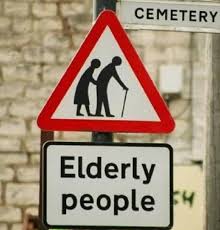
Time’s catching up with us all
Even if, like me, you think you’re keeping it at bay
Now, don’t get me wrong. I appreciate the offer of help, which at least reveals better attitudes in society than many of us might have come to expect these days. In much the same way as I appreciate being offered a seat on a bus or being treated with courtesy by the cops.

But it worries me that there are those out there who already regard me as so obviously decrepit. I was out playing badminton this morning, and acquitted myself reasonably well. The notion that I can’t lift a case doesn’t really fit with the self-image I like to cultivate.

However, no self-image is proof to the ravages of the years. Time, said the Latin poet, is the devourer of all things. It devours me as it devours everyone. The only way not to grow old is to die young. That was never a pretty prospect, and I’ve left it too late already anyway.

I suppose I should be grateful that today’s reminder of all those truths was delivered to me in such a gentle, and kindly, way.

Saturday, 16 April 2016

A SIM card that proved a fundamental principle

One of the more useful principles that have stuck with me from school physics is that “matter can neither be created nor destroyed.”

That’s a principle of the natural world, of course. I’m saying nothing about what’s possible supernaturally. I don’t want to get into an argument with my religious friends, so I can assure them I’m making not claim about the creation or destruction of matter by an all-powerful God to whom, of course, anything is possible.

No, I’m talking about ordinary, day-to-day life where, by natural means, nothing material can be created or destroyed.

Why’s this notion so useful? Well, if you’re like me and constantly prone to mislaying important things – glasses, keys, even that cup of coffee made with the last of the grounds, having forgotten to buy any more – it is a great comfort to remember that, being material, it can’t have been destroyed. I know that I left it somewhere, possibly somewhere sensible, more likely somewhere completely stupid, but wherever I left it, it’s still there, waiting for me to find it.

I had a reminder of the value the principle the other day. Two years on, the contract on my previous phone ended and I was able to take a new one. Fortunately, the upgrade I went for didn’t require a new SIM card. I just had to take the SIM out of my old phone and load it into the new one. 

Which sounds simple enough.

It might have been wiser to wait until the morning, when I would have been less tired. Instead I dropped the SIM card onto the carpet at my feet. Or so I thought. I spent twenty minutes hunting for it without success. I took a break. And then looked again, just as uselessly.

It was at my feet. How could it have gone anywhere else? The phones are mobile, but only if we carry them. How does a SIM card become mobile on its own?

I have little confidence in my ability to find things I’ve lost. But Danielle’s different. So when she also spent twenty minutes looking and failed, I had to fall back on the physics principle. The card had still to be in existence somewhere, we just didn’t know where.

We decided it had to be inside the dog. I hadn’t seen her getting close enough to swallow it, but it was hard to think of any other explanation. Still, I didn’t like the notion – it was much too reminiscent of the classic schoolboy excuse, “the dog ate my homework.” I wasn’t convinced.

And, indeed, the very next morning, my eye was caught by a glint of reflected sunlight. The SIM card! There it was. Lying innocently on the floor, as though it had done nothing to irritate me. In the kitchen, nowhere near where I dropped it.

So how did that SIM card travel so far? Was it hiding in a fold in my clothing? Did it attach itself to a shoe? Had the dog scooped it up and then sensibly dropped it (it certainly showed no traces of having been any further through her)?


Unlikely demonstration of the principle of conservation of matter
Ah, well. It showed up. It’s now my phone and working just as I hoped. Having proved, yet again, that though it can be mislaid, matter cannot be created or destroyed.

And that Im not good at keeping an eye on things. Or finding them when Ive lost them.