Showing posts with label Islamophobia. Show all posts

Wednesday, 29 November 2023

Popularising an ugly game

If you think that football is the international game, think again. If you think it’s athletics, or chess, or tiddlywinks, well, you’re still on the wrong track. Today, the great game in country after country, is ‘get the immigrant’.

It’s the one thing that seems to unite large, and growing, numbers across nations and cultures. They all hate anyone from other nations or cultures. And they’re keen to keep them well away, especially if they’re being badly treated and escaping persecution or back-breaking poverty.

Here’s what a British Conservative MP, William Evans-Gordon, had to say on the subject, talking about the horror of finding aliens taking over areas of London: 

East of Aldgate, you walk into a foreign town

Even further to the right, Nigel Farage told a UKIP conference about how upset he was on a train in the outskirts of London:

It wasn’t until after we got past Grove Park that I could actually hear English being audibly spoken in the carriage. Does that make me feel slightly awkward? Yes.

Returning to Evans-Gordon, he also declared:

Not a day passes but English families are ruthlessly turned out to make room for foreign invaders 

And another Conservative MP from the far right of the party, at the time Home Secretary and responsible for action on immigration, Suella Braverman, used the same kind of language about invaders when she told the House of Commons:

The British people deserve to know which party is serious about stopping the invasion on our southern coast, and which party is not

Keeping that kind of invasion out requires a solid barrier, and the Dutch politician Geert Wilders claimed he knew what was needed:

We must have the courage to restrict legal immigration instead of expanding it, even if we sometimes have to build a wall

Naturally, his is not the only, or most famous, call for a wall against immigrants. Who could forget Donald Trump, with all his typical self-deprecating modesty:

I would build a great wall, and nobody builds walls better than me, believe me, and I’ll build them very inexpensively. I will build a great, great wall on our southern border and I’ll have Mexico pay for that wall.

Trump got four years as president to show what he could do and got a few miles of wall built, not an inch of it paid for by Mexico.

Before we go any further, I should admit that I’ve cheated a little. 

Farage, Braverman, Wilders and Trump are all contemporary politicians. Evans-Gordon isn’t. He was a Conservative MP from 1900 to 1907. I quoted him only to show how little the rhetoric of these characters has changed in over a century. The only shift has been in the targets of their attacks. In the early years of the twentieth century, the great concern, not just in Britain but across Europe and in the United States, was with Jewish immigration. Persecuted within the Russian empire – which back then extended right into most of Poland – Jews were fleeing westward, often destitute and in terrible health. Far from being greeted with open arms and assistance, most of the countries to which they turned tried to keep them out.

These days, anti-Semitism has faded somewhat, though it’s making a bit of a comeback thanks to the pursuit of violence by both Hamas and the Israeli state. What has grown into that same space is Islamophobia. As Geert Wilders assures us:

I am not ashamed to say that our culture is far better than the Islamic culture, which is a culture of barbarism.

What’s interesting about these views is the paradoxes they often contain. For instance, there were several hours of violent rioting in Dublin on 23 November, in protest against a knife attack which left three children and an adult injured, some hours earlier in the city. The rioters burned buses and cars, including police cars, and looted shops.

Police at the riots in Dublin
Rioters shouted anti-immigrant slogans.

Curiously, the Guardian tells me that the Irish have also raised nearly 350,000 euros for a young man who intervened against the knife-wielder, at considerable risk to himself. Clearly his action was appreciated by many in the country. And who was this heroic young fellow? Why, a delivery driver by the name of Caio Benicio. Where’s he from? Brazil.

He wasn’t alone in his intervention. A seventeen-year-old student joined him, taking minor injuries to his hands and face. He was from France.

In other words, the riots were triggered by the actions of a man who, it seems, was a naturalised Irishman and long-term resident of Ireland. He was overpowered by two foreigners. Both recent immigrants to the country.

A similar irony emerges from the recent history of Geert Wilders. He won the most seats in the recent Dutch general election but is having a bit of trouble trying to put together a government coalition he could lead. The man he appointed to conduct negotiations with other parties, Gom van Strien, had to stand down before he’d even started because of fraud allegations against him. That’s quite useful evidence about Wilders, showing that it isn’t only in his political stance that he resembles Donald Trump, but also in the company he keeps.

What’s more, despite his virulently anti-immigrant views, he strangely takes a populist or even left-wing stance on various social and economic matters, such as healthcare, pension entitlement, the minimum wage and public housing. According to two Dutch economists, Marcel Klok and Marieke Blom, if it pursued such policies, a coalition including Wilders might well have the effect of stimulating the economy. But Dutch unemployment is low. So the economists told the Guardian

Given the current strains in the labour market, we expect this to result in more demand for foreign workers.

Wilders espouses economic policies that may well lead to more immigration, while continuing to spout his bitter anti-immigrant rhetoric. But there’s nothing unusual about that, as the Irish have shown, or indeed experience in Britain. Anti-immigrant language is common across the British political spectrum, while huge areas of the economy, particularly agriculture, the catering sector and healthcare are in desperate circumstances for lack of foreign workers.

Ah, well. Anti-immigration remains the great international sport. But that doesn’t mean that it necessarily makes any sense. 

Presumably that’s why it attracts spokesmen who talk nonsense, like Wilders, like Trump, like Braverman. Or William Evans-Gordon. Spouting the same bile for over a century, even if the ethnic group targeted has changed.


Saturday, 11 April 2020

An exceptional woman taking on the pandemic

A great many nations must be looking at New Zealand and envying that country its outstanding Prime Minister, Jacinda Ardern.
Jacinda Ardern after the Mosque shootings
Exactly
the right mix of kindness and steely firmness
You may remember how well she reacted to the Islamophobic shootings at two Mosques in Christchurch. She came through with exceptional tenderness, hugging survivors and the bereaved, but also with all the firmness needed. She said of the killer “we will give him nothing, not even his name” when she reported on the incident to Parliament and, indeed, did not name him.

She followed up with tightened firearm regulations, proving that she has real steel in her when necessary, achieving more than Trump ever even attempted (Obama tried but was denied) in the face of the terrible shootings in the US.

How much we yearn for an Ardern in other countries.

Take the British Prime Minister, Boris Johnson, hospitalised for CVid-19 infection. I’m glad he no longer needs Intensive Care, and he has my sympathy while he remains hospitalised. However, that’s neither more nor less sympathy than any of the other 16,000 or so patients admitted to hospital in the UK for Covid-19 treatment.

The Romans used to say that you should say nothing but good of the dead. In Johnson’s case, people have been quick to point out to me that I should say nothing but good of the sick either.

This reminds of the time, over four decades ago, when I was working in the British Civil Service, and one of my jobs was to track down fraud on National Insurance benefits. In a training class, I listened to ways of tracking down such nefarious behaviour by, among others, pensioners.

“We go after pensioners?” I asked, surprised.

“You don’t think,” the trainer replied, that someone who’s spent half a century being a rogue is going to mend his ways on his sixty-fifth birthday, do you?”

Yes, I feel sorry for Boris. But the fact that he got sick hasn’t stopped him being a self-serving, narcissistic liar. And I feel a little frustrated by the general consensus out there that I should stop saying so until he’s fully recovered.

Fintan O’Toole, an excellent journalist who usually works on the Irish Times but also contributes to the Guardian, sums up the situation perfectly in a piece about ‘British exceptionalism’ has been exposed as a myth by Coronavirus. As he points out, Boris delayed for far too long in addressing the Coronavirus outbreak. He also seemed to apologise for imposing the partial lockdown now in place in the UK. In particular, he seemed concerned about restricting the fundamental right of British citizens to go to pubs, as though there were such a right.

As O’Toole suggests, it’s clear that his real worry was that the measure would prove unpopular. So he was anxious about losing votes, as though that mattered more than saving lives. Which, for him, perhaps it does. Certainly, lives have been unnecessarily lost because of his reluctance to take the required action.

I don’t pretend that the Prime Minister of my new home country, Spain, was faultless in his handling of the crisis. On the contrary, he was far too late off the mark. But once he grasped the full import of the crisis, he introduced a far stricter lockdown than in Britain.

The lockdown has been painful, but it seems to be working. For nearly a week now, we’ve seen the numbers of new cases and new deaths falling day by day. Boris could have seen how Italy and Spain reacted (but was he looking?) and learned the lesson (but is he open to being taught?)

Obviously, Donald Trump is a far worse case still. In denial for weeks, pretending that the epidemic was of little importance, taking the wrong action (such as banning flights from China) when he took any action at all, repeatedly trying to belittle the significance of what was going on. Why, he’s even appointed as ‘Coronavirus Tsar’ one Peter Navarro, who has no medical expertise whatever.

And there are plenty of other examples of utter failures in positions of leadership around the world.

How did Ardern react to the pandemic?

She has gone for an ‘elimination’ strategy, as explained by two epidemiologists, Michael Baker and Nick Wilson, also writing in the Guardian. The aim is to stop all transmission of the disease within New Zealand. Returning travellers are being stopped at the borders and quarantined. The whole nation is under lockdown. Meanwhile, the authorities are tracking the cases that remain in the community, with a view to treating those patients before others are infected.

That’s what it means to have a leader in charge. She has the steel to impose a full lockdown. She has the determination to apply the strongest possible approach to the virus – elimination rather than mere containment. It may, of course, still not work, but it’s looking good at the moment: case numbers are falling and so far, there have been just four deaths.

Some will say that New Zealand has the advantage of being an island nation. That’s true enough. But then what’s the UK’s excuse? Cases and deaths are both still rising fast there.

The example set by New Zealand depends on having a Jacinda Ardern in charge, and they’re sadly rare. Most of us are stuck with a Trump or a Boris. But that only underlines how important it is for us all to grasp what might seem a truism: we need to focus on finding leaders capable of leadership. Because for some time now, we seem to have selected our top politicians on other criteria.

And how well would you say that’s going?

Sunday, 12 August 2018

Do Jews matter? Or Muslims?

Martin Niemöller, imprisoned by the Nazis
Denmark, once a beacon of tolerance and inclusiveness, has banned the Muslim full-face veil. It also now operates a system of officially designated ghettos, mostly inhabited by immigrants.

The Danish example has animated the far right in Britain, with Boris Johnson, contender for the leadership of the Conservative Party, claiming that, while he doesn’t back a ban, he feels the niqab makes women look like letterboxes or even bank robbers.

Many, even Tories, have denounced the ‘morally empty’ Johnson for encouraging Islamophobia in this way. But he has received outspoken support from Jacob Rees-Mogg, from the hard-right, hard-Brexit wing of the Conservatives. That link between Brexit and Islamophobia is no accident: whatever people may say about ‘taking back control’ or Britain assuming its rightful place in the world, the main motive behind Brexit was xenophobia, and the first target of British xenophobia is Muslims.

The rise of xenophobia is creating a toxic atmosphere in which fundamental values of human rights are rapidly receding. We badly need a force capable of resisting that trend, which is why it’s a tragedy that the British Labour Party, far from fighting this crucial battle, has undermined its own position by failing to refute the charges of antisemitism under Jeremy Corbyn’s leadership.

Now, I agree with his fans that the scandal is being sustained by right-wing propaganda against Corbyn and Labour. Where I disagree with them is in seeing this as in any way unprecedented or even unusual. Why, in 1924 the first ever Labour government faced a scurrilous campaign of vilification, including the publication (by the Daily Mail, a sewer then as it’s a sewer now) of a forgery, the ‘Zinoviev Letter’, which suggested that the Communist International was working for a Labour victory.

Attacks on Labour come with the leader’s territory. The hallmark of the leadership is its reaction to them. Sadly, the reaction of today’s leadership has been lamentable.

It could have adopted the International Holocaust Remembrance Alliance (IHRA) definition of anti-Semitism, with all its examples, immediately and in full. It didn’t. It decided that four of those examples would have limited its freedom to criticise the state of Israel. It’s hard to see how: nothing in those examples means that one can’t say, for instance, that the Israeli government’s attitude towards Palestinians is racist and abhorrent.

Corbynistas, however, objected to the four examples as a matter of principle. It had to be principle, since pragmatically it was a senseless decision. Ask most British voters about the Israel-Palestine conflict and it’s likely you’ll be met with ignorance. Those who do have an opinion are likely to come up with a ‘faults on both sides’ kind of argument. They might even say ‘well, Israel has to be able to defend itself against terrorists’. Persuading them that Israeli action goes way beyond legitimate action against terrorism would require a long process of education, and I’m not convinced many voters would be prepared to submit to it.

Oddly, though, the rejection of four examples was not, it turns out, a matter of principle after all. Corbyn has now decided that actually he can accept three of the four examples, so clearly they weren’t that problematic to start with. The suspicion has to be that in time he’ll accept the last one too.

Had he done that at the beginning, the attacks would not have stopped, but at least with swing voters he might have been given the benefit of the doubt. ‘Look, he’s accepted the international definition of antisemitism,’ they might have said, ‘and done it immediately. What more can you ask?’

By doing it late and reluctantly, he just looks truculent and unprincipled. He forfeits the credit he might have won otherwise.

Lousy politics.

The implications are more serious than that, however. After all, it isn’t antisemitism that is the most virulent form of racism in Britain today. It is far less widespread or intense than the Islamophobia which permeates society, as exemplified by Boris Johnson and Jacob Rees-Mogg. That’s what needs to be resisted before we follow Denmark down the ugly road it has taken.

But how does one resist racism by others when one’s own track record isn’t spotless? Until we’ve cleared ourselves of the charge of antisemitism, Labour can’t claim to lead the fight against racism. Boris may be morally empty, but a counter attack would be far more effective if we’d first secured the moral high ground ourselves.

The toxins run deep. A minority of Labour favours Brexit. Sadly, with his talk of the benefits of a ‘Labour Brexit’, the suspicion is that Corbyn is with that group. That gives it disproportionate power. So it’s unsurprising that the leadership is resisting, despite powerful pressure from the membership, attempts to have the forthcoming Labour Conference debate backing for a second referendum on the EU.

The French equivalent of the saying ‘birds of a feather flock together’ is ‘tell me who you hang out with, and I’ll tell you who you are’. Labour Brexiters are rubbing shoulders with the xenophobes they should be opposing. If they help reinforce racists’ views, they shouldn’t be surprised when they become tarred with that brush themselves. Backing Brexit lands them in the xenophobe camp.

Sadly, while it may only be Jews who are upset with Labour now, it’s Muslims who are facing general hostility. We should be strong in our defence of their rights. And not just for their sake: allow discrimination against the Jews or Muslims today and, who knows, in the long run you too could be the victim of your short-sightedness.

Niemöller adapted to our times

Wednesday, 25 April 2018

Corbyn's courage is not enough

Afiz Shah, who describes himself as British Asian, is a Labour Councillor in Bristol. He recently called in at a police station to report a serious crime, and was promptly arrested himself. He apparently ‘looked like’ a suspect the police were looking for.

Let’s be clear: ‘looked like’ means he had a similar skin colour.

This kind of ingrained racism is something from which many suffer for the colour of their skin or because they are Muslim. Suffer not once but repeatedly.

By contrast, though my mother’s family suffered from antisemitic persecution in the 1930s and 1940s – ninety relatives in Lithuania disappeared without a trace – I haven’t personally suffered any kind of threat or insult based on my Jewish roots. In particular, in my membership of the Labour Party, I’ve never seen any antisemitic behaviour directed against me or anybody else.

That’s not to say that I think antisemitism doesn’t matter. On the contrary, I think it matters deeply. It is a pernicious disease, just like any form of racism, such as the far more widespread Islamophobia in our society. It needs to be resisted, above all by the political left of centre, which ought to be the beating heart of anti-racism.

This means that any trace of antisemitism within the Labour Party itself has to be extirpated quickly and decisively. Not because antisemitism is in any sense the most important form racism, but because if we are tolerant of any form of racism, we weaken our position to combat all the others.

We owe it Afiz Shah and so many like him not to let that happen.

Many Jeremy Corbyn supporters claim that the accusation of Labour antisemitism within Labour is merely a stick used by his opponents to beat him. It certainly is such a stick, which is another reason that makes it urgent to deal with the problem. That it isn’t only such a stick is made clear, however, by Corbyn himself, in his statements of the seriousness of the problem.

‘We have not done enough to get to grips with the problem… my party and I are sorry for the hurt and distress caused’ he said before a meeting with Jewish leaders on 24 April.
Corbyn: not doing enough. Maybe not capable of doing enough?
It takes courage to admit that the party that made him his leader has not done enough to tackle a key failing.

On the other hand, who if not the leader is responsible for making sure that sufficient action is taken?

The Jewish leaders he met were deeply dissatisfied. They could not, for instance, persuade him to adopt the definition of antisemitism used by the International Holocaust Remembrance Alliance. For information, this is:

Antisemitism is a certain perception of Jews, which may be expressed as hatred toward Jews. Rhetorical and physical manifestations of antisemitism are directed toward Jewish or non-Jewish individuals and/or their property, toward Jewish community institutions and religious facilities.

This seems so uncontentious a definition it seems hard to understand why Corbyn could not accept it and pledge himself to campaign for the party to accept it. He couldn’t bring himself to do it.

The most telling criticism came from Jonathan Goldsmith from the Jewish Leadership Council who said that Corbyn ‘engages in conversation until you ask him to do something.’ Or, as he told the BBC, ‘when you ask him to do something he has this habit of staring and just shrugging.’

Corbyn has been a backbench MP for 35 years. For 35 years he has been paid to talk and write about politics in the highest forum Britain offers for it, but he’s never been called on to take responsibility for putting anything into action. Indeed, his image of a kind of saintliness depends on it: he’s never sullied his hand by actually having to deliver anything in reality.

Thirty-five years is a long time that produces ingrained habits. Perhaps to stare and shrug when asked to do something. It is now nearly a month since Jews protested in Parliament Square against antisemitism in the Labour Party, and we are still in a position in which Corbyn has to admit that ‘we have not done enough’.

I said before that it took courage to make that admission. Unfortunately, while leadership certainly requires courage, it needs more than courage alone. Another essential quality is decisiveness.

Sometimes Corbyn can be decisive. He quickly fired Owen Smith from his team for publicly espousing a position on the EU with which two-thirds of the Labour Party agrees. Unfortunately, there’s a suspicion that some of the antisemites against whom he’s required to take action are supporters, possibly friends, of his. Is he less decisive with his friends than with an avowed opponent such as Smith?

Wobbly with his friends. Accustomed to speaking a lot but doing far less. Corbyn seems fated to disappoint on an issue needing to be addressed urgently – not for the sake of the Jews but for all those facing racial bigotry.

The question Corbyn really needs to answer is this one: is he up to the job? Now, making an admission in answer that one will need far more courage than just accepting that too little has been done. An admission, after all, would have grave implications for his own position – implications he may not be willing to face.

Any more than his supporters are.

Tuesday, 2 January 2018

Hopes for 2018. Or are they just blinkers?

One of the aspects of 2018 that appeals to me personally is that it will be my second calendar year in a job I actually enjoy.

That may sound pretty unimpressive but when you’ve spent ten years moving between six jobs, five of which were lousy fits – or, to be fair, to which I turned out to be hopelessly unfitted – finding one that I actually like is a remarkable uptick.

So it’s good to be starting a new year in it.

One of the aspects I enjoy of the job is that it involves quite a lot of work in Italy. Why should that appeal to me? It’s where I was born, but in the course of a long career, I’ve never had the opportunity to work there. Now, however, I’ve been working with Italian colleagues and developing relations with Italian clients, and it’s wonderfully rewarding.

As a child, I spoke Italian pretty well. Perhaps to near-native level. Today – well, it’s half a century on and things get rusty. So one of the things I’ve been doing is working on the language. Reading is one of the best ways of doing that.

Do you know Primo Levi’s book The Periodic Table? I liked it so much that I’m re-reading it. The beauty is that it’s extremely funny, which only intensifies the harrowing poignancy of the life story of a man who was one of the few survivors of the extermination camp at Auschwitz.
Primo Levi: an extraordinary history for an outstanding writer
The book’s title is derived from the profession Levi first chose, long before he became a writer. He was a chemist. Each chapter is associated with the name of an element from the Periodic Table. Near the end of one of the early chapters, Zinc, Levi explains that:

…I had always considered my origins a negligible if curious fact, a little amusing anomaly, like someone whose nose is bent or who has freckles; a Jew is someone who doesn’t decorate a tree at Christmas, who shouldn’t eat salami but does anyway, who learned a little Hebrew when he was thirteen and then forgot it.

That struck a cord, because it is so close to the way I feel about being a Jew myself. If I were more religious it would matter much more but, since I’m not, it remains for me simply a cultural idea – or, more importantly, a cultural emotion – which is far from defining who I am. It’s as essential to my character as is my imposing height (167 cm or 5’7”) or my spectacular hair colour (six decades to get it to this particular white, though it was well under way in just three).

That’s surely how these characteristics should be. Of some interest, maybe, but not the basis for any kind of real judgement. Sadly, for Levi, in the late 1930s, his origins wouldn’t long remain a mere curiosity. As racial laws were promulgated by the Fascist government, walls began to go up around him, with the doors in them closing one by one.

These days, of course, while anti-Semitism is hardly dead, it isn’t the force it once was. Nor is it by any means the main cause for the persecution of people on the basis of what they are, rather than what they have done. Today the groups suffering the most are Muslims or Blacks.

Something that brought this home to me particularly strongly was when I asked a black woman I’d just met, where she was from. It was an innocent question. Her accent said loud and clear that the answer was ‘Luton’, the town to which my wife and I had just moved. That was the answer I was expecting. But that’s not an innocent question to a black person.

She replied, “I’m from Cheltenham”.

Now Cheltenham and Luton are about as far apart as any two towns can be in England. Not geographically, though they’re hardly neighbours. The real distinction is social. Cheltenham is nice, a word you should pronounce ‘naice’. It’s wealthy. It has a fine girls’ school. It has a major British spying centre. It has a Tory MP. House prices are, I doubt not, astronomical.

Luton has two Labour MPs. It’s just a tad dust-blown. Its great advantage is that, for being this close to London, its house prices are amazingly cheap – perhaps a third to a half of the capital’s.

It’s hard to imagine anyone with her accent coming from Cheltenham.

Still, that was her answer, and we chatted a little about the town and her upbringing there before moving on to other subjects.

By the afternoon, she’d got to know me a little better. And suddenly, unprompted, she turned to me and said, “actually, I was born in Jamaica. I came to Cheltenham when I was five”.

All the weight of blackness was suddenly laid bare for me. Ask a white Englishman where he’s from and he tells you. Ask someone black, and there’s a moment at least when he has to be wondering, “are you checking on whether I’m an alien? Whether I don’t belong here?”

The attitudes that would ultimately inflict terrible suffering on Levi are still there. They just have different targets, for the most part, today.

Back to Levi’s book.

The following chapter, Iron, starts with the words:

Outside the walls of the Chemistry Institute it was night, the night of Europe: Chamberlain had returned outplayed from Munich, Hitler had entered Prague without firing a shot, Franco had subjugated Barcelona and was sitting in Madrid. Fascist Italy, a minor pirate, had occupied Albania, and the premonition of catastrophe was condensing like a viscous dew across the houses and in the streets, in careful talk and muted consciences.

Well, we’re not there yet. Reading those words on the brink of 2018 reminded me how much less bad things look today than they did in 1939. But then, they didn’t look so bad in 1930, but the 1939 catastrophe came anyway.

And yet, if we wanted to live, Levi tells us later, if we wanted in some way to take advantage of the youth that was flowing through our veins, there was no other resource… than voluntary blindness.

Yes. That’s what stops us preventing that kind of slide. And yet, if Levi chose voluntary blindness, with what he was facing, what’s to stop us doing the same?

I’m looking forward to another year in a job I like. It should be fun. But is that just me choosing blindness too?

Monday, 4 December 2017

In praise of a great woman: people aren't dispensable

Time for a tribute to an exceptional mind. She left us extraordinary insights into the behaviour of man, particularly in extreme circumstances. Not just what we do but why we do it.

Two of her insights strike me as particularly important.

The first is the notion of the ‘banality of evil’. Hannah Arendt covered the trial in Jerusalem of former SS Officer and logistics coordinator for the final solution to the ‘Jewish Question’, Adolf Eichmann – he organised the transport of Jews to the extermination centres.
Hannah Arendt: a voice to listen to all the more today
What struck her most about Eichmann was his deep ordinariness. Many described him as a monster. What she saw was someone who could only speak in the clichés of officialise because he had no other vocabulary; in her world view, the inability to speak with clarity revealed an inability to think clearly; that made Eichmann literally thoughtless and unable to see the moral consequences of what he was doing.

She saw in Eichmann a man with little or nothing to distinguish him, a middle-class figure who had struggled to build a career or even make a living, and whose only talent turned out to be for the administration of transport for colossal numbers of people – no small task in war time with huge pressure on the railways.

Eichmann knew what would happen to the Jews once he got them to Auschwitz. But that wasn’t his problem. His task was just to get them there and he set about it with all the dogmatic persistence of a dedicated minor functionary. An accomplice in mass murder on a historically unprecedented scale was just the kind of man any of us might meet behind a counter or in a nondescript office somewhere. Indeed, we might him anywhere because he could be any of us.

That’s what makes evil banal: it can appear in the most everyday of people.

That’s the chilling conclusion of the notion of the banality of evil: any one of us could be capable of it. It is not the exclusive preserve of a particular type of person, a monster born.

The second of Arendt’s idea that particularly strikes me here is that western societies have, over the centuries, moved towards considering humans as dispensable. Arendt was Jewish and brought up in Königsberg. It’s a neat reflection of the terrible impact of the first half of the twentieth century that her city, the home of the great German philosopher Kant, is no longer in the far east of Germany but now belongs to a small exclave of Russia, beyond the Baltic states. Even its name has been expunged from the record. It is now called Kaliningrad, named for one of Stalin’s henchmen.

Germany eventually became a dangerous place for her to live. She was fortunate enough to get out (in 1933, when Hitler came to power), and eventually reached the US, with plenty of pain on the way, including internment in a camp in France. Over the next few years, it became increasingly clear that what the Nazis were working to achieve was the entire extermination of a group of people – several groups – simply for who or what they were, with no consideration of their guilt or innocence of any offence, indeed of anything they might have done. 

That led Arendt to the principles on which she based her colossal work, The Origins of Totalitarianism. In the totalitarian view, the human being counts for nothing. People can be wiped out, even tortured to death, because they have no importance in themselves compared to such notions as historical inevitability or the emergence of a race of supermen.

Why do I mention all this now?

Two reasons.

The first is that 4 December 2017 is the 42nd anniversary of the death of Arendt. She deserves to be far better known. Whatever I can do to help that, I do.

The second is that the concepts I’ve been describing seem horribly relevant again today. Around us we see people of complete banality playing with great evil backed by great power – not least the occupant of the White House who could, still, plunge the world into a most terrible war in Korea.

What’s more, Trump recently retweeted violently Islamophobic videos by an extreme right-wing group from Britain. Some Muslims have behaved outrageously badly – maybe one in three million Muslims, but in the Eichmann approach to humans, we don’t take the time to think things through, to distinguish between the tiny numbers of the guilty and the huge numbers of the innocent, to reject the simple approach to write off all Muslims en masse.

I’ve argued before that the Muslims are the Jews of today. By writing off an entire faith group in this way, the far right takes us further down that road. And Trump has endorsed it.

For the moment, Trump threatens merely a travel ban. But where will he take things? Especially if the target becomes North Koreans rather than Muslim? 

We’ve seen where that kind of thinking has gone before. Which is why, on the 42nd anniversary of her death, we need Hannah Arendt as much as ever. And need to listen carefully to what she taught us about human behaviour.

Thursday, 30 November 2017

Poor little Britain

It’s cold out there at the moment.
Sean Bean in Game of Thrones: “winter is coming”
Still, it is November, in the Northern Hemisphere, so we have to expect temperatures to be pretty uncomfortable. And at least we know that there are only three weeks to go before the days start to grow longer again. While the cold will be even more bitter, at least the lighter evenings will contain a promise of better times to come.

So much, at least, for the physical weather. When it comes to its status in the world, the cold has only just started to grip Britain. It will deepen a great deal further in the coming years, and not start to recede until British people at last emerge from the illusions behind which they prefer to hide.

Most central among these is the sense that their country is still a world power. A lion whose roar is heard around the globe. Some will cling on to that belief for a long time, but others are beginning to take the tough object lessons reality is delivering to them.

For many months, the hard Brexiters in government have been insisting that they will not move on the amount Britain will have to pay the EU on leaving. This is the so-called ‘divorce bill’. While a member of the EU, Britain entered into a number of commitments many of which involved the payment of money. Among other things, there are people who have retired from the EU Civil Service, to whose pensions Britain pledged to contribute. There is a sense in Brussels that these commitments have to be honoured despite Britain’s departure.

The hard Brexiters have been insisting that the figure should be low.

Take the case of Priti Patel. She had to resign from her post as International Development minister earlier this month, having demonstrated her humility in public service by conducting her own foreign policy while on holiday in Israel, where she had meetings with senior ministers including Benjamin Netanyahu, without reference to any other member of the government including the Foreign Secretary. Demonstrating the diplomatic self-control which make her such a loss to foreign affairs, she announced at the weekend that the EU could just “sod off” with their demands for a divorce bill.

It must have come as quite a blow to find that her erstwhile boss, the Prime Minister Theresa May, is now talking about paying as much as £50bn, perhaps twice the sum many had hoped. Ultimately, of course, there will be a compromise and a sensible figure will be agreed, whether near the £50n level or not. The key point is that Britain blinked first, and had to. In a doubtless unwelcome reminder to Brexiters, May had to admit that Britain is not in the driving seat, it can’t call the shots, it has to move towards the EU before the EU will move towards us.

Then came the affair of the Trump far-right Tweets. When Britain leaves the EU, it will be more dependent than ever on the US. President Trump (it still feels slightly unbelievable to write those two words together) early on made it clear that he was keen to offer Britain a trade deal, a piece of news Brexiters reacted to with glee. Sadly, Wilbur Ross, Trump’s Commerce Secretary was in the UK at the beginning of this month. He stressed that the US was ready to give Brexit Britain a trade deal, but we might just have to make a few minor accommodations. Like giving up on European-style regulation – shorthand for our having to abandon our unreasonable demands for our food to be edible.

Just over two weeks later his boss, the President himself, decided that it would be judicious to retweet three tweets with Islamophobic videos attached.

Even the most elegant of houses has to have a sewage system. All nations have to have their political cesspools. Britain’s is called ‘Britain First’, a neo-Fascist grouplet of no significance in our politics. Indeed, the woman who put up the tweets the President chose to pass on, chalked up the triumphant total of 56 votes in a run for parliament. Just to give some perspective on that figure, the winner of the election took 16,897 votes.

She is now facing criminal charges for religiously aggravated harassment and for using threatening and abusive language.

This is the person whose views the President decided to endorse.

In another example of our unreasonable attachment to certain standards, many of us in Britain rather resented this behaviour. The Prime Minister isn’t famed for her courage in standing up to Trump – she was the first head of government to visit him in the White House and issued him with an invitation to a State visit immediately, without the customary waiting period we generally like to take to see what kind of a President we are dealing with.

Yet even she felt she should speak out this time, telling Trump explicitly that he had been wrong. His reaction? To tell her to mind her own business.

When Home Secretary Amber Rudd spoke to the House of Commons about the Trump row, she repeated her boss’s rebuke to Trump. But then she went on to remind her listeners that the relationship with the States is vital. Which is true, and particularly now. But does she mean that we have to be careful what we say about him – even when he endorses our Fascists?

Many have been asking whether the invitation to Trump for the State Visit would be cancelled. It looks as though what Britain’s going to do is leave the invitation out there, but simply fail to set a date for it. Which, if you’re feeling generous, is a classic British compromise; if you’re feeling a little more severe, you might view it as something more like moral cowardice.

But what choice does Britain have? We’ve chosen Brexit which means we’ve chosen dependence on the States. Even under Trump.

Game of Thrones got it right. Winter is coming, and it’s going to be cold. For a very long time.

Tuesday, 28 March 2017

I have always depended on the cordiality of strangers

Often it works out well. On Sunday, we took both dogs to Ashridge Forest, one of the more magical places in the three counties Bedfordshire, Buckinghamshire and Hertfordshire. Making up for quite a lot of places of the other kind.

For Toffee, not yet seven months old, it was a matter of sheer delight. I think she had never previously encountered such a medley of smells. She ran through mile after mile of forest with her nose trailing along the ground for most of the way, as she revelled in the experience.

Sharing the joys of Ashridge in the spring
After giving the dogs their treat, we headed to the National Trust café which does an excellent line in homemade meals and cakes (not of course that we indulge in the cakes). The place was full – it took me twenty minutes even to get to the front of the queue, making me more grateful than ever the existence of a Kindle app on my phone – so we ended up sharing a table with other people.

By good fortune, we found ourselves opposite to women of Indian extraction, with whom we got into a pleasant conversation. We agreed about how awful racist objections to Muslim dress are, how desperate a state the Labour Party is in under its present non-leadership and how appalling it is that Britain is planning to leave the European Union.

It really is depressing watching someone self-inflicting a major injury. Especially when it’s your country.

I was amused that one of the women complained that she was constantly losing credit cards.

“How irresponsible is that?” she asked, I assume rhetorically, “what’s more irresponsible than losing credit cards?”

“Using them?” I asked.

“That’s what husbands are for,” she patiently explained, “to make sure you always have credit on the card.”

Her husband was clearly a different kind from my wife’s. With us, I was always the one running up the credit card bills. It was my wife who spent twenty-five years trying to train me to understand that my life would be a lot less stressful and a great deal more comfortable if I stopped treating “credit” as though it were “funds”.

These days I’m convinced that losing my credit cards would be a lot less irresponsible than using them. But it was fun meeting someone who took the opposite view. Especially in as glorious a setting as Ashridge.

Sunday, 29 January 2017

Brexit: independence – or the most demeaning dependence?

Trump’s travel ban is a shameful indulgence in toxic Islamophobia. Sure, he seems to be targeting nations not a religion, but don’t be fooled. That’s just a fig leaf to make it less difficult to charge him with religious discrimination.

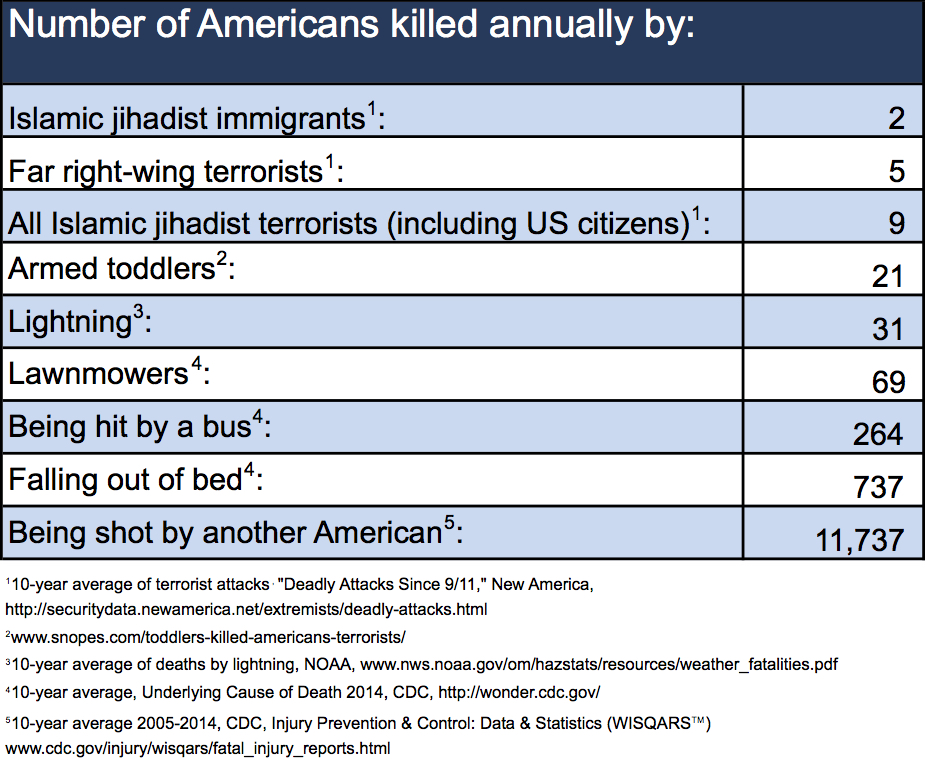
The ban has nothing to do with security and everything to do with a campaign against Muslims. As the Huffington Post points out, the number of Americans killed annually by Islamic jihadists is 9, only 2 of them by jihadist immigrants. 737 Americans die by falling out of bed, but Trump isn’t planning to make bed rails obligatory. 11,737 are shot dead by another American, and Trump certainly isn’t planning to do anything about cutting back on guns.

The Huffington Post sets the context for us
No, this is another attempt, like the Nazis’ in the twenties, to blame a group for ills you can’t solve and for which you don’t want to take responsibility yourself. It’s the Muslims, dummy, so let’s ban them.

In Britain, we’re not just sickened by Trump’s behaviour but shamed by May’s fawning on him. She held his hand at the White House and wants him to come over on a State visit. Many of us rightly feel this demeans us and makes us complicit in his disgrace.

I chose my words with care there. “Many of us” can rightly feel that way. Not all, though. Many others, shocked by Trump’s behaviour, have to bite their tongue and live with it. If you voted for Brexit, if you support it today, then you contributed to making our craven attitude towards Trump inevitable.

Many who voted for Brexit did so in the name of restoring British independence. That would be particularly true of the far-right party, UKIP – the United Kingdom Independence Party. Ironically, it is the leader of UKIP at the time of the Brexit referendum, Nigel Farage, who became the first UK politician to dance attendance on Trump. He proved so loyal and obsequious to him, indeed, that Trump called on the UK government to appoint him ambassador to the US.

Theresa May found enough courage to resist that call. But now she has become Farage’s rival in the deference stakes – instead of denouncing Trump’s travel ban, she resisted all attempts to get her to speak out against it, until the pressure became so overwhelming that she weakly assured the country:

Immigration policy in the United States is a matter for the government of the United States, but we do not agree with this kind of approach and it is not one we will be taking.

Why is she refusing to denounce Trump in the round terms he deserves?

Because we are leaving the EU. The belief of Brexiters is that Britain, freed from EU control, can establish new trading relationships with other nations that will enable it to preserve its commercial position. No trading partner could be more important than the US.

We come to the US as supplicants in these circumstances. We need the deal. We have to pay the price.

Clearly, part of that price will be to give up on our right to speak out against the abuses of the Trump administration. Others will come along: dropping our standards on carbon emissions or food hygiene (you liked our ban on genetically modified foods from the States? Wave goodbye to it). We have to defer to him in the hope that he’ll look after us. That’s the cost of throwing ourselves into such dependence on the US.

Because dependence is the word.

You thought Brexit would give us independence? The opposite, I’m afraid. We have made ourselves more massively dependent on the US than we have ever previously been in peacetime. Just in time for Trump’s inauguration.

Shamed by May’s fawning on Trump? Anyone with a sense of decency would be. But did you vote for Brexit? You voted to make us bow our heads to Trump.

That may not have been what you wanted when you cast your vote. It is, however, what you got. And, sadly, we all have to live with the unwanted consequences of your choice.

Sunday, 9 October 2016

Racism and xenophobia: we need to recapture the spirit of Cable Street

It was as shaming as it was sad to learn that Muslim female colleagues of my wife’s are afraid to visit France.

It was photos from Nice that had been the final straw. They showed four armed policemen converging on a woman in Muslim clothes on a Nice beach, to tell her to wear less. My first thought was of my youth, when the cry was for women to wear more on beaches. Ironic that society always feels it can tell women what to wear or not to wear.
French police move in on an existential threat to our civilisation:
a woman wearing too many clothes on a beach in Nice
My second thought was bleaker. Whether we like the police or not, we all ultimately rely on them. They’re supposed to make us feel safer, indeed to keep us safer. At their best, they should only be a threat over things we’ve done; but these police were a threat for what that woman was. Nothing suggested she’d done anything to harm anyone else, but because she was Muslim and felt the need to follow what she believed were the strictures of her religion concerning dress, she became a target for the police.

Where does a woman like that turn for protection if the police start off predisposed against her? No wonder my wife’s colleagues are so afraid of France. They feel unwelcome in a country that prides itself on being the homeland of human rights.

Sadly, we’ve been here before. At the end of the nineteenth century and for the first few decades of the twentieth, in many countries it wasn’t safe to be a Jew. Dress differently to mark your Judaism and, particularly in central or eastern Europe, you gave up your right to expect the police to look after you.

In some nations, the movement went to terrible extremes. In Germany, it turned into Kristallnacht where Jewish shops and business were vandalised and many Jews were beaten or killed in the streets, a harbinger of the full-scale Holocaust to come. In others, it was an insidious, subterranean hostility, which might be as mild as a refusal to allow a Jew into a club: you may remember the story of Groucho Marx, who was told he could join a club on condition he didn’t use the pool; he asked whether his daughter might be allowed to wade in up to her knees, since she was only half Jewish.

In Britain, the British Union of Fascists had been organised by a former Labour (and previously Conservative then independent) MP, Oswald Mosley. It wanted to bring anti-Semitism out into the open and even aped the militaristic uniforms of the German and Italian Fascists. In October 1936, the BUF decided to march through heavily Jewish areas in the East End of London. Anti-Fascists felt otherwise and mobilised to prevent them.

The result was the battle of Cable Street of 4 October 1936, whose eightieth anniversary fell last week. The battle didn’t pit anti-Fascists against Fascists, but anti-Fascists against the police. But the result was that Mosley got well away from there and the BUF rallied in Hyde Park, in the West End, instead of the East End.

Battle of Cable Street: the Fascists did not pass
The BBC spoke to a couple of survivors
Views differ as to whether Cable Street was as significant in halting the progress of fascism in England as many have believed. But it seems to me that whatever it may have achieved concretely, it was hugely important symbolically: 20,000 turned out against the Fascists, only 2000-3000 on the other side. The voice saying ‘no’ to an abomination was by far the louder. The battle is much more significant for what it revealed of an attitude than for what it may or may not have accomplished.

At a time when there’s once more a terrible lurch towards the far right across the great democracies, with increasingly overt xenophobia or downright racism, we need to recapture that attitude. Whether we’re confronting Trump in the US, UKIP in England, Viktor Orbán in Hungary, it’s the spirit of Cable Street that has to drive us.

And – who knows – why not start by finding it in France?

Friday, 29 April 2016

Labour anti-Semitic crisis? What crisis?

My mother being Jewish makes me, naturally, Jewish. God-fearing or not. In Israel or in the diaspora.

It’s a law nearly as inescapable as the law of gravity.

That meant I was, from childhood, regularly exposed to Jewish humour. Broadly, there are two great categories of jokes about Jews. On the one hand, there are those told by anti-Semites which target the supposed meanness and deviousness of Jews, and are desperately unfunny because they are so heavily marked by hatred. I shan’t be repeating any of them.

On the other hand, there are the jokes told by Jews about themselves. They highlight supposed characteristics of the Jew in a stereotype to which, I’m sure, no Jew really corresponds, but they are often brilliantly witty precisely because they are marked above all by wryness and a certain love.

For instance, a woman meets a young mother pushing a double buggy.

“Oh, what a lovely baby,” she says.

“Which one?” asks the mother, “the lawyer or the doctor?”

But one of my favourites concerns a mother with her son on a Tel Aviv bus. She keeps talking to her son in Yiddish even though the son always replies in Hebrew. Eventually, one of the other passengers turns to the mother and points out:

“Madam, your son is a citizen of the state of Israel. Our official language is Hebrew. You should be encouraging him to speak it.”

“Yes,” she replies, “but I don’t want him to forget he’s Jewish.”

I like that joke because of a profound truth at its core. There is a particular kind of Jewishness characterised, above all, by European Jewry with its Yiddish-speaking roots. That community reacted to persecution by loathing all persecution. It voted massively left of centre, it proclaimed a doctrine of tolerance, it was in the best and deepest sense of the word, liberal.

It would not have dreamed of believing that a Palestinian, as a Palestinian, was entitled to fewer rights than anyone else. It would have laughed to scorn the idea that such a Palestinian might be persecuted by a Jew. “We, the perpetual victims of racism, to be perpetrators of racism ourselves?” 

Sadly, that is a set of attitudes that seems out of vogue in Israel. The nation that speaks Hebrew is far less imbued with those values, which I cherish, than the nation that spoke Yiddish once was. It makes Israel far less the home of certain kinds of Jews than it might have been.

But not all Jews find their home in Israel anyway. The Jewish Agency apparently believes that something like 5.3m Jews, just 100,000 fewer than in Israel, live in the US. It used to be said that many American Jewish families would of course eventually settle in Israel, showing solidarity with their brethren there – but only once the sons were past military age.

There was also a story in the community about a suggestion that American Jews might be given their own soveriegn state within US territory, but it had to be turned down when no one could be found to agree to serve as Ambassador to Israel.

Right now, the papers are proclaiming that the British Labour Party is suffering a crisis of anti-Semitism. Jim Callaghan, Labour Prime Minister in the 1970s, once famously said of some economic difficulties the country was suffering, “crisis? What crisis?” He was made to pay for the words by a self-righteous press that found he wasn’t taking them seriously enough.

I’m inclined, today, to say “anti-Semitism crisis? What crisis?”

Naz Shah in the House of Commons:
the MP now suspended from the Labour Party
Naz Shah was elected Labour MP for Bradford West in 2015, wresting the seat back from a particularly unsavoury individual, George Galloway who took the traditionally Labour seat three years earlier. She has now been suspended from the Labour Party for supposed anti-Semitism. Among other things, it seems that in 2014 she posted a tweet suggesting that the whole population of Israel could be moved to the US, and the problem in the region would be sorted.

It may not have been particularly funny. But was it any worse than the joke, from inside the Jewish community, about no US Jew wanting to serve as Ambassador to Israel? Or anything like as deadly as some of the barbs that have been thrown our way down the ages?

Why arent we able simply to grin, shrug our shoulders and walk away from it?

We are in the closing stages of a US Primary Election campaign which is likely to see Donald Trump win the Republican nomination. This man has said that he would be prepared, as President, to exclude all Muslims from entering the US for a period.

It strikes me that this kind of Islamophobia, which extends far beyond Trump, is much more pernicious than the occasional outbursts of anti-Semitism that we see. And when it comes to offensive remarks, it is far more brutal than her weak joke.

We Jews of the diaspora used to represent some pretty admirable values, which we’ve rather lost recently – most British Jews today vote Tory. But it feels to me that we’re also in danger of losing our sense of perspective. And worse still, the sense of humour which we retained even through the Holocaust.

Now that would be a truly lamentable loss.

Saturday, 5 March 2016

Islamophobia and the unintended power of prayer

It’s always good to replace doubt by certainty.

I’m not sure whether anyone still believes that the basis of Islamophobia isn’t racism, rather than merely religious bigotry. Some perhaps cling on to that illusion. So an incident at Luton airport the other day is at least helpful in dispelling any such uncertainty.

Laolu Opebiyi is a British citizen living in North London. He’s also a committed Christian. I repeat: Christian, not Muslim. He belongs to a group called ISI Men. I repeat: ISI, not ISIS. ISI stands for Iron sharpens iron and is a reference to the Bible: “Iron sharpeneth iron; so a man sharpeneth the countenance of his friend” (Proverbs 27:17).

Unfortunately, sitting on a plane at Luton he used his phone to text members of his group to suggest a conference call prayer, and received a most unwelcome lesson of the effectiveness of prayer, in a wholly unintended way.

The passenger in the seat next to him was reading the text over his shoulder.

“What do you mean by prayer?” he asked.

The neighbour was soon asking to be let off the plane as he felt unwell. And a little later, Opebiyi was taken off it himself by armed police, who questioned him about his beliefs and demanded the password to his phone so they could check just what he’d been texting. They asked him to confirm that he was not only Christian, but had never considered converting to another religion.

The police quickly cleared Opebiyi of the damaging charge of religious belief with intent to be a Muslim, and said he could travel on. Then the pilot intervened, refusing to carry him. So he had to catch the next flight. Seven other passengers who’d left the earlier flight to avoid him realised that he was going to be on the one they were taking instead, and there was another bit of a scene.

Eventually, he got to his destination. But when he returned, his passport was refused by the e-passport reader and border staff questioned him again. As he told the Guardian:

Someone felt I was a terrorist because they saw the word ‘prayer’ on my phone and now I stand in uncertainty about my freedom of movement in and out of the United Kingdom.

I have nothing but sympathy for his view that:

Even if I was a Muslim, it was pretty unfair the way I was treated. I don’t think anyone irrespective of their religion should be treated in such a way. If we keep on giving in to this kind of bigotry and irrational fear I dare say that the terrorists will have achieved their aim.

An excellent point. The triumph of terrorism doesn’t lie in a bullet or a bomb. It happens in our minds and hearts.

Finally, here are some test questions for you.

What colour do you think Mr Opebiyi’s skin is?

Laolu Opebiyi: victim of Islamophobia.
Without even being Muslim
Do you still think that Islamophobia is all about the finer points of conflicting religious doctrines?

Aren’t we good in the West at illustrating our unshakeable commitment to the principles of democracy and human rights?