Showing posts with label Beirut. Show all posts

Sunday, 5 January 2020

Letrice in Beirut, or how we like to turn a bad situation into something far worse

It was Paris on the Mediterranean. It was sea-bathing in November, it was visiting Roman ruins in a blouse, it was sitting with colleagues on a sunny café terrace when at home everyone was indoors or wrapped in coats and scarves. It was no wonder her visit to Beirut left my mother, Leatrice, with indelible memories that she was still sharing with me 70 years later, not long before she died.
Leatrice in Baalbek or at the beach
She was a pretty 24-year old, but maybe already a little uptight...

It was 1948. A single trip abroad as a child had been followed by the thirties in London, then the air raid warnings and the bombs of the war, then the harsh winter of 1946, the bomb sites on every street, the rationing, the general gloom of the past-war years.

Leatrice, as I’ve mentioned before, got out just as soon as she could. In 1948, she was working as a typist for UNESCO in Paris. It organised a conference in Beirut and, to be a success in those pre-Word processing days, a conference had to have a legion of low paid assistants along, to record the words of the important or self-important, and to produce the documents without which no one would believe they’d actually been doing very much.

For Leatrice, it was a sheer joy to be there, to see the sights, to go for a swim, to visit the ruins at Baalbek, to enjoy the pavement life. I was reminded of that when going through another bundle of old photos, as part of a task that is probably going to take most of my retirement even if I have a long one, and came across more pictures of that trip.

What made the pictures all the more poignant was that I was looking at them just as I’d learned that Donald Trump, in what passes for wisdom in that orange head of his, had decided that the best action he could take in response to new threats from Iran, was to launch a drone-borne missile strike to assassinate the senior Iranian General Qasem Soleimani.

Now Soleimani was a ruthless autocrat and his hands are stained with the blood of thousands killed in combat or simply murdered in cold blood. The world is absolutely is arguably better off without him in it. But the same could be said of Saddam Hussein: we’re better off freed of him, or at least we would have been, had what followed in his wake not been far worse. Indeed, one of the most toxic consequences of bringing down Saddam was the rise of Soleimani.

It seems we don’t like learning from our mistakes (or, for those like Trump, perhaps we’re unable to learn), and keep thinking that a quick fix – the invasion of Iraq, the murder of Soleimani – is likely to deliver a long-term solution.

The reality, of course, is that Iran will avenge the death. It may do so directly itself, or it may use a proxy force, perhaps in Yemen attacking Saudi Arabia once more, perhaps in Syria attacking Israel, or indeed perhaps through its client militia, Hezbollah, in Lebanon. Whichever option they eventually select, it’s going to make the Middle East a still more tragic region than it already is.

Especially as whatever action they take, there will almost certainly be further retaliation from the US or its clients in Israel or Saudi Arabia. So things will ratchet up. Which, you may remember, is rather how things went after the invasion of Iraq.

Looking at my mother’s Beirut photos reminds me how far we’ve come.
Clockwise: the venue for the UNESCO conference;
Leatrice third from left at a pavement café; a street scene; the seafront.

Leatrice agreed with the description of Beirut as ‘Paris on the Mediterranean’. She regarded it as a sliver of paradise. But that was before the US and Russia, Israel and Iran, Saudi Arabia and Syria, to say nothing of its own internal conflicts, started interfering the life out of it.

I’d like to say that they’ve turned a paradise into a purgatory, except that purgatory is supposed to be where souls are purged ready to enter heaven. Sometimes, the Middle East looks more like a soul condemned to hell, from which there is no hope of escape. Certainly, none while its destiny is being set by Trump or Soleimani, Netanyahu or Assad, Putin or Mohammad bin Salman.

Saturday, 29 September 2018

Leatrice in Beirut

It’s strange how much certain things can change in seventy years. It’s even stranger, and rather sadder, to see how certain other things have grimly resisted every attempt at change. Or got worse.

In 1948, my mother Leatrice was living in Paris and working for UNESCO. In November, she travelled to Beirut for a conference and she wrote to her parents on the 16th, soon after arriving:

… I hope you have already received my cable. I didn’t want to let you know until I arrived that I was travelling by air, knowing that you would worry, but we had a most uneventful trip…

Flying was still an adventure seventy years ago. It’s true, I tend to phone Danielle after a flight to say I’ve arrived safely, but I do the same after a train journey or even a car trip. As it happens, I find the prospect of travelling any great distance by car far more daunting than catching a plane. I have more confidence in the pilot’s ability to fly his plane than in my own driving – or that of other drivers on the road.

As for a cable – a telegram – I don’t even know who still provides a service these days. Certainly, I don’t remember the last time I sent or received one. In the ages of text messages or emails, does anyone use telegrams?
Leatrice (third from left) enjoying a moment's relaxation in Beirut, 1948
The trip to Beirut marked Leatrice for life. She mentioned it frequently down the years. And looking at her letters home, it’s easy to see why.

The mountains now have snow on them, she wrote on 20 November. It is cold, clear and sunny. This country grows on one. The colour on the hills mixed with the brilliance of the Mediterranean is unbelievably lovely. I have come to like the Lebanese very much. After the coldness of the Parisian, it is heart-warming to meet people who laugh with their eyes as well as their mouths.

The people may have been great, but apparently Leatrice was concerned about the sanitary conditions:

… if we drink any water, we put chlorine in it. It tastes exactly like a swimming bath, but is at least disinfected.

Personally, I’d prefer to take my chance on the infection. On the other hand, it took me a week to recover from the Cairo belly I brought back from Egypt ten days ago, so maybe Leatrice was right.

But she hadn’t finished with the subject of the people.

… it is quite obvious that they are a pure Semitic race. Olive skinned, long heads, black hair, large black eyes, curly mouths.

The racial comments I’d probably avoid, personally, but I like the underlying message, one Leatrice would repeat throughout her life: ethnically, there’s no difference between the Arabs of the Levant and Jews. The idea that there should be racial tension between them, far less conflict, is simply indefensible.

But, and this is one of the things that has not changed in seventy years, or if anything has got worse, that conflict is proving agonising and irresolvable.

We touched down in Damascus and came by taxis over the border into Lebanon… We saw some truckloads of soldiers in Syria, but there isn’t actually much military activity there. Lebanon isn’t actually at war, although Syria is.

The Israeli-Arab war of 1948 had already broken out.

Isn’t it curious that at the time Syria had been relatively untouched by war? To the extent that it was regarded as safe enough to bring staff through to Beirut? That wouldn’t be the case today.

In any case, these days we’d fly directly to Beirut.

I am, of course, very tactful about myself, but discover there is practically no feeling at all about the war. After all Lebanon is not officially engaged in it. The people I know are all Christian, and they feel themselves in very much the same position as the Jews in the Middle East. A few hundred thousand (about 600,000 surrounded by 40 million Moslems, who hate their guts). They generally feel that there is a slight bond in having another minority just over the border as some slight protection. In 1860 there was an awful pogrom of the Christians here, and the ones left fled to the mountains, and hence most of the people living in the hills are members of the Greek Orthodox church [I think she meant the Maronite Christian church]. There are actually about twenty different sects getting on fairly amicably, including a Jewish community. I had my hair washed by a woman who spoke Russian, and then burst into Yiddish with another customer.

Some things have changed, others have stayed the same. The underlying tensions have continued and, if anything, hardened. And the communities that got along reasonably well have broken out into full-scale combat, especially in Syria. The fighting Lebanon was spared in 1948 has spilled over its borders. Indeed, the links between the Christians and Jews that my mother spotted, took a particularly ugly form in 1982. That was when Israeli forces stood back and let Maronite Christian militia carry out a massacre of the Palestinian inhabitants of the Sabra neighbourhood and Shatila refugee camp in Beirut.

A deeply moving representation of this terrible event is in the excellent semi-autobiographical Israeli film, Waltz with Bashir. The sense of horror is made somehow even more intense by the film being made as a cartoon. Until the last few scenes, at least.

Leatrice left Beirut on 15 December, after around a month. With many fond memories. As early as in her letter of 16 November, she had written:

Have now seen the cedars of Lebanon. A very lovely tree. Tall, graceful and a very bright green.

What a pity that Lebanon isn’t primarily known for its cedars any more.

And as for the effect of war on a peaceful nation, what more pitiful example could be provided than Syria...

Thursday, 19 July 2018

Leatrice: leaving Britain, entering marriage, living with an empty nest

Having only travelled out of Britain once in her life, and at three so she retained no memory of it later, my mother Leatrice set out to get to know the world better just as soon as the Second World War ended and peacetime made it possible.

It wasn’t easy at first. Her first trip, to Switzerland in 1947, was a shoestring affair, only made possible because accommodation was provided by a socialist youth organisation. But she loved it, right from her entry onto Swiss territory: she had breakfast in the restaurant at Basel station and was bowled over by the quantities of fresh-baked bread and, above all, the heaps of butter, an extraordinary luxury for someone from ration-bound Britain.

Clearly, she enjoyed the experience, because by 1948 she had gone a step further and moved out of the country altogether, to settle in Paris where she found a job with UNESCO. It was there, as I described last time, that she met the man who would become my father, attracted by her first glimpse of him in the form of a sighting of his silk socks.

But 1948 was also the year of a trip that she would remember as magical. She travelled to a UNESCO conference in Beirut, at a time when it was regarded as the Paris of the Mediterranean. It was a land of beaches and mountains, where skiers starting a run could look down towards swimmers in the sea, where history breathed everywhere and cultures coexisted, if not in harmony, at least without conflict.
Leatrice, third from left, in Beirut in 1948
She loved the visit. Throughout her life, she spoke in wonderment of the place, a wonderment tinged with horror at what Lebanon became later, as peace and pleasure gave way to blood and brutality.

1948 saw her launched into a series of adventures. The stay-at-home Englishwoman set out on a voyage of discovery. Or rather two, as her exploration of new countries was intertwined with her exploration of a new relationship, as she and my father got to know each other more intimately. For instance, it’s hard to imagine a more romantic setting than Capri and that’s where they went in 1949.
Leatrice in Capri (or nearby)
Their exploration of each other led in 1951 to their launching themselves into the 32-year long adventure of their marriage. That too was linked with travel: their wedding was in Genoa, as they travelled towards Rome where my father was taking up a post with the Food and Agriculture Organisation, another agency of the United Nations, like UNESCO.

That led to a further adventure, of the type that rather restricts other kinds: they launched into parenthood. Their ability to travel at will was hampered by my arrival in 1953 and my brother’s in 1956.

Still, we had good times. There were several summers in succession in Porto Ercole in Tuscany, now a major and fashionable seaside resort, then a small and isolated fishing village, with glorious beaches nearby – kilometre after kilometre of golden sand with barely a person on it.

We also travelled many times to England, later several times to France, and on one memorable occasion to what was then called Yugoslavia, not yet ravaged by secession and civil war. A memorable moment on a French trip came when we shot across the border into Spain, just for a day: Franco was still in power, at the head of the last Fascist regime in Europe, and we weren’t going to make an extended visit but, shamefacedly, felt we could get away with a day trip.
Day trip to Spain
Leatrice with my brother Nicky on the left
and me on the right
If my mother had a major disappointment in her life, it was being denied post-school education, partly because she belonged to a generation in which it was offered to few women, partly because she turned eighteen at a time when Britain was at its lowest point in the war.

Much later, she was able to fulfil her aspiration to study, but even while we were children, she hankered for an intellectual life. She belonged to a historical society in Rome. And when we went on holiday, usually camping, we seldom stopped anywhere for more than two or three days so that my brother and I could indulge our taste for swimming or playing on beaches, but would move on quickly to yet another town of historical significance and with wonderful churches.

‘Oh, no, not another church!’ became a bit of a refrain from the back seat of the car.

On the other hand, we were two of the laziest kids imaginable. For some reason, my father didn’t believe in making his sons help him, instead hoping that we would spontaneously volunteer to assist in pitching our tents. Never happened. We would sit, often in the car, reading (no computer games then) until he’d finished.

Honestly, I have no idea why he put up with it.

This life continued into the 1960s, when my father returned home one evening and announced that he had volunteered to join the United Nations special mission in the Congo. The country had sunk into civil war after independence from Belgium, and now the UN was putting in both military forces and civilian support to try to pacify the country and help it emerge onto a pathway to development.

As a married man, he was assigned to a nine-month posting (unmarried staff did eighteen). My mother never fully forgave him for taking it without even discussing it with her, but in his view it was his duty to step forward to the UN’s support when it was in its greatest need. As a result, she had to cope with two kids alone for nine months, and it was no easy task.

The posting would eventually lead to another major change. In 1966, after thirteen years under a boss who treated him with contempt, and with his career at a standstill, he could take no more of it. When the United Nations Development Programme, yet another UN agency, asked him to go back to the Congo as one of its staff, with a double promotion, my parents decided he should. In consultation with each other, this time.

At that point, they decided that our educational needs would be better served at a boarding school in England. Our lives under a single roof were about to end. From now on, my mother would be seeing her sons only in the school holidays. She’d be sharing an empty nest with our father for eight months of the year.

Another phase was starting. In a new country. On a new continent. And with a different home life.

Tuesday, 20 March 2018

A festival like a war zone

Ah, the joy of waking up to a morning of utter stillness!

Sometimes pleasure doesn’t need anything particular to happen. Sometimes it’s enough that something cease. Simple absence can do as much as any presence.

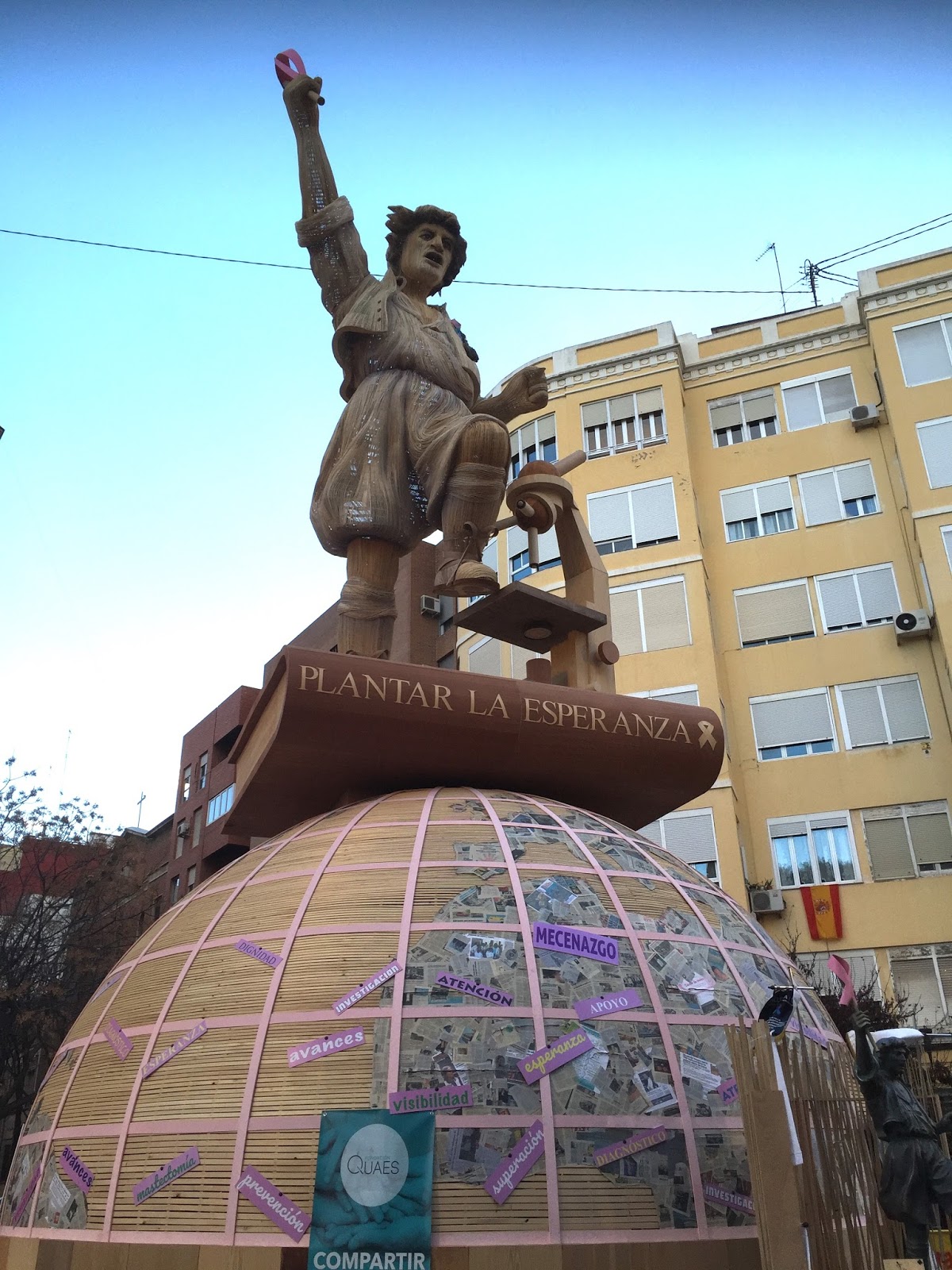
By sheer accident, and without either intending it or knowing about it, we took possession of our flat in Valencia at the time of the annual Fallas festival. A ‘falla’ is a wooden structure built in the street – often at an intersection, presumably as a means to optimising traffic flow – usually on some an amusing theme, or at any rate an uplifting one, such as the seven deadly sins, loneliness or breast cancer.

A powerful falla for breast cancer


Falla outside the town hall
A touching falla to loneliness
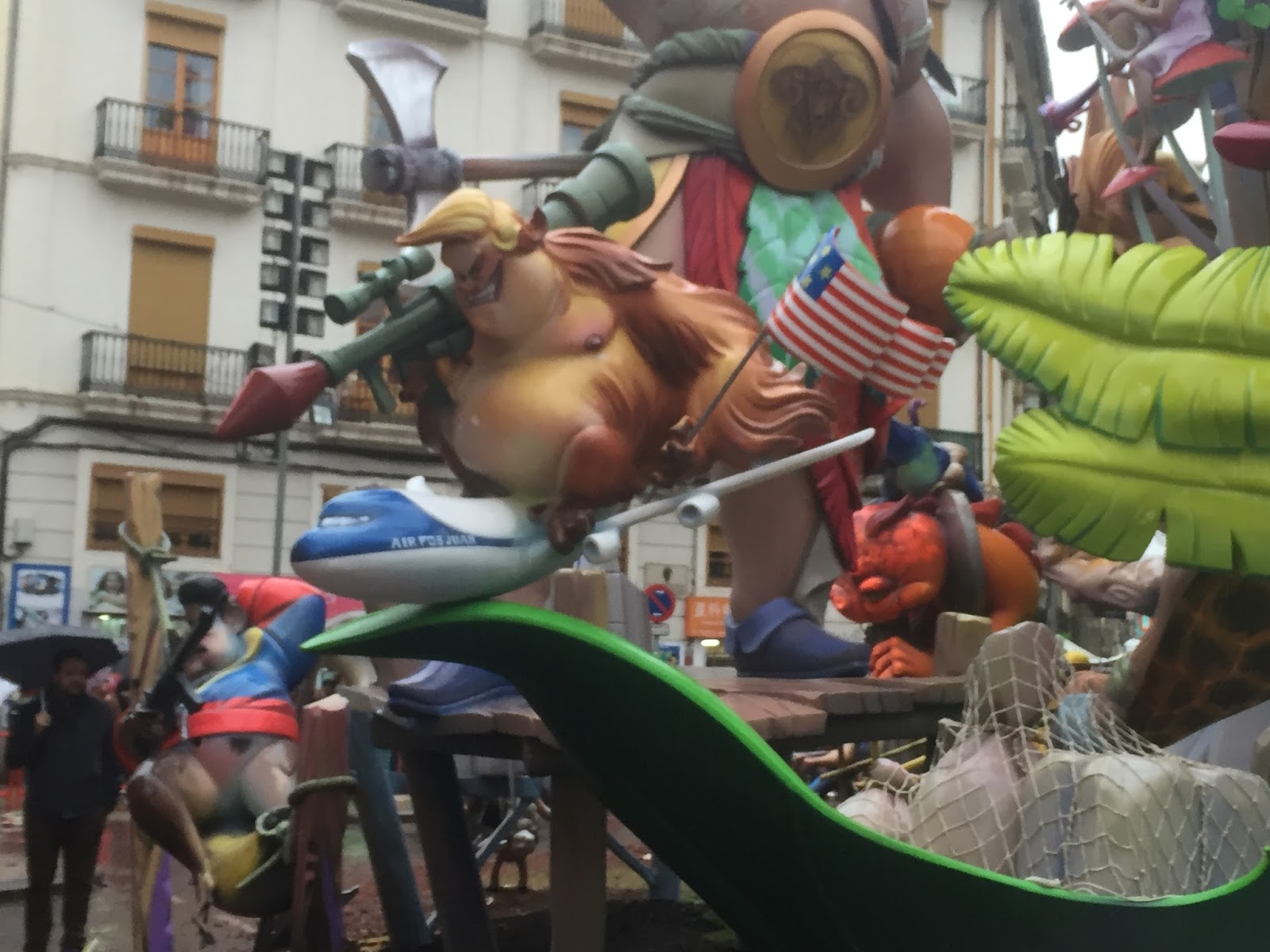
Several of the ones we saw reflected a theme of our day – a caricature of that fine President the US electorate voted against but the US constitution put into office. I suppose laughing at him is a reasonably healthy response. The alternative would be crying, which would be more effective and a great deal less encouraging.

A familiar figure clutching a US flag
With apologies for the poor focus. But then his is just as uncertain
While the Fallas are up, many Valencians don traditional dress and process through the streets, often accompanied by a brass band. This is a charming sight, as old and young, men and women, girls and boys, the able-bodies and the disabled all take part. They look wonderful and they reflect a powerful sense of community, embracing all walks of life, although to be quite truthful, the costumes in the city centre do contain just a tad more silk and are more luxuriously embroidered than the ones in the less well-heeled (or well-skirted) outer suburbs.

Members of a Fallas procession
The costumes are complex. A friend can be a great help
The only trouble is that once you have seen fifteen of these processions, the charm tends to wear off a little. At number fifty or sixty, even though they embrace old and young, men and women, girls and boys, able-bodied and disabled, they start to spread a sense of sameness, brass band or no. One starts to long for a little variety, provided in my case by a helpful pickpocket, in a dense crowd, who freed me of the burden of carrying my (brand new) work phone any further. 

That certainly broke the monotony for me and left me some far livelier feelings.

Those feelings were principally directed against myself. As Danielle pointed out, “why on earth were you carrying your work phone with you on a Sunday in the first place? And how often do I have to tell you not to put a phone in an outside pocket? Don’t you learn?”

It’s true that I’ve twice been relieved of phones by pickpockets, and the previous time it was in Madrid. Now, I’ve spent a great deal of time in Spain and intend to spend a great deal more, and it is not my experience that the country is any less honest than any other. However, it does seem to be endowed with more than the usual quota of pickpockets, and they seem particularly deft at their work. A lesson I need to learn. As my wife likes to remind me.

“She seems very wise,” my HR colleague Laura told me when I reported the loss.

“She is,” I replied, “and keeps telling me it’s a shame I don’t listen to her enough.”

“How odd!” said Laura, “that’s exactly the kind of conversation I keep having with my husband.”

The other custom associated with the Fallas is the throwing of fire crackers. There are even fenced off areas devoted to the practice, though that doesn’t seem to stop people chucking them wherever they like. There seems to be a particular variety that has been volume-enhanced, so to speak, so they let of a fearful retort. They’re the heavy artillery of crackers, where the usual ones are just small arms.

Now, I love fireworks. Arching up in the sky, bursting far above our heads, raining down multi-coloured and beautifully patterned collections of sparks, they’re a joy. The noise they make is clearly just a secondary characteristic, contributing little if anything at all to the spectacle.

Crackers, on the other hand, are just noisy, providing only the secondary effect. And, in my view, contributing little to the spectacle.

In fact, during the Fallas, the seem to convert the otherwise delightful city of Valencia into a latter-day version of Beirut at its worst. After a brief silence, new volleys of small crackers will suddenly start again. Palestinians are exchanging fire with regular Lebanese soldiers. Then, as the firing intensifies, it’s clear that the Druze militias have opened up against Falangists. Finally, as the heavy-artillery crackers start up in another sustained roll of thunder, you can hear Hezbollah exchanging cannon fire with Israeli missile emplacements.

Of course, it’s nothing like as bad as Beirut. There’s no fear, for instance, of being hit and maimed or killed oneself, for instance. No risk of anything much worse than having your phone lifted. But, in my judgement, not being quite as terrifying as Beirut, is a low bar to set for any form of popular entertainment.

Eventually the whole thing ends in a literal blaze of glory. All the fallas, being made of wood, are inflammable and, as midnight strikes at the end of the four-day festival, they are all set alight. The Fallas are destroyed by Fi-re (that at least should tell you how to pronounce it). Strings of bonfires stretch out across the city while fireworks (at last) burst overhead. A fitting end for essentially ephemeral art.

Cremà de Fallas.
A blazing end for truly ephemeral art
And then – peace returns. As though the militias had laid down their arms. The Israeli Defence Forces had withdrawn to their borders. Hezbollah had decided that it was time to transform itself into a social service group and held a mass destruction of its weapons.

A quiet morning dawns. The citizens can sleep again. Until they go about their business in calm with no further fear of an explosion behind them to startle them out of their tranquillity without warning at any moment.

At least for another year.

Monday, 14 March 2011

A sign of the (passing) times

Amazing how a simple shop sign can set a whole train of thought going.
A sign to conjure up dreams. Or nightmares
It happened the other day when I walked past the ‘Little Beirut’ sign in Luton town centre.

Ah, Beirut. They used to call it the Paris of the Mediterranean. My mother loved the place when she was there for some weeks back in 1947.

Her hotel was on the beach, with sun during the day and the sea breezes at night, and it took only fifteen minutes to drive into the hills and Lebanon’s emblematic cedars. Further up in the mountains, you could go skiing while watching bathers swimming from the beaches below.

There were two unusually harsh winters in England immediately after the end of the Second World War. Just to enjoy more merciful weather must have been a blessed relief, to say nothing of the pleasure of a gentle and friendly welcome into a city of charm and elegance. ‘It was a lovely, clean, pleasant city,’ my mother recalls, ‘a tourist town.’

But she adds ‘I was privileged to see it before it got ruined.’ The golden days of Beirut weren't going to last. As she tells me, ‘there were murmurs of things not being as they should be, but we weren’t really aware of anything.’ The murmurs turned into something much louder just a few months after her visit, when a bomb exploded in the Jewish quarter, though it caused no casualties.

Beirut: appealing...
...and rather less so
Since then there have been many more bombs and they have caused innumerable casualties. The Jews have gone, those who could heading south into what was Palestine then and is Israel now. They've been replaced by many thousands of Palestinians living in the refugee ghettos of the city. Christians have fought Moslems, different groups of Moslems have fought each other, peace keepers have come in, been blown up and gone, Syria has sent forces and so has Israel (again and again), Palestinians have been massacred and have fought back. If you haven't seen the Israeli film Waltzing with Bashir, the most powerful cartoon I know, watch it and see how far the Paris of the Mediterranean has been plunged into carnage and shame. 

So I hesitated when I stood in front of ‘Little Beirut’ in Luton. What would I find if I went in? It would have been wonderful to recapture the atmosphere of the city my mother visited and loved half a century ago. But what if it had conjured up the bloodied bodies and the heaps of rubble?

And how disappointing if it simply turned out to be yet another of the countless kebab shops that keep cropping up on our street corners.

Best just to walk past and meditate on how difficult we find it to preserve peace and harmony if we can even build them in the first place.