Showing posts with label Iran. Show all posts

Monday, 23 March 2026

Unintended consequences, or the West's blunder in Iran

As war rages in Iran, it’s worth pausing to imagine a different kind of leadership.

Smoke over Tehran following an Israeli attack on 13 June 2025
By Mehr News Agency, CC BY 4.0, from Wikimedia Commons
Think of it as a kind of fantasy exercise — like fantasy football — assembling the best possible team, while knowing it won’t be perfect.

So let’s imagine a leader of Iran not simply appointed by a bunch of religious figures, backed by armed groups whose main role is suppressing opposition. The leader we’re looking for owes his position to the support of the country’s secular parliament. And among the pledges to which he owes his election is putting an end to power built on brutal repression. Equally, he’s committed to working to limit the power of the clergy over wider society.

On the positive side, he’d be set on improving social benefits across Iranian society, ensuring that poorer Iranians, in towns and countryside alike, have the jobs and land they need to prosper. To fund that kind of programme, he’d use the revenue generated by Iran’s immense oil industry as well as by a progressive taxation system, in which the wealthiest contribute a greater share to government spending than the poor.

He needn’t be some kind of secular saint. What might his faults be? I suspect that in his hurry to achieve his laudable goals he might want to take emergency powers and would ask them to be granted to him by the very parliament that put him in office. That would reduce parliamentary authority. He might even go further and start to act against people who oppose him, leading to fracturing in his support.

So by no means a perfect leader. Even one who might in the long run prove the architect of his own downfall. But wouldn’t that be preferable to what both the Iranians and we, citizens of other countries, are having to deal with today?

Well, that was actually no fantasy. What I’ve been giving you is a thumbnail picture of Mohammad Mossadegh. He was Prime Minister of Iran, for a little under two and a half years, between 1951 and 1953. 

Mohammad Mossadegh
Public domain picture from Wikimedia Commons
This was the time when the British Empire was going into its terminal decline. India had already won its independence. The fifties would be when, in the phrase of British Prime Minister Harold Macmillan, a wind of change began to blow through Africa as colony after colony in that continent left the Empire too.

Iran was never a colony. Most of its oil, however, was controlled by the Anglo Iranian Oil Company (AIOC, which later became British Petroleum and today is known as BP). The British government had a controlling stake in the company so, in effect, Britain held undue authority over Iranian affairs.

When Mossadegh decided to nationalise the oil industry, to deliver the revenues he needed for his ambitious social programmes, the news was badly received in London. Declining power though it was, Britain still had the capacity to do damage, and it also had close ties with the power that was growing to replace it, the United States. The British put a blockade on Iranian oil and, with the Americans, persuaded Saudi Arabia to step in and increase production so the West wouldn’t suffer as a result. 

The effect was massive. Iran’s oil revenues collapsed, Mossadegh’s programme was doomed to failure, and the Iranian people condemned to poverty. As opposition grew, Mossadegh found himself becoming increasingly dictatorial in his moves to hold on to power. 

Now the American CIA, far better resourced than Britain’s spy agency MI6, began to take the lead role. Supported by Britain, US intelligence agents organised and funded a movement against Mossadegh. In August 1953, it succeeded, he was brought down, and with that, Iran returned to rule by the Shah — but now more dependent than ever on Western support.

In return, the western powers regained control of the oil.

It would prove to be a decision with long and far-reaching consequences.

A rare opportunity, to move towards a stable, secular and at least slightly democratic system in Iran, was lost. Over the next 26 years, the Shah steadily increased his power. That became particularly significant after the oil shock of 1973, when a surge in oil revenues seemed to put the Shah in a stronger position than ever. The growth in wealth gave him unprecedented power, allowing him to pursue rapid and far-reaching modernisation.

But the pace of change unsettled Iranian society. Economic disruption, social tensions, and growing opposition forced the regime to rely increasingly on repression to maintain control.

Even so, he could not hold the line. Opposition spread across the country, and in the end the army, though still intact, would not act decisively to keep him in power. In 1979, it was his turn to fall.

What replaced him?

Well, another Mossadegh regime might have been something to celebrate. But that wasn’t to be. Instead, out of the many currents that had opposed the Shah, many of them secular, it was the one led by the leading cleric, Ruhollah Khomeini, that took power. Iran was converted into a theocracy, the Islamic Republic. 

A few months later, supporters of the new regime had seized the US embassy in Tehran. Embassy staff were held hostage for 444 days, well over a year.

Within a year of the embassy seizure, Iran was at war with Iraq. It was a horribly bloody war that would last eight years. Despite Iraq’s powerful military, at the time still being armed by the US (who’d be fighting it themselves within twenty years), Iran emerged badly hurt but having lost no territory – effectively a victory from the Iranian point of view.

Khomeini died in 1989 and was succeeded by Ali Khamenei, who would rule for the next 37 years until he was killed at the outbreak of the present war. 

He headed a nation shaped and militarised by the war with Iraq and steeped in anti-American feeling, to which was added hostility towards Israel. It’s his nation which, despite the loss of its leader, is now putting up far stronger resistance to American and Israeli forces than many expected.

The war has inflicted severe damage on Iran and caused major disruption to the global economy, driving up oil prices and restricting the supply of key products such as fertiliser and helium.

Led by Donald Trump and Benjamin Netanyahu, the United States and Israel appear to have entered the conflict without a clear and agreed set of objectives. So far, the gains are hard to discern.

And the tragedy is that it’s hardly the West’s first error over Iran. It flows from its much earlier mistake. The blunder made 73 years ago. 

Ousting Mossadegh in 1953 certainly benefited oil interests in Britain and the United States. But the price of those short-term gains has been a long chain of consequences — from the Shah’s increasingly repressive rule, to his overthrow, to the establishment of a far more rigid regime — leading to yet another destructive conflict today.

It’s impossible to know what would have happened if Mossadegh had been left in place. There would, I’m sure, have been serious problems. But would they have been as bad as what has actually happened?

I seriously doubt it.


Sunday, 5 January 2020

Letrice in Beirut, or how we like to turn a bad situation into something far worse

It was Paris on the Mediterranean. It was sea-bathing in November, it was visiting Roman ruins in a blouse, it was sitting with colleagues on a sunny café terrace when at home everyone was indoors or wrapped in coats and scarves. It was no wonder her visit to Beirut left my mother, Leatrice, with indelible memories that she was still sharing with me 70 years later, not long before she died.
Leatrice in Baalbek or at the beach
She was a pretty 24-year old, but maybe already a little uptight...

It was 1948. A single trip abroad as a child had been followed by the thirties in London, then the air raid warnings and the bombs of the war, then the harsh winter of 1946, the bomb sites on every street, the rationing, the general gloom of the past-war years.

Leatrice, as I’ve mentioned before, got out just as soon as she could. In 1948, she was working as a typist for UNESCO in Paris. It organised a conference in Beirut and, to be a success in those pre-Word processing days, a conference had to have a legion of low paid assistants along, to record the words of the important or self-important, and to produce the documents without which no one would believe they’d actually been doing very much.

For Leatrice, it was a sheer joy to be there, to see the sights, to go for a swim, to visit the ruins at Baalbek, to enjoy the pavement life. I was reminded of that when going through another bundle of old photos, as part of a task that is probably going to take most of my retirement even if I have a long one, and came across more pictures of that trip.

What made the pictures all the more poignant was that I was looking at them just as I’d learned that Donald Trump, in what passes for wisdom in that orange head of his, had decided that the best action he could take in response to new threats from Iran, was to launch a drone-borne missile strike to assassinate the senior Iranian General Qasem Soleimani.

Now Soleimani was a ruthless autocrat and his hands are stained with the blood of thousands killed in combat or simply murdered in cold blood. The world is absolutely is arguably better off without him in it. But the same could be said of Saddam Hussein: we’re better off freed of him, or at least we would have been, had what followed in his wake not been far worse. Indeed, one of the most toxic consequences of bringing down Saddam was the rise of Soleimani.

It seems we don’t like learning from our mistakes (or, for those like Trump, perhaps we’re unable to learn), and keep thinking that a quick fix – the invasion of Iraq, the murder of Soleimani – is likely to deliver a long-term solution.

The reality, of course, is that Iran will avenge the death. It may do so directly itself, or it may use a proxy force, perhaps in Yemen attacking Saudi Arabia once more, perhaps in Syria attacking Israel, or indeed perhaps through its client militia, Hezbollah, in Lebanon. Whichever option they eventually select, it’s going to make the Middle East a still more tragic region than it already is.

Especially as whatever action they take, there will almost certainly be further retaliation from the US or its clients in Israel or Saudi Arabia. So things will ratchet up. Which, you may remember, is rather how things went after the invasion of Iraq.

Looking at my mother’s Beirut photos reminds me how far we’ve come.
Clockwise: the venue for the UNESCO conference;
Leatrice third from left at a pavement café; a street scene; the seafront.

Leatrice agreed with the description of Beirut as ‘Paris on the Mediterranean’. She regarded it as a sliver of paradise. But that was before the US and Russia, Israel and Iran, Saudi Arabia and Syria, to say nothing of its own internal conflicts, started interfering the life out of it.

I’d like to say that they’ve turned a paradise into a purgatory, except that purgatory is supposed to be where souls are purged ready to enter heaven. Sometimes, the Middle East looks more like a soul condemned to hell, from which there is no hope of escape. Certainly, none while its destiny is being set by Trump or Soleimani, Netanyahu or Assad, Putin or Mohammad bin Salman.

Friday, 16 August 2019

When the little kid tries to play in the big boys’ playground

Early in August, the Iranian Foreign Ministry summoned the Spanish Ambassador to protest at the seizing of the oil tanker Grace 1 in Spanish waters. The embarrassed Spanish diplomat had to explain that while he, and his government, agreed that the incident had occurred in their waters, Britain claimed them for itself and when it sent Marines to take control of the vessel, it did so without consulting Spain.
Britain seizes the Grace 1.
The act of a might imperial power
It was an action worthy of an Imperial power. Britain, after all, only claims jurisdiction over those waters through its possession of Gibraltar. That’s a rock the size of a (very) small mountain, attached to the Spanish mainland and nearly 2500 kilometres from London. Britain took possession of it in the early days of its imperial expansion and only by right of war, since it was handed over by the Treaty of Utrecht which concluded the War of Spanish Succession.

Why on Earth was Britain involved in a war about the Spanish succession? You may well ask. Especially as most of the fighting took place in Germany anyway. Please don’t expect logic in any of this.

So the anomalous possession of a piece of obviously Spanish territory gave Britain the right, or so it felt, to seize an Iranian oil tanker. It did so on the grounds that the tanker was breaching sanctions against Syria, contrary to decisions of the European Union. That’s ironic since Britain is hell-bent on leaving the European Union, but that clearly didn’t stop certain people thinking that EU law provided useful cover for doing what they wanted to do in the first place.

In passing, it’s actually questionable whether EU law really did. Carl Bildt, former Swedish Prime Minister and an expert on these questions, told the Guardian:

The legality of the UK seizure of a tanker heading for Syria with oil from Iran intrigues me. One refers to EU sanctions against Syria, but Iran is not a member of the EU. And the EU as a principle doesn’t impose its sanctions on others. That’s what the US does.

Spain claimed that, in reality, Britain was merely reacting to a demand from the US. Since the Americans have since made an attempt to seize the ship through the Gibraltar courts, it’s hard not to believe that this might, indeed, have been the case. It was US policy, rather than British, that led to the ship’s seizure.

So we have the curious spectacle of high-handed, possibly illegal, imperial action being taken by Britain. And yet it did so as no more than the poodle of the United States, a true imperial power where Britain, once a great power, is today a bit player in the game of global politics.

We didn’t have to wait long to have that proved to us. On 19 July, the Iranians seized the British tanker Stena Impero in the Strait of Hormuz. Britain was powerless – literally – to act. It had a warship in the region, but far too far away to intervene. And in its much reduced state, it could only choose to send one more ship. Britannia once ruled the waves, but no more. Today it can’t provide military protection for its merchant navy.
Iran seizes the Stena Impero
Tit for tat, calling the bluff on British powerlessness
It no longer has the force to play the stooge for Trump’s US, let alone play with the big boys in its own right.

It might be wiser, you might think, for it learn the lesson and stop throwing its limited weight around. Indeed, it might be wiser if it stopped pretending that it was big enough to play on the world stage with the real powers of the world. The US is up there in the top tier, but even Iran is a major regional power. Britain? A minor power on the edge of Europe.

Which is why leaving our union with 27 nations in Europe is such a self-destructive move. We’ve demonstrated we can’t stand alone. But some old-Empire nostalgists are going to force us to try anyway.

The postscript to the Grace 1 story shows the only piece of wisdom in this whole sorry tale.

Gibraltar may be a quirk of history, at least insofar as belonging to Britain is concerned. But Gibraltarians have their heads screwed on properly. They voted massively against Brexit. And now the courts, followed by the territory’s first Minister Fabian Picardo, have shown the guts to stand up to the Americans. The court would not support the US claim to impound the ship. And the First Minister has released it.

Now that really is taking back control, the slogan of the Brexiters. However, it happened in opposition to US demands. Which we’ll certainly be far less able to resist once we leave the protection of the EU.

What Brexiters wish for and what they get may be entirely different things.

Wednesday, 9 May 2018

Obama Trumped

The Donald has torn up the Iran nuclear arms agreement. On the basis that it was a rotten deal and shamefully one-sided. He’s probably right on the second point: it has led to Iran dropping its military nuclear programme, but few of the promised economic benefits in the way of foreign investment into Iran have materialised.

But maybe Trump didn’t mean that the deal was one-sided against Iran.

The worry seems to be that Iran has never abandoned a policy of extending its influence throughout the region, by manipulating puppet governments and backing deeply unpleasant groups. In particular, Irans friend Hezbollah has shown itself perfectly ready to take terrorist action or use violence generally to advance its political agenda.

What’s curious, though, is that it’s the states of the region most inclined to use such violence who are leading the charge against the Iran deal.

Saudi Arabia, for instance, seems intent on pummelling Yemen back into the Stone Age, as it uses its military to starve the Yemeni people and leave it victim to disease as well as injuries without the means to fight them. It also regularly kills large numbers of civilians – for instance, at weddings or funerals – always it claims unintentionally, which means the Saudis are either lying and therefore committing war crimes, or telling the truth and therefore so utterly inept that they shouldn’t be allowed anywhere near a weapon.
Saudi Arabia teaching Yemen to appreciate peace
Israel, too, has long established the principle of a hundred eyes for an eye, reacting to any attack on its people by one tens of times more powerful and more murderous. It also regularly intervenes militarily in Syria, in just the same way as Iran or Russia does, with the same callous indifference to the wellbeing – or even survival – of the citizens or the hopes for peace.

But these two nations proclaim their commitment to ending terrorism as their reason for wanting the nuclear deal with Iran ended.

Meanwhile, in the greatest irony of all, it is the United States itself that has done most to ensure the growing power of Iran across the Middle East. It was Dubya Bush, after all, slavishly supported by Tony Blair, then British Prime Minister, who invaded Iraq to bring down Saddam Hussein. Saddam was a deeply unpleasant character and no one deserved to overthrown more than he did, but he was also deeply hostile to Iran. Why, he even fought an eight-year war against his neighbour.

His overthrow left a power-vacuum in Iraq into which flowed the Shia groups who, precisely because they represented the majority of the people, he had always oppressed and prevented holding power. They were enthusiastic supporters of Iran, ruled by fellow Shiites. So in place of Saddam, we now have a puppet-government of Iran’s holding sway over Iraq and its oil.

The West itself set the trap in which it was then caught.

And it looks as though Trump wants to do exactly the same thing again. The Iran nuclear deal was by no means perfect, but it was the only deal we had. Whatever Benyamin Netanyahu of Israel may say, all the evidence points to a huge reduction in Iran’s nuclear programme. In addition, we now have observers from the International Atomic Energy Agency regularly checking Iran’s installations, which we didn’t have before. But just as the UN inspectors were disbelieved when they reported that Saddam didn’t have weapons of mass destruction, before the Iraq invasion whose declared goal was to deprive him of them, so Trump refuses to believe the IAEA inspectors today.

What is certain is that if the agreement fails, Iran will return to preparing and stockpiling nuclear weapons. The reformist government may well fall and be replaced by something far less accommodating. Iran may turn from an uncertain partner in peace into an enemy all the more dangerous for thinking itself threatened.

Like Dubya and Trump before him, but at far greater scale, Trump is creating precisely the monster he claims to be acting against.

An ignorant man turns his own weapons against himself. Sadly, he turns them against the rest of us too. Something for which we have to thank the equally deluded minority of US voters who thought they would somehow benefit from putting him in a position to do the damage.

Just as with Brexit, if your answer is Trump, you’re asking the wrong question.

Saturday, 14 April 2018

Mission accomplished: déjà vu

It’s always a little sad to see someone who really can’t be expected to know better, take credit for completing a job when they’ve barely even started. Worse still, they may have started down the wrong route. A child, say, who carefully paints all the parts of his new model before assembling it, only to find they no longer fit together afterwards.

Or the US President who claims to have achieved his objective when he has achieved nothing – or, worse still, achieved the opposite of his intent.
Dubya in 2003
That was my first thought when I heard that Donald Trump had claimed ‘mission accomplished’ following the US-French-British missile strikes on Syria. It was exactly the same claim as made by Dubya Bush back in 2003, giving me a thoroughly dire sense of déjà vu. That followed the invasion of Iraq and the toppling of Saddam Hussein. Dubya clearly felt he’d achieved a major success, a view that looks jaded fifteen years on, with fighting still raging in the region and the only winners in Iraq being the West’s great bogeyman, Iran.

That didn’t stop Trump making the same claim for his missile strikes. And I suppose he was right in the most limited possible sense: he gave the world notice of his intention to use missiles against Syria, and he has indeed used missiles against Syria. If that was the extent of his mission – to demonstrate the military power at his disposal – then I suppose the mission was indeed accomplished.
Donald Trump in 2018
One might imagine, however, that such an action ought to deliver more than that, however. More than allow Trump a feel-good macho glow (Macron of France, too, I suppose, though whether May enjoys machismo it’s hard to say – but then, little surprises me about her any more). Generally, one would expect the use of massive military force to advance some cause or another, beyond the purely personal. 

Topple President Assad, maybe? 

End the suffering of Syrian civilians after seven years of civil war? 

At least ensure that chemical weapons would not be used against them again?

Maybe that last goal may be achieved, though I think it would take a brave man to assert it. We shall see. And even if it, it’s unclear to me that being killed or crippled is that much less unpleasant by artillery fire than by chemical weapons.

As for overthrowing Assad or ending the war, it would take a high degree of naivety to believe that the missile strikes will have achieved that much. Or even that bringing Assad down, however desirable in itself, would do any more in Syria’s current crisis than the equally attractive overthrow of Saddam did in Iraq.

Perhaps there’s one negative benefit the strikes have produced: they seem not to have destroyed any Russian equipment or inflicted any Russian casualties. That suggests that we may have avoided a third world war for now.

No. It’s hard to believe that these strikes have done anything very much, except persuade people in the west that, because something had to be done about the chemical attacks, it was legitimate to just about anything, which is what has now been done.

That may have made Trump, Macron and May feel better about themselves. Which I suppose is a benefit of sorts. Though they’re unlikely to have done anything for the Syrians or, indeed, for anyone in the West.

Still, Mission accomplished. Again. In some sense of the expression.

Saturday, 16 January 2016

Two nations from the axis of evil: contrasting treatment and outcome

It’s interesting to reflect that George Dubya Bush, who has to be in the running for dumbest US president ever – a position only likely to be challenged if Donald Trump is elected – lumped Iran and Iraq together, with North Korea, in what he saw as the “axis of evil.”

Two of those three nations have been the target of intense action by the US.

It was Dubya himself who turned his guns – literally – against Iraq, with the invasion of 2003. Thirteen years on, the nation is a shattered patchwork of regions in conflict with one another. At the centre is a weak government dominated by none other than Iran. To the north, the Kurds form an autonomous region which is independent in all but name. Both the Baghdad government and the Kurds are in a state of continuous war with what has to be the world’s most brutal terrorist group, ISIS, an organisation that grew strongly in the power vacuum Bush’s war created.

There is no reliable estimate of the deaths caused by the war. Those available range from over 100,000 to over a million.

Iran, on the other hand, never enjoyed the privilege of invasion by a US-led coalition. It continued in its evil ways, but as it toyed with developing nuclear weapons, it came in for some tough and highly effective economic sanctions. At the same time, the US and other nations engaged in intense bouts of diplomatic activity with succeeding Iranian governments.

As I write these words, the International Atomic Energy Authority seems poised to publish a report officially recognising that Iran has abandoned its military nuclear programme. As a result, a prisoner exchange is to take place between the US and Iran – a small, symbolic gesture, but symbols matter, especially as there’s bitter opposition to the deal from the backwoodsmen in the States (aka as the Republican Party). A symbolic release will be a significant success for Obama, though his opponents, and in particular Donald Trump, won’t give him credit.

US Secretary of State John Kerry and
Mohammad Zarif, Iranian Foreign Minister
Most significant of all, the deal would allow Iran back into the world economy.

Iran and Iraq may have been lumped together at one stage. But their histories in recent years have diverged starkly. Above all, that’s been due to the different policies adopted towards them by the West.

The problems in South Africa and Iran were approached through a mix of sanctions and diplomacy. In Iraq, Lybia and Afghanistan, on the other hand, the West took military action.

Compare. Contrast. Learn a lesson.

And, friends in America, for heaven’s sake – for all our sakes – keep Trump out of the White House.

Monday, 4 January 2016

Beheadings and beheadings, and how the West has no idea how to react to any of them.

Curious times we live in.

We’re rightly shocked and sickened by the appalling behaviour of ISIS. It has released yet another video of a gruesome beheading of people the group disapproves of. We’re particularly upset in Britain because the main figure has a British accent. It wasn’t that long ago that a drone took out a similar British-accented assassin, so-called Jihadi John. This was presented at the time as a major success for the Western cause, which was to be further reinforced by the Royal Air Force joining in US-led airstrikes against ISIS positions in Syria.

Well, a few weeks on, it seems that those airstrikes haven’t achieved much. Jihadi John’s heir is in place and, apparently, plying his bloody trade just as fiercely as his predecessor. Indeed, those airstrikes aren’t even finding much to do. Planes have had to come back with their weapons unfired for lack of targets. Instead, if they take any useful action, it’s in Iraq supporting the advance of the Iraqi army back into the city of Ramadi.


Iraqi troops retaking Ramadi from ISIS
with support from Western airstrikes that actually served a purpose
Oddly, the government has yet to admit that critics said all along that a campaign of airstrikes in Syria would be useless, until there were forces we could back against ISIS on the ground – as in Iraq. No doubt that’s an oversight by Cameron which he’ll correct as soon as he can, when he admits he got that call wrong.

He’ll no doubt be as keen to admit his error as Blair was to admit his own, and far greater one, of invading Iraq in the first place.

Meanwhile, Saudi Arabia has decided to do some of its own beheading. Like ISIS, it carries them out in public, to make the process as ghoulish as possible. On the other hand, it doesn’t film them or post the videos on-line for the edification of the West – indeed, it goes out of its way to hide what it’s up to, suggesting that it’s rightly ashamed. It also works at quite a scale: fully 47 killed in the latest outrage.

What’s worse is that one of those murdered – executed is far too anodyne a term – is a leading Shia cleric in this Sunni state. Now, he wasn’t a particularly savoury character, by Western standards. He favoured the establishment of a theocratic state, with religious leaders running the state, rather like Iran at its worst. But by killing him, Saudi Arabia made him a martyr. Specifically, a martyr for Iran with its 90% Shia population.

So there have been ugly protests in Tehran, including an invasion of the Saudi embassy. Now Bahrain, the United Arab Emirates and Sudan, models of democracy all, have joined the Saudis in severing or reducing their diplomatic ties with Iran. On the other side, Iraq, tipped into being another Shia-dominated nation under the tutelage of Iran, following Blair and Dubya’s ingenious invasion of 2003, has come out on the side of its mentor.

Few developments could be more worrying for the whole world, let alone the Middle East, than increasing tensions between the two regional superpowers, Saudi Arabia and Iran. And that’s what now’s happening, as a result of the barbaric behaviour of the former. Barbaric behaviour not unlike that of ISIS.

The West doesn’t confuse these two series of killings. So it will do no more than express token regret over the Saudi beheadings. Saudi, of course, has oil and huge financial influence in the West. ISIS has neither, at least for the moment. In addition, the West has a track record of entirely miscalculating the reality of tensions in the Middle East. One can’t help wondering whether distinguishing between the two types of assassination isn’t just a measure of its underlying confusion.

So here are the key questions: was it actually sensible to let governments with that level of incomprehension of the situation in the region, take further military action out there? Or might it have been more judicious to take a little longer to think about alternatives? And if none came to mind, perhaps hold back from ill-judged gestures unlikely to improve matters?

Thursday, 8 October 2015

The Great British Bake Off, antidote to the bad news in a world dominated by superpower jostling

It’s great to come across the odd good news story out there, in amongst so much that’s bad.

Few are worse than the intensifying Russian intervention in Syria. What’s worst about it is that it reminds me of the behaviour of Germany in the run up to the First World War: Germany had emerged as a nation only rather late – it was proclaimed, ironically in France, only in 1871 – so it missed out on that precious time of empire building by so many other European powers.

Germany could have taken the intelligent decision that imperialism was inherently immoral (how on earth does one seriously justify a bunch of Brits, from a nation with terrible poverty, ill health and criminality in the nineteenth century, telling Indians how to live their lives?) and didn’t even benefit the imperial power that much (Britain remained racked by poverty, ill health and criminality when the Empire was at its height). Instead, it decided to get in on the act and carve out its own dominions, an ambition which led to increasingly intense clashes with France, Russia and Britain, and then the great 1914-1918 bloodbath.

So it’s worrying to see history repeating itself. The US under Dubya, enthusiastically supported by Tony Blair as British Prime Minister, went blundering into Iraq without international endorsement or legal basis, with results from which we’re still suffering twelve years on.

The worst aspect of that is that it established a precedent for ignoring the UN or norms of international legality, and simply using brute force, because one can.

Russia, reprising the role of Germany 140 years ago, instead of deciding that this kind of behaviour is reprehensible, leads to highly undesirable unplanned consequences, and ought to be avoided, has decided that anything the US can do, it can do too. So it’s blundering into Syria, making a painful situation far worse.

Why, if the latest reports are to be believed, it’s even rivalling the US in its capacity to create collateral damage, or even collateral mayhem: it seems four of its missiles may have hit Iran instead of Syria. I suppose one or two thousand kilometres of inaccuracy are to be expected in what specialists like to refer to as the “fog of war.”

Anyway, it’s in this context that I was delighted to find out about the winner of this year’s Great British Bake Off competition.

Now this is a pretty great programme. I watched it one year, though I gave up afterwards and watched neither of the last two competitions: I find the experience too stressful. It’s like watching England play rugby: it’s occasionally satisfying but often deeply depressing. In fact, in many ways the Bake Off is worse. At least on the rugby field, I know who to support and, therefore, by the simplest possible process of elimination, who to oppose. With the Bake Off, I sympathise with absolutely everyone, and want each of them to win, which means I’m distraught over the weekly elimination of a contestant, and inevitably disappointed over the final result by the failure of all the others who didn’t make it.

Nadiya Jamir Hussain, on her way to Bake Off victory
Still, I have to say that I take great pleasure over this year’s winner. She’s Nadiya Jamir Hussain, and she competed in a hijab.

We’re a long way from true assimilation in this country, and assimilation is never really reliable anyway (the Jews thought they’d achieved a high degree of assimilation in Germany in the nineteenth century, and look where that got them in the twentieth). Still, it’s good to see that a British woman can be celebrated by a British institution – the BBC had the year’s highest ratings for any programme, on any channel this year, for the final of the competition – even though she’s a Muslim.

At least there’s some progress, then.

Of course, we then have to return to all the everyday problems of racism in Britain – only today there’s been a new outcry over the poor level of dementia care offered to patients of Afro-Caribbean ancestry – but, hey, at least we can take a brief timeout to enjoy one positive event.


Postscript It was amusing to see the Guardian report that the Daily Mail failed to give front page coverage to the Bake Off result this year, as it had in the past. 

At least the paper that supported the Nazis in the 1930s has retained some consistency with its roots.

Monday, 23 February 2015

The lesson of ISIS: be careful what you wish for

Back in 2003, the West went to war in Iraq because it decided the world would be a better place without Saddam Hussein having weapons of mass destruction. It did that against the advice of many, none better placed than the weapons inspector on the ground, Hans Blix, who doubted there were any weapons of mass destruction there. The US in its wisdom, or at least in what passes as wisdom in George Dubya Bush, decided Blix and co were wrong and, with the fervent support of Britain under Tony Blair, waded in.

That was what we wished for.

Dubya, source of wisdom in the West at the time of the 2003 invasion
Showing his sureness of human touch

Once in Iraq, the West discovered that Blix had been right, and there were no weapons of mass destruction there. But it stuck firmly to its guns: it may not have been necessary to rid the world of Saddam Hussein’s weapons, but it was nonetheless a marvellous step to have rid it of him.

So that was what we wished for.

Because Saddam Hussein’s power base had been Sunni Arabs in a predominantly Shia nation with a large Kurdish minority, and because the Sunnis had been massively over-represented in the military, the West disbanded the old Iraqi army and set out to put in place a democratic constitution in which the majority would find its voice.

Democracy was what we wished for.

Elections returned a Shia-dominated government which set up a new, Shia-dominated army and, in its weakness, became a puppet of the West’s great bogeyman in the region, Shiite Iran. Sunnis felt disenfranchised and marginalised, and Kurds began to agitate for increased autonomy for their region. So we propped up the government in Baghdad and supplied it with lots of lovely weaponry.

A strong central government dependent on us is what we wished for.

The bitterness among Sunni Arabs created fertile ground for extremists to launch a movement. That gave ISIS its opportunity in Iraq. The disgruntled Sunnis have since had time to be completely disabused with their supposed liberators, but in the meantime ISIS had gained a foothold from which they could tackle the new Iraqi army with its lovely weaponry. ISIS pushed towards them, watched them disintegrate, captured and murdered large numbers of soldiers while the others hightailed it back to Baghdad, and then collected all that lovely weaponry for itself. So we started bombing ISIS.

A Middle East free from terrorist extremism is what we wished for.

Kurdish Permerga
Gutsy, determined, but without the heavy weapons they need
ISIS turned its attentions to the north of Iraq where it ran into the Peshmerga, the army of the Kurds. ISIS had good American kit, captured from the Iraqi Army; the Peshmerga had AK47s and courage. Western airpower helped them resist. But the Western powers wouldn’t arm them, because that might strengthen their drive for independence from Iraq.

A strong central government in Baghdad was still what we wished for.

As an article in today’s Guardian explains, now the Peshmerga sit facing ISIS lines on the approach to Mosul, an Iraqi city being terrorised by its cruel occupants. The West would like ISIS kicked out of Mosul, but isn’t sure it wants the Peshmerga, who have the will but not the means, to do it; we’d rather it was the Iraqi government, but though we’d probably supply it with the means, no one after the last debacle can possibly imagine it has the will; as for the unfortunate inhabitants of Mosul, while almost anything would be preferable to their so-called fellow Sunnis of ISIS, as Sunni Arabs there’s little comfort for them in the notion of finding themselves under the control of either the Kurds or the Shiites.

So today the West hesitates. It is perhaps thinking about what it should do next. Maybe it’s wondering what it should really be wishing for.

That might have been an intelligent thought back in 2003. But since we’ve let the ISIS genie out of the bottle, it may be a little too late.

Because now there really is a weapon of mass destruction loose in the Middle East.

ISIS about its ugly work.
Now there's a weapon of mass destruction in Iraq

Friday, 19 December 2014

As a public service: unveiling a pattern that the bright young things seem to have missed

I’m going to explain this very carefully and slowly, so even the bright young things at the Pentagon and the Foreign Office can get it.

Iran is a really, really dangerous country. So dangerous, in fact, that we had to make sure that it didn’t get a democratically elected leader. When it tried with Mohammad Mosaddegh, back in the 50s (yep, this story goes that far back, at least), we in the West overthrew him.

So Iran got the Shah, and that was fine and dandy until in 1979 he got overthrown in turn and replaced by the awful Ayatollahs. Who were even worse than Mossadegh.

In our consternation, we turned for help to our good friend Saddam Hussein (yep, he was a good friend then), who was really running a fairly decent dictatorship in Iraq, only torturing opponents; he would later demonstrate moderation by not using poison gas on too many civilians.

We gave him lots of nice weapons to fight Iran with, which he did for eight years. At the end of that time, since it was clear that neither side was actually going to win, they decided to call it a scoreless draw and went home.

Tasteful tribute to the war dead in Iran
But then Saddam had a lot of nice American toys to play with and a bit of a taste for war (just like the Americans, as it happens. And the Brits. And the French. And the Israelis. Most of the good guys, in fact). He was pretty sure he could count on his good friends, so he invaded Kuwait.

Sadly, for some in the US this was crossing a bit of a line. So we went to war against him. We got him out of Kuwait, but not out of power. We needed something else

That wasn’t a problem. We invented some stuff about weapons of mass destruction, and to back up our point, we rediscovered the poison gassing of his civilians, and decided that maybe it wasn’t that acceptable after all. We got Tony Blair to go on TV and look honest while spinning lies, and back we went to war to get rid of Saddam Hussein.

Sadly, with him gone, we found Al Qaida trying to take power in iraq.

Another quick rethink was in order. We decided to back a government in Baghdad backed by Iranians (remember them?) and between us and our new friends, the friends of Iran, we saw Al Qaida out of the picture.

But we barely had time to draw breath before ISIS, even worse than Al Qaida, were out there torturing and beheading thousands of civilians to say nothing – and this is really serious – even a handful of Western citizens. So who did we turn to?

Why, we called on Al Qaida for help. Of course. We had some Al Qaida guys call some ISIS guys they knew to see if they could perhaps save Peter Kassig, an American hostage, and stop being really beastly any more, at least to Westerners.

Sadly, we cocked up. We didn’t tell the Jordanians that the Al Qaida guy in Jordan was a friend, unlike the Al Qaida guys who were enemies, so they arrested him and he’s locked up to this day. ISIS duly murdered Peter Kassig and things went on getting worse.

Now there is in all these events something that we students of matters historical like to call a “pattern”. In case those bright young things mentioned above are struggling to grasp it, I’ll spell it out.

It works like this. Every time we find an enemy, we knock him off his perch. Unfortunately, he’s usually replaced by someone even worse. To deal with that character, we often have to turn to the very people we were fighting against before.

Now it’s hard to imagine anyone much worse than ISIS. They seem pretty much the pits. But we shouldn’t underestimate Western ingenuity. If we really set our minds to it, we can probably conjure up something still more horrific than ISIS, and then have to turn to ISIS for help to deal with it.

Given their track record to date, would anyone doubt their ability to pull the trick off? And make us nostalgic for ISIS? As we seem to have been forced to become for Al Qaida? For Iran? Even for Saddam Hussein in his time?

If only we’d thought of that before ousting Mossadegh.

Saturday, 14 June 2014

Who's the rebel, who's the democrat, who's the bloodthirsty dictator? Middle East politics for beginners

Sit up at the back of the class there. Pay attention. Stop texting your friends or chatting to your neighbour. 

Today we’re tackling the problem of Western policy towards the Middle East, and it’s complicated, so follow carefully. There will be a test at the end.

Start by learning two principles that will help follow the rest.

First of all, democracy’s a delicate machine, and like all machines, it needs regular oiling. So anyone with oil is a friend. 
Careful, though: we’re not that fond of Russia. Don't worry. Russia’s more about gas than oil, so it’s a bit of a toss-up whether we need to like them in the first place.

Secondly, Israel’s a friend and Iran’s a demon. 


Israel’s a great democracy, like us. There may be people who don’t agree, but they’re in places you’ve barely heard of and will never go to, like Ramallah or Gaza City. The people you get to vote for all agree that Israel’s a good, peace-loving friend, and they can’t all be wrong, can they?

As for Iran, well, they’ve been beastly to the West on repeated occasions. In particular, they took a load of Western diplomats hostage in a thoroughly reprehensible way. And they may or may not be building a nuclear weapon, which makes them really worrying. We can’t have nuclear powers in the Middle East. Well, apart from israel of course, but see above.

Because Iran’s so nasty, we were keen to help Iraq under its fine leader of the time, Saddam Hussein, when it went to war against its neighbour. But then, sadly, Saddam thought he could invade Kuwait. Now that’s a country with lots of oil, and so at least as good a friend as Iraq (which also has oil). So we invaded right back, with a view to bringing ex-friend Saddam down.

But then we didn’t. The Russians didn’t like the idea, and this was one of those occasions when we thought we ought to treat that gassy lot as friends. So we left Saddam alone.

Next, though, he did something unforgivable. He didn’t stop a bunch of Saudis attacking the United States on 9/11. It’s true that he didn’t have anything to do with the terrorists, but Saudi Arabia has lots and LOTS of oil, so we couldn’t pick on them; besides, we had unfinished business with Saddam, so this seemed like a good opportunity. If you can’t follow the logic, don’t worry. Nor can anyone less.

The second war on Iraq was an unmitigated success. Where the people of Iraq used to live in fear under a bloodthirsty dictator, now they live in fear under a terrorist-riven nominal democracy. Also it has a government run by friends of Iran. Which, it seems, is just fine. Again, it may damage your health to try to follow the logic here (or, indeed, try to find any).

Next a rebellion started against another bloodthirsty dictatorship: that of President Assad in the country next door, Syria. Now Syria doesn’t have any oil, so we can safely line up against its government. On the other hand, it doesn’t have any oil, so why would we bother? Even so, the West decided the trick would be to rain a few missiles down on them, just to show that democratic values mean something.

That would have got up Russia’s nose again, because Assad is their bloodthirsty dictator, but this was another of the occasions when the West felt that we could safely dislike the Russians.

In the end the West didn’t do it, because a number of people wondered whether missiles were quite precise enough to hit only the bad guys and leave the good guys entirely unharmed (to say nothing of ordinary unaligned civilians, at least 100,000 of whom died in Iraq). And being precise is particularly key in Syria, if only because it turns out that the rebel side isn’t composed entirely of good guys. In fact rather a lot of them are part of the very movement that attacked the US on 9/11.


ISIS. Heroic champions of democracy resisting tyranny in Syria
Or do I mean vile terrorist opponents of democracy in Iraq?
Which leads to the latest act (certainly not the last act) of this exciting drama. Because one of those rebel groups is ISIS. We’re told that stands for Islamic State in Iraq and the Levant, which is worrying if only because it suggests that they don’t know how to spell ‘Levant’. They’ve started taking over cities in Iraq, even though there are only 7000 of them. It turns out that the armed forces and police of the shiny Western-backed democratic government have been melting away in front of them.

As a result, the US is considering taking military action in Iraq again. They might bomb ISIS. And, because they like to be consistent, they might bomb them in Syria too. So instead of bombing Assad and the Syrian regime, they might end up bombing the rebels against him. Well, some of them anyway. Assuming they can tell one lot from the others.

Meanwhile, because ISIS is fighting for Sunni Islam against the Shias in power in Iraq – well, in office in Iraq – Shiite Iran is keen on blocking them too. They’re offering help to the government.

So the US and Iran could end up on the same side.

Isn’t that fun?

OK, no more enjoying the irony. Time to take the test below.


Middle East Crisis Test

Choose the option that most closely describes the way things are.

1. The West is:

  • for Iraq and against Iran
  • for Iran and against Iraq
  • against Iraq and Iran
  • all of the above
2. The West is:

  • against Syria’s President Assad
  • against some of the rebels against President Assad
  • against Assad’s friends in Iran
  • on the same side as Assad’s friends in Iran
  • all of the above
3. The rebels fighting the Syrian government are:
  • heroes taking on a repressive sectarian regime
  • people to back because they are the enemies of Iran
  • terrorists representing the worst threat the West faces today
  • fundamentalists we ought to help Assad crush
  • all of the above
4. The rebels fighting the Iraqi government are:
  • heroes taking on a repressive sectarian regime
  • people to back because they are the enemies of Iran
  • terrorists representing the worst threat the West faces today
  • exactly the same people as in question 3
5. The Western intervention in Iraq has been
  • a glowing success
  • an unmitigated disaster
  • an incoherent blundering action with no clear goals or exit strategy
  • exactly what happens when you think military force can solve civilian problems
6. Faced with the prospect of Western intervention in Syria, your reaction is:
  • it would be a magnificent act backing democracy against dictatorship
  • it would turn out as incoherent and damaging as it was in Iraq
  • who the hell would we back?
If you chose the final option to all six questions, you have grasped Western strategy for the Middle East, in all its coherence and clarity. You might consider pursuing a career as a highly-paid policy adviser on the region.

Monday, 16 September 2013

The US and Iran? Really? What brought that on?

The US might soon be talking to Iran. 

Just writing those words feels a little weird. It’s like saying that Napoleon and the Duke of Wellington have decided to meet at a café near Waterloo, to see whether they can’t patch things up over a good bottle of French White and a plate of snails.

Not that, if the US-Iran meeting takes place, it’ll necessary mean getting together in a room and talking round a table. No, that would be far too big a step for this early stage in proceedings. It’s possible that the US delegation might run into the Iranian delegation in the corridors of the United Nations building in New York, on the fringe of the General Assembly meeting, and stop to pass the time of day.

‘Good Lord! Hold on, hold on,’ Obama will say, ‘don’t tell me – it’s president Rouhani, isn’t it? I was sure I knew that face...’

President Hassan Rouhani of Iran: will Obama recognise him?
Well, the smile's hard to miss

‘President Obama,‘ Rouhani will reply, ‘big fan. Always wanted to meet you. Did you see that we had a woman competitor in the Triathlon World Championships in London? See? You can talk to us now. We’re civilised.’

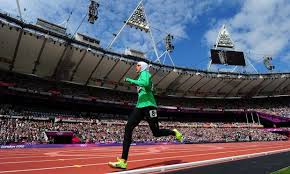
Shirin Gerami
first woman for Iram in an international tritathlon
wearing the Islamic clothing that did so much for her chances

Personally, I’d be perfectly satisfied with their having a casual encounter in a corridor. I’m a great fan of The West Wing and some of the best decisions in that spellbinding and realistic series were taken while stalking along White House corridors.

Actually, any kind of encounter would be welcome. It would be the first meeting between the heads of state of the two countries since the fall of the Shah. The first step towards calming tempers since they got hot eleven years ago, over the Iranian nuclear programme. For years we’ve lived with the prospect of possible war between the two greatest powers of a tinderbox region, Israel and Iran, if not between their sponsors, the US and Russia. 

Any kind of talk to release tensions has to be good.

Let’s hope it happens and let’s hope it leads to greater things. And if it does, let’s remember what was at the start of the process: the decision not to launch missiles at Syria.

And 
let’s not forget what was at the start of the process that led thereJust for the fun of it, here are the events that brought us the Syria breakthrough which may be gradually thawing US-Iranian relations today:
  1. Ed Miliband, leader of the British Labour Party, decided to oppose the government over action on Syria
  2. Miliband took the Labour Party into the ‘No’ lobby against joining an immediate US-led missile attack
  3. The British Parliament voted not to join that action
  4. Obama decided not to launch missiles until he’d consulted Congress himself
  5. Syria’s ally Russia took advantage of the delay to propose that Syria put its chemical weapons under international control preliminary to their destruction
  6. Syria agreed to UN control over its chemical warfare stocks
I bet Miliband had no idea that he was starting anything quite so big, when he decided that it was time, at last, to stand up to David Cameron.

Wednesday, 28 August 2013

I have a nightmare

It’s so quaint, isn’t it, that Britain continues to be a monarchy? The pageantry, the millennial rituals. And now with a baby too. It makes you feel all pink inside.

We’re about to see another glorious aspect of this enchanting tradition re-enacted. It’s called ‘royal prerogative’, and doesn’t that sound grand? It doesn’t mean the right of the queen to travel around the West End of London in a gilded coach, and devil take the traffic. It means that there are certain things the queen can do, as sovereign, without being answerable to parliament or having to consult it.

One of those things is to take the country to war.

Now she doesn’t actually exercise that royal prerogative herself these days. Instead, it’s delegated to the British government acting in her name. So Tony Blair was able to take us to war in Iraq on the basis of royal prerogative and David Cameron could do the same, any day now, in Syria.

And why not, after all? That initiative of Blair’s went so well. Iraq is now fully pacified, fully democratised; the fact that 66 people were killed this very morning by terrorist action in the capital is of course regrettable, but things are never perfect; and the fact that the nation is now little more than a puppet of Iran’s merely proves… well, I don’t know what it proves, but it proves something, and certainly not that the intervention was less than the stunning success George ‘Mission Accomplished’ Bush claimed.

I see no reason to assume that intervention in Syria will achieve anything else.

Of course, it wouldn’t actually matter if the government gave up royal prerogative: with a docile parliament and a pliable opposition leader, there’s little doubt it would get the authorisation it needed to support the military action already decided upon. Decided in Washington not London: the American War of Independence may have made the US independent of Britain, but it has left Britain entirely dependent on the US.

So on this day, the fiftieth anniversary of Martin Luther King’s ‘I have a dream speech’, we’re faced with the depressing spectacle of a US President poised to take not just his own country but France and Britain as well, into another military adventure in the Middle East.


In King's footsteps? Or just Dubya's?
Perhaps we ought to add a line to that great speech, to bring it up to date: ‘I have a dream… that some day a black President will be sitting in the White House, and will drag his allies into another senseless war, just like his lamentable white predecessor did.’

Personally, I have a nightmare.

A nightmare that fifty years from now Britain will still be taking its most dangerous decisions on the basis of a mechanism centuries out of date.

A nightmare that at that time the ‘democracies’ will still be reaching for military means as the first resort, rather than the last, for confronting their political problems.

A nightmare that a woman in the White House, like a black man, will behave as badly as any of their white male predecessors, proving in the saddest possible way that Dr King was right, and no race (or gender) is to be preferred over another.

Tuesday, 19 March 2013

A great anniversary, and so many more to come

So here we are at the tenth anniversary of the start of the Iraq invasion. It’s an action still vehemently justified by Tony Blair, who beats Tricky Dicky Nixon in the honest politician stakes only because he looks straighter (I never understood how anyone could look at Nixon’s jowly face and shifty eyes and expect anything even remotely resembling the truth from him).

Tricky Dicky: the caption says it all

Blair has a powerful argument that he deploys with increasingly tedious frequency against any critic: ‘surely you can’t disagree that the world’s a better place without Saddam Hussein’. 

I always want to answer him, ‘it surely is. As it would be a better place without car bombs going off daily around Baghdad, without the one hundred to several hundred thousand Iraqi civilian deaths the war caused, without powerful nations trampling on international law, and without countries going to war on the whim of policy-makers instead of solid evidence.’

Come to think of it, perhaps the big question to put to Blair (and Dubya, and their supporters) is what’s happening in Iran. Way back in the days of the Iran-Iraq war, the West’s darling was Saddam Hussein’s Iraq, because anyone who was against Iran had to be democracy’s friend. In fact, when Saddam Hussein invaded Kuwait, he always claimed that he’d been given the nod by none other than the United States, and it certainly seems that at the very least the Americans had sent him some pretty mixed messages.

Today, the bogey man’s Iran again. Our good friend Israel keeps threatening military action to prevent Iran becoming a nuclear power. The West rattles its sabres, deploys its battleships, ratchets up its sanctions.

In between, the West had a couple of wars with Iraq. And where’s Iraq now? Run by a Shiite government that’s turned it into a client state of Iran. For instance, Iran is actively backing the Assad regime in Syria, and channeling a lot of its support through Iraq.

So Iran was the enemy of the West and is its enemy again. In between the West helped make a regional superpower of Iran by installing a friendly regime in Iraq.

Is it just me or does that seem – how shall I put this – a trifle incoherent?

But an anniversary isn’t it just a time to look backward. It’s a time to learn the lessons of the past and prepare for the future. So let’s see what lesson we can learn from the ten years in Iraq.

Again, it’s Tony Blair who gives us the clue. What was he telling the BBC tonight, apart from the fact that he has no regrets about what he did in 2003? That the price of not intervening in Syria might be higher than the price of intervening.

In other words, things went so well in Iraq, he can’t wait to repeat the experience in Syria.
Straight-speaking Blair, in a role he can't wait to reprise
So what’s the lesson? When you’re in the kind of place Blair inhabits, you never learn any lessons from history.

And, sadly, most of the people in power today are the worthy successors of Blair, Dubya and their mates.

On this glorious anniversary, look forward to celebrating a lot more of them in the future.