Showing posts with label Franco. Show all posts

Friday, 14 August 2020

Corona: not just the problems we knew about

Corona just means crown. We use the word for things that have, or seem to have, a crown. There’s a corona around the sun. There’s a corona around the particularly nasty virus we talk about so much these days. And, of course, there’s a corona on every crowned head, by very definition.

So spare a thought for poor Spain. Like England, it’s struggling with both the health and the financial impact of the virus. Its strict lockdown to protect public health worked a lot better than the weaker measures in Britain, but the damage to the economy has been painful. Though, oddly, England has damaged its economy even more seriously, while controlling the pandemic less well. But then, England has Cummings and Johnson.

Today, however, cases in Spain are increasing once more at a depressing rate, and lockdown measures are having to be reintroduced. Just as they are in England. Although in England they seem to be targeting the Midlands and the North first of all, as though the Conservatives want to punish traditional Labour areas for having the audacity to vote for them instead.

Spain has an additional element of suffering. It’s also having to cope with Corona problems of the other, more ancient variety. The ones associated with the Crown. Especially since its previous occupant, Juan Carlos I, erstwhile King and now King emeritus, decided to do a bunk, fleeing abroad to some destination that has yet to be made public.

Juan Carlos I: ex-King who did a flit, and who knows to where?


His flight was precipitated by the ongoing investigation of his financial affairs. In particular, the judicial authorities find that his bank accounts in Switzerland raise a number of questions they’d like answered (yes, the understatement is deliberate).

This is sad, because Juan Carlos was the designated successor to the dictator Franco but, instead of maintaining the dictatorship, he oversaw an orderly transition to democracy. A referendum adopted the new constitution, still in force today, less than three years after the dictator’s death.

What’s more, not three years after that, when a coup against the new regime was launched by disaffected members of the paramilitary police and the army, Juan Carlos spoke out powerfully against it, rallying the nation to the cause of legitimate government. That ensured the coup’s failure.

Guardia Civil Colonel Antonio Tejero invading Parliament


Now, I’m a bit of a cynic and I share the misgivings of many over the length of time it took the King to come out with that statement. The initial attack against the Parliament took place just before 6:30 in the evening and the King’s broadcast went out at 1:14 in the morning. He recorded it around an hour earlier, but even that was six hours after the coup was launched.

There are those who say he knew in advance that it was going to happen, and only came out firmly in opposition once it became clear not enough of the army supported it. I don’t know how true or false that is. It is interesting, however, that there are those doubts, and that even as long ago as 1981 there were therefore some suspicions clouding the admiration felt towards the King by the Spanish people.

Which may have been a harbinger of what has happened now.

Even so, there are over 600 streets and squares called after Juan Carlos I across Spain. I am, indeed, in one of them now, as I write this piece from the flat near Madrid my one-year-old granddaughter inhabits and kindly shares with her parents (and, right now, us).

Today, a number of councils are facing motions from the Left suggesting it may be time to change the names of those streets and squares.

The government, too, led by Pedro Sánchez, a Socialist but on the Right of his party, is having to fight off moves from his coalition partner, from parties on whose parliamentary support he relies, and even from Socialist colleagues, to review the legal position of the Crown in Spanish politics. It is an offence, for instance, to insult the King, though that could be changed simply by new legislation. More problematic, the King can’t be held accountable for his acts either, and to change that would require a constitutional amendment.

Not the moment, Sánchez argues.

Ah, yes. He has a lot on his plate. Spain is closing down discos and bars again as the scourge of the virus builds again. The country has a shattered economy to rebuild. And now it has the distraction of a monarchy with a former King who’s beginning to look as toxic as the virus.

It amazes me that in today’s world we still have regimes led by men entitled to deference by right of birth. That strikes me as something to fix, so I’d like to see all three questions addressed at once. And perhaps in Britain as well as Spain.

But I can see how it makes the uphill struggle that Spain already faces even steeper and longer than it already was.

So spare my adopted nation a little sympathy…


Postscript: when the military knows how to respond to a coup

On the night of the coup, 23 February 1981 (so the event is referred to as 23F), the only city that was taken over by the military was the one where we live now. Let me quickly say that the two things aren’t causally connected. It’s just that the military region of Valencia was commanded by the general who supported the coup most actively.

Things went reasonably smoothly for him, until he sent tanks out to the airport at Manises, to get the air force unit there to join in. He got a dusty reply from the colonel in charge, according to the story a minister of the time later told:

“I have a Mirage on the runway with its engines running and armed with air to ground missiles. If the tanks heading for the base don’t turn around and pull back I’ll order it to take off and attack them. And I have another Mirage fighter ready on the runway just in case.”

The tanks retreated.

Monday, 10 August 2020

Peaks among the mountains

It’s odd going on holiday in retirement. I mean, a break’s always a good thing to have. But being retired is like a continuous break anyway. A break from a break? Seems odd.

But odd isn’t bad. And this break was great.

How should I begin to describe the greatness?

I suppose a good starting point is the place itself. We travelled to Cantabria and Asturias, on Spain’s northern coast. Once there, we spent most of our time in the mountains.

Forests in the mountains of Cantabria

The same mountains, under conditions more English
Except that the temperature remained pleasantly mild

This was only my second visit to northern Spain, and the first proper one. Back in about 1967, my parents didn’t like the idea of visiting the country while the dictator Franco was still in power. But, having got down to Hendaye, in South-West France and right on the border, they decided we should at least pop across and take a quick look. We had a day-long visit to San Sebastián before beetling back to the (politically) safer territory of France. De Gaulle, still President back then, had at least had the decency to be elected to that office, rather than seize power militarily like Franco.
My mother with her sons on that day trip, way back then


In 2020, we could take a little time and let ourselves be enchanted.

We discovered a restaurant we enjoyed enormously. So much, in fact, that we visited it three times rather than try anywhere else. It’s the Mirador Peña Colsa in Cabuérniga if ever you want to try it, and I recommend you do. The local specialty of Cocido Montañes is worth a visit for its own sake, the mountain setting is superb, and we particularly liked the proprietor, with whom we struck up such a relationship that she gave us a bottle of wine as a leaving present after our last visit.

Her attitude was exactly right. Brimming over with friendliness, as so many are in Spain, where rudeness or hostility seem limited to a tiny minority. On our second visit, she announced, “Ah. All my tables are reserved,” and then added, looking around, “now, where can I put you?”

She was a specialist at squeezing people in. We even saw one couple lunching at a table in the car park.

A couple enjoying their at a table on the edge of the car park


Then there were the remarkable landscapes. Occasionally one comes across places one can only think of as magical. On this visit, that was a series of waterfalls – well, at the cascade level – in woodland at the top of a long valley. ‘At the top’ meant a long and weary walk, but the water, without being freezing, was cooling enough to provide all the relief we needed.

Woodland cascade in Cantabria

Even the poodles enjoyed it, with Luci going so far to take a swim to cool herself down.

Luci enjoying the woodland pool

Equally memorable, but for qualities more dramatic than magical, was our visit to the Picos de Europa. These are not the peaks of Europe – the high Alps are far higher – but they are the first sight sailors would see on returning to Spain from the West. The ‘Peaks of Europe’ told seamen tired of the long Atlantic crossing that they were nearing home.

That’s where we had an experience that illustrates one of the other qualities we’ve come to know and, in a rather special sense, love in Spanish authorities. About twenty or thirty kilometres out from where we planned to start our walk, we came across a ‘No Entry’ sign alongside another announcing that the road had been closed for work.

What? After driving so far? They wouldn’t let us get to the start point of our hike?


Now this is something that keeps happening in, say, Madrid. A road will suddenly be closed, with no apparent good reason, no notice and no attempt to set up a diversion. “Sorry, mate,” someone in the local administration seems to be saying, “you’re just going to have to find another way. And if there isn’t one, find something else to do.”

There certainly wasn’t any other way to get where we wanted to go. And, indeed, while we sat and pondered, we saw more than one car turn back. But then we chatted with another driver and we collectively decided that, since they hadn’t actually put a cordon across the road, we might just have a go.

Which was just as well. The road wasn’t closed. There were roadworks happening, at three places – bulldozers hacking great chunks out of the cliffs, in fact – but as long as you accepted that you might be caught by a temporary closure, and have to wait to be waved through, you could still get to the top.

I suspect the men doing the work simply didn’t have any warning signs about possible delays. “Oh, heck,” they probably said to each other, “we’ll declare the road closed. And for good measure, put up a ‘no entry’ sign. The bold and the rebels will come through anyway. If the others go home, well, at least there’ll be fewer cars for us to deal with.”

We enjoyed the hike in the mountains. It was exhausting, and we had to turn back before we reached the top of the pass we were aiming for, but we saw eagles and we saw chamois, as well as spectacular. What more could we want?

A chamois herd enjoying its lunch

And the whole experience was given additional spice by knowing we’d braved a no entry sign to undertake it. All contributing to a great break-from-a-break.


Tuesday, 4 August 2020

The King has flown...

The King has flown the coop! Literally.

Well, literally as far as flying is concerned. I understand he took a plane. He didn’t really live in a coop, but in a significantly more desirable residence, the Zarzuela palace on the outskirts of Madrid.

He wasn’t a real King any more. He abdicated in 2014 and became ‘emeritus King’. Some nasty scandals, involving an elephant shoot, a mistress, and a lot of unexplained millions, made it advisable for him to stand down.

The elephant hunt was in Botswana in 2012, when Spain was struggling with soaring unemployment. Junkets at 40,000 euros a head weren’t viewed favourably. Especially when the King’s expenses were being covered by a Saudi businessman.

Besides, the King wasn’t accompanied by his Queen, Sofia, but by Corinna Larsen. Let’s just call her a ‘close friend’.

Emeritus King and close friend


The business of the millions emerged later, and many of them came from Saudi too. For what hasn’t ever been made clear, but he built up 100 million US dollars in a Geneva bank account. He transferred 65 million euros to Corinna. So you can see how close a friend she was.

There were also delightful moment, including the transfer of banknotes to Switzerland in a briefcase. Straight out of the kind of clichéd international thriller series that you might only watch on a wet Sunday, if you don’t feel up to anything more demanding.

I ought to clarify that when I say he wasn’t a ‘real King’, I was using the word ‘real’ in the English sense. In Spanish, ‘real’ doesn’t really mean real, it means royal, which he really was once, but isn’t really any more. Following a royal cockup.

I hope that’s clear.

It amuses me that if you live long enough, you get to see practically everything. I never expected to witness the restoration of a monarchy. To me, restoring monarchies was something Europe gave up on a couple of centuries ago. But, in 1975, Spain put the royal family back on the throne. That meant crowning the King we’re talking about, Juan Carlos I.

Now that I live in Spain, I keep being surprised by how many things are ‘real’. You know, you don’t have a yacht club, you have a royal yacht club. You don’t have a Music Academy, you have a Royal Academy of Music. It’s like England, rather than most Latin nations, which are Republics.

Still, if the restoration of the Spanish monarchy struck me as an anachronism, at least the events that accompanied it were pretty impressive. The dictator Franco had made Juan Carlos heir to his power. That was the Franco who had seized power in a military uprising forty years earlier and consolidated it through bloody civil war and brutal repression.

Juan Carlos used Franco’s legal framework to take Franco’s system apart. Within three years, the Spanish people had voted by referendum to move to a parliamentary monarchy as democratic as any in Europe. The subsequent elections included parties that had been banned and hunted for decades, including the Communists.

The King had been under no obligation to take this road. Most historians agree that, though the popular pressure for democratisation might have been hard to resist, he did far more to ease the transition than one might have expected. He built himself an enviable reputation, so that even among Republicans, many would say, “I’m not a royalist, I’m a Juan-Carlist”.

There aren’t so many Juan-Carlists these days. No one has put it better than the ex-King himself: “anyone under the age of 40 will only remember me as the one with Corinna, with the elephant and with the briefcase”.

How the mighty are fallen.

Still, it’s exciting to witness not just the restoration of a monarchy, but now the flight into exile of a monarch. One more throwback to a distant past.

Juan Carlos is keen to stress that his isn’t a flight from justice. It’s true that, sadly, all those dodgy financial transactions have led to police investigations. Even Corinna, now ex-friend just as he’s the ex-King, may be facing up to four years in gaol for money laundering. Juan Carlos says he will make himself available to any enquiries into his affairs. His departure from Spain was just to cause no further embarrassment to his homeland, and to allow his son, now King Philip VI, to play his role more easily.

It’s not clear where Juan Carlos will end up. It seems that for now he’s gone to the Dominican Republic. A lovely irony for Republicans: a King abandons his monarchy to take refuge in a Republic. You couldn’t’ make it up.

Who knows where he’ll head next. He obviously has friends in Saudi, but it’s hard to imagine him going there. But, hey, who knows.

In any case, and this may not come as a surprise, it doesn’t seem that Queen Sofia will be joining him.

In England, for decades after the Stuarts were kicked off the throne, their fans, when drinking the King’s health, would pass their wine over a glass of water, to indicate they were drinking to the “King over the water”.

Perhaps some in Spain may do the same for Juan Carlos. Or, if he does go to Saudi, they could pass their glass over a dish of sand. Unless they feel a piece of elephant hide is more appropriate.

Interesting times…

Thursday, 28 May 2020

The Spanish fighters again: liberation achieved. And denied.

When we last saw our gutsy Spanish Republican fighters in the French Foreign Legion, they were rather twiddling their thumbs in North Africa waiting for something to change.
Well they did eventually change. And in a big way.
Men of the Nueve with their halftrack Guadalajara
In 1943, the Americans landed in Morocco and, together with British forces, in Algeria. The local French military was still ostensibly supporting the Vichy regime of Marshall Pétain and serving under its orders, which meant Nazi orders. They put up a bit of a fight but soon caved, though not before some three thousand men had been killed and a lot more injured.
At that point, the local leadership, specifically the commander of the French forces, Admiral Darlan, suddenly realised they had always been lifelong democrats and switched to the Allied side. They required little in return, except being kept in office, which might have led to some friction with the Free French and in particular with de Gaulle.
Fortuitously, a young royalist decided the best way to secure the return of the rightful King to the French throne was to assassinate Darlan, which he duly did. It turned out he was wrong, as far as getting the King back was concerned, but he certainly removed a major irritation for de Gaulle.
Meanwhile the Allies, advancing from Morocco in the West and Algeria in the East, eventually drove the German army to defeat in Tunisia. The French, having switched sides, fought with the Allies, and that included the French Foreign Legion, who saw some tough battles, in which its Spanish Republican forces played a key role. And lost many men.
Not all the French forces had had to switch sides. Some soldiers had been with the Free French right from the start. In particular, one idealistic young officer had raised a small force in the French colonies south of the Sahara, marched it across the desert and joined the British effort against General Rommel in Libya.
Leclerc with his Armoured Division, during the liberation of France
His name was Leclerc (well, it was Philippe de Hautecloque, really, and Leclerc was just a nom de guerre which he’d adopted in the hope that it would deflect the attention of the authorities from his family back in occupied France). De Gaulle made him a major general and gave him the Second Armoured Division, the iconic Deuxième DB, to command. It was selected to be the only French unit to be included in the Allied landings in Normandy when they eventually came.
Unfortunately, he only had 4000 men and he needed 15,000. He set out to recruit new soldiers. One group from whom he found it easy to recruit were the Spaniards, who transferred in droves out of the Foreign Legion and into his Deuxième DB. Manuel Fernandez, whom I quoted yesterday, summed things up:
“The ideas of de Gaulle corresponded more to ours than those of the others who’d stayed with Pétain. The officers of the Legion considered us as red Spaniards, as revolutionaries… The senior officers would say to us, ‘you’re not in Spain here. You’re not going to make a revolution here.’ We’d keep quiet. The officers with de Gaulle, on the other hand, said ‘oh, did you fight in Spain? Good… The men the officers wanted were Spaniards. We had a certain experience, not just in Spain, but in the campaign in Tunisia too.”
Spanish recruits to the Deuxième DB
parading on the beach in Morocco
From the many Spaniards mobilised into Leclerc’s division, one company, the ninth, was almost exclusively Spanish: 146 out of 160 men. Commanded by a Frenchman, Raymond Dronne, and his number 2, the Spaniard Amado Granell, from Valencia, who had commanded a division in the Civil War, it passed into legend as ‘La Nueve’, ‘The Nine’.
The Deuxième DB landed in France in August 1944. The American high command had committed to allowing French troops to lead the Allies into the French capital.
On the 20th, an insurrection broke out in Paris, with Resistance units taking action against the Nazi occupiers. De Gaulle asked for and obtained authority to press on to their support as quickly as possible. On the 24th, Leclerc told Dronne and the Nueve leave and go to Paris. They left at 7:30 that evening and by 9:30 the company, supported by a squadron of tanks from the French 501st armoured regiment, arrived at the Paris Town Hall. There, the first ‘French’ soldier to make contact with the Resistance forces that had taken control was Lieutenant Granell, the officer from Valencia who had held general rank in the Spanish Civil War.
The next day, as well as attacking several key points around the City, Spanish soldiers also accepted the surrender of the German Commander and took him into custody, before handing him over to French authorities.
The men who had fought so hard to keep Spain free, at least had the satisfaction of leading the liberation of France’s capital.
One of the halftracks in the parade down the Champs-Elysées
celebrating the liberation of Paris

The action in Paris wasn’t the Nueve’s last. They fought on through the rest of the war, even reaching Berchtesgaden and Hitler’s hilltop eerie, the Eagle’s Nest. By then though, only 16 of the 146 Spaniards of the combat were still fit for combat. They had lost 35 dead and 97 wounded.
Captain Dronne, their commander, said of them:
Some of them are experiencing a clear moral crisis due to the losses we've suffered and above all to the events in Spain.
The Spaniards who fought with the French had hoped that after overthrowing Fascism in Italy and principally in Germany, the Western Powers would turn their attention to Spain and finish it off there too. It wouldn’t happen.
The best slant to put on that decision is that the Western Powers had bled enough in the war and they didn’t want to fight another. That may be partly true. But Franco was no Hitler, the Army he led no Wehrmacht. Overthrowing his regime would not have required anything like the force or the losses that the battle against the Nazis had cost.
The less honourable explanation is that the West was already turning its attention against the Soviet Union. Far from wanting to take on Franco’s rather eccentric brand of Fascism – he was always more of a Franquist than a Fascist – they preferred to concentrate their efforts against Communism. In that fight, Franco could if anything be something of an ally, just as soon as he could be brought out of his pariah state. Which happened in the fifties, when the easing of measures against his regime was the price paid for stationing American forces in Spanish territory.
Ultimately the thousands of Spanish Republicans who fought and died for France and for the freedom of their own country, would be let down. “We weren’t fighting for a flag,” Manuel Fernandez would tell the 2017 documentary makers, “we were fighting for ideas”. They were fighting for freedom, in their country as well as France.
Well, they were cheated of that goal. But at the very least, we owe it to them to remember their sacrifices and their courage.
The lesson for me? Even in Europe, the Second World War didn’t start on 1 September 1939. It began on 17 July 1936, with the nationalist uprising against the Second Spanish Republic.
Nor should it have ended when it did. Once they’d finished off Hitler and Mussolini, the Western Powers should have seen off their ally Franco. Which means the war would not have ended in Europe on 8 May 1945.
But it did. With the work not quite done. Sadly.

Wednesday, 27 May 2020

The Spanish fighters who changed my views

After four years of Nazi occupation, Paris was finally liberated by Allied armies on 24 August 1944. Units of the mythic French force, the ‘Deuxième DB’, the Second Armoured Division, led the way into the city. They had raced there to support the population that had risen against the occupying forces.
In the evening, the first half tracks pulled into the square outside the Paris town hall. As in all such units, the vehicles had all been given names by their crews, names that were painted on their sides:
Gudalajara
Brunete
Ebro
Santander
Teruel
If you’re thinking “those don’t sound like French names”, you’d be right. They were great battles of the Spanish Civil War. And the language the crews were talking was Spanish.
These were the men of the ‘Nueve’ (‘nine’ in Spanish), the ninth company of the Deuxième DB, almost exclusively Spanish. Their commander, the French Captain Raymond Dronne, wrote of them later:
The Spaniards fought remarkably. Commanding them is a delicate matter but they have enormous courage and experience of combat.
That ‘delicate’ is a glorious piece of French understatement. It chimes with what Dronne was told when he was first given command:
Everyone’s afraid of them. They’re good soldiers. They won’t give you any problems.
The halftrack Guernica of the Nueve in Paris in 1944

Moving to a new country certainly gives you a new perspective on many things you thought you knew.
For instance, I’ve had to rethink some of the most elementary facts I felt I knew about the Second World War. I’ve long accepted that it didn’t start on 1 September 1939 with the Nazi invasion of Poland, as is generally taught in schools. The first shots were fired on 19 September 1931, when Imperial Japanese forces invaded the Chinese territory of Manchuria.
OK, you might think, but that was the Pacific Theatre. In the European theatre, the war started in September 1939, surely? Well, that too is an idea I’ve had to revise, under the gentle guidance of Marisa, a friend we’ve met out here in Spain, who’s frighteningly well-informed on history.
My view was always that the Spanish Civil War, which started in July 1936, was a sort of preamble to the World War. In reality, however, with the Soviet Union supporting the Spanish Republic, while Nazi Germany and Fascist Italy backed the military uprising that brought Franco to power, it offered a first opportunity for three of the major powers of the coming World War to test each other’s strengths and weaknesses and, indeed, to expose some of their forces to combat.
That feels more like the first Act of the wider war rather than merely a preamble to it.
In any case, it wasn’t just the Germans and Italians, or to a smaller extent the Russians, who emerged from the Spanish Civil War with trained and battle-hardened veterans ready for the next stage of the conflict. There was also quite a lot of the Spanish Republican army. The Republic itself had been defeated and overthrown, but many of the soldiers survived.
Large numbers joined the flood of over 450,000 refugees fleeing across the Pyrenees into France. They rightly feared the retaliation that Franco’s victorious regime would exact from them if they were caught. The regime proved they were right by what it did to those it did in fact catch.
In France conditions were, however, not particularly better. They were held in what the French called “internment camps”, but the Spanish, especially the ones who were there, unequivocally referred to as “concentration camps”. Lack of food, poor sanitation and inadequate housing led to huge numbers of deaths. This was 1939, after all, when France and Britain still hoped that their policy of appeasing Hitler might avoid war. That desire, combined with the xenophobia and right-wing beliefs of a significant current amongst Frenchmen, conspired to ensure the refugees were shockingly badly treated.
Offered the option of returning home, about 100,000 chose to go, mostly women and children. Few of the combatants, understandably, took up that offer, however. Some paraded in front of French officers hoping to be taken into the army, but the generals, who were to be humiliatingly defeated the following year, decided they didn’t need these experienced troops whose political loyalties they weren’t sure of (they were generally left wing, some extremely).
Some 10,000, however, were recruited into the Foreign Legion. And, once war with Germany broke out, others were taken into ‘Foreign Labour Companies’ who were set to work on the Maginot line, the great string of bunkers and fortresses along the border with Germany. Life there was certainly preferable to the camps, though in the end it worked out little better. After defeating France, the Nazi authorities captured many of the Spanish workers. Refusing to treat them as prisoners of war, and working with the Franco government’s agreement, they transferred them to concentration camps. Over 7000 were sent to the Mauthausen camp and fewer than 2500 were released at the end of the war.
Chillingly, some of the survivors later said that their experience in the French camps helped them to prepare for the Nazi ones.
Those who were able to avoid capture, joined the resistance. And among those who had taken part in the fighting, many decided to carry on the battle. One Spaniard in the Foreign Legion, Manuel Fernandez, described his feelings on the defeat of France to a 2017 television documentary:
“It was the greatest disappointment of my life. There were moments when I cried like a child. I’d fled Spain and here I was going to fall into the hands of the Germans.”
One answer was to join General de Gaulle who was setting up Free French forces in London. Of his initial 2000 men, 300 were Spanish.
Alternatively, those who were in the Foreign Legion could cross the Mediterranean with their units. In North Africa, however, they were under the orders of the government in Vichy, a puppet regime of the Nazis, set up after the defeat of France. There they were left to wonder how they’d managed to escape Franco, only to find themselves in a military unit whose orders were dictated by a government collaborating with Franco’s most powerful ally, Hitler.
It would take over two years. Though then things would change dramatically.
But more of that in another post. Just click here...

Tuesday, 3 March 2020

Thoughts of the victims of war in a Valencia air raid shelter

If you’re sightseeing around our local city, Valencia, the saddest sight you can see is an air raid shelter. I’ve visited two and there are many others.
Inside the air raid shelter under the Valencia town hall
They date from “the war”. However, I believe when most of us say “the war” we probably still mean the Second World War, if we’re from countries that took part in it. In Spain, “the war” means the Civil War the raged from 1936 to 1939, led to the overthrow of the Spanish Republic and ushered in 36 years of dictatorship under Francisco Franco, ending only in his death.

On the other hand, there are many people, inside and outside Spain, who would reckon that the Spanish Civil War was a part of the Second World War. That makes some sense. After all, despite signing the same non-intervention treaties as the democracies, Germany and Italy, then under Nazi and Fascist control respectively, sent not just weapons but military forces to support the Franco rebellion. Only the Soviet Union supplied the Republic, and then only with toxic strings attached.

So major players in the Europe-wide conflict that was about to break out were involved in the Spanish war. The air raid shelters in Valencia were built to withstand attack by Italian forces, chiefly in the form of bombing raids from bases they had set up on the island of Mallorca.

One of the striking aspects of our visit was a video they played us. At several points, I realised that I wasn’t listening to Spanish any more, but to Italian. What was being played was Fascist propaganda about how ‘heroes’ from the Italian air force were taking part in raids on Valencia to make civilisation safe from ‘Soviet communism’, in a fight many saw as a Christian crusade.

Down in that air raid shelter, that irony was particularly bitter. These were shelters for civilians, and they were the main victims of the raids. The propaganda claimed the bombers were targeting armament factories and military concentrations. In reality, they were dropping their bombs on civilian dwellings.

No one puts that better than the great New Zealand cartoonist David Low, who has Franco being told that his Arab troops are concerned by the ‘unchristian’ behaviour of his army.
David Low has an officer reporting to Franco, Mussolini and Hitler
“Excellency, the Moorish troops are disturbed.
They say our conduct of the war is unchristian.”
The assault on civilians would become the hallmark of the long struggle that the Spanish Civil War announced: heavy bombing of civilian centres, often described as a means of ‘weakening enemy morale’. Killing civilians to undermine morale? There’s a word for that. It’s terrorism.

And I was particularly struck by one of the photos in the air raid shelter. A mother with her child. Both faces are paralysed with fear. And it’s perfectly obvious that neither has been guilty of an act that merits the punishment they’re undergoing.
Part of the display in the air raid shelter
Left, a bombed home. Right, a terrified mother and child
Sadly, this kind of terror bombing was by no means limited only to the enemies of the democracies in those years of war. In fact the worst bombing was carried out by the Western powers themselves, something they should perhaps bear in mind when they denounce terrorism today. Dresden, Cologne, Hamburg all but destroyed, with tens of thousands of dead.

And, to top it all and inflict still greater destruction, there were the atom bombs dropped on the civilian populations of Hiroshima and Nagasaki.

Mentioning those Japanese cities reminds me of the only reason I disagree with those Spaniards who say the Second World War started with the conflict in Spain. That same David Low I mentioned before had a different view, which I share. After all, there was a Pacific Theatre to World War II as well as a European one. Fighting started there in 1931, when Japanese troops invaded Manchuria, five years before the uprising in Spain and eight before the Nazi invasion of Poland.
In the background, the “Japan-China mixup” as a mugging
In the foreground, the USA, France, Britain,
Germany and Italy are walking away
One is saying, “Don’t you think, after all, there
may be something in the idea of having a police force?”
Another replies, “Tut Tut! Too risky! Much wiser and cheaper
to wait until we’re all murdered in our beds
Just as in Spain, the democracies stood back and did nothing. And, just as Low warned, they paid the price. All the enemies they would face in the official Second World War – Japan in the Pacific, German and Italy in Europe – were using the earlier conflicts to get into shape to fight the big one.

A tragedy. Which makes visiting the Valencia air raid shelters such a sad moment. Though perhaps a necessary one.

Saturday, 22 February 2020

Romans, Arabs, Fascists and hard drinks

Organising events is something a great many of us have done at some time. 

It might be a bring-and-buy-sale. It might be some worthy public meeting, or a concert, or a festival stand, perhaps raising money to defend women’s rights, or protect the polar bear, or prepare the overthrow of capitalism. It might just be an amateur dramatics evening.

What I think few of us are likely to have done is organise a stand at risk of being attacked by Fascists, or to make a major archaeological discovery as we do so. But that’s what our friend Marisa did.

The thing about Marisa is that she’s extremely bright and frighteningly well-informed. She also happens to be a Valencia City guide, by which I don’t mean that this is what she really is in any essential way, only that among the many things she does is act as an official guide around Valencia. In either English or Spanish, naturally, as monolingualism would be far too limiting.

Her brightness and depth of information make her tours particularly fun, so we join them whenever we can.

Regular readers of this blog will know that Terry Pratchett is one of my favourite writers. Ankh Morpork is the biggest city in his fictional Discworld. In Men at Arms, he says of it:

Technically Ankh-Morpork is built on loam, but what it is mainly built on is Ankh-Morpork; it has been constructed, burned down, silted up, and rebuilt so many times that its foundations are old cellars, buried roads and the fossil bones and middens of earlier cities.

As with most of Pratchett’s comments about the Discworld, this one is equally true of a lot of the world we inhabit. Especially its older cities. What the centre of the city of Valencia is built on is Valencia. Or, more accurately, Valentia.
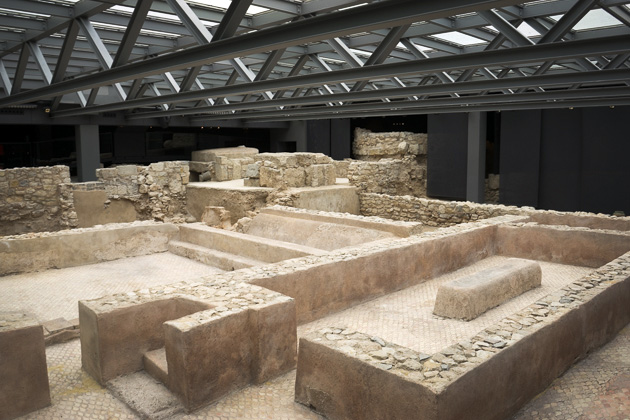
The baths of Roman Valentia
Underneath the present city. Naturally
Valentia was founded by the Romans and, as Marisa explained, it was used to settle former soldiers of the legions that had fought the Lusitanians under their iconic commander Viriathus. Those Lusitanians had been too benighted to appreciate that the Romans were there to liberate them from their primitive way of life and initiate them into the wonder and glory of life as Roman citizens.

The Romans were prepared to go to great lengths to help them attain civilisation, even if that meant massacring them in large numbers to attain that noble goal.

To be fair, the Romans were enlightened enough to settle quite a few of Viriathus’s soldiers in Valentia. After all, they were veterans too, weren’t they? Besides, as a boss of mine once told me when I mentioned we were buying our first house, “the best way to make a man a conservative, is to give him something to conserve”.

It didn’t work with me, I’m glad to say. We sold that house, anyway.

It didn’t work that well for the early Valentians either, or at least not for that long. 75 years later the city was razed in the Civil War that raged throughout the Roman possessions, to decide which of two power-hungry autocrats, backed by big money and large armies, should rule over them.

Can you imagine? A state of the world in which ordinary people have their lives wrecked because plutocrats are fighting each other for power. How sad it would be if the same kind of thing happened today.

It took half a century, but eventually the city was rebuilt, on top of the Roman ruins and sometimes using stones from them, as is traditional. Eventually it morphed into Spanish Valencia.

Which is just as well, as we might have found it difficult to live here otherwise.

In between, it spent a time under Arab rule. After Marisa had shown us some of the Roman remains under the modern-day city, she asked whether we’d like to visit the fragments of Arab wall that can still be seen in certain basements.

Well, we decided we would, so we did. In particular, she took us to the place where, back in the 1980s, there was a patch of wasteland with a slowly collapsing house at the back of it. At that time, Marisa was a student at the art school, then called the Royal Academy of Saint Charles.
The Fallas are the great festival of Valencia
They're about to come around again
A latter-day Valencian tries the traditional costume
One year, when the great annual festival of the ‘Fallas’ came around, she and some of her friends decided to organise a drink stand to raise a little money. The Council gave them permission to use the wasteland.

It was full of rubbish that people had been throwing there for years, if not decades. The first job was a long and tedious clean-up of the whole site. In particular, they had to clear the stairs that led down into a basement where they were planning to sell their drinks. When they got there, they found that one side of the basement was made of what looked like old, strongly cemented and thick walls.

They thought little of it and went ahead selling soft drinks, along with Agua de Valencia, which looks like orange juice but isn’t, and is certainly not soft. It all went well, in general. Their only problem was that this was the eighties and there were still a lot of unreconciled Fascists around, who hadn’t accepted the return to democracy after the death of the dictator Franco.

Sadly, some of these people are making a comeback again today, with the hard right surging in the polls. That’s one of the biggest issues that Spain, like many other countries, now has to face.

Back then, some of these Fascists identified, correctly as it happens, the students on the drink stand as left-wing and decided that they would make a great target for violent attacks. Ultimately, the students had to hire a security guard to protect them.

I’ve worked on drink stands before, but I’m glad to say I’ve never needed to protect myself from physical injury.

What was most remarkable, however, was the wall. Eventually, the students decided that it might be rather more significant than they had originally imagined. They mentioned it to the council.

It turned out that what they’d stumbled across was one of the best-preserved segments of the old Arab wall around the city, significantly bigger in Arab than in Roman times, lying under the newer buildings.
Marisa, with the Arab wall she helped uncover, behind her
It was a privilege to have one of the people responsible for its discovery showing us that stretch of wall, now well-preserved and set up for visitors to admire. Especially as they’d uncovered it in order to sell Agua de Valencia, a drink it strikes me as particularly apt for celebrating such a find.

It just goes to show. Facing down Fascist violence can have some remarkable consequences. Though this has to be one of the least expected.

Saturday, 8 February 2020

A watercourse, a poet and a lot of persecution

There’s a piece of doggerel most schoolkids learn by heart:

In 1492, Columbus sailed the ocean blue

Rather fewer people, outside Spain anyway, know that 1492 was also the year that the last Moorish – Arab and Muslim – part of Spain fell to the Christian reconquest of the country. Ferdinand and Isabella, the ‘Catholic Monarchs’, captured the Emirate of Granada that year, making the entire Iberian Peninsula Christian once more.
The Alhambra in Granada
Fell to Ferdinand and Isabella when they defeated the Moors
And gave its name to their decree against the Jews
It was barely two months later that they issued the Alhambra decree, named for the great Moorish palace in Granada, expelling all practising Jews from Spain.

One of Spain’s, and indeed the world’s, greatest poets was Federico García Lorca. He was gay, in the early part of the twentieth century, when that was hardly a safe thing to be. He was also from Granada, and replying to a reporter in 1931, he said:

I think being from Granada gives me an inclination towards sympathetic understanding of the persecuted: the Gipsy, the Black, the Jew…, the Moor, that we all have within us.

He might have added “the homosexual” but that might have been dangerous.
Lorca. Outstanding poet. Champion of the oppressed
By the summer of 1936, it had become dangerous simply to be Lorca. That was when the military uprising, against the Republic that then ruled Spain, began.

The rebel leader was Francisco Franco, who would hold Spain in a rigid dictatorship for nearly four decades. His regime had no time for a gay champion of underprivileged minorities.

The Nationalists Franco led also believed that the revolt was a crusade for Christian values. So they were particularly ill-disposed towards Lorca for the comments he made during an interview in June 1936, just weeks before the military rebellion started. Asked for his view of the Christian reconquest of Granada, he replied:

It was a very bad moment, though they say the opposite in the schools. We lost an admirable civilisation, a poetry, an astronomy, an architecture and a delicacy unique to the world, and replaced them with a poor, cowardly city, a land of piety in which the worst of the Spanish bourgeoisie operates today.

Unforgivable words for the Nationalists who, just two months later, caught up with Lorca and murdered him.

All this came to back to me while walking in the hills above Valencia the other day.

This region is remarkably fertile. Far more so than the relatively poor country around Granada. It doesn’t rain often, but when it does, the rain comes down like a waterfall, in storms that usually last three or four days.

That means there’s all the water agriculture around here needs. The trick is to manage it well, so that it doesn’t all seep away to the sea in between the storms. And, to this day, the locals are happy to acknowledge that the irrigation systems they use are based on techniques their ancestors learned from the Arabs.

Irrigation water flowing in the Sierra above Valencia
That made it poignant to walk along watercourses guiding irrigation water from the mountains to the fields and orchards. Every few metres there’s a side channel, with a small sluice to let water into the adjoining fields or keep it out. These structures are modern, not Moorish, but they use the same principles.

My mother had a refrain when talking about Spain. The two great errors of that nation’s history, she maintained, errors which ensured its long-term decline, were defeating the Moors and kicking out the Jews. With them, they lost their best agriculturalists (to say nothing of the cultural wealth Lorca listed) and their most skilled financiers and traders.

So walking along a watercourse in the hills above Valencia isn’t a simple, innocent exercise. It’s redolent with historical meaning. In the Moors, Spain had an outstanding civilisation, which it defeated and overthrew, to its own lasting harm.

In the Jews, it had another great minority with much to contribute, persecuted for merely being other.

And centuries later, Spain produced a magnificent poet, who understood and empathised. Who knew what it was to be oppressed. Who, finally, fell to that very oppression at the hands of a dictator certain he was acting for his white, Christian and Spanish nation.

And who, by doing so, inflicted further damage on that nation, just as the earlier persecutors had.

The saddest aspect of all these memories? The descendants of those self-harming oppressors are ready to do it all again. The Trumps, the Johnsons, the Leaders of the Italian League or of Spanish Vox. They learn nothing and keep making the mistake of thinking that homogeneity is the way to greatness.

Whereas, as Lorca knew, it’s stultifying and ultimately fatal.
Water, water everywhere. All for the land to drink