Showing posts with label Paris. Show all posts

Sunday, 5 January 2020

Letrice in Beirut, or how we like to turn a bad situation into something far worse

It was Paris on the Mediterranean. It was sea-bathing in November, it was visiting Roman ruins in a blouse, it was sitting with colleagues on a sunny café terrace when at home everyone was indoors or wrapped in coats and scarves. It was no wonder her visit to Beirut left my mother, Leatrice, with indelible memories that she was still sharing with me 70 years later, not long before she died.
Leatrice in Baalbek or at the beach
She was a pretty 24-year old, but maybe already a little uptight...

It was 1948. A single trip abroad as a child had been followed by the thirties in London, then the air raid warnings and the bombs of the war, then the harsh winter of 1946, the bomb sites on every street, the rationing, the general gloom of the past-war years.

Leatrice, as I’ve mentioned before, got out just as soon as she could. In 1948, she was working as a typist for UNESCO in Paris. It organised a conference in Beirut and, to be a success in those pre-Word processing days, a conference had to have a legion of low paid assistants along, to record the words of the important or self-important, and to produce the documents without which no one would believe they’d actually been doing very much.

For Leatrice, it was a sheer joy to be there, to see the sights, to go for a swim, to visit the ruins at Baalbek, to enjoy the pavement life. I was reminded of that when going through another bundle of old photos, as part of a task that is probably going to take most of my retirement even if I have a long one, and came across more pictures of that trip.

What made the pictures all the more poignant was that I was looking at them just as I’d learned that Donald Trump, in what passes for wisdom in that orange head of his, had decided that the best action he could take in response to new threats from Iran, was to launch a drone-borne missile strike to assassinate the senior Iranian General Qasem Soleimani.

Now Soleimani was a ruthless autocrat and his hands are stained with the blood of thousands killed in combat or simply murdered in cold blood. The world is absolutely is arguably better off without him in it. But the same could be said of Saddam Hussein: we’re better off freed of him, or at least we would have been, had what followed in his wake not been far worse. Indeed, one of the most toxic consequences of bringing down Saddam was the rise of Soleimani.

It seems we don’t like learning from our mistakes (or, for those like Trump, perhaps we’re unable to learn), and keep thinking that a quick fix – the invasion of Iraq, the murder of Soleimani – is likely to deliver a long-term solution.

The reality, of course, is that Iran will avenge the death. It may do so directly itself, or it may use a proxy force, perhaps in Yemen attacking Saudi Arabia once more, perhaps in Syria attacking Israel, or indeed perhaps through its client militia, Hezbollah, in Lebanon. Whichever option they eventually select, it’s going to make the Middle East a still more tragic region than it already is.

Especially as whatever action they take, there will almost certainly be further retaliation from the US or its clients in Israel or Saudi Arabia. So things will ratchet up. Which, you may remember, is rather how things went after the invasion of Iraq.

Looking at my mother’s Beirut photos reminds me how far we’ve come.
Clockwise: the venue for the UNESCO conference;
Leatrice third from left at a pavement café; a street scene; the seafront.

Leatrice agreed with the description of Beirut as ‘Paris on the Mediterranean’. She regarded it as a sliver of paradise. But that was before the US and Russia, Israel and Iran, Saudi Arabia and Syria, to say nothing of its own internal conflicts, started interfering the life out of it.

I’d like to say that they’ve turned a paradise into a purgatory, except that purgatory is supposed to be where souls are purged ready to enter heaven. Sometimes, the Middle East looks more like a soul condemned to hell, from which there is no hope of escape. Certainly, none while its destiny is being set by Trump or Soleimani, Netanyahu or Assad, Putin or Mohammad bin Salman.

Friday, 12 October 2018

Sunshine in an oddly artificial but strangely attractive spot

Some curious places can be surprisingly appealing.

Take the Buttes-Chaumont park in Paris. For a long time, it was a refuse and sewage dump, a place where the bodies of executed criminals were put on display and, in one part, a gypsum and limestone quarry The gypsum was used to make plaster, so it was an important substance in building, which at least makes the purpose of that part of the site constructive – in the most literal sense – and that’s more than can be said for the other bits.

Eventually, though the city of Paris decided to make a park of the place.

I don’t know whether the presence of all that gypsum played a role in how they set about it, but they used a lot of concrete in modelling the park to their design. A waterfall, outcrops of boulders, a stream running between rocky banks – they were all built, not found, laid out by man not nature.

That’s what makes the place so odd. Little or nothing about it is natural, the landscape itself is artificial.

Natural it may not be, but the lake’s an attractive spot for all that
And yet, oddly enough, it manages to be attractive. The waterfall is worth a visit, and the lake is beautiful, especially with the rocky crag in the middle of it, crowned with a belvedere from which one can just glimpse the distant Sacré Coeur in Montmartre. So it’s fun to go to.

OK, I admit, it’s a bit remote, but that is the Sacré Coeur there
Danielle and I hadn’t been to Paris for years, though we lived on the western edge of the city for three years back in the nineties. My brother and his Danielle live now, and it was good to visit them for a couple of nights. Especially as the day before he left was his birthday so we took them out for a pre-birthday celebration.

During the day, while they were both working, we popped down to the Buttes-Chaumont to enjoy the park again. Which turned out to be wonderful. It helped that the weather was glorious, even well into October. What helped the day less was that it had been cold in the morning, so we ended up having to carry coats and sweaters as soon as the clouds cleared.

We even had lunch in a little restaurant opposite one of the gates. We could have eaten outside but chose to go inside, because it was simply too warm in the sun. So it was a fine way to enjoy the last day of our nearly six weeks in Continental Europe.

Of course, by the time we got home to Luton, it was chucking it down with rain. But, hey, it wouldn’t be a welcome home, would it, if it didn’t feel like home?

The waterfall’s fake too
But I like it anyway

Saturday, 6 October 2018

The dancing was inspiring, but the revolution never happened

Flamenco music and dance  it just gets your pulse racing.

That was the feeling that came over me the first time I went to a concert. That was in Paris, oddly enough. I was there on a school trip, the first time I’d failed to spend a holiday with my parents, making it an important rite of passage in itself. 

The music captures the soul of Spain and the musicians were, indeed, Spanish. The setting, on the other hand, was pure French. And it was a curious time in French history: the Easter of 1969. 

Less than a year earlier the city had seen the great events of May-June 1968. Many had then believed that the very foundations of the French state were under attack, that a new French revolution was taking place. Students in the Latin Quarter of Paris, the main university area, were out on the streets daily, battling against riot police.

Paris May-June 68: a student flinging cobblestones at police lines
The students’ weapon of choice was the cobblestone, dug out of the roadway and used as a missile against the police lines. When I first saw one of those stones close up, I have to say I was amazed by the strength some of those students must have had. I couldnt have thrown one far.

Many Paris streets were still cobbled at that time, but that was changing. For me, the most striking legacy of those events, was seeing the heaps of cobblestones piled in the courtyard of the youth hostel where our party stayed. Clearly, the authorities weren’t going to be caught out again: they were removing a far too easy source of ammunition for future rioters.

Do you remember the start of Butch Cassidy and the Sundance Kid? Butch, played by Paul Newman, casing a bank which he’s beginning to realise now has too much security for his gang to raid again, asks ‘What was the matter with that old bank this town used to have? It was beautiful.’

A security guard replies ‘People kept robbing it.’

‘Small price to pay for beauty,’ says Butch.

Paul Newman as Butch Cassidy,
regretting the disappearance of the beautiful old bank
For as long as the cobbled streets of Paris were only causing havoc to car suspensions, the beauty seemed worth the price. But when they provided the fuel for revolution, the price was deemed too high.

Not that there ever really was a revolution. Years later, I heard a radio interview with Maurice Grimaud, Paris Police Chief at the time, and he said that it was a strange revolution that didn’t cost a single life – two people died on the fringes of the fighting but none at all in the fighting itself. And, as he pointed out, the conflict was entirely contained within the Latin quarter – he never lost control and never allowed it to spill out of the small area where it began.

That didn’t stop Charles de Gaulle, then President, running off to the French garrison in Baden-Baden, ready to form a government in exile and prepare for a new triumphant return in arms to the fatherland, just as he’d done in 1940. But by 1969, he was back in the Elysée Palace. Though not for long: he resigned as I was travelling back to school.

So it was in a slightly febrile atmosphere, the jittery climate of Paris in 1969, between the May-June days and de Gaulle’s departure, that I saw my first Flamenco concert. An oasis of pleasure in a desert of tension. And it marked me. It left me with an ineradicable love of Flamenco. What’s more, whenever I hear Flamenco again, I think of that strange moment in Paris half a century ago. 

As I did the other day, as we approach the end of our stay in Valencia. It was another great performance, full of verve, dynamism and beauty. There are moments whenever I watch Flamenco when I wonder how they manage to do it. The boots hit the stage with such force. The singing is so powerful. The guitar playing so frenetic. The dancers are full of passion while maintaining such dignity.

The performance also gave me a sense of political wistfulness. Because the audience was made up of French and German and Dutch as well as Spaniards. And even a group of English people.

Brought together in joint enjoyment of an exciting evening.

Passion and dignity combined
It was clear that the groups had a great deal in common, bound together by a shared culture. How could one of them be about to sever its links with the others? Why was Brexit going to force those Englishmen to break their bonds with their fellow Europeans?

Its a strange, incomprehensible state of affairs.

It’s clear that more and more people in Britain are turning against Brexit. It is tearing the ruling Tory Party apart. It has caused major divisions within the Labour opposition too, divisions that would doubtless explode if ever the party came to office and had to deal with the issues of leaving the EU.

No one seems set to gain from Brexit, and yet no one seems to be able to do anything to stop it. Britain seems bound, inevitably, for a great leap backwards. A change against progress and towards a world that prefers walls to bridges.

Ah, well. Another good reason for going to a Flamenco concert. Get the blood stirring, the feet tapping, the hands clapping. And take your mind off the sheer cussedness of the world. 

I met Flamenco soon after a revolutionary movement that reverberates still today. And now I’ve enjoyed it just before a reactionary step of equal moment. Sadly, while the revolution never really happened, Brexit I fear most certainly will.

Saturday, 29 September 2018

Leatrice in Beirut

It’s strange how much certain things can change in seventy years. It’s even stranger, and rather sadder, to see how certain other things have grimly resisted every attempt at change. Or got worse.

In 1948, my mother Leatrice was living in Paris and working for UNESCO. In November, she travelled to Beirut for a conference and she wrote to her parents on the 16th, soon after arriving:

… I hope you have already received my cable. I didn’t want to let you know until I arrived that I was travelling by air, knowing that you would worry, but we had a most uneventful trip…

Flying was still an adventure seventy years ago. It’s true, I tend to phone Danielle after a flight to say I’ve arrived safely, but I do the same after a train journey or even a car trip. As it happens, I find the prospect of travelling any great distance by car far more daunting than catching a plane. I have more confidence in the pilot’s ability to fly his plane than in my own driving – or that of other drivers on the road.

As for a cable – a telegram – I don’t even know who still provides a service these days. Certainly, I don’t remember the last time I sent or received one. In the ages of text messages or emails, does anyone use telegrams?
Leatrice (third from left) enjoying a moment's relaxation in Beirut, 1948
The trip to Beirut marked Leatrice for life. She mentioned it frequently down the years. And looking at her letters home, it’s easy to see why.

The mountains now have snow on them, she wrote on 20 November. It is cold, clear and sunny. This country grows on one. The colour on the hills mixed with the brilliance of the Mediterranean is unbelievably lovely. I have come to like the Lebanese very much. After the coldness of the Parisian, it is heart-warming to meet people who laugh with their eyes as well as their mouths.

The people may have been great, but apparently Leatrice was concerned about the sanitary conditions:

… if we drink any water, we put chlorine in it. It tastes exactly like a swimming bath, but is at least disinfected.

Personally, I’d prefer to take my chance on the infection. On the other hand, it took me a week to recover from the Cairo belly I brought back from Egypt ten days ago, so maybe Leatrice was right.

But she hadn’t finished with the subject of the people.

… it is quite obvious that they are a pure Semitic race. Olive skinned, long heads, black hair, large black eyes, curly mouths.

The racial comments I’d probably avoid, personally, but I like the underlying message, one Leatrice would repeat throughout her life: ethnically, there’s no difference between the Arabs of the Levant and Jews. The idea that there should be racial tension between them, far less conflict, is simply indefensible.

But, and this is one of the things that has not changed in seventy years, or if anything has got worse, that conflict is proving agonising and irresolvable.

We touched down in Damascus and came by taxis over the border into Lebanon… We saw some truckloads of soldiers in Syria, but there isn’t actually much military activity there. Lebanon isn’t actually at war, although Syria is.

The Israeli-Arab war of 1948 had already broken out.

Isn’t it curious that at the time Syria had been relatively untouched by war? To the extent that it was regarded as safe enough to bring staff through to Beirut? That wouldn’t be the case today.

In any case, these days we’d fly directly to Beirut.

I am, of course, very tactful about myself, but discover there is practically no feeling at all about the war. After all Lebanon is not officially engaged in it. The people I know are all Christian, and they feel themselves in very much the same position as the Jews in the Middle East. A few hundred thousand (about 600,000 surrounded by 40 million Moslems, who hate their guts). They generally feel that there is a slight bond in having another minority just over the border as some slight protection. In 1860 there was an awful pogrom of the Christians here, and the ones left fled to the mountains, and hence most of the people living in the hills are members of the Greek Orthodox church [I think she meant the Maronite Christian church]. There are actually about twenty different sects getting on fairly amicably, including a Jewish community. I had my hair washed by a woman who spoke Russian, and then burst into Yiddish with another customer.

Some things have changed, others have stayed the same. The underlying tensions have continued and, if anything, hardened. And the communities that got along reasonably well have broken out into full-scale combat, especially in Syria. The fighting Lebanon was spared in 1948 has spilled over its borders. Indeed, the links between the Christians and Jews that my mother spotted, took a particularly ugly form in 1982. That was when Israeli forces stood back and let Maronite Christian militia carry out a massacre of the Palestinian inhabitants of the Sabra neighbourhood and Shatila refugee camp in Beirut.

A deeply moving representation of this terrible event is in the excellent semi-autobiographical Israeli film, Waltz with Bashir. The sense of horror is made somehow even more intense by the film being made as a cartoon. Until the last few scenes, at least.

Leatrice left Beirut on 15 December, after around a month. With many fond memories. As early as in her letter of 16 November, she had written:

Have now seen the cedars of Lebanon. A very lovely tree. Tall, graceful and a very bright green.

What a pity that Lebanon isn’t primarily known for its cedars any more.

And as for the effect of war on a peaceful nation, what more pitiful example could be provided than Syria...

Monday, 2 January 2017

Forgetfulness of things past

The thing about Tweed is that it never goes out of fashion. Of course, you might think that was because it was never in fashion in the first place but, hey, that doesn’t make the statement any less true.

I’m deeply attached to my fine, old Tweed jacket.

I say old because it is old but, to be fair, it was probably old when it was new.

And by “attached” I don’t mean I’m sufficiently fond of it to wear it. Every year or so I go through my wardrobe picking the clothes I never wear and chucking them out. Or rather, this being England where the only thing in constant growth is poverty, not chucking them but recycling them through a charity shop.

Each time I carry out this culling exercise, I come across the tweed jacket and I think, “I shouldn’t get rid of that one. I should wear it a bit more”. It’s a thought that comes with a pang of guilt, since each time I realise that I haven’t worn it, even once, since the last time. It continues to hang in my wardrobe, seemingly immoveable because I’m no more prepared to part with it than I am to put it on.

Today I was preparing an expense claim and realised I’d mislaid a train ticket. Whenever this happens – and, alas, it happens more often than I like – I always check through the breast pockets of all my jackets, since that’s an obvious place to stuff a ticket which you’re going to need at a barrier in a short time.

What prompted me to look in the tweed jacket I can’t imagine. There was no chance the missing ticket would be in a garment I hadn’t put on for years. But what I did find was something even better, a discovery that opened a door to a trip down Memory Lane. Except in my case Forgetfulness Lane is far more apt.

I found two boarding card stubs (remember when airlines used to have those? Before you could use a phone?) They were for a flight from Paris Charles de Gaulle to Barcelona, one 12 November. The outward flight was at 7:30 am.

The last time I lived close enough to the airport at Roissy to catch a plane there at 7:30 was 1998. We’re talking about a trip that happened up to two decades ago (you might spot the fact that my seat was in the ‘no-smoking cabin’ which certainly dates things a bit).

The trigger for a flood of memories.
Or in my case none at all
Sadly, I have no memory of the trip at all. Which seems a pity, since Barcelona is one of my favourite cities.

Was it the 7:30 start? In November? Maybe it was sheer trauma that led to my memory failure. A kind of act of mercy by my psyche. Particularly as I notice from the return stub that I flew back the same day, on the flight that left just before 6:00. I can only have had about six hours in the city itself, making it an experience to bury rather than relive.

What can have possessed me to wear tweed to Barcelona? It’s true that it’s cold in November. Even so, the Spaniards dress so well. Was I trying to make a point of my Englishness, it being a profoundly English tradition to wear that quintessentially Scottish cloth?

Lots of fascinating questions. Speculating on the answers is almost as pleasurable as reliving the lost past. It’s a kind of non-nostalgia.

For Proust, it was the taste of a Madeleine cake. For me, it was the rough feel of tweed. Of course, for Proust the experience triggered an avalanche of remembrance of things past. In mine, it merely reminded me of my forgetfulness.

Where I have the edge over Proust, though, is in my succinctness. He used a million and a quarter words on recreating his memories. I’ve taken fewer than 700 on the failure of mine. 

A small mercy, dear reader, to be thankful for.

Wednesday, 23 March 2016

Responding to the Brussels attacks: how to get it wrong

It’s Brussels this time. At least another 31 deaths and over 200 injured. Harrowing, dismal events, and the latest in a series of them.

The scene at Zaventem airport, Brussels, soon after the explosion
That’s bad enough, but then it gets worse. As usual, our own reaction will magnify the damage and give the terrorists a victory they’ve done nothing to merit.

The Belgian government, for instance, will go way over the top with security measures, making life much safer but far less convenient. People will have to leave earlier to get to work on time, earlier to catch a plane. So as well as the tragedy inflicted on the families immediately involved, the terrorists will leave a lasting mark on the economy of a major European capital, making it more difficult to run.

The British government has added to the mix by advising against travel to Brussels. I have no particular reason to go to Brussels at the moment, but fear of terrorism wouldn’t stop me: the place is going to be one of the safest on earth for the new few weeks or months. Just a pig to get around.

In any case, it would be nonsense to fear Brussels, since I commute into London. That city has to be facing a risk of terrorism at least as high as at any time since the IRA campaign of the eighties. But I still feel I’m much more likely to be involved in a traffic accident than caught up in a terrorist outrage; since I’m not going to stop crossing roads or driving a car, it makes no sense avoiding London.

Besides, refusing to be deflected denies the terrorists an easy win.

There are other, still more vital ways, of denying them. One of the most important is to resist the urge to bomb them out of existence. It was that kind of thinking that got us into our difficulties in the first place: an illegitimate, unnecessary war in Iraq spawned ISIS. The Syrian civil war has become a proxy for East-West clashes as well as tensions inside the Middle East, that are wreaking havoc in Libya and Yemen too. We’ve brutalised a great many young men, and not a few young women, and given them something to avenge.

Staffan de Mistura, UN Special Envoy on the Syria crisis, told the Guardian that, following the Brussels attacks:

The message we are drawing out is that we need to end the fires of war. We need to find a political solution in Syria to make sure we can all concentrate on what is the real danger, in the world and in Syria.

Take away the underlying conflict, and you take away its expression in other countries – in Turkey, which suffers more often than most, but also in Europe.

Going a step further, we also have to resist the temptation to blame the outrages on Islam or Molenbeek, the district of Brussels from which the attacks against both Brussels and Paris came. Donald Trump is naturally attacking immigration itself as the source of such terrorism, trying to blame entire populations for the work of a handful of people; in Britain, the far-right UKIP attacks open borders in Europe, ignoring the fact that Salah Abdeslam, who led on the logistics of the Paris attack, was stopped at the Hungarian-Austrian border in September 2015, but was allowed to drive on. The failure wasn’t due to the Schengen groups open borders but to lousy intelligence.

Stigmatising a European Muslim population of several million for the actions of a tiny minority simply creates more enemies for us; targeting Molenbeek would be just as counter-productive, since what makes the district generate aggression so easily is precisely that it’s so poorly assimilated. 30% are out of work. One in three of the population is foreign. Increasing its pain will do no one any good.

The IRA campaign in Northern Ireland was waged by a few hundred activists. Behind them, however, there were probably many thousands of passive supporters who provided the active members with information and shelter as necessary.

Eventually, once Westminster had woken up to a more intelligent approach to the province than military repression, huge sums were invested into Northern Ireland to revive the economy. A long campaign led to reasonably fair access to jobs, housing and education for Protestants and Catholics. The effect was to drain the swamp that gave the activists their support.

At the same time, intense and highly competent intelligence work enabled the security services to break up IRA groups and thwart attacks. After all, if the IRA had to depend on many thousands, it was impossible not to have leaks to the police, and good intelligence took advantage of them.

It’s clear, if only from the fact that Abdeslam escaped arrest in Molenbeek for several months, that there’s an extensive passive support network there too. Again, there must have been leaks. But were the security forces set up to take advantage of them? Belgium is, for instance, coming to terms with the fact that the police force has far too few Arabic speakers.

Whatever Trump may say, Molenbeek doesn’t demonstrate a failure of the Community, merely a failure of Community policing.

Will we be smart enough to apply the lessons of Northern Ireland elsewhere in Europe? To respond to the latest attacks not with increased repression but with investment and highly-competent intelligence work? To help all our sad little Molenbeeks, across the continent, out of their misery rather than drive them deeper into it?

Which boils down to one simple question: will we avoid giving the terrorists yet another undeserved victory?

Monday, 16 November 2015

Combating terrorism: we know what works and what doesn't. So why do we keep choosing what doesn't?

There’s no simpler solution to complex politics than war.

That’s because all war requires is the willingness to spend a lot of money, sacrifice a number of lives of your own people and, if things go to plan, a lot more lives of another people. Mostly nations of the prosperous West have little difficulty working up the necessary will. So, for instance, the Fench reaction to the Paris attacks, to mount bombing raids on ISIS in Syria, is a simple, not to say simplistic, response.

French air strikes.
Simple. Powerful. Effective? Who knows.
Almost as simple is rounding up people. It’s more difficult if you take the trouble to arrest real suspects, against whom you can mount a case. If you just go after people who might be supporters, without pedantic concern for, say, evidence, that’s as easy as bombing raids. You might, like France, just round up the perpetrators’ families.

Not that I’m particularly criticising France. Other nations behave as badly. Consider reactions to the 9/11 attacks on the US in 2001, carried out by a team which was predominantly Saudi. The leader of the organisation behind the attack, Al Qaida, was also Saudi. Much of the funding was Saudi.

It still made some sense to attack Afghanistan, if only because the Al Qaida leader, Osama bin Laden, was living there. But it made no sense to attack Iraq next. Iraq? There was no suggestion of Iraqi involvement in 9/11. So the justification for the Iraq invasion became weapons of mass destruction. Absence of evidence, the hawks would tell us, isn’t evidence of absence. However, once we were able to establish facts on the ground, it became clear there was plenty of evidence of the absence of those weapons. And hence absence of any justification for the war.

To try to give it some kind of retrospective appeal, the invading forces decided to rebuild the country along new, improved lines. Unfortunately, they used the army to do the job. Armies are designed to destroy, not to build. So the effects were as disastrous as might – ought – to have been expected.

After years of downright oppression, the Shia majority of Iraq took power. Like most people previously downtrodden, they leaped at the opportunity to do some treading down themselves. The West, which had casually disbanded the Iraqi army with its Sunni leadership, took no steps to protect Sunnis from the rule of their enemies. New Sunni resistance movements emerged, fell under the control of religious fundamentalists, and from that toxic fusion, produced ISIS.

Doesn’t the French reaction, so far, to the Paris attacks remind you of the US/UK response to 9/11? Force first, and repression, rather than thought, self-analysis and careful consideration of the consequences of action.

Self-analysis is badly needed. It’s emerging that both Iraq and Turkey warned France of the impending attacks. That they weren’t forestalled is a major intelligence failure. Analysing that shortcoming is far harder than despatching aircraft or arresting suspects. Besides, many people – some of them individuals I’d previously regarded as sensible – are clamouring for heavy handed action. “Close the borders!” they call, “lock up the imams! Kick out the refugees!”

That last call is particularly curious. Many refugees are fleeing the onslaught of ISIS, the very foe we face in the West, and which the West created. More Syrians are killed every day than in the Paris attacks that so stunned Europe. Close the borders to them? That’s like eating a starving man’s meal and then refusing to let emergency supplies through.

What’s worst about the demand for repression is that we saw what happened when we took that approach towards Iraq. It heightened tensions. It attracted recruits to the insurgent cause. It led to the unleashing of the forces we now have to combat.

Curiously, we also know a different way of behaving and know it works. When the troubles broke out in Northern Ireland, Britain’s initial response was also repressive. The consequences were Bloody Sunday, the Guildford 4, the Birmingham 6, a whole litany of other miscarriages of justice, murders, bombings and misery.

Eventually saner spirits prevailed. They understood that an insurgency only survives with the support of a disaffected population. So steps were taken to stop the disaffection. Housing, job opportunities and education were improved for the previously oppressed nationalist communities. Military action was maintained but at a lower level, while the accent moved more firmly on effective intelligence work, until the IRA was so penetrated that its decisions were being communicated to British security services in near real time.

Out of all this came the Good Friday peace agreement. There have been setbacks, but by and large it’s held. The result, for anyone who remembers Belfast before, is spectacular. It used to be a city under siege; today it’s vibrant and exciting. 

That approach works, and we know it works. Against ISIS, we may have to use more extensive brute force, to defeat it militarily. But we’ll also need far better intelligence work than France has produced so far. And we’ll need to support the communities that produce the terrorists.

The last step’s counter-intuitive. It means investing in the very people from whom the insurgency emerges. It means making them prosperous and tolerating their cultures and faiths. For those in France who are sickened by the Muslim veil or beard, and are saying so loudly since the attacks, that will be a hard pill to swallow.

Trust me, guys. It really works. Far better than repression, which is what ISIS wants – repression generates the oppressed, disaffected Sunnis who made it strong in the first place. ISIS hates the idea of well-off Muslim communities in the West, peacefully coexisting Shia and Sunni Muslims in the Middle East. 

Because they’ll snuff ISIS out.

Saturday, 14 November 2015

Paris attacks: how we might react, and how we should

Yesterday morning, 13 November, the British media were dominated by one story: the probable killing by a US drone strike in Syria of “Jihadi John”, British citizen Mohammed Emwazi. He became notorious around the world when he executed, on camera and with cruel delight, six captives of the ISIS group.

Jeremy Corbyn, leader of the UK Labour Party, responded to the news of Emwazi’s likely death, with the comment, “it appears Mohammed Emwazi has been held to account for his callous and brutal crimes. However, it would have been far better for us all if he had been held to account in a court of law.”

Indeed. Being killed in the streets of Raqqa by a US weapon turns him into a martyr of the fight against imperialism; in front of a court, he could have been exposed as the cruel, small, cowardly man he really was.

The point was made more strongly still and, for me, more movingly by Diane Foley, mother of one of Emwazi’s victims, James Foley.

Diane Foley: It saddens me that, here in America, we’re celebrating the killing of this deranged, pathetic young man…

ABC (Brian Ross): It gives you no solace?

Diane Foley: No. Not at all. Had circumstances been different, Jim [James Foley] probably would have befriended him and tried to help him. It’s just so sad that our precious resources have been concentrated to seek revenge, if you will, or kill this man when if a bit of them had been utilised to save our young Americans... That’s what our country should be doing, I think, is protecting our citizens and the vulnerable, the people who are suffering, and not trying to seek revenge and bomb… I’m sorry… Jim would have been devastated with the whole thing. Jim was a peacemaker. He wanted to know how we could figure out why, why all this is happening.

ABC: For you there’s no sense of justice then, in this strike?

Diane Foley: Justice? No. It’s just sad. We have to be careful … not to glorify this deranged young man. I mean, he’s a sad individual, filled with hate for us. I hope our country can choose to lead in ways of peace and valuing young Americans who are trying to protect… our best ideals. That’s the part of America I’m proud of... I don’t like this bully part, I’m sorry, no.

She’s so right. We went to war in 2003 to wreak revenge for 9/11 on someone, anyone – after all, Iraq had nothing to do with the attacks – and the result has been twelve years of more disasters including the rise of ISIS, the ravaging of the region, a huge flow of refugees which we’re struggling to cope with, and further terrorist outrages. Twelve years, with no end in sight.

Yesterday morning, though, the talk was all about how significant the likely death of Emwazi would prove. Since he was not a significant player in ISIS, it was generally felt that his death would not be a body blow to the organisation, though it would be a major propaganda coup.


Parisian emergency services going into action
at the Bataclan concert hall, where most victims were killed
And then we had the Paris attacks. When it comes to propaganda effect, it leaves the killing of Emwazi firmly in the shade. It was a way of saying to the West:

Firstly, that we are all targets – ISIS doesn’t attack individuals like Emwazi, it attacks whole populations, with no interest in guilt or innocence (or rather, on the assumption that we are all guilty).

Secondly, the attack shows that our twelve years of fighting, with all the investment of lives and treasure, have had no impact at all on degrading our enemies’ capacity to strike us. The Paris attack is the worst France has undergone since the Second World War.

There’s quite a message behind this.

Lesson number 1 is the easy one: ISIS is a present and growing threat, and we need to combat it.

Lesson number 2 is that the approach we’ve taken so far has only been partially successful. Excellent intelligence work in a number of countries has prevented attacks within their territory. France probably needs to do a great deal better in this field. But when it comes to snuffing out the movement at its roots, in Syria and Iraq, we’ve done little more than nibble around the edges of the problem. Indeed, we created many of the difficulties in Syria and Iraq ourselves when, in our pursuit of the kind of revenge Diane Foley criticises, we incompetently waged war in the region. Remember the prisoner abuses in Abu Ghraib prison in Iraq, and ask yourself what they did to attract recruits to ISIS.

Lesson number 3 is the lamentable one. The most common reaction to the events in Paris will probably be to want to do more of precisely the things that have proved ineffective in the past. There’ll be more Islamophobia. There’ll be more calls for curbs on immigration. There’ll be more pressure to go to war.

What there’s unlikely to be is any attempt to follow Diane Foley’s advice, to stop wasting our resources on seeking revenge, and instead focus on protecting our people and upholding our values. That doesn’t mean ducking the issue of war if military action really is necessary, but only taking it when we know exactly what we’re doing, it’s limited to necessary and defensible goals, it’s legal and we know it can achieve what we need.

If I’m lucky, I’ll be proved wrong. The West will adopt a different and far more intelligent approach to the problems that 9/11 and the ill-thought out Western reactions have caused. And at last we’ll see effective action taken.

Well, we can always hope...

Thursday, 20 June 2013

You don’t have to be Orpheus to descend to Hell, you just need a ticket

Most major cities pride themselves on putting in underground railway systems.

Odd, really, since when you plunge into any of them they generally turn out to be pretty ghastly places. They show how right most religions are to place Hell underground.

The London tube is one of the worst. It always seems to be horribly crowded.

Now I know it
’s a bit of a paradox to say that. I mean, if I weren’t there to experience how crowded it was, it would be marginally less crowded. But like most others, I suspect, I view myself and anyone with me as travellers, and everyone else as a crowd.

Even without the crowd, the tube is painful. It’s hot and clammy and claustrophobic, partly no doubt because it’s really squeezed into its tunnels: there are often only inches between the edge of tube cars and the tunnel side.


The London Tube: no margin for comfort
Still, in being uncomfortable, the London underground’s no worse than most others.

For instance, I’m always amazed that people write in such flattering terms about the New York subway. It’s always struck me as desperately old-fashioned, noisy and bone-rattling. Badly out of place in the home of technological innovation.

As for the Paris metro, it’s particularly dismal. First of all, it stinks. I don’t know whether it’s burning brake pads or what, but the smell is one of the most unpleasant I’ve come across in any city’s underground system. Everyone always looks absolutely miserable too; again, I realise that I’m guilty of some kind of solipsism here: I regard all the others as being miserable, and making me miserable by contagion, but I appreciate that others might see things the other way round.

Occasionally, underground systems can be quite interesting. For instance, before the wall came down, the Berlin U-Bahn had quite a few ‘ghost stations’. These were closed stops on the eastern side of the wall, their names still in Gothic script from the thirties, no adverts up on the wall or the tattered remnants of posters decades old, dim lighting, armed police on the platforms making absolutely certain that no-one got off the trains from the west or, more important, tried to get on.


Ghost station on the U-Bahn in the bad old days.
Fascinating but spooky
That was pretty spooky and interesting, but it wasn’t exactly pleasant.

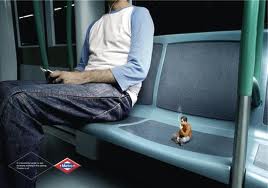
In fact, the only metro system that I’ve been on recently and found relatively tolerable is the one in Madrid. It’s one of the more modern ones, so that’s perhaps not so surprising, but it does show that things could be less awful.

What makes the Madrid metro more attractive? There really is space in the tunnels around the carriages, and the carriages themselves are wider. Stretch out on the London tube, and even I with my short little legs am practically touching the passenger opposite. In Madrid there’s space between the rows to fit in people, legs, luggage, whatever.


Madrid Metro: room to breathe. Until it fills up at least
The greater width and the clearance in the tunnels makes the whole system much airier and fresher. That’s helped by air conditioning which is actually switched on from time to time. And they even have mobile signal down in the tunnels.

It still isn’t exactly fun, particularly when the carriages fill. But it’s a lot better than Paris or London.

Still, to be fair to poor old London, at least the tube does have a couple of jokes associated with it.

‘Do you know the way to Turnham Green?’ is one. The answer is, of course, ‘Leave 
em out in the rain.’

And the classic ‘Is this Cockfosters?’ to which the answer is 
well, it’s certainly not mine.

And the tone of that joke probably reflects pretty accurately the quality of the experience of travelling on the system.


Unusual passenger in Madrid