Showing posts with label Abraham Lincoln. Show all posts

Wednesday, 20 May 2020

Boris Johnson second rate? No way.

When I look at the behaviour of the Johnson government, the thought “second rate” always springs to mind. Only to be replaced by, “that’s so unfair”. Followed by a swift reassessment.
Gentle humour, charmingly readable
Decades ago – oh, it was probably the seventies – I discovered the books of George Mikes. Most English speakers pronounce the name as though it were the plural of the nickname ‘Mike’. Or rather, since practically no English speaker even remembers him, perhaps I should say that they used to pronounce the name that way.
He was Hungarian by birth, though he lived most of his life in England. Strictly his name ought to be pronounced something like Mick-esh or possibly Meek-esh. But I like to think of him as Mikes.
He wrote a whole series of books commenting on the different nations he visited, starting with his adopted country, Britain. Just the title of the first of those books gives a feel for his style: How to be an Alien: a handbook for beginners and more advanced pupils. His books were light-hearted, humorous reflections on the behaviour and attitudes of various countries.
In one of his books, and I certainly wouldn’t be able to find the passage now, he mentions that a critic had called his writing second rate. He rejected this notion as a wild exaggeration. By way of explanation, he gave a ranking of authors, which again I don’t remember, but here’s a similar, if partial and entirely personal, ranking of my own.
In the ‘first rate’ I’d want to include Jane Austen, George Eliot, Elizabeth Gaskell, Graham Greene, George Orwell, Harper Lee, Salman Rushdie and Terry Pratchett.
So in the ‘second rate’ I’d have to have Charles Dickens, Edith Wharton, Joseph Conrad, Joseph Heller, John le Carré and Hilary Mantel.
I’m not going to bore you by going down a whole list, but simply point out that the second rate is made up of outstanding writers, whose names will ring down the ages, and who produced extraordinary books.
Mikes reckoned that he was at best tenth rate, which is probably about right. He’s down there with other writers who entertain and help you wile away a dull hour – you know, John Grisham and Nevil Shute – good writers (well, Shute was a lousy writer but a great story teller) who hit the spot but are a long way behind the best.
Now we can take the same approach to government. We need to be careful, however, because there are more factors to take into account. Competence is crucial, but competence applied to do harm is a defect, not a virtue.
On those grounds, while Abraham Lincoln in the US, Clement Attlee in the UK or Pierre Mendès France in 1950s France, were all first rate, we’d have to say that Tony Blair, whose government might have been first or second rate without Iraq, tuned out at best third rate in the end.
Because they were competent and did more harm than good, I’d have to put the Wilson governments up into second rate. Equally, the Callaghan government didn’t do too much wrong, entitling his time in office to be viewed as third rate.
Maggie Thatcher was extremely able and powerful, but did huge harm, wiping out whole communities (a few years ago, I revisited a village in Yorkshire which was once thriving when it its mine was running, to find it run down, shrunk in population and with 40% of the population on either unemployment or invalidity benefit, victims of Thatcher’s vandalism).
Twelfth rate at best.
When the amateur burglars pay a call
A fine metaphor for the inept playing at Thatcher
I remember an advert from a long time ago for an insurance company. It showed a devastated living room, with books and records all over the floor, amongst the ruins of broken furniture, devices and pictures. The catch phrase was something like, “If you think professional burglars are a threat, wait until the amateurs pay you a visit”.
Well, if we think that the competent Thatcher was a damaging presence, we now need to absorb just how much damage an incompetent version of the same can do. Think of a government that stumbles from crisis to crisis with no plan or guiding philosophy except its own self-aggrandisement, that takes its decisions too late and applies them too weakly, that sacrifices lives to profits in cruel indifference to the suffering and bereavement it causes, and then seeks to blames its advisers for its shortcomings. Yep. You’ve got it. That’s the Johnson government. Thatcher redux, without the ability.
Second rate, this lot? Way beyond their reach
Shall we say twentieth rate for the Johnson government? Or, OK, let’s be generous, maybe nineteenth. But second rate? Nah. They’re nowhere near that good.
As Mikes made clear, second rate is pretty remarkable.
The Johnson crowd comes way, way down below that on the Mikes scale.

Thursday, 26 September 2019

Boris Coup: Day 30

It’s facing a crisis that most truly brings out the character of a politician. For better in some cases. For far worse in others.

Lincoln became a man for the ages in the American Civil War, and spoke of the battle he was leading to ensure that “government of the people, by the people, for the people shall not perish from the earth”.

Churchill won his stature in the world, and his place in history, by the way he faced the threat of Nazi invasion. My mother, who lived through the period, told me how, at a time when voices were being raised to talk peace terms with the Germans, it built the morale of the nation, and personally sent a tingle down her spine, to hear him declare, “we shall never surrender”.

Then there’s Boris Johnson, following his defeat by the Supreme Court, and facing hostile MPs. In particular, he faced criticism from women MPs worried about the threats to their safety that flow from just the kind of inflammatory language Johnson uses, and just the kind of far-right fanatics he encourages. He gave us, “I have never heard so much humbug in my life”.
BoJo lashing out in parliament
Not a pretty sight
Yes. Perhaps not quite so impressive as the other two. Not his finest hour. Hardly a display of self-control and nobility of character. But that’s Boris, on day 30 of his coup attempt, now painfully unravelling before his eyes. He’s starting to sound ever nastier, more willing than ever to lash out at anyone who stands in his way.

A lot of that is calculation. He knows that there are voters out there who value just that kind of brutality. They like to convince themselves that this is strength, not understanding that real strength wins its arguments by winning supporters, and doesn’t need to humiliate or crush its opponents.

Playing to that audience, however, has its dangers too. Trump’s playing that game in the US. It may not work there: although his antics strengthen his standing with his most convinced supporters, they’re not attracting voters from the centre. With an intelligent campaign, and the right kind of candidate, the Democrats can win those votes, leaving Trump with only his core, and defeated.

Unfortunately, things are not that straightforward in Britain. If Johnson can hold a core vote similar to Trump’s, of around 40%, that will probably be enough under the UK system to win him a parliamentary majority. If the election is delayed, he may have enough time to discredit himself, as the consequences of Brexit sink in. But for now, both the weak leadership of the Labour Party, and its apparent readiness to allow an election early, are setting up the conditions for a BoJo win.

So he remains unrepentant, refusing to apologise for his intemperate outbursts, partly no doubt because he’s angry at what happened to him in the Supreme Court, partly because he thinks it prepares the ground for him to win an election.

Another principle attributed to Lincoln, probably incorrectly, is that you can fool all the people some of the time, you can fool some of the people all of the time, but you cannot fool all of the people all of the time.

Words that could have been written for BoJo. Who does, indeed, seem to be intent on fooling just enough of the people, just enough time to get himself into Downing Street with a majority to back him.

However unpleasant he reveals himself to be on the way.

Monday, 26 August 2019

Commemorations and mythologies

National myths matter. They define, or perhaps more accurately they express, national character.

One of the most memorable conversations I had was with a Mexican friend explaining to me how important, to a Mexican, was the story of the ‘Malinche’. She was the native woman who became the mistress of the conquistador Cortés. She is the mother of the nation, formed as it is from the mixture of Spanish and native bloods; she is also the woman who betrayed her people to become the mistress of the man who led a bloody and deadly conquest of her land.

By the same token, Cortés is the father of that people. And yet he was also the murderer of thousands of its ancestors. That erotic but treacherous, intimate but murderous relationship is at the root of Mexican mythological history. And it’s as complex and fluid as Mexican life itself.

The United States has its mythical past too. And like most mythologies, what it owes to historical fact is pretty limited.
Celebration of the myth:
Mayflower pilgrims bring godliness and love of freedom to North America
American mythology starts with a bunch of pilgrims landing at what is now Plymouth rock in Massachusetts, seeking religious freedom. It then picks up the current of representative government, of the notion that the people are the true sovereign power in a state. It culminates in the emergence of democratic rule, at a time when in old Europe democracy was still a dirty word, though it would ultimately become the aspiration of so many countries.

Much of this is true. In the nineteenth century, the torch of democracy was held almost exclusively by the Americans. When Abraham Lincoln talked about the American Civil War as a conflict fought to ensure that government of the people, by the people, for the people should not perish from the earth, he was voicing an important truth. And yet, the United States was no democracy when he spoke it: no blacks and no women enjoyed the rights of white men. Even Catholics were far from enjoying the same rights as Protestants.

Those contradictions can be traced right back to the historical roots of the myth.

The Mayflower pilgrims weren’t concerned with religious freedom in general, only with their own religious freedom. As their descendants would show, most dramatically in the Salem witch trials, they were fully capable of being as vicious in their persecution of others as those they fled back in England.

In addition, they weren’t even the first to land in North America. They got there in 1620. A full twelve years earlier, the first permanent European settlement had been set up in Virginia. And a year before the pilgrims landed, two events occurred in Virginia whose fourth centennials have been celebrated in the last few weeks.

Back in July, it was the launching of representative government. Trump attended that commemoration. And this weekend, it was the arrival of the first slaves from West Africa. Trump stayed well away.

At the weekend, today's African Americans commemorated
the first arrival of African slaves in North America
A year before the Mayflower Pilgrims
Back in August 1619, the British privateer White Lion arrived near what is now the town of Hampton in Virgina and landed “20 and odd Negroes” whom he traded for food. The principle that humans could be bought and sold had been established. Slavery had begun its grisly existence on the North American continent and would not end for nearly two and a half centuries. Only in 1865, with the adoption of the thirteenth amendment to the US constitution, would slavery finally and for all time be abolished in the US.

Its consequences would not die so soon, however. When Trump tells black Congresswomen to go back where they came from, he is expressing an attitude that underlay slavery and still hasn’t been driven out of US culture: that people of African ancestry are not fully members of American society.

That the attitude still persists is not a truth with which all Americans are at ease. Which is why the foundation myth of the country is much more concerned with the Mayflower pilgrims, misrepresented as champions of religious liberty. And with the birth of representative government, an event in which it’s easier to take pride than in the first arrival of slaves.

Which is why Trump went to the first commemoration. About representative government. Not to the other one. The one about slavery.

But it’s much more important that the second one happened.

Thursday, 4 July 2019

Have a happy Independence Day. But maybe remember what it means too

Twelve score and three years ago, the fathers of our cousins across the Atlantic, brought forth on their continent a new nation, conceived in liberty and dedicated to the proposition that all men are created equal.

Well, all men in the strictly limited sense of the word ‘man’. Women weren’t given the vote or anything radical like that. And even amongst men, it wasn’t really every man. The main author of the American Declaration of Independence, Thomas Jefferson, was a slaveowner himself and able to live with the notion that anyone black amongst men created in supposed equality, could be held in slavery, his rights being pretty much equal to those of livestock.

Roger Taney, Chief Justice of the USA
who denied African-American any rights a white man was bound to respect
The fact that slavery existed at the same time as the founding fathers issued the Declaration of Independence, suggested to many that its lofty sentiments were only ever intended to apply to whites. This led, as I’ve pointed out before, to what today is a shocking claim at the conclusion of the Dred Scott case in 1857. Chief Justice of the United States, Roger Taney, declared in his judgement that from the earliest days of the nation, ‘negroes’ were seen as inferior and, indeed, “so far inferior, that they had no rights which the white man was bound to respect.”

There have been many cases, for instance of police shootings of black men, which rather suggest that some still feel that African Americans have no rights a white man is bound to respect.

Nor were all white men precisely equal. Most of the states of the time applied fancy franchise rules, with the vote only available to those who held certain levels of wealth. There was a widespread feeling around the western world at the time that those without property had nothing to lose from political decisions, and might therefore act recklessly if they were given a say in them.

But none of that really matters. Or rather, it matters a great deal, but only to show the way humanity makes progress: through compromise, through half measures, through what may sometimes seem nothing less than hypocrisy. Despite all the contradictions and equivocations, the Constitution that was written based on Jefferson’s powerful words, has stood the test of time remarkably well, surviving a devastating civil war that led to the abolition of slavery; the often brutal measures to repress the women’s suffrage movement; and the authoritarian attempts to hijack the Constitution during the McCarthy era.
Senator Joseph McCarthy:
tried to distort the US Constitution into authoritarianism
Through its existence, it has been a beacon to millions around the world. When that Constitution was launched, ‘democracy’ was a derogatory term in Europe. It implied chaotic rule by the masses, by their nature incapable of rule and opening the door to anarchy. When Lincoln claimed, in the Gettysburg address, that the aim of his war was to ensure “that government of the people, by the people, for the people, shall not perish from the earth”, he wasn’t exaggerating. Precious few parts of the Earth allowed the people much of a say in government; Lincoln’s efforts ensured that rather more of the US people had such a say; the enfranchisement of women half a century later extended that for the first time to a majority of the people. The other nations we now think of as democracies followed in the wake of the United States.

It is, therefore, hard to overstate the importance of the event the US celebrates on 4 July, not just for Americans but for the world. Certainly, it took a lot longer to come even close to recognising that all men, and women, should be seen as equal, and we’re still far from realising that equality in practice. But at least the aspiration has been there since 1776 and we’ve slowly moved towards it.

Sadly, the vision Jefferson and his contemporaries championed, flawed and contradictory as it may have been, but still profoundly invigorating and freeing in the long term, is now more under threat than ever. Donald Trump is once more trying to distort the Constitution in an authoritarian direction, as Senator McCarthy did in the fifties – but this time with the power of the White House behind him.

So perhaps today’s celebrations need to be a little muted. Among the festivities, Americans need to realise that a man elected under the provisions of the Constitution is undermining it. And, to adapt Lincoln’s words once more, they should highly resolve that those who preceded them shall not have struggled in vain, and continue the fight to ensure that a nation conceived in liberty and dedicated to the proposition that all and not just some people have an equal right to freedom, can indeed endure.
Donald Trump:
trying McCarthy's trick again, but with the power of the White House


Wednesday, 22 May 2019

Seward: three telling tales retold

Picking up where I left off last time, it must have been a terrible blow to William Seward not to win the Republican nomination for the presidency in 1860. And even more galling to see the country lawyer Lincoln go on to win the Presidency in his stead. Even so, at a time when candidates did not campaign for themselves but relied on their allies to campaign for them, Seward was by far the most active promoter of Lincoln’s cause, travelling from State to State, apparently tireless in his canvassing on behalf of his rival.
William Seward
In defeat, a loyal friend to his successful rival
It was only reasonable that his reward should be the highest non-elective office in the land, that of Secretary of State. But Seward viewed the role’s responsibilities rather differently from his boss. He must have thought that the relatively untried Lincoln would be out of his depth as President, and needed someone to guide him, or even to run the government in his name.

“Whatever policy we adopt,” Lincoln quotes him as saying in a response he drafted but never sent, “there must be an energetic prosecution of it.” And Seward apparently suggested that “either the President must do it himself… or devolve it on some member of his cabinet. Once adopted, debates on it must end, and all agree and abide.”

Seward obviously had a candidate in mind for the Cabinet member to whom such authority might devolve.

What did Lincoln feel about this? He noted: “I remark that if this must be done, I must do it.”

The man elected to the post with the power would exercise it and no one else. That, no doubt, is what Lincoln explained to Seward face-to-face, rather than in a letter. In that quiet tone, without aggression, without raising his voice.

What I like most about this story is that Seward took the point and never again tried to challenged Lincoln’s authority. Indeed, he became Lincoln’s strongest and most loyal supporter. Which didn’t mean that he never stood up to him – on the contrary, he learned to respect Lincoln, though that didn’t stop him offering advice, even if necessary in opposition to the President’s own views..

My second anecdote concerns just such a moment.

The Trent affair was one more crisis in the seemingly uninterrupted sequence of crises of a life-and-death civil war. The British mail ship RMS Trent had been stopped on the high seas by a US warship and two commissioners (diplomatic envoys) from the Confederacy – the self-proclaimed rebel government in the South – removed from it.

That profoundly displeased the British government. Which, in turn, was bad news for the US, one of whose primary war aims was to stop Britain or France intervening on the side of the South. Indeed, that was the very reason the Commissioners had been seized: to stop them appealing for support in Europe.

You can imagine, however, that there was joy in the North over the capture of these two leading rebels. And when objections were raised, a feeling that the US couldn’t possibly back down and hand them over. What a humiliation that would be.

Seward felt that was exactly what they should do, humiliating or not. As a higly effective lawyer he put together a powerful brief: the seizure, because it was carried out on the High Seas and not in US waters, was illegal; it was precisely to stop this kind of attack on neutral shipping by the British that the US had gone to war in 1812; and, in purely pragmatic, political terms, handing the commissioners back would disarm those in Britain who wanted to back the South.

Lincoln listened to the argument but wasn’t convinced. A good lawyer himself, he told Seward he would prepare a counter-argument and present it at the following day’s cabinet meeting.

In fact, at the Cabinet meeting next day, all the discussion was on how the handover of the Commissioners to the British should be undertaken, who should contact whom in the British government to make it happen, how the decision should be communicated to other politicians and the public.

As they emerged from the Cabinet room, Seward asked Lincoln what had happened to the case he had planned to present against him.

“I found,” Lincoln replied, “that I could not make an argument that would satisfy my own mind, and that proved to me that your ground was the good one.”

Is that anecdote about Seward or about Lincoln? I leave it to you to decide. Although I’m not convinced it matters.

My final anecdote comes from several days after Lincoln’s assassination.

Not everyone realises that the President was not the only planned victim of the murder plot. Assassins were due to target the Vice President Andrew Johnson and the Secretary of State William Seward, too.

Seward had suffered a serious carriage accident and was bedbound already. Fortunately, his would-be assassin was intercepted by his carers and, though Seward suffered severe additional injuries, they were not fatal.

As he began to recover, he saw through his window that the flag on the Defence Department was at half-mast.

“The President is dead,” he announced.

As he’d been instructed, his attendant attempted to contradict Seward, to spare his feelings. But Seward knew better.

“If he had been alive he would have been the first to call on me… and there’s the flag at half-mast.”

He lay back on his pillow with the tears flowing freely down his face.

Lincoln and he had been adversaries. But they had become close collaborators and finally friends. Seward mourned the death of his erstwhile rival as sincerely as anyone in the country, if not more so.

It’s not the least of Seward’s outstanding qualities that he was able to walk that road to reconciliation, respect and ultimately grief.

Monday, 20 May 2019

A birthday that reminded me of a strange event

Google – or was it Wikipedia? there are so many of these things these days and it matters so little which is doing the talking – reminded me this week that William Seward’s birthday fell on the 16th of May.

It was his 218th birthday so I don’t imagine he was doing much celebrating. But I raised a glass to his memory. Because he’s one of those figures that I think deserves to be remembered with affection and a twinkle of humour.
Not perhaps the most attractive of men
but a most attractive character
He was born into wealth and into a family which owned a few slaves in the last few years of that shameful institution in the state of New York. Whether or not his family’s experience of slave ownership played any role in the formation of his ideas, he grew up with an abiding and outspoken hatred of that abuse. Inevitably, he was one of the main figures in the launching of the Republican Party in the 1850s.

That party, as well as having a powerful conservative wing, was also the home of many US radicals, including most of those in favour of abolishing slavery. It was, above all and increasingly, the party of liberal Northern, business and financial interests, against a much more strongly agrarian and conservative current in the Democratic Party, in which Southern concerns played a forceful and growing role.

Funny how things have changed, isn’t it? The Liberal wing of Republicanism seems to have sunk without trace. It’s the Democrats today who represent the liberal currents of the wealthy North East, the West and of some central states.

By 1860, Seward had served two terms as Governor of New York and was approaching the end of his second term as a Senator for that State. He was one of the best-known and powerful voices in the Republican Party and his track record of public service was outstanding. No wonder that when his name was submitted to the Republican convention in Chicago that year, for selection as the party’s presidential candidate, he seemed not just the front runner but a shoo in for the nomination.

Back home in New York – candidates in those days didn’t attend the conventions, though it was there that nominations were decided, in a time before primaries – back home, his friends and family had put together a huge celebration to mark his selection including a battery of cannon to mark the great moment.

Unfortunately, however, he’d put off many of the more moderate members of his party. Or maybe it would be more accurate to describe them as prudent or even nervous. Many felt that to oppose slavery too openly would spell doom for the country, splitting it irretrievably and possibly even precipitating Civil War. Many felt it was wiser to adopt a less radical stance, perhaps of allowing slavery to continue where it was already practised but prevent its spread anywhere else.

Sadly for Seward, while he was able to command the biggest single bloc of convention delegates on the first ballot, it didn’t constitute a majority. And through the next three ballots, his vote remained static.

Instead, the less abolitionist majority, originally split among several candidates including Ohio Governor Salmon Chase and former Missouri Representative Edward Bates, began to coalesce around just one.

And who was he?

Well, his name is known around the world today, far beyond the borders of the United States. But you need to imagine yourself back into the atmosphere of the times to realise how extraordinary his nomination was.

He was a local politician of limited education, raised in agonising poverty, who earned his living practising law in a thinly populated state, and had only made any significant amounts of money when he began to take briefs for such enterprises as the railroads. His total experience as a politician at national level was a single two-year terms as a congressman eleven years earlier, when he had signally failed to make anything like a name for himself.

No Alexandria Ocasio-Cortez, recognisable anywhere today after only a few months in office and so well-known, indeed, that she can simply be referred to as AOC.

A major national party nominated for President of a United States on the brink of Civil War, and at a crisis point over slavery that was as moral as it was political, a man barely known outside his State and with limited previous political experience.

He was, of course, Abraham Lincoln. He won the 1860 Presidential Election, though without winning a majority of the popular vote. Despite all the prudence of the moderates, the result of that vote precipitated the secession of the Southern states, and the Civil War they had hoped to avoid by selecting Lincoln in the first place.

One of his first acts was to appoint his rivals from Chicago to his Cabinet. Salmon Chase became Secretary of the Treasury. Edward Bates became Attorney General. And Seward, cheated of his coronation, became Secretary of State, the most senior member of the Cabinet, second only to the President himself.

Better, as Lyndon B. Johnson would later colourfully claim, to have them in the tent pissing out than outside the tent pissing in.

I’m only going to tell three anecdotes about Seward, three of my favourites. But, this post being more than long enough already, I’ll come back to them in my next.

Saturday, 1 September 2018

US Railways. Or Railroads. Oh, how are the mighty fallen

The United States didn’t invent the railways. That was Britain. It’s like football, where Brits invent something and then watch foreigners do it better.

The Americans don’t even call them railways, instead using the word railroads, but hey, they didn’t invent the things so why should they get the name right?

When Abraham Lincoln first emerged from crushing poverty, he made some money as a railroad lawyer, as did Clarence Darrow who later became one of the best defence lawyers ever. And major fortunes were made in the sector – one thinks of Cornelius Vanderbilt or EH Harriman, for instance.

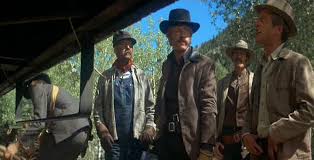
Actually, I have to say that when I think of EH Harriman, what comes to mind is the classic film Butch Cassidy and the Sundance Kid. Do you remember the pathetic figure of Woodcock, the train guard Butch calls on to open the door of the freight car carrying the money, so his gang can take it? Butch warns him that he could get blown up when they dynamite the car, and Woodcock explains:

… you gotta understand that Mr E H Harriman himself of the Union Pacific Railroad gimme this job and I never had such responsibility before and since he entrusted me to get the money through, I got to do my best, don’t you see?

Sundance and Butch trying to persuade Woodcock to open the door
rather than be blown up
It didn’t work out well for him. Or for the money. But fine for Butch and Sundance.

Today, that’s all gone. US trains, where there is a service at all, are infrequent, shabby and slow. As I discovered, or rediscovered, during the trip to Boston from which I’ve just returned.

It was when I travelled to the town of Framingham. That’s ‘Framing’ to rhyme with ‘naming’, not with ‘hamming’. I had some trouble explaining where I was going before I understood that one.

It was dark when I headed back. The station was deserted bar two or three sinister-looking young men, but I suppose that when you’re 65 any large young man looks a bit sinister at night. There was no café or waiting room. Or staff.

Framingham Station in the gloom
with the painfully high footbridge in the background
There are two platforms (or tracks, as they say) at the station. When I arrived from Boston, I left the train at one of them, so I thought the train back might arrive at the other. But a metal sign suggested that trains from that platform only travelled away from Boston. And a similar sign on the other platform suggested it was for ‘Inbound’ trains. Which was odd, since I’d arrived at it from an outbound one.

They like those metal signs. There was another which said ‘stand back, train approaching’. Since it was a permanent sign, it didn’t seem to be particularly helpful. After all, I can testify that there were long periods when trains were anything but imminent. Unless that includes half an hour away.

There were also scrolling LED signs. They might have told me where the next train was heading and when it would arrive. Not at Framingham. There they just informed us that the car park charges had ‘changed’.

Don’t you love that euphemism for ‘gone up’?

Destinations? Times of trains? Possible delays? Nothing. Nada. Zilch.

The problem at Framingham is that the only way across the tracks was over a high bridge. I decided to position myself at the bottom of the stairs on the side I guessed the train might use, ready to tear up, over and down if I had to.

As it happens, the train did come in on the platform I chose, though I had to do some tearing all the same, because the train stopped a long way from the footbridge.

To give credit where it’s due, the train was bang on time. But that’s all the credit it deserved. The interior was unprepossessing. Minimalist. Barely utilitarian.

Boston suburban trains. Not the height of luxury
I sat across the aisle from a young woman sleeping stretched out over three seats. We trundled uneventfully through the Massachusetts night for several stops. But then the young woman woke up. She decided to listen to music on her phone. But, it seems, she either didn’t have, or didn’t want to use, earphones. And she liked her music loud.

I wouldn’t have liked her music if it had been soft. Loud it was painful.

But I was tired and didn’t feel like a confrontation. The train had several other carriages. Moving would be easy.

Or so I thought.

I had no sooner tried to enter another carriage than the guard called out, ‘Hey, sir!’

Isn’t it odd how disrespectful the word ‘sir’ can sound if you really want it to?

‘The other carriages are closed,’ she told me severely. Which was manifestly not physically true, since the doors were wide open. I suppose I have to admire her fine grasp of metaphor.

The result was that I spent the last few stops hearing, though I tried not to listen to, that objectionable young woman’s music.

Eventually we arrived into Boston, much to my relief. A little late despite being so punctual at Framingham. Not even in that respect was the service impressive.

Lincoln wouldn’t have been proud. Nor Clarence Darrow. And I don’t imagine even Woodcock would have found much to celebrate in that sad little descendant of the fine trains Butch Cassidy used to rob as he tried unavailingly to defend them.

Saturday, 6 August 2016

Corbyn, leadership – and Lincoln

The British Labour Party’s tearing itself apart in a contest to choose a new leader, Owen Smith – or possibly to re-elect the existing one, Jeremy Corbyn. 

For many, the dispute is about principle or policy, but in reality it’s about something far more fundamental. It’s about leadership itself, which is hard to define, but easy to spot when we see it. And one historical figure has shown it far more powerfully than any other.

When Abraham Lincoln won the presidential nomination of the Republican Party, he started as far from the front-runner.

That position belonged to William Seward, who’d taken a strong position against slavery, the most controversial issue in the United States at the time. Another candidate, Salmon Chase of Ohio, had been even more strongly outspoken, and had the backing of the abolitionists within the party. The Republican Party was, however, new and had been formed by disparate, sometimes incompatible trends; the conservative faction, inclined to preserve the Republic’s traditions, even at the cost of retaining slavery, had its in Edward Bates, from the slave state of Missouri.

The most powerful expression of leadership
Despite his personal abhorrence of the institution, Lincoln’s position on slavery was that it had to be tolerated where it was already established, but it should not, on any account, ever be allowed to extend into any of the new territories of the still expanding United States.

Lincoln was initially in poor second place to Seward. But the latter, as well as enthusiastic supporters, had also made numerous enemies within the Republican Party. As supporters of other candidates switched, Lincoln closed the gap, overtaking him and winning the nomination on the third ballot.

At a time when it was regarded as inappropriate for candidates to campaign on their own behalf, Lincoln had to depend on others to canvass for him. In what is an extraordinary tribute to his generosity, no one campaigned more extensively than Seward. He started with a nine-state tour, addressing huge rallies; he ended with an intense campaign in his own state of New York, without which Lincoln might have been denied his victory.

If Lincoln wasn’t campaigning, that didn’t mean he was uninvolved. From his home in Springfield, he directed operations throughout the country, gave newspaper interviews and decided the content of the campaign. He kept himself astonishingly well-informed, as one visitor discovered to his consternation. Doris Kearns Goodwin tells the tale in her highly readable book, Team of Rivals: “I found that he was more conversant with some of our party performances in Oneida County than I could have desired.”

On campaign content, his view was that he would say nothing more than he had already published. But he was careful about the messages others were communicating. In another passage, Goodwin tells us:

John Wentworth, now the mayor of Chicago, was continually making references to an argument the party was trying to avoid – that a Republican win would bring an eventual end to slavery altogether. Knowing Wentworth was set to introduce Seward [at a public meeting], Lincoln asked the New Yorker to reassure the audience that Republicans “would not interfere with slavery where it already existed.” Seward readily agreed… In distancing themselves from Northern abolitionists, the Lincoln team was far more concerned with reassuring Northern conservatives than with conciliating the South.

A brilliantly-run campaign, to which Lincoln was able to recruit even his most powerful recent foe, with judicious use of silence or at least moderation on the key issue of the day, won Lincoln the presidency.

One of his first official actions was to form a Cabinet. As Secretary of State, the most senior position, he appointed William Seward. As Secretary of the Treasury, the second, he chose Salmon Chase and as Attorney General, Edward Bates. So all three his rivals for the Republican nomination were in his Cabinet.

The other four posts in the then seven-strong government went to Democrats. Not just rivals, but opponents of his party. With just one change, the appointment of Edwin Stanton, also a Democrat, as Secretary of War, Lincoln had the team that would help him win the Civil War for the Union – one of the most effective Cabinets the US has seen.

As the nation descended into civil war, Lincoln’s discretion on slavery proved invaluable once more. It was instrumental in keeping four slave states in the Union, and out of the Confederacy. And that was crucial to victory.

What about the question of slavery itself?

In January 1865, just months before he was murdered, Lincoln engineered the passage by Congress of the 13th Amendment banning slavery from the US for ever. Something he could never have done without winning the presidency and then the Civil War, by then all but over.

The lesson for us?

The road to political success is often a tortuous one. It takes a great deal of ingenuity, even deviousness, to follow it. It’s not enough to grab a megaphone and keep blaring out the message, however principled it may be, or even right. Sometimes, a little silence is far more effective.

You also have to use the political structures in which you live to bring in the changes you know are needed. Lincoln built a cabinet that maximised support for his government; he worked with Congress to build majorities for the measures he knew had to be passed; and because he handled the issue with care, he exorcised the great bane, slavery, that had poisoned his country at its roots since its foundation.

It’s too much to ask that Labour today finds itself a leader of the calibre of a Lincoln. But I don’t think it’s unreasonable that we set that kind of leadership as a benchmark to aspire to. And, sadly, our present leader, unable to win the support even of his own parliamentary colleagues, falls far below that standard.

Sunday, 3 January 2016

Americans and their words

The reason I find the occasional eccentricities of their English baffling is that Americans often make excellent use of the language. 

Here’s the opening of John Grisham’s The Litigators:

The law firm of Finley & Figg referred to itself as a “boutique firm.” This misnomer was inserted as often as possible into routine conversations, and it even appeared in print in some of the various schemes hatched by the partners to solicit business. When used properly, it implied that Finley & Figg was something above your average two-bit operation. Boutique, as in small, gifted and expert in one specialized area. Boutique, as in pretty cool and chic, right down to the Frenchness of the word itself. Boutique, as in thoroughly happy to be small, selective and prosperous.

Except for its size, it was none of these things.


Better written than one might expect
Why do I like this writing?

Firstly, I find it refreshing that Grisham breaks a couple of my own taboos. Repetition, for instance, as in using the word “firm” twice in quick succession. I go out of my way to avoid such repetition. He’s also relaxed about the passive (“was inserted”) which I try to avoid, on the grounds that active verbs are more dynamic. Or so I’ve been taught.

Secondly, the simplicity of the style is engaging. “Two-bit”, “pretty cool” – the language is everyday and familiar. The last three sentences don’t even have a main verb. And Grisham avoids pompous words. Indeed, the only moderately recherché word is “boutique”, but its Frenchness and slightly high-flown tone make his point. You might perhaps quibble about “misnomer”, not perhaps a common term, but it’s hard to imagine anything to replace it without a long and clumsy periphrase.

This understated style is an ideal I pursue. It feels like no style at all, letting the reader apparently straight through to the meaning underneath.

It’s only simple in appearance, however. Those last three sentences represent a classic trick of rhetoric, the rule of three ending in a cadence. Compare it with the Churchill speech:

Never in the field of human conflict
was so much
owed by so many
to so few.


It’s a powerful device of the best orators. And Grisham even closes by including a second set of three within the first: “small, selective and prosperous.”

Then he opens a paragraph with a short, punchy sentence that undermines everything he has said before. It all adds up to an effective hook to draw the reader into the rest of the book. Which, incidentally, I enjoyed.

If your taste is for something more elevated, you could do worse than turn to Carl Sandburg. He was a poet but also the author of a fine biography of Lincoln. He describes a young Civil War soldier discovering the body of another that had been left for a year sitting apparently at ease against a tree, and tells us:

He had interrupted a silence where the slants of silver moons and the music of varying rains kept company with the one against the tree who sat so speechless, though having so much to say.


The use of the word “slants” is a poet’s touch: it’s unclear that there’s such a thing as a “slant”, but perfectly clear what he means. In addition, the sentence has a single comma, dividing the long flow of description of the physical scene from the last few words – another cadence – that add a new dimension to the scene and make it representative of far more than itself.

Americans make use of the language as well as any English speaker. That’s why I find it difficult to understand the bizarre turns of phrase they sometimes adopt.

Why do they visit with, or meet with, people? You can hardly meet or visit anyone without them, can you? So what’s wrong with simply visiting or meeting them?

They can be clever about filling gaps in the language. British English has no expression corresponding to French “bon appétit.” The Americans have turned to “enjoy”, a generally transitive word used intransitively, to make up for this deplorable lack. I’ve adopted it with enthusiasm.

I wish they’d come up with some way of expressing the distinction between “connaître” and “savoir” in French, or “kennen” and “wissen” in German: it’s the difference between knowing a person and knowing a fact. The absence of a distinction in English allows us to play on words, as in “I know about him, but I don’t know him”, but the language is still poorer for not marking this real distinction.

Similarly, it’s an irritating gap in English that we have no single word for the opposite of “behind”. The French have “devant” to go with “derrière”, the Germans have “vor” as they have “hinter”. All we have is the laborious circumlocution “in front of.” With their creative approach to language, I’d have expected the Americans to come up with a bright translation for “vor” or “devant”. But they’ve done the opposite. They’ve used “in front of” as a template, to give us the equally ugly and unwieldy “in back of”, as an alternative to “behind.”

A disappointing lack of imagination, if I may be allowed the criticism.

Still, it’s nothing like as awful as the expression I came across the other day. I was informed that something had been “based off of” something else.

Now, with an expression that is essentially an image – “based” is being used metaphorically – there ought to be some link to the reality behind it (or in back of it?) If you’re off it, you’re certainly not using it as a base.

As for off of, whatever is the point of the second preposition? If something’s off its base, what more need be said? Surely it’s off your head to add that “of”? Or off of it.

Saturday, 17 October 2015

An early and illustrious exponent may explain why politicians indulge in so much BS

When it comes to BS, I’m sure most would agree that few can rival politicians. 

To be fair, I’ve worked, and even enjoyed working, with a number of salesmen (which includes women, by the way) who would give them a good run. Overall, however, I have to say that none achieve quite such outstanding mastery of BS as our statesmen.

Generally speaking, the ‘B’ in ‘BS’ stands for ‘Bull’. That’s why I was amused to come across a case of a fine BS performance by a politician where the ‘B’ stood for ‘Bird’.

The particular politician who established himself as a champion in this field was William Henry Seward. He would later win his place in history, firstly by being the front runner for the Republican US Presidential nomination in 1860. To the amazement of many, he failed to become the candidate, and then showed his quality by backing the rival who beat him, Abraham Lincoln. Indeed, at a time when the tradition was that candidates did not campaign for themselves, Seward did more to secure Lincoln’s election than any other man, canvassing 15 states, all but one of which went to his candidate in the general election, giving Lincoln the White House.

Seward then became Lincoln’s most valuable ally and his Secretary of State throughout the Civil War.

His great BS moment, however, came some time before all this. Back in 1856, then Senator Seward took legislative action to address the growing needs of US agriculture. At the time, one of the world’s main fertilisers was guano – sea bird excrement. BS, in fact.

Guano was mostly collected from islands on which the stuff had gathered for years or centuries. Rather like the Bull form of BS, which piles up in every increasing depth in our great legislative arenas.

Seward brought forward a proposal to give the US the right to occupy any guano island not already in the possession of a foreign nation. He was successful, and the Guano Island Law was enacted on 18 August 1856. Seward had made it clear that it was not intended to provide the United States with a means to extend its possessions, but only to give it access to sources of guano not claimed by anyone else, which could be given up later, once the supply had been exhausted.

However, though it left in this option for the US to withdraw from such islands, it didnt make it obligatory to do so. Guano ceased to be a particularly useful fertiliser, as other new forms became available, soon after the law was adopted. But of the more than 100 islands claimed, the United States still holds on to twelve. One at least is relatively well known.

Within six months of its attack on Pearl Harbor in December 1941, which failed to eliminate the US threat to Japanese naval dominance of the Pacific, Japan had another go at achieving that aim. On 6 and 7 June 1942, a major battle was fought that cost Japan four aircraft carriers to the US’s one. By then, Japan no longer had the resources to make good such losses. In other words, it was a turning point in the war in the Pacific, after which Japan never again had the opportunity to knock out the US as a naval rival.

By what name do we call that battle? By the name of the American naval base that was the key to the Japanese attack: Midway.


Idyllic Midway Atoll.
But the airstrip shows that the military matters more than the guano
The Midway atoll was a collection of islands seized by the US under the provisions of Seward’s Guano Island Act. One of the twelve such possessions that was never given up. Even though the guano is, presumably, no longer anything more than a bit of an unsightly nuisance.

All this, I feel, makes Seward something of a BS star. I mean, how many politicians have achieved anything of such lasting effect from mere BS? He became a major American statesman later, one of the great Secretaries of State, but you have to admit that you can already see from his guano measure, that he would leave a lasting mark on American history.

Incidentally, the Guano Islands Act has never been repealed. It’s on the US statute book to this day. It’s still in effect.

Perhaps that’s why so many politicians go in for so much BS: they know from Seward’s example that it can be of historic importance.

Sadly, however, they seldom get beyond the Bull variety.

Wednesday, 14 October 2015

John McDonnell: what matters is that the decision was right, not how you got there

The commentariat has been going wild in Britain this week. It’s been fascinated by the question of whether John McDonnell, newly appointed Shadow Chancellor of the Exchequer under newly elected Labour leader Jeremy Corbyn, had made a right hash of things.

The background is that the actual (as opposed to Shadow) Chancellor, George Osborne, has proposed new legislation binding future governments – including his own – to running budget surpluses in “normal times.”

At best, this is a gimmick (I’ll come on to what it is at worst in a bit). It’s ill-thought out: it doesn’t, for instance, distinguish between investment and current expenditure. Investment may well generate a big return in the future (perhaps a new railway line, or a government-financed scientific breakthrough), so it makes no sense to treat it as merely a cost today and not count any of the future benefit against it.

More crucial still, it’s a law that can’t be enforced. Parliament makes all laws, and therefore unmakes any law it wishes; it can’t bind itself by law, because all it would take if it became disenchanted with a law in the future, would be a quick act repealing it. By extension, since under what passes for a constitution in Britain, a government has to have a parliamentary majority it’s hard to see how parliament can pass a law to bind the government: it can simply use its majority to repeal anything it finds irksome.

At worst, what the proposal really intends is to justify further massive cuts in public expenditure, by passing them off as prudent financial management. Many suspect that there’s an unspoken agenda on the part of the Conservative Party to shrink the State. That’s a legitimate aim, naturally, but it ought to be expressed openly, not slipped in disguised as something else. On the other hand, one can understand why the government would want to disguise such an aim: we’ve learned just recently that the NHS, for instance, is on the brink of bankruptcy, with a deficit approaching a billion pounds in a single quarter, making it a little difficult to argue for further cuts.

Finally, it may be just a trick to try to embarrass Labour, by challenging them either to support the government or to paint themselves as opposed to financial prudence.

Which takes us neatly to John McDonnell.

Just a couple of weeks ago, at the Labour Party Conference, he announced that he would be supporting the government initiative.

Now, however, he’s switched round 180 degrees and decided to oppose it.

Imagine the uproar! “U-turn!” cry opponents or the media. “A mess and a muddle!” “Labour in chaos!” At their least ungenerous, hostile commentators point out that McDonnell’s new in post and his wobbles and inconsistencies are all part of the learning pains anyone might expect to go through.

In any case, they make it clear that the whole episode reflects badly on Labour. But then, they would, wouldn’t they?

To me, the whole thing’s another gimmick, just like the government proposal itself. It’s an attempt to paint Labour as incompetent – whereas, to me and a great many others, what matters isn’t that McDonnell changed his mind, but that he ended up taking the right decision.

John McDonnell
Why care that he changed his mind, if he got it right in the end?

This puts me mind of a story about Abraham Lincoln, the man I regard as the best politician in history, bar none.

In 1861, during the American Civil War, a US Navy ship intercepted a British mail vessel, RMS Trent, put men on board and seized two Confederate envoys who were heading for Europe to stoke up support for the rebellious States. Britain was furious, the United States delighted; Britain threatened war, and the US responded with the diplomatic equivalent of “bring it on.” Britain at that time had the world’s most powerful navy; Lincoln knew that he was in no position to fight a second war alongside the great struggle in which he was already engaged. But he didn’t want to back down to Britain, with all the loss of pride that would entail, to say nothing of the opprobrium it would excite around the country.

His Secretary of State, William Seward, on the other hand pointed out that such a sacrifice would be a lot smaller than the cost of a war. He recommended handing over the envoys to Britain.

Lincoln told him he couldn’t do that, and would prepare a paper arguing against Seward’s position that very evening. However, the next morning he turned up at the Cabinet meeting without a paper, and agreed with Seward’s proposal. Surprised by his agreement, the latter caught up with Lincoln after the meeting, and asked why he hadn’t submitted the promised paper.

“I found,” Lincoln replied, “I could not make an argument that would satisfy my own mind, and that proved to me your ground was the right one.”

Yes. If your second thoughts are better than your first, go with them.

Getting it right first time is great, and it’s a pity McDonnell didn’t. But getting it right at all is what matters. Nothing’s worse than sticking to a bad position come what may. That’s what Maggie Thatcher used to do, refusing to back down from any of her ideas, however misguided; that gave us the poll tax and the Section 28 homophobic legislation, and ultimately led to her downfall.

So well done, John McDonnell, for recognising that you had it wrong. And for having the courage to admit it and change your view. 

Because what matters is the quality of your final decision, not the route by which you got there – even if it was a little convoluted.