Showing posts with label Death Penalty. Show all posts

Friday, 22 June 2012

Liam Holden: slow steps towards civilisation

My father was anything but a radical lefty. In his life, most of which was spent away from Britain, he took part in only one election, in 1945, when he voted for the Conservatives or more precisely, for Winston Churchill.

Nevertheless, he held views that most conservatives would have found unorthodox. In particular, he loathed the death penalty. I think he was as moved as anyone by arguments against the cold-blooded taking of life, or against the facile equation between two lives embodied in the principle that someone who kills another deserves to die himself. But the argument that clinched it for him was judicial fallibility.

‘Death is the only sentence you can do nothing to correct,’ he would say. ‘Get it wrong and you can’t undo it.’

We can debate all the other arguments but that one does indeed seem unanswerable. Since you can never even begin to make amends to a dead man, then quite apart from any moral consideration, the only judicial system that can use the death penalty must be one that guarantees never to make an error.

So it was fascinating to read about the case of Liam Holden in the Guardian. He was the last man condemned to hang in the United Kingdom, for the terrorist murder of a soldier in the troubles in Northern Ireland. Back in 1973 his sentence was commuted, so instead he served eighteen years in gaol. Now his conviction has been overturned. Those years can never be given back to him, but at least he’s alive. As his lawyer puts it, the family are grateful ‘that they are dealing with a quashed conviction and not a posthumous pardon.’

My father would have been pleased about that, but he might also have had a comment to make about the grounds for the successful appeal.

Soon after the Second World War, having been recently demobbed, he worked with the British occupation administration in Germany. At dinner one evening with compatriots who were complaining about Nazi atrocities, my father mildly pointed out that the British too had not been above ‘taking a pair of scissors’ to captives who were suspected of having useful information they were refusing to divulge.

Soon after that unfortunate comment, he found himself being energetically thrown, fully clothed, into the hotel swimming pool. His dinner companions’ had just underlined the inanity of the statement that the truth never hurts. Only the truth has the capacity to hurt.

Liam Holden’s conviction was overturned because, among other things, he was held and interrogated illegally by the British Army in Northern Ireland. In particular, he was subjected to what we now call ‘waterboarding’. As the Guardian points out, Holden ‘loathes the term waterboarding.’ In his view, ‘It wasn't waterboarding. It was torture.’
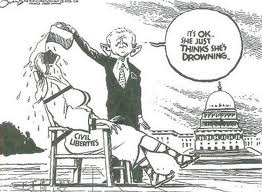
Curious way to fight for freedom

In the West, we like to present ourselves as the moral superiors of those, in particular Moslem fundamentalists, whom we fight in places like Iraq or Afghanistan. It’s interesting to find that our habitual use of torture gores back a long way. We might do well to learn a little humility.


Doing away with torture and the death penalty would be the kind of advances my father would probably have classified, using one of his favourite terms, as ‘civilised values’.

Nearly 30 years after his death, it’s good to see civilisation taking another small step towards adopting some of them.

Saturday, 19 December 2009

Death, thou shalt die

News of an excellent trend reaches us from the US. A report by the Death Penalty Information Centre – not a cheerful name, but the organisation’s role is positive – points out that death sentences in the country fell in 2009 for the seventh year running. They are down to 106, under a third of the peak in 1998.

The report suggests that much of the decline is related to the sheer expense of capital punishment, particularly given widespread doubts of its effectiveness as a deterrent. I have to say that I like any argument against the death sentence, but that highly practical consideration doesn’t have quite the nobility of some of the more powerful and more moving objections on moral or philosophical grounds.

Still, the report also suggests that a major consideration has been what I’ve always regarded as the single unanswerable argument against the death penalty: the system sometimes gets it wrong. With nine exonerations of death row inmates in 2009, and a total of 139 since 1973, it seems to get it wrong quite a lot (how many other miscarriages of justice have taken place but not been discovered?)

That’s the nub of the problem. Jail an innocent man for even a short time and you damage his life, perhaps irreparably, but you can at least do something to try to right the wrong – indeed, if we were more generous with compensation and support after release, we could do quite a lot. Kill him and anything you can do is about as useful as saying ‘whoops’.

To me, the most chilling words in the DPIC’s report were:

In Texas, a prominent forensic scientist commissioned by a state legislative panel reported that arson evidence used to convict and sentence Cameron Todd Willingham to death failed to show any crime had been committed. Willingham was executed in 2004.

The man is dead and it’s possible no crime at all was committed. I’m reminded of Mr (later Lord) Justice Donaldson. He presided over the 1975 trial of the Guildford Four, accused of IRA terrorist attacks in Surrey and south London, and expressed regret that they had not been charged with treason, which still carried the death penalty at the time.

In 1989, they were released following conclusive evidence that the police had lied at their original trial and they’d had no part in the bombings for which they’d been sentenced.

It was bad enough that they had been wrongly deprived of so much of their lives. How much worse it would have been, however, had Donaldson been in a position to deprive them of their lives altogether.

Until judges, and indeed juries, can be shown to be infallible there can be no good case for retaining the death penalty. Moral and philosophical considerations aside.