Showing posts with label Fascism. Show all posts

Thursday, 12 September 2019

Iconic photo of fervour for liberty. In a less than iconic place

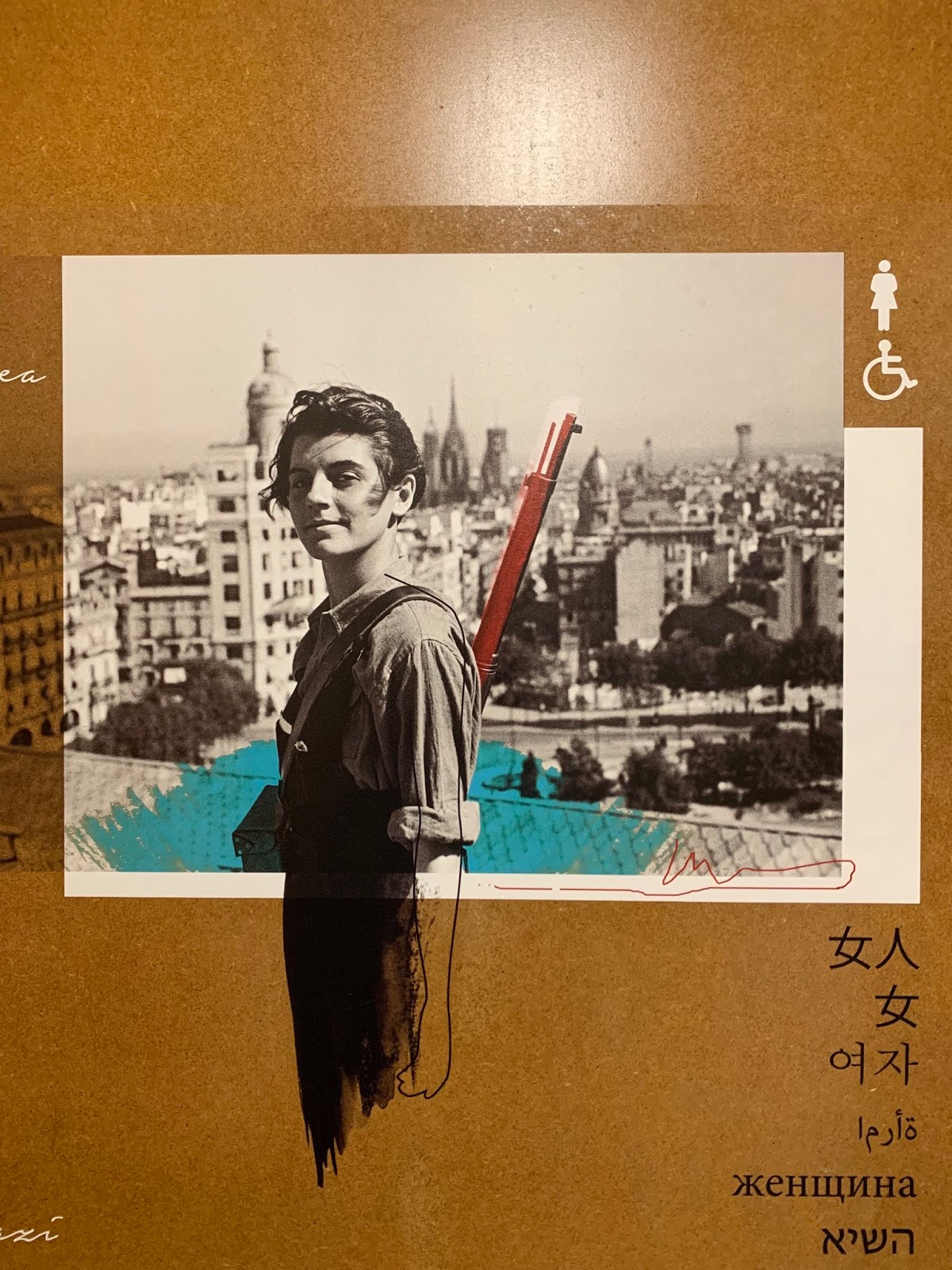
One of our favourite restaurants here in Valencia, the Refugio, has chosen to mark the door to the women’s toilet with a picture which is nothing short of iconic.
An icon of liberty
making a women’s toilet sign which at least has the merit of originality
You might, perhaps, even feel that it was a little disrespectful to use that particular picture for that particular purpose. However, the owner of the restaurant, as well as being likeable, is a devoted supporter of the anti-Fascist cause in the Spanish Civil War. I’m sure he chose the picture as a statement of his sympathies.

What a great picture it is, indeed. A young woman in the informal uniform of a soldier in the militia of the Spanish Republic stands atop one of the highest buildings in Barcelona, the city spread out below and behind her, a rifle slung over her shoulder and a smile on her lips as she looks to the camera.

It’s a picture that has adorned book covers, film promotions, and countless newspaper or magazine articles. It embodies the nobility and beauty of the cause as well as, to those of who know that the war ended with a fascist victory ushering in nearly four decades of oppression, a sense of heart-wringing pathos.

So it’ll come as no surprise to discover that, like so many propaganda pictures, the reality behind the photo is quite different.

In the first place, the ‘young woman’ only just deserves the description. She was seventeen at the time. Perhaps to call her a ‘girl’ would be going too far, but it’s hard not to put the word ‘very’ in front that ‘young woman’.

As she pointed out later herself, Marina Ginestà – yes, we know her name – was far too young to be a combatant. Instead, she was working for one of the Republican newspapers and acted as an interpreter to a journalist from the Soviet Union.

She certainly had not been issued with a rifle by the militia. Indeed, the moment of the photograph was only the second time she’d had a rifle in her hands, the first having occurred only a few hours earlier, when she held one that belonged to a friend of hers. That was also the only time she had fired a rifle, when she pulled the trigger by accident. The only injury her firing the rifle caused was to herself, when the militia man she nearly hit returned the favour with a slap.

Let’s be clear, I don’t condone slapping anyone, least of all a young woman by an older and doubtless stronger man. On the other hand, I can’t help feeling a little sympathy for the militia man in this instance. He must have felt that it was bad enough being shot at by fascists at the front, without having a little slip of a girl without training and clearly unable to manage a gun, opening fire on him too when he was, in theory, somewhere safe.

When I told the restaurateur about the background to the photo, he laughed and sad “it’s a very Spanish story”. In fact, I'd say that the reality has a gloriously human, even earthy, quality to it which perhaps makes the picture less inappropriate for a toilet door. 

But as a photo of what it seems to represent, it’s a complete fake.

However, unlike fake news today, it isn’t a lie. The picture tells a much deeper truth: about hope, the energy and courage of youth, and the vitality of a cause. They’re all worth remembering, decades after the failure of that particular struggle, but as we face similar assaults on our liberties today.

That core of truth is what makes the photo deservedly iconic. And uplifting to see, even as I walk past it on the way to the toilet in a favourite restaurant.

Thanks, Juan Guzmán, for taking the photo. And even warmer thanks to Marina Ginestà  for making it so inspirational, and so wistful.

Monday, 8 July 2019

Painting from memory

Memory. It’s a curious organ. And one that we don’t use anything like enough.

For outsiders visiting Spain, it’s often hard to remember that the nation isn’t that far from a fascist past. Francisco Franco, dictator for nearly four decades, only died in November 1975. A great many Spaniards living today still remember his times. 

That always strikes me when I hear a Spaniard talk about “the war”. That doesn’t mean the Second World War, as it would for a Brit or a Frenchman or a German. Generally, it means the Spanish Civil War, which brought Franco to power.
Equipo Crónica in the Reina Sofía museum
So close are the events of that terrible time, that reminders keep emerging. One that we found particularly moving was in the Reina Sofía museum in Madrid: a series of six paintings by an artistic collective, called Equipo Crónica. The group was set up in the early sixties by three artists from Valencia, Rafael Solbes, Manuel Valdés and Juan Antonio Toledo. Toledo, however, was called up for military service soon after and, when he returned, he found the collaboration between the other two had grown so close he could no longer fit in.

Within the collaboration, they used simple, plain colours, not merely to underline messages that are often intense to the point of brutality, but so as to avoid the touches and undertones of paint that would distinguish one painter from the other. They are truly collective works.

Franco remained a brutal authoritarian right up to his death. That release, for Spain and beyond, as much as for himself, came on 20 November 1975. But less than two months earlier, on 27 September, five young men were murdered – ‘executed’ is just a euphemism – by firing squad, on the orders of a court martial, countersigned by the dictator.

A salute to the last victims of Franco’s killing machine
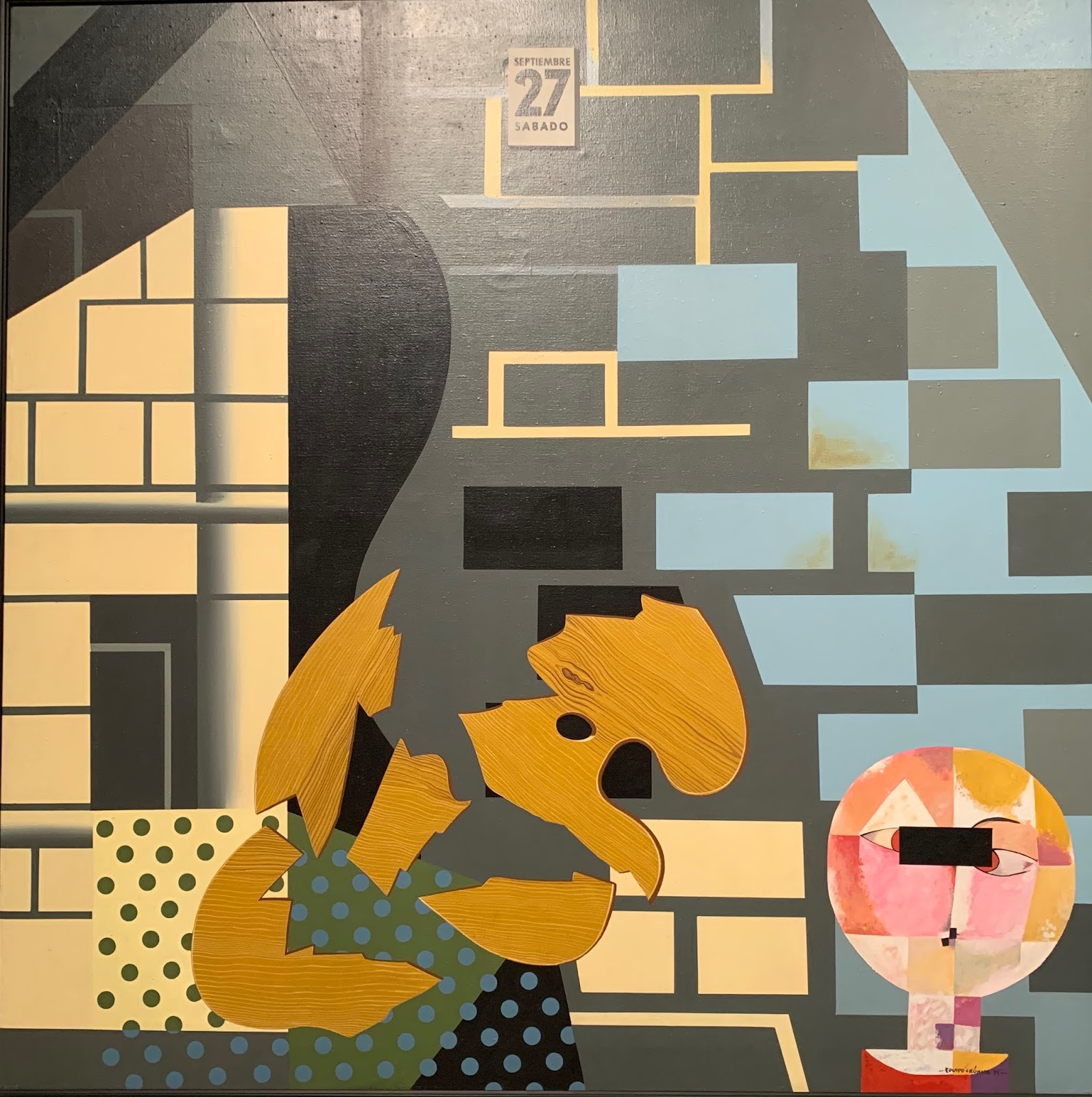
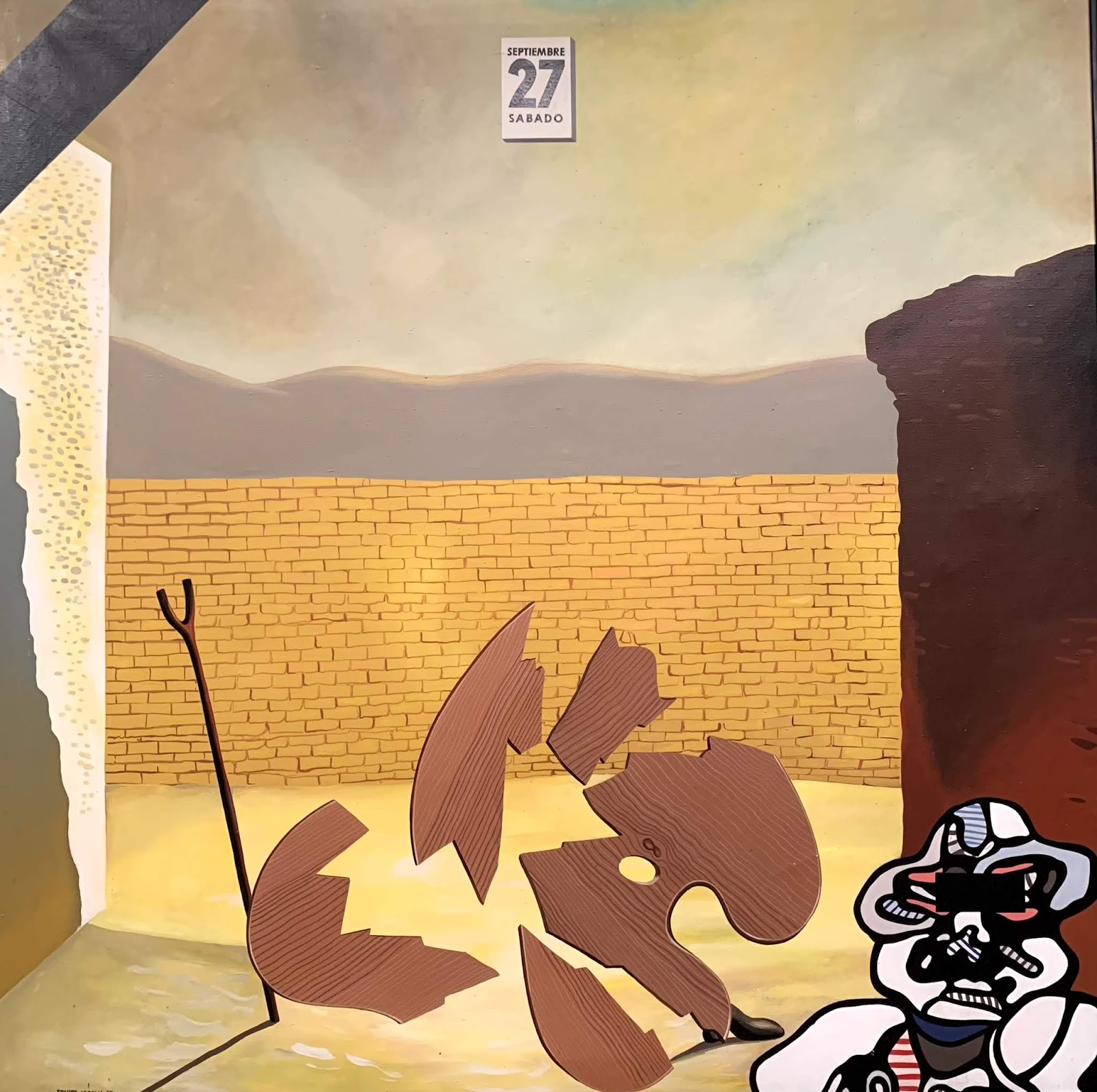
Equipo Crónica decided to record the event in a series of ten paintings, six of which we saw in the museum. They chose not to make the paintings strictly documentary, depicting the actual event of the execution. Instead they made them “symbolically documentary”: each shows a wall (since the victims were stood up against a wall to be shot), a leaf from a desk calendar showing the date of the murders, a face with eyes blacked out to depict what happened to the young men or perhaps the blindness of the world, and a black strip for mourning across the top left.

The walls are, apparently, each in the style of an artist admired by the collective, but I can’t identify them.

In the foreground is a painter’s palette, broken into five pieces, one for each of the victims and perhaps a symbol of the impotence of art in the face of such criminality.
Palette broken into five pieces
Face with eyes blacked out
A wall for the victim to stand against
Mourning stripe at top left
The date at the top
It’s a strong and striking memorial not just to the victims of a specific crime, but of the dangers the hard right and nationalist movements represent for all of us (Franco adopted the label ‘nationalist’ for his side in the Civil War, against the ‘Republicans’ he eventually defeated with help from both Nazi Germany and Fascist Italy). It was moving to see it in one of Spains most prestigious museum. Long may it serve as a reminder to Spaniards of what it means to accommodate the far right.

A reminder many of us outside Spain badly need, too. In Hungary. In Poland. In Italy, for pity's sake. And, far from least, in Brexit Britain.

Our memories of the dangers of fascism are over 70 years old, from the Second World War, rather than little over 40 as in Spain. And we’re becoming forgetful. Toying with notions that should have been consigned to the history books.

At our own serious peril.

Thursday, 13 September 2018

Uneasy but necessary bedfellows: history and politics

A book I read in the old East Germany, by a dissident called Heinz Knobloch, had a catch phrase running through it, ‘mistrust the green spaces’. A green space was often a spot where once a building stood that represented something the regime would rather not publicise, but which was too important to be built over completely. A major office of the Nazi regime, or of the Weimar Republic it overthrew, or even of the German Empire that preceded both.

Perhaps the best example of this fiddling with historical monuments concerned not a building but a statue. The imposing equestrian statue of Frederick the Great of Prussia, with its frieze of significant people of his time around the plinth, originally stood on the grand boulevard of Berlin, Unter den Linden.

The Frederick the Great statue in 1920
The Socialist Unity Party (SED) that ruled East Germany weren’t going to have that symbol of royalist and aristocratic elitism standing in the capital’s most prestigious avenue. For a time it vanished altogether. But, hey, Berlin was the capital of Prussia, and Prussia was the heartland of East Germany. After a while, the statue reappeared, but not in the capital, instead in the Charlottenhof Palace in Potsdam. On display, but not in too public a way.

Then came another rethink. In the 1980s, the SED changes its historical memory policy. East Germany was a state but not a nation. To make it a nation, it needed cultural roots and therefore a history. Frederick II was one of the greatest figures of its past, and the SED decided that, after mature reflection, and taking all things into consideration, it was important to bring him out of his relative obscurity and set him back up somewhere with a bit of class about it.

So the statue reappeared on the Unter den Linden. Where it stands to this day.

Politics makes history. And history matters to politics.

That’s as true in Spain as it is in Eastern Germany. Around the corner from where we’re living in Valencia is a thoroughfare that proclaims itself to be ‘Democracy Street’. However, the sign also tells us that it was formerly ‘Castán Tobeñas Street’.

Democracy Street. Formerly Castán Tobeñas
‘Aha,’ I thought when I saw it, ‘might this be a leading figure of the Fascist period deemed better forgotten than commemorated?’

So it seems. He was a jurist who rose to the position of President of the Spanish Supreme Court, a post he held for nearly 25 years under Franco, until just before his death. Seems open and shut. A major figure of Franco’s regime, far better consigned to the dustbin of history than commemorated by a street in Spain’s third city.

The reality is far more complex. But when is reality anything but complex? Why else does Donald Trump avoid it altogether?

Pascual Marzal is a Professor of the History of Law at Valencia University, and served as a member of the City Commission on the application of the Historical Memory law under which the street name was changed. He says he’s fully on board with the law, but opposes its application to Castán Tobeñas.

He points out that Tobeñas was also a leading judge under the second Republic, the one that Franco overthrew. He was, indeed, tried by a court martial of the Fascist regime, which acquitted him on the grounds that the previous government had appointed him exclusively for his legal skills, not for any particular political position. Such were those skills, indeed, that they decided to make use of them too. Hence his promotion to the Supreme Court.

Apparently, Tobeñas wrote some seminal texts on civil law and is regarded to this day as a major scholar in the field.

As Marzal asks, who can say with certainty that they would have behaved better under an autocratic regime? Would we resist? Or would we, like Tobeñas, come to terms with the regime and accommodate with it in order to make a living?

It’s an excellent question.

My wife comes from Alsace, in Eastern France. With the adjoining department of the Moselle, it is the region of the country that lost most men during the Second World War. The problem is that, because Germany regarded Alsace not as occupied France but recovered national territory, young men were subject to German conscription. So those Alsatian dead were above all wearing German grey not French blue. Few wanted to serve, but the consequences of a refusal were dire, not just for the individuals but for their families too.

These were the ‘despite ourselves’ (malgré nous) and a lot of them died in Russia. France has little reason to be proud of what they did, but Alsace has every reason to mourn their loss. So the region has its war memorials, though they say little about what uniform the men they commemorate were wearing when they died.

Tobeñas seems similar. He was unfortunate to live under a regime he could not serve with honour.

Unfortunate indeed. But though he couldn’t serve it with honour, he chose to serve it anyway. Why then should he be honoured today with a street name? After all, he was a judge. An authority of the law. And he served a regime that came to power illegally and ruled with little legal restraint. A jurist, above all others, must have found that particularly lamentable.

I’m glad the malgré nous have their monuments in Alsace. But I’m equally glad that the law on historical memory has deprived Tobeñas of his street. And I love the fact that it’s become Democracy Street instead, a lovely dig at Fascism.

History is complex. Sometimes it makes judgements that are perhaps too black and white. But they have to be made.

This one strikes me as have got more right than wrong.

Saturday, 21 October 2017

New Zealand an antidote to a toxic trend still sadly topical today

There’s a striking frieze inside Milan Central station, a relief that has a certain attractive quality at first glance. It’s only when one comes to look at it more closely that one notices details that are far less attractive. And it’s no relief at all.
Elaborate carvings look down on the entrance lobby of Milan station
At either end of the frieze is a symbol that it’s hard not to recognise. The symbol of magisterial authority in ancient Rome: a bound bundle of rods with an axe projecting from the middle. It symbolised power, the axe underlining that it went as far as life and death.
Striking detail: a symbol we might have hoped behind us
And what was the bundle called? Why, a fasces. It gave its name to the movement that adopted it as symbol in twentieth-century Italy, Mussolini’s Fascism.

In a sense, that’s not inappropriate. Mussolini built the Central Station (well, to be accurate, he got some other people to build it for him). He put his party’s symbols among the decorations. If we look at the entire frieze again, we can see that there’s a blank space in the middle, clearly designed for lettering. Presumably once it contained some uplifting slogan of the Fascist state, urging the people to sacrifice to the glory of the nation. That might possibly be in war, that most glorious of all Fascist actions, as long as, like station-building, you could get other people to engage in it for you.

The words have been expunged. But presumably the cleaners of Fascist symbolism didn’t feel the fasces themselves could be removed without damaging the entire frieze, so they remain in place. Which is particularly apt, since it underlines a fundamental point: there are certain lethal viruses that simply cannot be entirely wiped out but lie dormant for decades or even centuries, before bursting forth again in some new and terrible contagion.

That’s certainly the case of Fascism. Around the world, we have seen that phenomenon of the thirties emerging once more: the impoverished, the left-behind, the disappointed entitled, rally around the providential man who voices their hatred of others – above all, of the Other – and promises them quick fixes to their suffering which they can never deliver. And they get elected.

We’ve seen it in Trump. We’ve seen it in surge of support for the far Right in Germany and Austria. We’ve seen it in the move or Brexit in Britain.

Brexit’s a particularly striking case. Its essence is xenophobia, fear of the foreigner. Some defend it as a way to protect jobs or wages; all the evidence is that the damage to both has been done by British forces not foreigners. Others defend it as a means to protect workers against a club of capitalists; all the evidence is that workers have gained more rights through EU membership than they’ve ever lost.

It even creates strange bed fellows, or perhaps I should say boatmates. One of the more remarkable photos of the Brexit campaign showed Kate Hoey, left-wing Labour MP, literally in the same boat as Nigel Farage, like her a leader of the Brexit movement, and a worthy heir, if ever there was one, of the men who proudly made the fasces their symbol in the 1920s: nationalistic, Islamophobic, a hater anything that deviates from a strict interpretation of the white, English-speaking mainstream.


All in the same boat? Or getting on swimmingly while making the country sink?
Far left and far right together in the toxic mix that Brexit made
How did she end up in the boat with him? That’s the toxic nature of Brexit. More broadly, it’s the toxic effect of all those nationalisms now spreading their tentacles around the world. Again.

Curiously, I saw the Fasces in Milan last week. The next morning, I discovered that the centrist, moderate Labourite Jacinda Ardern would be leading the next government of New Zealand. Here are a few predictions I make with absolute certainty:

  • The same people who would climb into a boat with Nigel Farage will criticise her for forming a coalition with New Zealand First, an unpleasant nationalistic party. I agree with their concerns, because she’ll surely have to meet its leader Winston Peters on some unpleasant anti-immigration measures. I can only hope that as a small minority in the coalition, New Zealand First will have its worst poison drawn. I’d also remind those who like to walk shoulder to shoulder with Kate Hoey that pots have to be careful what they say about kettles, and Farage was far more than a minority partner in the Brexit coalition.
  • Ardern will set out to do some good, as she’s told us: she wants to build “a country where our environment is protected, where we look after the most vulnerable, where we support our families, where we make sure people have the most basic of needs, like a roof over their head.” Her goals will be far more limited than many of us would like, and she’ll achieve far less than even she wants, but she will do some good. That’s because she’s in government, and government can do things, when oppositions can only proclaim them.

Her arrangement with Peters means that Ardern is at best containing right-wing populism rather than blocking it. However, in a world where a Trump can win the White House, that feels like a welcome change. 

It was particularly welcome to me after seeing the Fasces, still hanging on, inside Milan station. 

Friday, 4 October 2013

Fascism: how does one resist it?

Did you ever see the Costas Gavras classic film, Z?

When it comes to building tension, few films have equalled it. I particularly liked the use of the rat-a-tat-tat of an IBM golfball typewriter as part of the soundtrack: it provides a percussion accompaniment to much of the work of the Examining Magistrate investigating the violent death of a left-wing politician.

Its effect is particularly powerful when it suddenly stops: the magistrate, having previously always corrected anyone who had referred to the death as a ‘murder’ and insisted that they call it an ‘incident’, had in dictating a report used the work ‘murder’ himself. There is a sudden, deathly silence and then the voice of the typist: ‘don’t you mean ‘incident’?’

But by then it was clear that it wasn’t an incident, that the man had been murdered. And that takes us into the final chilling sequence of the film, as the army’s tanks move in and a military government is formed; those who investigated and exposed a crime find they are now the criminals and facing persecution; even witnesses disappear in quick and mysterious succession.

The setting of the film? Thinly disguised Greece as the 
Colonels’ seized power, back in 1967. I was fourteen at the time and beginning to take an interest in politcs. At that age, whatever I discovered seemed immutable, good for all time. A few years later, I felt nothing but sorrow for a fellow student and friend of mine, a Greek who, it seemed to us both, would be condemned to live with that oppressive and vicious regime for a long time to come.

Keeping Z's veil transparent: 'any resemblance to real events,
to people living or dead, is no coincidence. It is DELIBERATE.'
In the end that didn’t happen. The Colonels fell in 1974 and democracy was restored. Like the change in regime in Spain a year later, it seemed like a new spring in the non-Soviet part of Europe; soon we began to feel that these new democracies were here to stay, and it was hard to imagine them ever drifting back towards Fascism.

Today, for Greece at least, there’s less grounds for that casual optimism. A nakedly neo-Nazi movement, Golden Dawn, took 7% in the polls last year and won its first seats in the Greek parliament.

I say ‘nakedly’ but the reality is that they deny their Nazi roots. These movements always do. But their symbols, their beliefs and most tellingly their behaviour (they organise gangs to use violence against immigrants or minorities), all mark them as belonging to that same deplorable tradition.

Golden Dawn: who could possibly mistake them for Nazis?
Most worryingly, it emerged recently some of their thugs were being given training by elements in the security forces. That really awoke memories of Z: Costas Gavras underlined the ugly nexus between the violent right wing and the military-police establishment.

Now though Golden Dawn have perhaps overreached themselves. A left-leaning singer has been murdered, and a Golden Dawn member has admitted responsibility. The reaction of the authorities has been astonishing for its swiftness and effectiveness. Leading members of Golden Dawn, including MPs, have been arrested and charged with serious offences.

It’s a fascinating, if frightening, moment to watch. The great paradox of democracies up against totalitarian violence is to know how far they can go: if they go beyond the rule of law, they may be more effective, but aren’t they themselves then undermining the very democracy they wish to uphold?

But the Greek government has decided that it has to act. And so far it has acted within the law anyway, so one has to wish it well in its aspiration to crush a viper before it strikes.

That’s what makes the spectacle fascinating. What makes it frightening is another historical parallel. In 1923, Hitler launched his ill-fated ‘Beer Hall Putsch’ in Munich. This attempted uprising was crushed in two days. Hitler was tried and imprisoned – but not deported to his native Austria, as he might have been, since he wasn’t a German citizen.

Instead he was held in comfortable conditions in a castle where he wrote Mein Kampf. He was released after eight months; nine years later, he was Chancellor of Germany.

So the question now is, how will the Golden Dawn’s defendants be treated? Will they be convicted of serious or minor offences, will they face sentences that take them off the political scene?

There’s a lot riding on that. What a shame if another 14 year old has to sit through a successor film to Z in a few years time, and feel the same sense of frustration and anger so many of us felt back in 1967
. Or the same sorrow for the fate of Greece.

Even for another outstanding film, that would be too high a price to pay.