Showing posts with label Spanish Civil War. Show all posts

Wednesday, 13 September 2023

Unplanned pleasure

Fail to plan, they say, and plan to fail.

I’m sure there’s some truth in that. As there is in most aphorisms. Not all of them of course. I have no idea who came up with that bright little drop of optimism that ‘good things come to those who wait’, but he must have been living in a different universe from mine.

Still, even if planning is generally a good thing, it’s often the unplanned that gives the greatest pleasure. 

While we were in southwestern France last weekend, we decided to pop down to the beach at Argelès-sur-Mer. That was less of a visit than a pilgrimage. The beach is spectacular, but we live near the Spanish Mediterranean coast and probably wouldn’t travel to France just for sand and sea. No, this beach isn’t just golden and sunlit, it’s associated with something much darker and shameful.

The beach at Argelès, showing no sign of its shameful past
When Francisco Franco succeeded in overthrowing the Spanish republic in 1939, ushering in 36 years of dictatorship ended only by his death, some 500,000 people who’d served the legitimate government fled, mostly into France. There they were interned by the French authorities. Something like 100,000 of them were simply dumped on the beach at Argelès with, initially, practically no amenities apart from the wire fencing to prevent their escape. 

When I say ‘nothing’, I really mean nothing. There were no latrines. There was no shelter. There was no reliable supply of fresh water. Every now and then someone would turn up and toss some food at the internees. It was pretty vile. Hunger and disease-ridden, as I’m sure you can imagine.

Deaths were nothing like as horrific as they might have been had the internment lasted longer, but fortunately with the outbreak of the next war, the world war, within months of the Spanish defeat, many were recruited into the French armed forces, while others were able to move on to friends or family ready to take them in, or into charitable accommodation, above all that provided by Quakers. Even so, several hundred died.

So, we visited the beach to see what the place looked like. There’s no trace of the camp anymore but still, it felt like a small act of deserved respect to visit the place where this shameful act took place.

But then we had the whole of the afternoon ahead of us. What to do next?

We saw signposts to a coastal path that zigzagged along the top of the sea cliffs, towards the lovely fishing village of Collioure, a few kilometres further on. I say ‘fishing village’ though what it really is now is a major tourist destination with some pretty wonderful accommodation for the pretty wonderfully rich. We went there once before, but by car, and found it was impossible to park anywhere inside the town, it was so seething with visitors. In the end, we had to park outside the town and walk half an hour to get to the seafront. 

To be fair, though, it’s such a fine place that it was worth it. Indeed, walking in was probably an enhancement to the visit, since it gave us time to see the place from various angles as we approached it, which is a much better way to get to know somewhere than shooting in by car.

Anyway, this time we had no intention of walking all the way to Collioure. It was only a little over four kilometres away, but it was hot, the terrain was rough, and there was a lot of climbing. We decided we wouldn’t go the whole way. 

So, naturally, we did.

Approaching Collioure the hard way, by the cliff path
It was good to see Collioure again. It was, I suppose unsurprisingly, just as attractive the second time as it had been the first. But we were pretty tired. Our main concern was getting back to Argelès, where we’d left the car. A bus, we decided, would be just the thing and, failing that, a taxi.

There were signs to the tourist office. But at 4:00 on a Sunday afternoon? No chance it was open.

And yet it was. 

“Is there a bus to take us back to Argelès?” we asked.

“Ah, I’m afraid,” the friendly woman behind the counter told us, glancing at her watch, “that by now the last bus will have gone.”

“Oh,” we said, trying not to sound too disappointed.

“But there is a boat,” she went on, “and the next one leaves in twenty minutes, from the pier just outside this office.”

Joy. Elation. Relief, too.

Collioure Castle in the background, with our boat in front
It may not seem much, but it felt like luxury
We waited the twenty minutes and then travelled back to Argelès in what felt like luxury, even though it was just a crowded tourist boat. But it was a pleasure. We saw from below the cliffs we’d struggle past above just an hour or so earlier. We enjoyed watching the surf crashing on the rocks, and the sinking sun casting a glow on the deep blue sea around us. And we got back to Argelès in twenty minutes instead of an hour and a half, and in comfort instead of in footsore exhaustion.

Leaving Collioure, the easy way, by boat
It was a delightful, and entirely unplanned pleasure. It can be the best kind, I reckon. Certainly, that’s how we felt.

Of course, the good thing didn’t come to us as we waited for it. On the contrary, we had struggle to it along difficult paths through oppressive heat.

Further convincing me that whoever said that about good things coming to those who wait, certainly didn’t belong to the universe I inhabit.


Wednesday, 27 May 2020

The Spanish fighters who changed my views

After four years of Nazi occupation, Paris was finally liberated by Allied armies on 24 August 1944. Units of the mythic French force, the ‘Deuxième DB’, the Second Armoured Division, led the way into the city. They had raced there to support the population that had risen against the occupying forces.
In the evening, the first half tracks pulled into the square outside the Paris town hall. As in all such units, the vehicles had all been given names by their crews, names that were painted on their sides:
Gudalajara
Brunete
Ebro
Santander
Teruel
If you’re thinking “those don’t sound like French names”, you’d be right. They were great battles of the Spanish Civil War. And the language the crews were talking was Spanish.
These were the men of the ‘Nueve’ (‘nine’ in Spanish), the ninth company of the Deuxième DB, almost exclusively Spanish. Their commander, the French Captain Raymond Dronne, wrote of them later:
The Spaniards fought remarkably. Commanding them is a delicate matter but they have enormous courage and experience of combat.
That ‘delicate’ is a glorious piece of French understatement. It chimes with what Dronne was told when he was first given command:
Everyone’s afraid of them. They’re good soldiers. They won’t give you any problems.
The halftrack Guernica of the Nueve in Paris in 1944

Moving to a new country certainly gives you a new perspective on many things you thought you knew.
For instance, I’ve had to rethink some of the most elementary facts I felt I knew about the Second World War. I’ve long accepted that it didn’t start on 1 September 1939 with the Nazi invasion of Poland, as is generally taught in schools. The first shots were fired on 19 September 1931, when Imperial Japanese forces invaded the Chinese territory of Manchuria.
OK, you might think, but that was the Pacific Theatre. In the European theatre, the war started in September 1939, surely? Well, that too is an idea I’ve had to revise, under the gentle guidance of Marisa, a friend we’ve met out here in Spain, who’s frighteningly well-informed on history.
My view was always that the Spanish Civil War, which started in July 1936, was a sort of preamble to the World War. In reality, however, with the Soviet Union supporting the Spanish Republic, while Nazi Germany and Fascist Italy backed the military uprising that brought Franco to power, it offered a first opportunity for three of the major powers of the coming World War to test each other’s strengths and weaknesses and, indeed, to expose some of their forces to combat.
That feels more like the first Act of the wider war rather than merely a preamble to it.
In any case, it wasn’t just the Germans and Italians, or to a smaller extent the Russians, who emerged from the Spanish Civil War with trained and battle-hardened veterans ready for the next stage of the conflict. There was also quite a lot of the Spanish Republican army. The Republic itself had been defeated and overthrown, but many of the soldiers survived.
Large numbers joined the flood of over 450,000 refugees fleeing across the Pyrenees into France. They rightly feared the retaliation that Franco’s victorious regime would exact from them if they were caught. The regime proved they were right by what it did to those it did in fact catch.
In France conditions were, however, not particularly better. They were held in what the French called “internment camps”, but the Spanish, especially the ones who were there, unequivocally referred to as “concentration camps”. Lack of food, poor sanitation and inadequate housing led to huge numbers of deaths. This was 1939, after all, when France and Britain still hoped that their policy of appeasing Hitler might avoid war. That desire, combined with the xenophobia and right-wing beliefs of a significant current amongst Frenchmen, conspired to ensure the refugees were shockingly badly treated.
Offered the option of returning home, about 100,000 chose to go, mostly women and children. Few of the combatants, understandably, took up that offer, however. Some paraded in front of French officers hoping to be taken into the army, but the generals, who were to be humiliatingly defeated the following year, decided they didn’t need these experienced troops whose political loyalties they weren’t sure of (they were generally left wing, some extremely).
Some 10,000, however, were recruited into the Foreign Legion. And, once war with Germany broke out, others were taken into ‘Foreign Labour Companies’ who were set to work on the Maginot line, the great string of bunkers and fortresses along the border with Germany. Life there was certainly preferable to the camps, though in the end it worked out little better. After defeating France, the Nazi authorities captured many of the Spanish workers. Refusing to treat them as prisoners of war, and working with the Franco government’s agreement, they transferred them to concentration camps. Over 7000 were sent to the Mauthausen camp and fewer than 2500 were released at the end of the war.
Chillingly, some of the survivors later said that their experience in the French camps helped them to prepare for the Nazi ones.
Those who were able to avoid capture, joined the resistance. And among those who had taken part in the fighting, many decided to carry on the battle. One Spaniard in the Foreign Legion, Manuel Fernandez, described his feelings on the defeat of France to a 2017 television documentary:
“It was the greatest disappointment of my life. There were moments when I cried like a child. I’d fled Spain and here I was going to fall into the hands of the Germans.”
One answer was to join General de Gaulle who was setting up Free French forces in London. Of his initial 2000 men, 300 were Spanish.
Alternatively, those who were in the Foreign Legion could cross the Mediterranean with their units. In North Africa, however, they were under the orders of the government in Vichy, a puppet regime of the Nazis, set up after the defeat of France. There they were left to wonder how they’d managed to escape Franco, only to find themselves in a military unit whose orders were dictated by a government collaborating with Franco’s most powerful ally, Hitler.
It would take over two years. Though then things would change dramatically.
But more of that in another post. Just click here...

Monday, 20 January 2020

Tragic Trenches, Brilliant Banter, Blazing Bonfire

The woods behind our house are one of my greatest sources of pleasure from living where we are in Spain. And I’m finding myself fascinated by my reading about the Spanish Civil War, when a struggling and democratic Spanish Republic was overthrown by a Fascist dictatorship that lasted nearly forty years. Finally, Danielle and I have developed a love for the sport of Nordic walking, where one goes stalking along with a stick in each hand, like skiing without skis or, come to that, snow, and watch walkers unencumbered by sticks go streaking past us.

What better pastime could there be than an activity that combines all three?

Our Nordic Walking group met in our village, La Cañada, the other day. Wonderfully convenient. We went striding through my favourite woods, to a spot adorned with the melancholy remnants of low cement constructions linked by trenches. We’d seen them before without identifying them for what they were: the final line of defence before Valencia of the beleaguered Spanish government, facing the Fascist forces of Francisco Franco.
Blockhouses and linking trenches
from the final line in Valencia's defeated struggle against Fascism
That terrible, literally last-ditch defence never took place. The decisive battle of the war, which lasted for nearly four months between July and November 1938, took place far away, on the river Ebro. The Fascist forces, with their Italian and German support, won a decisive victory and inflicted huge losses on the Republic. So when it came for Franco to move on Valencia, the fighting was all but over and the city surrendered without a last stand.

It was poignant to see those final, desperate defences that in the end proved futile, especially given what we know came next.

Fortunately, from there we headed for a place with far more cheerful associations: the ‘Three Oaks’ (‘Tres Robles’) restaurant in our village, La Cañada. We were served a fine paella, of the Valencian variety (with meat, not seafood), Valencia being the home and origin of that great dish. The company was good, the conversation lively and the atmosphere entertaining.
The Nordic Walking group in the Tres Robles
I particularly like the restaurateur himself. Danielle had bought some fish from the fine local fishmonger, one of the assets of La Cañada, and asked the restaurateur whether he would keep it in his fridge for us while we lunched.

This he agreed to do though, when I came to ask for it back, he carefully explained that, under Spanish law, anything left in a restaurant owner’s position for over an hour without being claimed back, was legally his. Since this is precisely the kind of banter I enjoy, I told him that I naturally assumed he’d already eaten the fish, or at any rate served it to his clients. At that point, he confided in me that he had not, since we were foreigners, and needed to be treated with unusual kindness.

Instead, he told me how I ought to cook it: in coarse salt. That’s something I’m keen to try next time, though on this occasion Danielle had already chosen the recipe and the ingredients for a traditional Spanish sea bream dish. Which was delicious. 

The restaurateur wished us every enjoyment of the fish, but on one condition: that we send the bones to Puigdemont.

For those who may not be following the debate over Catalan independence from Spain too closely, Carles (to give his name in its Catalan form) Puigdemont is the former president of the Catalan region (or nation, as campaigners for independence would describe it). He is currently living in exile in Belgium, since he faces trial and, given what has happened to those of his collaborators who weren’t lucky enough to get out, probably a long prison sentence if he returns.

In Valencia, the Catalan separatists are not much admired. In fact, I might go so far as to say they’re roundly loathed. Resented too.

“They view us as Southern Catalonia,” they tell me.

Indeed, it only surprises me that the restaurateur wanted Puigdemont sent so much as fish bones.
Puigdemont's share of our excellent sea bream
In the evening, we headed for a different village, up in the local mountains. It’s called Olocau, so the fact that I accept its existence proves conclusively that I am no Olocau denier.

They were due to celebrate the feast of Saint Anthony with a bonfire and fireworks on the main square. Actually, we’d earlier seen the wood piled up ready for lighting, and it was clear that what was going to happen there was going to be about as much like what I think of as a bonfire, as the Battle of the Ebro was like a bar brawl.

Which is why we went to see how it turned out.

We were there early and spent a while wandering around the village. Many of the houses have huge main doors, the kind you could drive a carriage through or at least a horse and cart, as I’m sure many used to in the past. You know, the kind of door which has a human-sized one set into it. As we wandered around in the night, we found several of them open, allowing us to see in to the brightly lit interiors. At several, we asked if we could take photos.

To our amazement, one family suggested we come inside to admire the tiled walls, the wooden beams, the homely fireplace and, in particular, the cellar with its oak wine barrels, the last trace of the occupation of the present owner’s father as a wine maker. The barrels are now empty.

“All but one,” he explained, “we top it up every year with the same wine from the same grape and enjoy it greatly.”
The Olocau house we visited
With a family member in one picture, and barrels in another
It struck me as typical of this region, with its warm-hearted openness to us immigrants, that they invited us into their home in this way. It made for an attractive end to a great day.

Spectacularly topped by the bonfire and fireworks. Which were just as dramatic as we were expecting.
Fireworks and the bonfire in Olocau

Monday, 16 December 2019

While at war: courage in admitting you were wrong

Picture a lecture theatre in an old and prestigious university. You know, wooden panelling, a lofty ceiling, rows of wooden benches reaching up to the top and back of the hall, where the students sit.
Karra Elejalde as Miguel de Unamuno
But these aren’t students. There are some teachers and local worthies, mixed with armed soldiers and Fascist Party storm troopers. For this is 1936 at the university of Salamanca in Spain. Specifically, it is the 12th of October, and the military uprising that is going to lead to three years of civil war and the overthrow of the second Spanish Republic, is a few months old.

The 12th of October. That’s no random date. Even today, it’s Spain’s national day. It was chosen to mark the moment that Spain, through Christopher Columbus, ‘discovered’ America. That’s not an event much celebrated by the descendants who were already there and quickly learned to regret being discovered.

Back in 1936, it had been baptised the ‘Day of the Race’. That’s nothing to do with trying to run faster than others. It’s to do with celebrating the Spanish race above all others. If it weren’t so ugly, and hadn’t cost so many lives, this notion of race would be laughable: the Spanish are descendants of Celtic Iberian villagers, mixed with Carthaginian traders, followed by Roman legionaries, and then Germanic tribesmen who came marauding and stayed to settle before being overrun in turn by Arab adventurers; somewhere Jewish merchants and administrators joined the mix, along no doubt with Catholics from England and Ireland or exiles from Italy, to say nothing of the many ‘Indians’ from the Americas who came back along the shipping lanes that Columbus opened in the other direction.

In other words, the Spanish even in 1936 were about as racially pure as any street mongrel. Just like the English, with their Celtic roots, their smattering of Latin speakers, overrun by Anglo-Saxons and later by Norsemen of various types, to which have been added Jews from all over Europe and North Africa or Indians – not the American variety, but the kind that includes the whole of the Asian subcontinent covering Pakistan too – Nigerians, Jamaicans, Poles and Russians, and a glorious, rich mix of every nation on earth.

Still, to Spanish Fascists of 1936, the race was something to celebrate. And they did so in the great lecture theatre of the University of Salamanca.

One of those present that day was Miguel de Unamuno, philosopher, writer, poet and then rector of the University. He had been disgusted with the disorder and chaos of the Republic and had welcomed the military uprising as a way to bring back peace and order to his country. The Republic dismissed him. The rebellion restored him.

For a while he thought he could count on Franco’s support, if only to save the lives of friends of his who had been arrested. It was a vain hope. Two of his closest companions were murdered despite his entreaties.

On the 12th of October, he wasn’t due to speak. So he listened to speeches extolling the greatness of Spain, and of the holy war now being fought to save it.

Finally, he could stand it no more. He rose and began to speak:

I know you must be expecting my words, because you know me and you know that I am incapable of remaining silent in the face of what is being said. Saying nothing can, sometimes, mean acquiescing… I had said that I didn’t want to speak, because I know myself. But… I have to. There has been talk here of an international war in defence of Christian civilisation… But this one is only an uncivil war… To win is not to convince, and above all one has to convince. But there is no convincing through hatred that leaves no place to compassion…

Another presence on the platform was that of General Millan Astray, founder of the Spanish Foreign Legion. After Unamuno spoke, there were cries from the audience of the Legion’s slogan, “¡Viva la Muerte!”, “Long live Death!” Unamuno replied:

I have just heard the cry “long live death!” That sounds the same as “death to life!” And I, who have spent my whole life creating paradoxes that annoyed those who didn’t understand them, have to say to you, as an expert in the matter, that this paradox strikes me as ridiculous and repellent… Whatever the proverb may say, I have always been a prophet in my own country. You will win, but you will not convince. You will win because you have superior brute force, but you will not convince because convincing means persuading. And to persuade you need something that you are missing in this struggle, reason and right.

The words “you will win but you will not convince” work better in Spanish: “Venceréis, pero no convenceréis”.

This is the scene to which Alejando Amenábar’s latest film, While at War, builds.

There’s controversy about the film. It’s far from certain that the words traditionally attributed to Unamuno are exactly the ones he spoke: there’s no recording or transcript available. There is even a school of thought that suggest the words were embellished by a left-wing Spanish journalist who took refuge in London after the war, Luis Portillo. In a neat irony, he had a son in Britain, Michael, who became a Conservative politician and a minister in Margaret Thatcher’s cabinet.

There are also mixed views of the film. Amenábar has a tendency to distance himself perhaps a little too much from his characters, and that makes it difficult to empathise with them, and to feel their tragedy ourselves, viscerally. I did, but my two companions, one of my sons and my daughter-out-law, didn’t: the film left them cold and unengaged.

It didn’t leave me cold. I was fascinated by its depiction of Franco as a truly little man, in moral as well as physical stature, worming his way towards power. Millan Astray came across as just the monster I’ve always believed he was. But I was particularly fascinated by the depiction of Unamuno, as a man who got the politics wrong at the beginning and had, slowly and with enormous pain, to admit his error and put it right with what was, after all, an immensely courageous public statement repudiating the Fascists and all they stood for.

It didn’t happen exactly as in the film. The audience didn’t mob him or threaten to lynch him. He wasn’t rescued by Franco’s wife. But it’s true that immediately afterward, he was dismissed as rector for the second time and definitively. He was also placed under house arrest. He died two months later.
The aftermath of Unamuno’s speech was no lynching
He’s surrounded by Fascists, but Millan Astray is shaking his hand

There’s plenty wrong with the film, but plenty right too. I enjoyed it, partly because it’s the first time I’ve seen a film in Spanish without subtitles. It means I shall watch it again as soon as I can, if only to be able to say again and again, “oh, that’s what he was saying.”

I will, however, also be watching it again because for me, at least, it’s well worth seeing twice.

Thursday, 12 September 2019

Iconic photo of fervour for liberty. In a less than iconic place

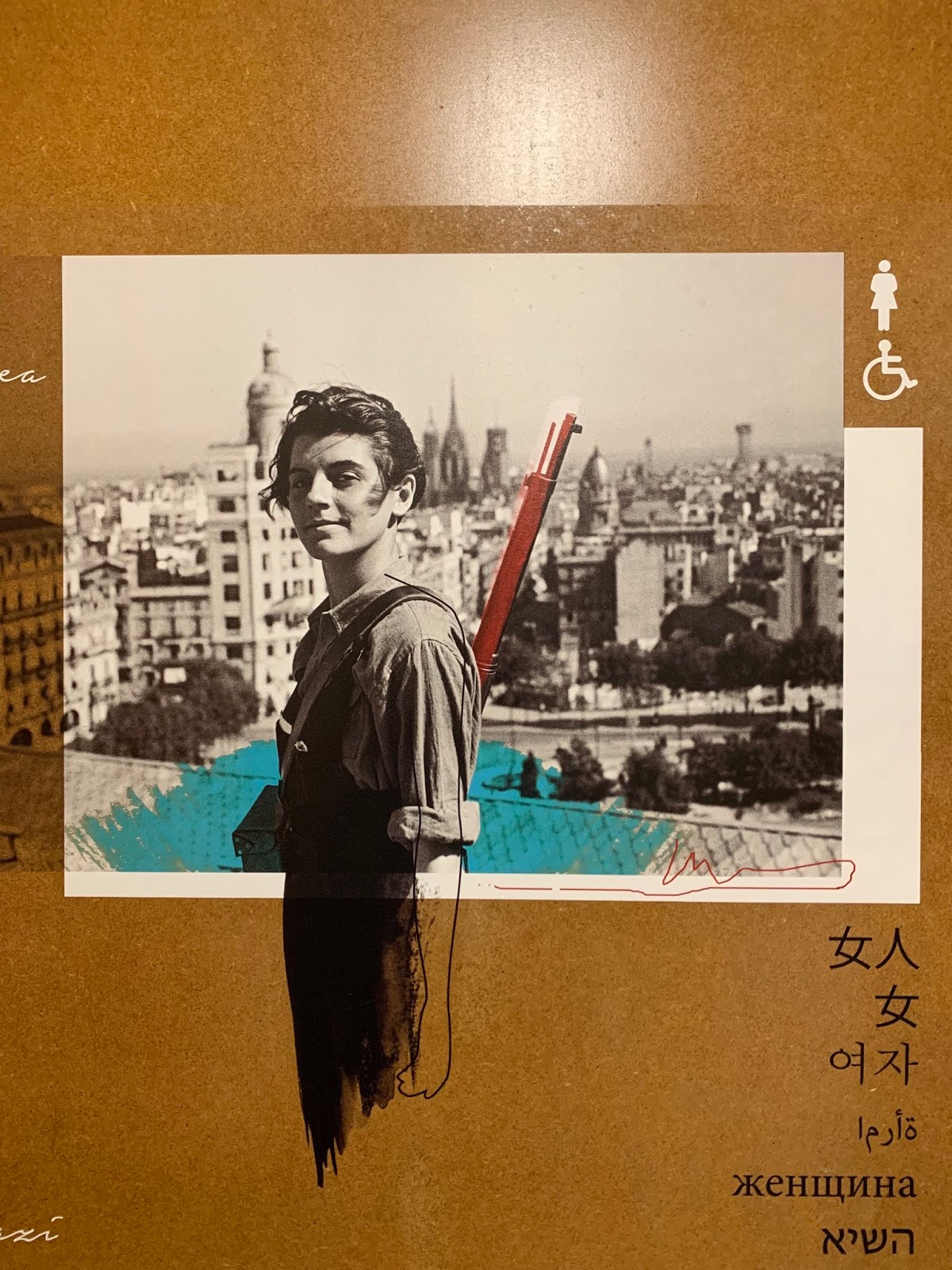
One of our favourite restaurants here in Valencia, the Refugio, has chosen to mark the door to the women’s toilet with a picture which is nothing short of iconic.
An icon of liberty
making a women’s toilet sign which at least has the merit of originality
You might, perhaps, even feel that it was a little disrespectful to use that particular picture for that particular purpose. However, the owner of the restaurant, as well as being likeable, is a devoted supporter of the anti-Fascist cause in the Spanish Civil War. I’m sure he chose the picture as a statement of his sympathies.

What a great picture it is, indeed. A young woman in the informal uniform of a soldier in the militia of the Spanish Republic stands atop one of the highest buildings in Barcelona, the city spread out below and behind her, a rifle slung over her shoulder and a smile on her lips as she looks to the camera.

It’s a picture that has adorned book covers, film promotions, and countless newspaper or magazine articles. It embodies the nobility and beauty of the cause as well as, to those of who know that the war ended with a fascist victory ushering in nearly four decades of oppression, a sense of heart-wringing pathos.

So it’ll come as no surprise to discover that, like so many propaganda pictures, the reality behind the photo is quite different.

In the first place, the ‘young woman’ only just deserves the description. She was seventeen at the time. Perhaps to call her a ‘girl’ would be going too far, but it’s hard not to put the word ‘very’ in front that ‘young woman’.

As she pointed out later herself, Marina Ginestà – yes, we know her name – was far too young to be a combatant. Instead, she was working for one of the Republican newspapers and acted as an interpreter to a journalist from the Soviet Union.

She certainly had not been issued with a rifle by the militia. Indeed, the moment of the photograph was only the second time she’d had a rifle in her hands, the first having occurred only a few hours earlier, when she held one that belonged to a friend of hers. That was also the only time she had fired a rifle, when she pulled the trigger by accident. The only injury her firing the rifle caused was to herself, when the militia man she nearly hit returned the favour with a slap.

Let’s be clear, I don’t condone slapping anyone, least of all a young woman by an older and doubtless stronger man. On the other hand, I can’t help feeling a little sympathy for the militia man in this instance. He must have felt that it was bad enough being shot at by fascists at the front, without having a little slip of a girl without training and clearly unable to manage a gun, opening fire on him too when he was, in theory, somewhere safe.

When I told the restaurateur about the background to the photo, he laughed and sad “it’s a very Spanish story”. In fact, I'd say that the reality has a gloriously human, even earthy, quality to it which perhaps makes the picture less inappropriate for a toilet door. 

But as a photo of what it seems to represent, it’s a complete fake.

However, unlike fake news today, it isn’t a lie. The picture tells a much deeper truth: about hope, the energy and courage of youth, and the vitality of a cause. They’re all worth remembering, decades after the failure of that particular struggle, but as we face similar assaults on our liberties today.

That core of truth is what makes the photo deservedly iconic. And uplifting to see, even as I walk past it on the way to the toilet in a favourite restaurant.

Thanks, Juan Guzmán, for taking the photo. And even warmer thanks to Marina Ginestà  for making it so inspirational, and so wistful.

Monday, 8 July 2019

Painting from memory

Memory. It’s a curious organ. And one that we don’t use anything like enough.

For outsiders visiting Spain, it’s often hard to remember that the nation isn’t that far from a fascist past. Francisco Franco, dictator for nearly four decades, only died in November 1975. A great many Spaniards living today still remember his times. 

That always strikes me when I hear a Spaniard talk about “the war”. That doesn’t mean the Second World War, as it would for a Brit or a Frenchman or a German. Generally, it means the Spanish Civil War, which brought Franco to power.
Equipo Crónica in the Reina Sofía museum
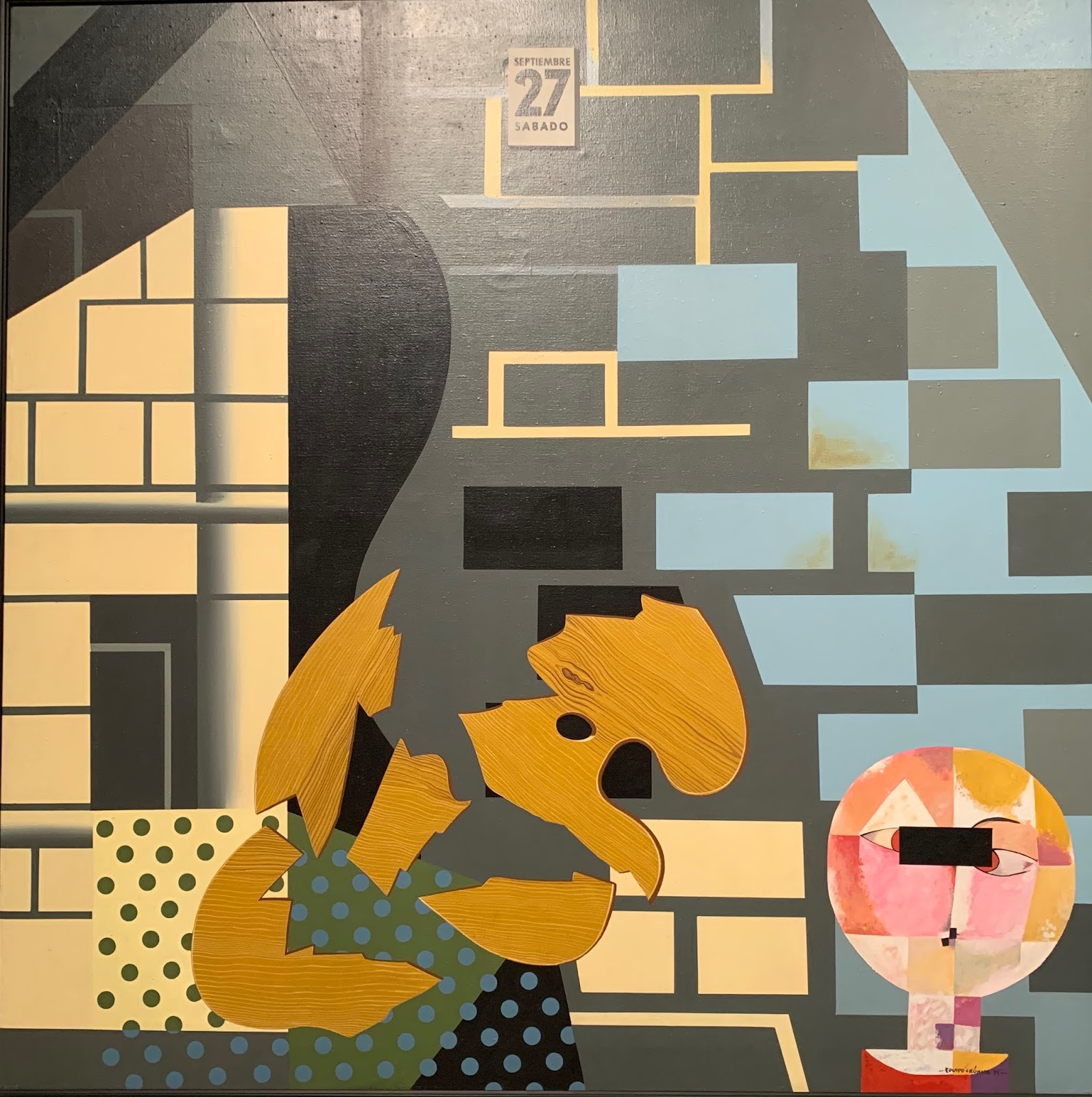
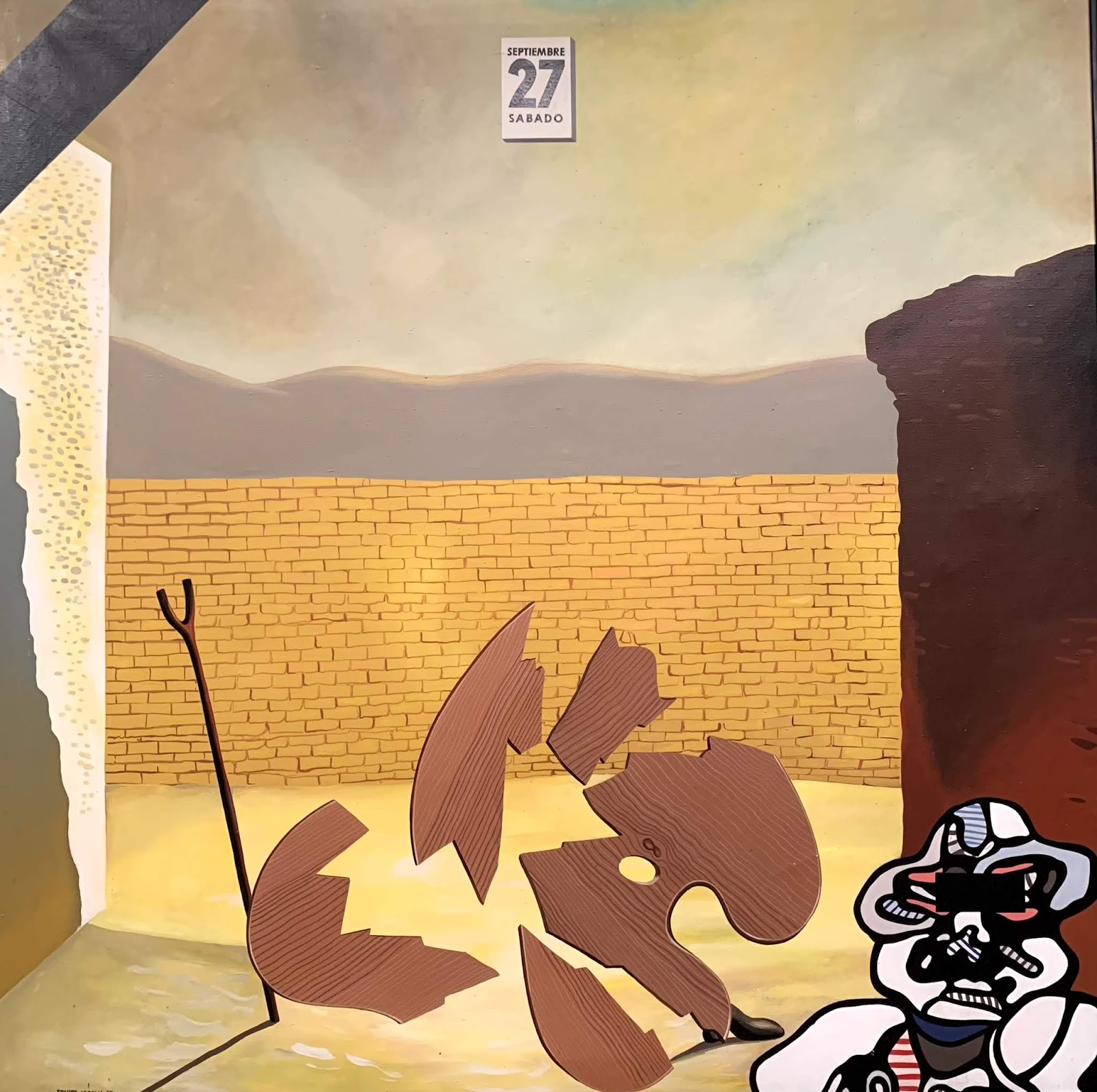
So close are the events of that terrible time, that reminders keep emerging. One that we found particularly moving was in the Reina Sofía museum in Madrid: a series of six paintings by an artistic collective, called Equipo Crónica. The group was set up in the early sixties by three artists from Valencia, Rafael Solbes, Manuel Valdés and Juan Antonio Toledo. Toledo, however, was called up for military service soon after and, when he returned, he found the collaboration between the other two had grown so close he could no longer fit in.

Within the collaboration, they used simple, plain colours, not merely to underline messages that are often intense to the point of brutality, but so as to avoid the touches and undertones of paint that would distinguish one painter from the other. They are truly collective works.

Franco remained a brutal authoritarian right up to his death. That release, for Spain and beyond, as much as for himself, came on 20 November 1975. But less than two months earlier, on 27 September, five young men were murdered – ‘executed’ is just a euphemism – by firing squad, on the orders of a court martial, countersigned by the dictator.

A salute to the last victims of Franco’s killing machine
Equipo Crónica decided to record the event in a series of ten paintings, six of which we saw in the museum. They chose not to make the paintings strictly documentary, depicting the actual event of the execution. Instead they made them “symbolically documentary”: each shows a wall (since the victims were stood up against a wall to be shot), a leaf from a desk calendar showing the date of the murders, a face with eyes blacked out to depict what happened to the young men or perhaps the blindness of the world, and a black strip for mourning across the top left.

The walls are, apparently, each in the style of an artist admired by the collective, but I can’t identify them.

In the foreground is a painter’s palette, broken into five pieces, one for each of the victims and perhaps a symbol of the impotence of art in the face of such criminality.
Palette broken into five pieces
Face with eyes blacked out
A wall for the victim to stand against
Mourning stripe at top left
The date at the top
It’s a strong and striking memorial not just to the victims of a specific crime, but of the dangers the hard right and nationalist movements represent for all of us (Franco adopted the label ‘nationalist’ for his side in the Civil War, against the ‘Republicans’ he eventually defeated with help from both Nazi Germany and Fascist Italy). It was moving to see it in one of Spains most prestigious museum. Long may it serve as a reminder to Spaniards of what it means to accommodate the far right.

A reminder many of us outside Spain badly need, too. In Hungary. In Poland. In Italy, for pity's sake. And, far from least, in Brexit Britain.

Our memories of the dangers of fascism are over 70 years old, from the Second World War, rather than little over 40 as in Spain. And we’re becoming forgetful. Toying with notions that should have been consigned to the history books.

At our own serious peril.

Saturday, 27 October 2018

A lovely city. An excellent meal. Great conversation. And some invaluable insights

The soft glow of gaslights in Zagreb's Upper Town
It’s curious being back in a country I haven’t visited for over half a century. 

A lot has changed. Starting with its name. Back then, it was just a constituent republic of a state called Yugoslavia. Today, it’s the independent republic of Croatia.

My first visit was in 1964. Among the few memories that have remained with me was the port of Dubrovnik, with three US warships docked in it. Even at eleven years old, it struck me as fascinating to see a ‘Communist’ nation hosting the US navy. It was testament to Tito’s wit in playing off the great powers against each other, as it was to a more intelligent side of US foreign policy, cultivating better relations with a supposedly enemy power, rather than going to war with it as in Vietnam.

After all, the US won the game in Yugoslavia. Vietnam inflicted their first ever defeat on them.
Flower market in Zagreb's old centre
We did get to Zagreb in 1964, but only to the suburbs. I remember a good lunch and little else. That made it all the more pleasurable to discover how much the city has to offer, as our friend Ana showed us around it on this visit. A beautiful old centre with a huge market offering every imaginable ware, streets offering fine prospects at every turn and glorious views from an upper town whose streets are still lit by gas in the evenings.
Roofs and spires, seen from the Upper Town
It’s a fine, and above all European, city. And the lunch was as good as back then.
With Danielle (left) and Ana
And Marija Juric Zagorka, Croatia's first female journalist
But our conversation was even more interesting than the city.

I’d already discovered in Valencia than when people talk about ‘the war’ they don’t mean the same thing everywhere. In Britain, France or Germany, it generally means the Second World War. In Spain, it’s the war against Franco’s Fascists in the late 1930s. But with a chill up my spine, I realised that when Ana speaks of ‘the war’ she means something that she suffered directly herself, where she saw and heard air raids coming in over the city in which she lives.

She’s talking of the war the Serb-led Yugoslav army waged against Croatia to prevent its becoming independent.

‘Not a civil war,’ she assures us, ‘because Croatian forces never set a foot on Serbian territory. It was a war started by the Serbs and fought in self-defence by the Croatians.’

We first met Ana in Strasbourg. She reminded us of the quaint habit there of sounding air raid warnings at noon on the first Wednesday of every month, as a test of their civil defence readiness. The first time she heard it, she froze with terror at hearing the familiar wail with its blood-curdling associations. Only when a colleague realised what was happening to her and explained that it was only a test of equipment, was she able to regain her composure.

To me, such memories belong to my parents’ generation, not mine. And certainly not to Ana’s: she’s significantly younger than we are.

‘For years,’ she told us, ‘I wasn’t allowed to be Croatian. The state tried to force us all to be Yugoslavs, but we never were and never wanted to be.’

The right to self-determination was asserted for all peoples after the First World War. In Yugoslavia, as in Czechoslovakia and other nations, it was never truly applied. Only now can Croats, Slovenes, Macedonians, Montenegrins and even Kosovans at last begin to live their own lives, free of the authoritarian tutelage of Belgrade.

Bosnia and Herzegovina remains a mess, of course. Something Ana feels particularly strongly, as she was born there – only 200 metres from the Croatian border, but still inside Herzegovina. For now, there’s a fragile peace, but it’s hard to know whether it will strengthen in the future or break down into renewed conflict.

And what about Croatia itself? Doesn’t Ana fear a new outbreak of hostilities?

‘I don’t think so. After all, we’re members of NATO now.’

At a time when it’s fashionable to write NATO off as the work of the devil – a position shared by Donald Trump and the far left – it’s a salutary reminder that there are people who rely on it for the defence of their freedoms. Maybe the organisation, for its many faults, isn’t entirely without redeeming features.

Nor is it the only international organisation to which Croatia belongs. Another, as important as NATO, is the EU. Coming here is a useful reminder that one of the major purposes of the EU, far greater than its economic role, is to begin to put an end to violence between states, at least in Europe. That’s a continent that has seen more than enough blood flowing from its internal strife down the centuries.

Right up to as recently as the 1990s in former Yugoslavia.
Croexit? No thanks
The Croatian flag flies with pride next to the EU’s
Croatia’s proud of being in the EU. I wish more people in the UK could understand that. Before they undermine the organisation and deprive themselves of its benefits by an intemperate, ill-thought out and self-harming Brexit.

Wednesday, 13 June 2018

Pleasure, and a timely lesson, from the Hamburgers

There are more bridges in Hamburg than there are in the whole of Venice and Amsterdam. Taken together.

How do I know that? I was told by a taxi driver. And the word of a taxi driver is not to be doubted, is it? Like the word of a US President. So I haven’t checked. I have to admit, though, that if I havent looked, it’s partly just because I wouldn’t want to find out that it wasn’t true.
The Elbe in Hamburg
In any case, it’s highly plausible. The city has water everywhere. It’s a great port, after all, at the mouth of the river Elbe, and with many channels of its tributary, the Alster, flowing through parts of the city centre. Water, hills and parks make a city, in my view, and Hamburg has the first and last of these.
Water, water, everywhere
Many of the waterways are lined with old warehouses, a reminder that the city was once one of the chief centres of a great trading association of northern Europe, the Hanseatic League. Most German cities like to have their car number plates identified by a single letter – B for Berlin or F for Frankfurt, for instance – because a short abbreviation indicates a great city. Hamburg insists on two – HH for Hansestadt Hamburg, recalling its long commercial traditions.

Hamburg warehouses. And more water, of course.
‘England is a nation of shopkeepers,’ Napoleon once said. I realised just what he meant, and just why he said it, when I was recently reading some material on Britain in the eighteenth-century. In the Napoleonic wars, Britain tried for as long as possible to avoid getting involved in fighting on land in Europe, preferring to limit its military commitments to the sea (trade needed the sealanes kept open, after all). Instead, it offered subsidies to its allies to do the actual fighting. It could offer those subsidies because it was a powerful trading nation, though as I argued here recently, even Britain suffered as embargoes and counter-embargoes were imposed.

Hamburg, like Britain, prospered by trade. A message Brexiters and Trumpistas would do well to remember. Erecting barriers makes nations poorer. Knocking them down makes them richer – all of them: this isn’t a zero-sum game, both sides gain from trade. And war damages them.

Alongside parks and waterways, spires help a city too. My eye was caught by a tall church tower as I was walking between meetings, but I couldn’t get to it just then – I was in the city for work, after all. However, later, having seen a colleague off at the station, I found that my route back to the hotel took me close to it. “I could take a look,” I thought.
The ruined church of St Nikolai in Hamburg
It turned out to be the tower of the St Nikolai church. Only the tower and the chancel survive. The main part of the nave was destroyed in 1943 when the Allies bombed the city, in the aptly – and vengefully – named ‘Operation Gomorrah’. The Royal Air Force bombed at night, the US Air Force by day; the RAF carpeted the city indiscriminately, the USAF targeted military works (such as a submarine factory); a fire storm engulfed the city, leaving a number of dead that has never been precisely determined, some of the corpses having been completely incinerated in the flames.
Picasso evoked the terror of the Nazi bombing of Guernica
The museum in the crypt of the ruined church makes it clear that the chief blame for the horror belongs to Hitler and Nazism, that none of this would have happened had they not set Germany on a vain road to world power, and that the Nazis indeed had pioneered the use of mass bombing of civilians before the Allies did: the museum mentions Guernica during the Spanish Civil War, Warsaw, Coventry and, indeed, London, all bombed long before 1943.

That’s generous of the German historians.

However, it hardly lessens the guilt of the Allied strategists. The exhibition quotes Air Chief Marshall Arthur ‘Bomber’ Harris saying ‘There are a lot of people who say that bombing cannot win the war. My reply to that is that it has never been tried… and we shall see.’

Let’s be clear: the bombing of civilian targets has only one aim. In World War 2, the Allies called it ‘breaking the morale of the population’. Today we call such attempts by a single and simple word: terrorism. The destruction of Hamburg by fire was absolutely clearly an act of state terrorism, something we would do well to remember whenever we throw up our hands in horror at state terrorism practised by our enemies today.
Hamburg ablaze during Operation Gomorrah
St Nikolai has been left ruined, like the Memorial Church in Berlin or Coventry Cathedral in England. There is a quiet, stately mournfulness about these monuments to those moments when we get things wrong and build walls instead of bridges. 

Salutary in this city of so many bridges and which has suffered so much.

Are you listening, Trumpistas and Brexiters?

I suppose it would have been appropriate to have had a hamburger
among the Hamburgers. But I resisted the temptation

Tuesday, 4 May 2010

Britain in 2010 and the unlearned lesson of the Spanish Civil War

It’s early yet to start to pass a judgement on the present century. The last, on the other hand, deserves to be classified as the ‘Dark Century’, even among the many other ghastly ones before it. Never have so many suffered and died in that century, and never for so little. I’ve written before about a footbridge across the Rhine in Kehl, opposite Strasbourg, where people stroll across a Franco-German border which cost millions of lives in three wars. Standing among the families enjoying the afternoon sun, you have to wonder what the point was.


‘Nations trek from progress’ wrote Wilfred Owen in his extraordinary poem, Strange meeting.


The main purpose to which progress was put in the Twentieth Century was to find new and far more devastating ways for humanity to be inhumane to itself. The Holocaust, the nuclear bombs on Japan, the killing fields of Cambodia: great power to benefit mankind put to use to destroy it.


In amongst all the ghastliness, one episode that deserves more attention is the Spanish Civil War. An autocratic leader, Francisco Franco, led a brutal, colonial army – one of his problems at the beginning of the fighting was to get the army from the Moroccan colonies to Spain proper – supported by a class coalition of small and large landowners, leading industrialists and inevitably the Roman Catholic clergy, to bring down a democratically elected government that was trying to reform a hopelessly backward system. The Government did many things wrong and carried out some shameful atrocities, but on the other side the scale of brutality was hard to believe. Whole villages would be put to rape and murder, leftists were tortured and killed, even being thrown down wells which were then stopped up with boulders.


The sheer extent of the violence has yet to be determined. Archaeological work now underway on Civil War mass graves may give an indication, though we already know that at least 50,000 were murdered and more likely 200,000. Several million were forced into exile. What’s more, the regime that eventually won the war in 1939, imposed 36 years of stultifying and often cruel oppression on its people before Franco finally died in 1975.


At the time, one of my colleagues was an engineer who wore corduroy trousers, thin-rimmed glasses and a jacket with patched elbows. I never saw it, but I bet he smoked a pipe at home. He was too young for the part, but he looked like the perfect representative of the old left of the 1930s, reading Orwell and supporting the international brigades in Spain. When we told him that Franco had died, he looked at us grimly and replied:


‘I blame his doctors. If they’d been worth their salt they’d have kept him alive for at least another six months of growing agony.’


A while later we told him that Franco had been buried.


‘I hope they stuck a stake through his heart,’ he said.


The second most shameful aspect of the War was that Mussolini’s Italy and Hitler’s Germany came in gaily on the Fascist side. In fact, it was German planes that got Franco’s troops back to Spain. Later, other German planes bombed the Basque town of Guernica, in the raid made famous by Picasso’s monumental painting.


The Germans and the Italians had fun in Spain, trying out the new toys with which they’d equipped their armies, and helping to put into power a regime sympathetic to their aims and thereby weakening France, with Fascist regimes on three of its borders, and indirectly Britain too.


That British interests were at stake was clear to Germany. Goering met Mussolini early in 1937 and said they needed to win the war in the next three weeks because Britain could not possibly stay out of it any longer than that.


Which brings us to the most shameful aspect of all of the War. Britain didn’t get involved. It stood on the sidelines and watched while the Spanish Republic was strangled, its people suffered and bled, and those powers against which Britain was soon to be fighting for its life were immeasurably strengthened. In sheer stupidity and moral turpitude it’s hard to imagine anything that Britain could have done that was much bleaker.


Strangely enough, as well as many on the left, at least one leading figure of the right, excluded at that time from government, stood out against this bankruptcy of principle. Though I don’t share the general adulation for Winston Churchill, there are aspects of his political career that impress me as much as they impress anyone. On the Spanish Civil War, he saw that British strategic interests were at stake and a Fascist victory would damage them.


Many on the left understood that, and Churchill at least in the Conservative Party. Most in his Party had nothing like his vision, and they preferred to put their class interests – in the victory of a rabidly anti-Communist movement – above their strategic interest in halting the growth of Fascism. In doing so they made the Second World War virtually inevitable. The European War, indeed, broke out within six months of Franco’s conclusive victory.


Why is this relevant now?


Because on Friday of this week, 7 May 2010, it looks increasingly likely that the Conservative Party will once again take office in this country. They are promising a reduction in inheritance tax which will benefit a tiny percentage of the very wealthiest. They are promising to repeal an increase in National Insurance, in effect another form of income tax, brought in by the present government; its repeal will disproportionately benefit the highest salary earners.


They are promising to do this at the same time as they are declaring that their top priority will be to reduce the government deficit. With those tax reductions, the cuts they will have to make in public services will be steeper still.


And who suffers the most from cuts in public services? The poorest. What’s more, reduced public spending is likely to jeopardise the economic recovery which is just under way and far from secure.


Great to see that the traditions are still alive. We still have a Conservative Party wedded to class interests rather than strategic interests.


And we’re still stupid enough to vote for it.