Showing posts with label George Bush. Show all posts

Thursday, 14 July 2016

Bush, Blair, Boris and Brexit. And my poodle Luci

It’s frightening when a pet falls ill.

It can be messy too, of course. I’ll spare you the details but you can probably imagine what the clearing up was like when I tell you that our toy poodle, Luci, had some acute digestive problems. In any case, the cleaning was the least of our concerns as she began to tremble uncontrollably while drooling from the mouth. Usually lively and playful, she collapsed and lay wherever she’d slumped, apathetic, shaking and miserable.

We had to make an emergency dash to the vet’s. Far from giving us any words of comfort, he looked as worried as we were. We had to start grappling with the notion that we might be about to lose her. Fortunately, however, his professional skill and her natural powers of recovery eventually won through, and after a night of anxiety, we found her in the morning already well on the way back to her normal self.

What had put her in that state? 

Despite her tiny size, she has quite an appetite. One that is entirely undiscriminating. If she comes across anything that seems eatable, she gives way to temptation and eats it without hesitation. We have to be quick to stop her and, if we’re not quick enough, that’s it, it’s gone, swallowed and into her belly. Where it may, as was the case this time, wreak havoc.

Plenty of charm, but not so strong on the self-control
Complete surrender to immediate gratification. Not a thought to the possible future consequences. Not the smallest trace of self-control.

The capacity to exercise such self-control is what separates us from the animals. We can defer gratification. It means we can walk past what seems appealing but might in reality be harmful.

Conversely, we often lose that capacity, and find ourselves behaving like Luci: acting first, thinking afterwards. So I suppose, just as the self-control separates us from the animals, its failure shows us how closely we linked we still are to them.

What does it take? Well, if you happen to have a particularly challenged US President – yes, you identified him correctly, I mean Dubya – who’s made up his mind that he needs to pick a fight in Iraq, and you’re a British Prime Minister particularly star-struck by wealth or power – yes, full marks, I mean Blair – you might be inclined to go blundering into battle with him. Without a thought to the consequences.

That’s what the Chilcot Report into the Iraq War showed. There’d been no planning. Nobody had thought about what would happen after the initial military phase, what problems we might face or what resources we might need to deal with them.

Chilcot was clear. A perfectly predictable consequence was an upsurge in fundamentalist terrorism, affecting the whole region and many countries beyond. Just like Luci, Dubya and Blair swallowed the tempting morsel of a quick and easy war, and discovered that it turned out to be a long and bitter struggle. After which, they left it to the rest of us to clear up the mess.

What happens with individuals can happen with whole countries too. Britain – or more specifically, England and Wales – decided on 23 June that the UK should leave the EU. Since then it’s turned out that no one had planned for what might happen next. There may be a terrible shock coming for Brexit supporters: the government seems highly tempted to leave the EU but stick with the European single market, which would mean Britain continuing to pay contributions to the EU, having to accept freedom of movement with EU countries, and having to accept EU rules while having given up any say in making them.

Like Luci, the consequences of the decision may turn out to be a lot less enjoyable than the initial act may have appeared.

Luci, of course, recovered quickly and fully. I’m sure a lot of people in Britain are hoping that recovery from Brexit will be just as easy. Sadly, when it comes to the other spectacularly ill-planned decision, war in Iraq, we’re still struggling with the consequences today. With no end in sight.

Still, whether Brexit turns out as easy as Luci’s illness, or as painful and drawn out as the Iraq conflict, one conclusion we can be sure of: it would make life a lot easier if we could learn to plan a little better.

And, perhaps, to exercise a tad more self-control.

Sunday, 5 August 2012

The indolence of Hitler. And some other politicians too

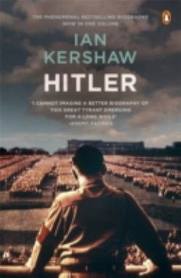
Do you know Ian Kershaw’s biography of Hitler? I can’t sing its praises loudly enough.

Gripping, insightful and
full of lessons for our own times too.
It is full of insight on the more obvious aspects of the dictator’s personality: the active cruelty, its underlying bigotry, principally but not exclusively against the Jews, and the fanaticism with which it was driven through; but also the passive cruelty of indifference, that allowed him to send millions of soldiers to their deaths without a word of grief for them or of compassion for their families.

However, these aren’t the aspects that interest me here.

Kershaw also paints a startling picture of Hitler’s idleness, right up to the first years of the war. The dictator would rise from bed late in the morning and go for his bath. He would emerge around noon and hold meetings until about 2:00 when he would have a much delayed lunch, to the despair of the kitchen staff.

In the afternoon he would hold another couple of meetings around tea. Exhausted by these exertions, he would then take a rest. Dinner was at 8:00 followed by films, music or conversation, mostly in the form of endlessly repeated monologues on whatever subject he cared to choose. He would get to bed at about 2:00 a.m.

This dilatory schedule didn’t stop his regime achieving some of its most striking successes: the annexation of Austria and later of Czechoslovakia; then, once war proper had started, victories in Poland and in the Balkans.

However, he was laying the seeds of the disaster to come. Paradoxically, though he kept adding to his personal power, he lacked the energy to provide much direction. Instead, his most senior leaders set policy through their turf wars, with each vying for personal advancement by attempting to do the things Hitler wished for, but hadn’t stated.

Kershaw calls this thinking ‘working towards the Führer’ and it was an appallingly inefficient way to run a government. By contrast, at the height of the war, Churchill could leave Britain for relatively long periods abroad, safe in the knowledge that the government he left behind would continue to operate along legal lines and implement agreed policy.

Churchill could have that confidence even though he left the government in the hands of the leader of the main opposition party, Labour
’s Clement Attlee, the man who would oust him from office at the first post-war election. If any tribute were needed to the superior effectiveness of democracy over dictatorship, this must surely be it.

Meanwhile, back in Germany, things started to change when Hitler went to war with the Soviet Union. Initial spectacular success soon fell apart as it became obvious to all but the most convinced Hitlerites that Germany was now in a battle with a massively more redoubtable power than it had ever previously faced. And as the war started to turn tough, so his behaviour started to change.

His old idleness began to disappear. He became an insomniac. During the day, he would pore over maps and orders and hold frequent long discussions with his generals. As he lost faith in them, he took increasing control himself. To deliver victory, he preferred to draw on his experience as a corporal in the First World War and his belief in the capacity of his will to achieve anything to which he set his mind, rather than the experience and training of his senior officers.

From being a layabout, he became a workaholic.

And how effective was it? A useful indication is given by the reaction in Britain to the proposal by Special Operations Executive, a young and violent wartime addition to the secret services, to assassinate Hitler.

‘On no account,’ replied the others, ‘there’s no possible replacement for him at the head of the German armed forces who we’d be happier to see in the position.’

The time of Hitler’s indolence sowed the seeds of his regime’s destruction. The time of his workaholism ensured and accelerated its collapse.

Interesting, isn’t it? Idleness in lousy politicians is bad news. But that’s as nothing to when they really 
get going.

In my view this is as true in a democracy as it is in a dictatorship.

George W. Bush may have been the laziest man to become President of the United States: briefing papers had to be summarised and even then they had to be read aloud to him; he would take extraordinary amounts of leave – up to twelve weeks a year – and rarely worked as much as six hours a day. Even then he managed to drag not just his own nation but several others into long, bloody and so far fruitless wars.

Can you imagine how disastrous things might have been if he’d stayed around long enough to become a workaholic?

In Britain today we have a Prime Minister whose reputation is for a relaxed approach much like Dubya’s. Rather than think a policy through, David Cameron prefers to come up with some half-baked proposal which he withdraws when it’s pointed out how unlikely it is to work.

It’s hard to feel much respect for him. Again, though, let’s be careful what we wish for. Imagine if he started actually working: how much more damage could he do? 


Probably safer, as with Dubya, to make sure he’s gone well before he emerges from the indolent stage.

Thursday, 17 February 2011

Which army is the lesser evil?

Anxious times in Egypt. With the army in control, will the country really move towards freedom and democracy, or are we going to see a decline into chaos followed by more autocracy?

Perhaps one ought to be thankful that it's the Egyptian army that’s on the streets. In Iraq, it's the American army. With democracy no more secure in Baghdad than in Cairo, at last in Egypt you can count the civilian deaths in tens rather than in tens of thousands.


Egyptian tanks in the streets of Cairo: cause for concern...

...but probably preferable to the US equivalent in Iraq

Postscript

So it's confirmed that the justification for the Iraq war was based on one man's lies about weapons of mass destruction, taken as gospel by various Western governments and their so-called ‘intelligence’ services (demonstrating the old principle that ‘military intelligence’ is an oxymoron, like ‘airline food’). Amazingly, they gave this ‘agent’ the cover name ‘Curveball’ which rather suggests they realised he was misleading them – I don’t know a lot about baseball, but I think a curveball is specifically designed to fool the batter by its tricksy trajectory.

Anyway, it certainly vindicates all those who were saying back in 2003 that Hans Blix was probably right and there weren’t any WMD in Iraq. It also helps answer another major question: were our leaders knaves or fools?

The answer seems to be that Bush was a fool and Blair a knave.

Tuesday, 14 December 2010

Nixon and his successors: rememberance of things past, anticipation of things to come

Little incidents can bring buried memories flooding back, so that a distant moment is suddenly with you again as though you were living it now.

For Proust, it was the taste of a Madeleine cake conjuring up his childhood.

For me, this weekend, it was seeing the latest releases of extracts from the Nixon tapes. Suddenly, I was back in a New York street, in fine rain, the street lights glistening on the wet pavements, in front of a shop window with a poster whose evocative message had stopped me in mid-stride.

Tricky Dicky: man of confidence or confidence man?
Oh, for those long-lost days when the United States had a President who was clearly not a man forced into politics only because he couldn’t make a success of any other career. With his wits and ethics, Tricky Dicky Nixon could have flourished in many other walks of life. Say, as a market trader.

Doesn’t it warm the cockles of the heart to remember those glorious aphorisms of his such as ‘When the president does it, that means that it’s not illegal’?

What’s been coming out now? It seems that ‘…the Irish can’t drink … Virtually every Irish I’ve known gets mean when he drinks. Particularly the real Irish.’ The Italians: ‘those people … don’t have their heads screwed on tight.’ And as for the Jews, they ‘are just a very aggressive and abrasive and obnoxious personality.’ Don’t limit your amazement to the sentiment, let yourself go in wonder at his command of the English language too.

As for Blacks, he commented on the view expressed by a colleague that ‘they are coming along, and that after all they are going to strengthen our country in the end because they are strong physically and some of them are smart’. ‘Some of them are smart’ and ‘they are coming along’ were, it seems, judgements that were just a little too generous. ‘My own view is I think he’s right if you’re talking in terms of 500 years. I think it’s wrong if you’re talking in terms of 50 years. What has to happen is they have be, frankly, inbred.’ Ah, yes, a little breeding is what these people need. Presumably to turn them into shining examples of humanity such as the Nixon product itself. And don’t you just admire the prescience? I mean, he was speaking over three decades before the election of Obama.

I noticed that USA Today reacted with something less than enthusiasm to one of Nixon’s utterances. Talking about the prospects of Ronald Reagan occupying the Oval Office, he had said ‘Good God, can you imagine – can you really imagine – him sitting here?’ And he added ‘I can imagine anyone ... but Reagan.’

The paper seemed to feel that Nixon had revealed a character flaw (even the finest have them) in misjudging this great man who would indeed eventually follow him into the White House.

Reagan had his own magnificent quotations. Faced with student unrest at Berkeley, he showed his resolution: ‘If it's to be a bloodbath, let it be now. Appeasement is not the answer.’ Later, he denied that he had called for a bloodbath. He’d probably forgotten he’d said it. His was another of those times that conjure up feelings of nostalgia, in his case for a President with the gifts that come from incipient Alzheimer’s.

Since then the same Grand Old Party has thrown up two George Bushes to teach us to rate Reagan more highly.

But it isn’t nostalgia that is my main emotion today, it’s that delightful tingle that anticipation of the future gives. Could the Republicans be about to serve us up another White House occupant to make even Dubya look good?

Remind yourself of gems such as:

“Refudiate,” “misunderestimate,” “wee-wee’d up.” English is a living language. Shakespeare liked to coin new words too. Got to celebrate it!’

Isn’t that worthy of Nixon at his best?

And what about:

... obviously, we've got to stand with our North Korean allies.

The command of foreign policy and sensitivity to its nuances is deeply reminiscent of Reagan, isn’t it? For instance, in his famous statement into a live mike:

My fellow Americans, I am pleased to tell you I just signed legislation which outlaws Russia forever. The bombing begins in five minutes.

Who’d have thought anyone could make us look back on Reagan and Dubya as men to miss? And to feel that Tricky Dicky, deceitful, racist and convinced he was above the law, represented something of a golden age?

Yep. Get ready to enjoy the Sarah Palin show.