Showing posts with label Strasbourg. Show all posts

Friday, 22 March 2019

Déjà vu, or a little touch of globalisation

Déjà vu is, of course, a present experience. It isn’t generally a true memory of something that has previously happened, but a false memory of familiarity from the past of something one has, in all likelihood, never seen before.

Unless, of course, it’s a perfectly genuine sense of realising that a scene encountered apparently for the first time, genuinely corresponds to a true memory.

That’s what I experienced recently. Danielle and I went into a supermarket on the outskirts of Valencia, a city that is already beginning to feel truly like home but which we’d abandoned for a fortnight, to avoid the sleeplessness that accompanies the glory of the annual ‘Fallas’ festival.

I’d never been in that particular supermarket before. And yet as soon as I entered it I recognised the place. The entry was near the rightmost end of the huge roomful of shelves. All that was further to the right was the electronics section, with a limited range of computing and games accessories as well as music players. The wine was where I expected it, about two-thirds along the shop to the left of the entrance, up against the back wall; bottled water in front of it and a little further along; at the far left-hand end was the fresh produce, meat and fish.

The tills, too, were up at that end of the shop, and most of them, as usual, unmanned. The whole effect was of a place somehow flyblown. Slightly unappealing. It seemed to have everything one might want without quite creating an attractive atmosphere in which to find it.

I knew this place. Though I’d never been there before.

But, of course, there was nothing supernatural or even mildly spooky about the experience. The phenomenon, far from being otherworldly, was quite the reverse. It was merely one of the minor effects of globalisation.

The pronunciation of the name of the French supermarket chain Auchan really isn’t ‘Ocean’, as preferred by many British expatriates. The way it’s pronounced, it sounds like the words meaning ‘in the field’, ‘au champ’. Translated into Spanish, that would be ‘al campo’. Those words could also mean ‘in the countryside’, which has attractive associations, of leisure and pleasure and the open air.

So when Auchan opened its Spanish subsidiary, it called it ‘Alcampo’. A clever international play on words.

Auchan. Not to be confused with Alcampo
Well, not that clever I suppose. But hey, this is the world of commerce, not the theatre of Oscar Wilde.

And the Al Campo on the outskirts of Valencia was laid out in exactly the same way as the Auchan on the outskirts of Strasbourg. We did a lot of shopping there when we were living in that fine city, because if the interior appearance was a tad short of especially inviting, the produce was always good. Just like the Alcampo where we did our shopping in Valencia.

So the experience wasn’t so much déjà vu as plus ça change, plus c’est la même chose. Or, as we might say in English, another supermarket may be just one more drop in the Auchan.
In Russia too. And, boy, they look exactly the same there

Saturday, 27 October 2018

A lovely city. An excellent meal. Great conversation. And some invaluable insights

The soft glow of gaslights in Zagreb's Upper Town
It’s curious being back in a country I haven’t visited for over half a century. 

A lot has changed. Starting with its name. Back then, it was just a constituent republic of a state called Yugoslavia. Today, it’s the independent republic of Croatia.

My first visit was in 1964. Among the few memories that have remained with me was the port of Dubrovnik, with three US warships docked in it. Even at eleven years old, it struck me as fascinating to see a ‘Communist’ nation hosting the US navy. It was testament to Tito’s wit in playing off the great powers against each other, as it was to a more intelligent side of US foreign policy, cultivating better relations with a supposedly enemy power, rather than going to war with it as in Vietnam.

After all, the US won the game in Yugoslavia. Vietnam inflicted their first ever defeat on them.
Flower market in Zagreb's old centre
We did get to Zagreb in 1964, but only to the suburbs. I remember a good lunch and little else. That made it all the more pleasurable to discover how much the city has to offer, as our friend Ana showed us around it on this visit. A beautiful old centre with a huge market offering every imaginable ware, streets offering fine prospects at every turn and glorious views from an upper town whose streets are still lit by gas in the evenings.
Roofs and spires, seen from the Upper Town
It’s a fine, and above all European, city. And the lunch was as good as back then.
With Danielle (left) and Ana
And Marija Juric Zagorka, Croatia's first female journalist
But our conversation was even more interesting than the city.

I’d already discovered in Valencia than when people talk about ‘the war’ they don’t mean the same thing everywhere. In Britain, France or Germany, it generally means the Second World War. In Spain, it’s the war against Franco’s Fascists in the late 1930s. But with a chill up my spine, I realised that when Ana speaks of ‘the war’ she means something that she suffered directly herself, where she saw and heard air raids coming in over the city in which she lives.

She’s talking of the war the Serb-led Yugoslav army waged against Croatia to prevent its becoming independent.

‘Not a civil war,’ she assures us, ‘because Croatian forces never set a foot on Serbian territory. It was a war started by the Serbs and fought in self-defence by the Croatians.’

We first met Ana in Strasbourg. She reminded us of the quaint habit there of sounding air raid warnings at noon on the first Wednesday of every month, as a test of their civil defence readiness. The first time she heard it, she froze with terror at hearing the familiar wail with its blood-curdling associations. Only when a colleague realised what was happening to her and explained that it was only a test of equipment, was she able to regain her composure.

To me, such memories belong to my parents’ generation, not mine. And certainly not to Ana’s: she’s significantly younger than we are.

‘For years,’ she told us, ‘I wasn’t allowed to be Croatian. The state tried to force us all to be Yugoslavs, but we never were and never wanted to be.’

The right to self-determination was asserted for all peoples after the First World War. In Yugoslavia, as in Czechoslovakia and other nations, it was never truly applied. Only now can Croats, Slovenes, Macedonians, Montenegrins and even Kosovans at last begin to live their own lives, free of the authoritarian tutelage of Belgrade.

Bosnia and Herzegovina remains a mess, of course. Something Ana feels particularly strongly, as she was born there – only 200 metres from the Croatian border, but still inside Herzegovina. For now, there’s a fragile peace, but it’s hard to know whether it will strengthen in the future or break down into renewed conflict.

And what about Croatia itself? Doesn’t Ana fear a new outbreak of hostilities?

‘I don’t think so. After all, we’re members of NATO now.’

At a time when it’s fashionable to write NATO off as the work of the devil – a position shared by Donald Trump and the far left – it’s a salutary reminder that there are people who rely on it for the defence of their freedoms. Maybe the organisation, for its many faults, isn’t entirely without redeeming features.

Nor is it the only international organisation to which Croatia belongs. Another, as important as NATO, is the EU. Coming here is a useful reminder that one of the major purposes of the EU, far greater than its economic role, is to begin to put an end to violence between states, at least in Europe. That’s a continent that has seen more than enough blood flowing from its internal strife down the centuries.

Right up to as recently as the 1990s in former Yugoslavia.
Croexit? No thanks
The Croatian flag flies with pride next to the EU’s
Croatia’s proud of being in the EU. I wish more people in the UK could understand that. Before they undermine the organisation and deprive themselves of its benefits by an intemperate, ill-thought out and self-harming Brexit.

Tuesday, 26 June 2018

There's good emergency service triage. And then there's the other kind

It came as a bit of a surprise when the French Emergency Department doctor (‘urgentiste’) I was talking to asked if we could postpone for a week the webinar we were planning.

‘You may have picked up that there’s a bit of a controversy in France around emergency services right now, and we’re even more crazily busy than usual.’

Well, I hadn’t picked that up. But two friends were with us from the glorious Eastern French city of Strasbourg where we used to live. One of them was a nurse, so I reckoned she’d know. Though actually both of them were fully up to date, and for a good reason.

‘Yes, a terrible scandal,’ they told me. 'In Strasbourg.’

The problem had arisen on a call to the emergency services. Rather than describe what happened, I’ll just translate the transcription of the call, between a frightened caller and a triage clerk:

‘Miss, I’m in pain…’

‘OK, so you phone a doctor, OK, got it? You understand, phone SOS Médecins [the primary doctor emergency service].'

‘I can’t.’

‘You can’t? Oh, really, you can phone the ambulance service but you can’t…’

‘I’m going to die.’

‘Yes, you’re going to die, without a doubt, some day, like everyone else… Ring SOS Médecins, OK?’

‘Please, help me, Miss.’

‘I can’t help you. I don’t know what’s wrong with you.’

‘It hurts, it hurts…’

It’s hard to disagree with the Enquiry finding that the clerk’s tone was harsh.

That was at 11:30. At 12:32, a relative rang again and, by sheer bad luck, was dealt with by the same clerk. Again, the call wasn’t put through to a physician, although two were available.

At 13:47, SOS Médecins itself called the emergency service. This time a different clerk answered. She put the call through to a physician who immediately sent an ambulance. It arrived at 13:58. Some two hours twenty minutes had been wasted by then, and that proved critical: although the patient was immediately hospitalised, she died at 17:30.

She was 22.

This tragic litany proved career-limiting for the first triage clerk, who has been suspended pending dismissal. It did no good to the emergency service director either, with the report of the Enquiry recommending that his resignation, already offered, be accepted.

It’s a classic case of rare – or hopefully rare – ineptitude. A fine object lesson in how not to run triage. Triage is the process by which healthcare staff decide what level of care a patient might need. Clearly, it failed in this case.

However, that there’s one other aspect of these events which casts a still deeper shadow over them. The woman who died was called Naomi Musenga. As my French friends point out, even on the telephone, her accent would have revealed her sub-Saharan African roots.
Naomi Musenga, in a photo from franceouest.fr
Would she have been treated differently if she’d been white?
Would the clerk have reacted differently had the caller’s voice identified her as white? Who can say? But the way things are in the world today, how can we immediately rule it out?

At any rate, it’s no wonder my French ED physician was too busy for a webinar this week.

Wednesday, 23 May 2018

Not woman's work

We have no dishwasher in our new flat in Valencia.

I’m using the word ‘new’ to mean new to us. The building is, in fact, nearly a century old, which is hardly ancient by Spanish standards, but certainly doesn’t qualify as recent either. So it’s our new flat in a relatively old Valencian building.

In any case, we haven’t put a dishwasher in. So I’ve just finished washing some dishes, making it all the more appropriate that I write this post, for reasons that will become increasingly clear as you read it.

Hanging washing out to dry in England is something of a gambler’s exercise. You have a reasonable chance that within a few hours – it seldom takes less than that – it’ll be dry. But you have as good a chance that it will be dripping wet again, indeed possibly wetter than when you took it out of the machine in the first place. England, it has been rightly pointed out, is a country without a climate but plenty of weather.

Valencia, on the other hand, has the kind of climate that makes it a joy to rely on. For most of the year, the temperature is neither uncomfortably hot nor unpleasantly cold. When the rain falls, it tends to be seen as a pleasant change and a welcome refreshment for plants, rather than yet another annoyance. Leading to a washing line full of clothes being drenched.

We haven’t been in Valencia long enough to have become used to our new state of affairs. Danielle still takes delight in hanging washing out on our pocket-balcony, and even more at being able to take it back in, bone dry, about five minutes later.

In fact, she enjoys it so much that she couldn’t resist saying so on FaceBook.

Danielle's FaceBook pic of our balcony washing line
Monica is a friend of ours who is Spanish herself but living in Eastern France. That's where we met her, during our time in or near Strasbourg. She replied to Danielles post to point out that hanging up washing should not be regarded as woman’s work and that I, too, should pull my weight.
Trying to show willing
Photos can’t lie, can they? So I’m delighted to include one of me fiddling with the buttons on the washing machine. I admit that this does not absolutely prove that I took charge of doing that load of washing, but at least it shows that I was interested in understanding the process. Which counts for something, doesn’t it?

Besides, I did try to pull my weight in other ways. For instance, when it came to the IKEA assembly tasks, it was I who undertook the bulk of them. Readily I might add. With pleasure even.
The joy of IKEA assembly
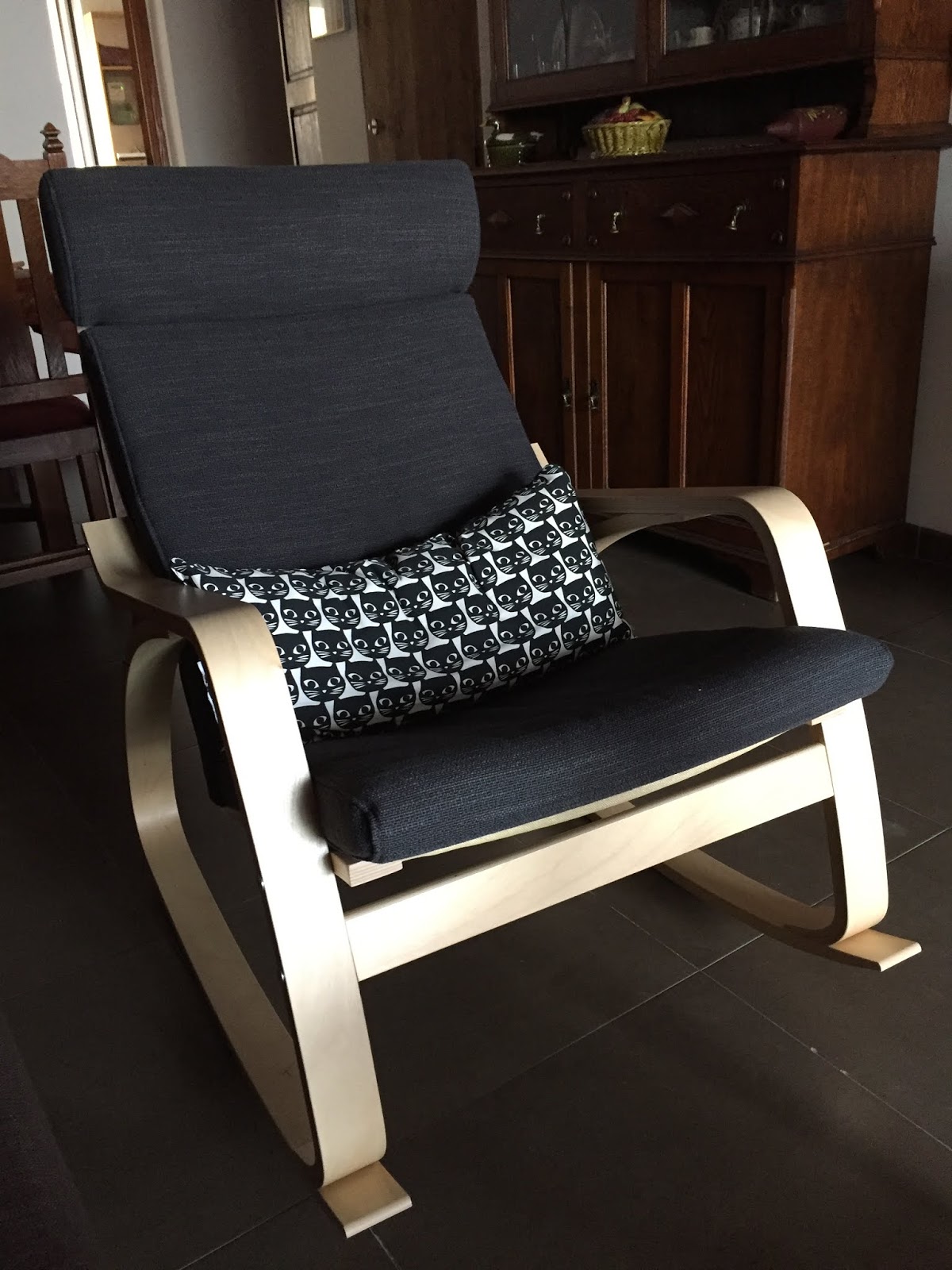
One of those tasks was particularly satisfying, though I’m not sure I should be admitting as much. What it led to was the kind of chair that led my stepson David to point out that, since I was now a granddad, it was time I had one. My view is that, since I’ve been a granddad for thirteen years now, it’s actually long overdue that I should be able to relax in a rocking chair.
Granddad’s delight. And Grandma’s too
Not, of course, that I expect to spend much time rocking. There’s work to do, and no reason to suppose that it’s specifically female. As Monica would no doubt point out, if ever I suggested otherwise.

Sunday, 4 March 2018

A rolling stone sheds some more moss

Closing an era. Moving on. Turning the page. All those clichés. Danielle, and I have just done them all. 

Again.

Turning the page is particularly apposite. My grandmother once told me that I had occupied three pages in her address book, I'd moved so often. And that was while I was still a student, before I even got launched on my removal-littered career.

A few days ago, Danielle counted fourteen places we'd lived in since we've been married. As she's just bought us a new flat in Valencia, in Spain, we're ready for the fifteenth. Which will be fun, since I've not seen the place and I'm looking forward to discovering it.

But before we get to number 15, we've had to clear up number 10. That was our flat in Kehl, just into Germany on the east bank of the Rhine, opposite Strasbourg in France's most eastern province, Alsace.
The Kehl Passerelle between Germany and France
No blood runs beneath it today
When I describe Alsace as being in France I should add "today". The country Alsace belongs to is a matter of history and not just geography. Danielle's grandfather was born German and her mother spent four years of her childhood under German rule. Today, Kehl has a soaring footbridge across the Rhine, so we can stroll across from one country to another in leisure and at ease, without even showing a document. It's a monument to the resolution that never again should blood be wasted over that border, as it has so often down the centuries.

Cellars and attics are great but they're dangerously tempting. They become repositories for huge quantities of things that we find it hard to part with but which we never actually use or even look at, preferring just to know that we still own them though they do nothing for us. Our flat in Kehl contained twelve years' worth of accumulated possessions, and at least the same amount again in the cellar - boxes and boxes dumped there and forgotten about until we had to deal with them as we left the place.

It took four days of intense work. The first day was spent packing things for Spain, making some hard choices on the way: we decided to take less than a third of our possessions. On day two, once the removals van had left with the stuff for Valencia, we had to find people we could give things to, and prepare the rest for dumping. On the third day, three men turned up with a dumper lorry and dumped a huge pile of our belongings in it, throwing them in without respect or care, breaking up chairs and tables, transforming them from objects to some of which we were attached, into simple junk.

Then there were the books. There were 3000; we kept fewer than 300. The entrance hall was once lined with well-stocked bookshelves. Gradually the books had to go. Then the bookshelves went too. It was a long drawn-out parting ritual that brought home at last to me that we were truly leaving.

The hall well-lined with books; shelves emptying as boxes fill;
the bare hallway at the end
Fortunately, though, we didn't have to throw any books into the dumper. A wonderful woman came around to see us not just once but five times, bringing empty boxes for the books and cheerfully carting full ones downstairs and into her car, more quickly and apparently effortlessly than I could, despite her seventy years. They'll be sold for a small sum a kilo, but they'll go to someone who wants them, and whatever money they generate will be used for charitable purposes.

Day four of the trip was when we wrapped things up. A few more things could be given away. As much as we could get into our car went into it, for the trip back to England with us. And then came the really heart-rending moments: the decision that this or that precious possession had to go to the tip or charity. My PhD notes. Danielle's long-treasured Christmas-tree decorations, practically family heirlooms, went to a charity. The latter was particularly sad: we could probably have fitted the decorations into the car after all, but now we've parted with them.

That's what closing a chapter means: a lot of partings and almost inevitably at least one leading to regrets. We just have to keep reminding ourselves that if we were able to live without those things for so many years, we probably didn't really need them that badly. Like most rationalisations, that's persuasive though hardly a consolation for a sentimental hurt.

Finally, we climbed into the heavily-loaded car and headed for home, having pulled up our roots in Germany.

Not that Kehl really feels all that German any more. Even when we moved there, we'd hear a lot of French in the streets. One of the benefits of the euro was that prices were entirely comparable on each side of the border, and a number of Strasbourg residents worked out that there were a lot of things that could be bought more cheaply in Germany. Most shops had at least one French-speaking employee. Indeed, I even heard one shopkeeper apologise to a client for having only German speakers. It struck me as a delicious irony that the German owner of a shop in Germany had to apologise for conducting his business in German. A powerful illustration, if any were needed, of the principle that it's the customer who counts.

On this visit, however, things had gone far further. The Strasbourg tram now runs all the way to Kehl. One now hears more French than German on the main street. Instead of being short of French staff, there are now shops in Kehl with only French employees, where there is no native German speaker. Kehl is rapidly turning into a French town.

It was a French possession once before, in the eighteenth century. But that was down to military occupation. This time it was the natural extension of a conurbation. A far more civilised way of achieving the same end.

It seems Kehl is setting out on a new era of its existence just as we end the era of our residence there. We've parted from our favourite flat, from many good friends and, least important of all but nonetheless a wrench, from many things we thought mattered to us.

We may well be back. To see the friends, mainly. To visit Strasbourg. To see how Kehl's getting on.

But never again as inhabitants.

Monday, 6 February 2017

The city of Strasbourg: a place of bridges, not walls

The city of Strasbourg is well worth visiting. For us, it’s particularly pleasant to be back here. We lived in the region for ten great years.

Today, we even popped by the war memorial, not because it’s particularly beautiful – it isn’t – but because it’s so rich in symbolism.

Not the most beautiful of memorials, 
but certainly one of the richest in undercurrents of meaning
The woman is Alsace, the province which has Strasbourg as its capital. In French, Alsace is feminine; in German, Elsass is neutral. There’s more to representing her as a woman that might at first seem obvious.

The two young men on her knees are naked because it would be painful to show them in uniform: they wouldn’t necessarily be wearing the same one. Alsace lost more men in World War Two than any other part of France, because the Nazis regarded the province as German, so young men were called up for service in the Wehrmacht and many died on the Russian front, wearing grey not blue.

That’s why the plinth reads “à nos morts”, to our dead, leaving out the usual words, “pour la patrie”, for the Fatherland. It would take far too much explanation if anyone asked which Fatherland they laid the lives down for.

It’s useful to stand in front of that monument. It’s a helpful reminder of what the European Union’s about. It isn’t really about the shape of bananas or the size of any one country’s contributions to the common budget. It’s about making sure we avoid ever engaging again in that kind of futile bestiality, dividing a province and even individual families. 

To say nothing of the entire continent.

Brexit specifically undermines the initiative to secure peace after centuries of war. That alone should be a matter of shame for Britain for generations to come.

There’s far more to Strasbourg than the war memorial, of course.

There’s Christian’s which has to be the best chocolate shop I’ve ever come across anywhere in the world. It’s just wonderful to pop in there for a hot chocolate, especially as the snooty waitresses always seem to make a point of letting me understand that I absolutely don’t belong there. I’m far too uncouth.
Oh dear, oh dear.
Not the way to behave – or dress – in Christian's.
We showed up in Christian’s this morning and covered the table with a computer and three phones, one of which was connecting the laptop to the internet. Neither of us was wearing suitable attire – neatly tailored jackets, a discrete touch of silk beneath them, or perhaps some fine creation in linen – and we were talking English. Absolutely the wrong tone. I always think that Christian’s would embody the spirit of Brexit perfectly, with its exclusivity and conviction of superiority, if it were translated into French. The difference, of course, is that at least Christian’s serves fabulous hot chocolate (I had Ecuadorian – magnificently spicy) whereas, if Brexit has any redeeming features, I’ve yet to discover them.

Another advantage of Christian’s is that it’s close to Strasbourg’s lace cathedral which takes the breath away even when you’re used to it.
Lace Cathedral
And then there’s the rive Ill (nothing sick about it, I assure you), for another form of beauty in the setting winter sunshine.
The River Ill at sunset
Ah, Strasbourg. Lynchpin of Europe. Jewel on the Rhine. A river now crossed near the city by four bridges (including a footbridge and an international tram bridge, would you believe), turning it into a link between two new friends, instead of a barrier between old enemies.

So refreshing when one lives in Britain, intent on turning the Channel once more into a Trump-like wall.

Sunday, 23 November 2014

Happy Liberation Day

Seventy years ago today, the city of Strasbourg fell to Free French forces, under the command of General Leclerc de Hautecloque.


French troops enter Strasbourg, November 1944
Strasbourg is the capital of Alsace, on the Rhine, as far East as you can get in France without finding yourself in Germany. In fact, for centuries many Germans claimed that once you were in Alsace (perhaps I should say Elsaß), you were already in Germany. 

The territory had been German until the seventeenth century, and became German again after the Franco-Prussian War of 1870. It was only reincorporated into France at the end of the First World War. When it was retaken by German forces in the Second, it wasn’t regarded as occupied France, but as re-integrated Reich territory. One particularly painful consequence was that, unlike other Frenchmen, young men from Alsace were treated as Reich citizens and subject to call-up.

So to drive the Germans out of Strasbourg was to achieve not just a military victory, but a major symbolic one. It would mark the definitive end of German occupation, with only minor operations left to clear the final German positions.

But it was even more symbolic because of the words pronounced nearly four years earlier by the French commander, then Colonel Leclerc. He had captured the Italian position at Kufra, in the Sahara desert of Lybia, at the head of Free French forces brought up from Chad.


Leclerc and his officers watch the French flag being raised
over the Italian fort at Kufra, March 1941
In the great scheme of things, the battle of Kufra was unimportant. Fewer than 700 soldiers were involved. Its significance was that it marked France’s return to the war on the Allied side, and what’s more, marked it with a victory. It was an acorn; Leclerc had the vision to see the oak it could turn into.

So at the end of the battle, in March 1941, he had his troops swear what has come to be known as the oath of Kufra:

Swear not to lay down your arms until our colours, our beautiful colours, are floating from Strasbourg Cathedral.

He understood the importance of the capture of Strasbourg, and set it as his goal before he’d even left Africa.

On 23 November 1944, the goal was achieved. And, indeed, a young soldier took it on himself to scale the tower of the Cathedral and fly the flag from it.

Today, Strasbourg has become a city symbolising peace. No one challenges French sovereignty over it. Why, French and German military units even train together nearby. The Council of Europe, including the Court of Human Rights, brings together representatives from all over the Continent in the city.

We lived in or near Strasbourg for eight years, and I nurture the hope of moving back some day. Tonight, I’ll raise a glass to all my friends in and around that fine city, on the occasion of the seventieth anniversary of its final liberation.

And for now, put this note up to mark the day.


The French flag still flies frequently today
over the Cathedral in Strasbourg

Thursday, 4 October 2012

Whirlwind of wine and a wedding in a non-existent land

You might be surprised to learn how much pleasure can be had travelling around a non-existent region.

The region in question is Alsace-Lorraine which vanished in 1918, along with the German Empire to which it belonged.

Of the present French region of Lorraine, only one department, the Moselle, was part of Germany. On the other hand, the whole of Alsace was included: both departments, known as the Upper and Lower Rhine, singularly unimaginative names which nonetheless threw a former colleague of mine into confusion.

‘Why did they call them that? The Lower Rhine bit’s above the Upper Rhine on the map.’

I couldn’t think of a withering reply so simply said ‘because that’s the way the river flows’, as patiently as possible. Patience was something I was called on to show a lot with that particular colleague, though I can’t say I succeeded all that often.

My wife Danielle and I have just returned from travelling around all three bits of the old German province.

In the Upper Rhine we visited friends who run a small glassblowing business, but I’ve spoken about them before so here I’ll only say how much I enjoyed sharing a bottle or two of the local Pinot Blanc wine with them and their extended family. This included chatting with a 12-year old boy and his 10-year old sister though, to be strictly truthful, it wasn’t so much a question of chatting as of being chatted to. Whatever my faults, being excessively tongue-tied isn’t one of them, so it was quite an experience to be reduced to silence by the joyous but uninterruptible flow these two managed to produce. Irresistible, though, in children that full of spirit.

Me and my (chatty) new friend Nicholas
From there we headed up the map but down the river to the Lower Rhine and Strasbourg, which is pretty much my favourite city. If it has a fault it’s that it contains rather too many fine old-stye Strasbourgers, convinced against the evidence, of their superiority over everyone else. Still, it’s hard to complain too much about that kind of mentality if you live in England, which is run by people who embody it in spades. 

In any case, those Strasbourgers count for little in Strasbourg, full as it is of so many different races, creeds and nationalities. Why, there are even some 20,000 British people there, to say nothing of the colonials – Americans, Canadians and the rest – who speak what they claim is the same language. And one of the best things about all those foreigners is that most aren’t ex-pats (semi-detached superior beings, due to leave as soon as their short-term contracts run out), but foreign residents, living there indefinitely and working on the same terms and conditions as any other local.


Strasbourg's cathedral 
soaring above one of its mediaeval streets
Water, water everywhere: Strasbourg's a city of rivers and canals
I could talk endlessly about Strasbourg but will simply whet your appetite with the little-known fact that the city boasts one of only a couple of dozen hospitals in France which still has its own wine cellar (and Strasbourg’s contains a barrel from 1472, before America had even been invented); it is, in addition, the only French hospital to retain its own bakery. So if you visit the cellar you get served excellent ‘crémant’, as good as many a champagne, and perhaps a local Riesling and Muscat (I always say that the Alsatians apply French genius to German wine and the result is outstanding). Alongside you get a slice or two of Kugelhopf (and I’m not going to try to describe this extraordinary savoury cake to you, you just have to go out and taste it) along with brioche (and the words Marie Antoinette never actually pronounced were in fact ‘let them eat brioche’).


The cave historique at the hospital: just magic
To complete our Alsace-Lorraine visit, we ended up with a swing through the Moselle department, on the other side of the Vosges range of low mountains or large hills, ideal country for walking if that’s your bent (as it’s ours).


Natural and human ruins in the Vosges woodlands
The wedding reception was the most riotously entertaining it has been my pleasure to attend. The Moselle wine at dinner was outstanding, but the high point of the evening was the song and dance show laid on by the bridal couple themselves, ably supported by some of their childhood friends: the bride remains in touch with people she has known since she was four or five. Amazing. I can’t even remember the names of the people I knew then, apart from ‘Mummy’ and ‘Daddy’, of course. 

She however had dragooned several of her nursery school friends into a show including a version of Thriller that proved to my satisfaction that though Michael Jackson may no longer be around, his spirit lives on.


Félicie and Yann, bride and groom, leading the floor show
In fact, my only concern about the whole event was that our friends were getting married after eighteen years as a couple. I did warn them that hasty decisions can occasionally lead to difficulties later, but they seemed to feel they ought to be able to deal with any that might crop up.

The reception was in the Ceramic Factory Casino in Sarreguemines. I loved the name of the place: it had stopped being a ceramics factory before it became a casino but, by the time, we got there, it had stopped being a casino either. Danielle, who had never been to a casino, had thought she might have a flutter, but her introduction to the thrill of the table will have to wait a little longer.

But I loved being a building that had outlived its name twice. It seemed wholly appropriate to a non-existent region. And, set as it was by the river Sarre and with walls boasting colossal ceramic decorations, it proved that mere non-existence needn’t necessarily be a block to beauty. 

Part of the front of the Casino des Faïanceries
in Sarreguemines
...and the same building glimpsed through the trees
from the other side of the Sarre
Take it from me: you can get a real kick from a non-existent region. You should try it yourself some day.