Showing posts with label Suffragette. Show all posts

Monday, 2 November 2015

A children's story with sad roots; women fighting for their rights; a man struggling to survive on a lifeless planet

The thing I really liked about the Mary Poppins books is that there was absolutely nothing soft of candy-flossy about her. She was stern. Smiling didn’t come naturally, if it came at all. She was briskly efficient and businesslike and no one messed with her, or at least, not twice.

So it was a bit of a surprise to see Julie Andrews in the film regularly sporting her trademark endearing smile, as though the hills were alive with the sound of music. Not Mary Poppins at all. Dick van Dyke likewise, apart from the unspeakable parody of a cockney accent, also had an unbearable niceness about him that had little to do with the P L Travers’s writing. And yet, somehow, in common with millions of others, I found the film as enjoyable as the books – if in a completely different way.

The beauty of Saving Mr Banks is that it shows how the bridge between those two creations was made. It’s a tear jerker and if that isn’t your cup of tears, then it’s probably worth keeping away from the film. Within its genre, however, it has to be one of the best.


Saving Mr Banks
Tom Hanks genial as Walt Disney, Emma Thompson less so as P L Travers
What the film explores is the gulf between the fantasy world of fiction and the real story that may well have inspired it. Travers had grave misgivings about allowing Walt Disney to make a film of her books, fearing precisely what happened – far too sweet an interpretation, a musical and, worst of all, cartoons. The film shows Disney, well portrayed by Tom Hanks, trying to convince Travers, superbly played by Emma Thompson as an adult and by Annie Rose Buckley as a child. Eventually, she gave way, but not before a great deal surfaced, about an adulated father wrecked by his own failings. It turns out that Mary Poppins really wasn’t there to help the children, but to save Mr Banks, the father. And we find out why.

Most films about the suffragettes focus on the wealthy ones who would suffer terribly while imprisoned, and force fed, but nonetheless returned to homes not utterly destroyed by their absence, because nursery maids had looked after the children and the family was able to eat without their mother’s wages. That makes Suffragette refreshing, because it focuses on a working class woman, powerfully portrayed by Carey Mulligan, for whom going to jail for her principles means far more than a few weeks suffering – it means jeopardising her family life and her ability to earn a living.

The film also shows one of the tougher problems of the British suffrage movement, its use of terror tactics. Admittedly, they used rather special forms of terrorism, designed to avoid injury to people, let alone loss of life, but bombs are bombs. It’s courageous of the film to confront the use of such weapons, by characters presented as sympathetic.

What it ducks, on the other hand, is the question of whether those tactics, and indeed the wing of the suffrage movement represented by such luminaries as Emmeline Pankhurst, actually did much to advance the cause. It also fails to answer a question that it raises itself by making the protagonist working class: had the movement achieved equal voting rights for women as for men, Carey Mulligan’s character would still not have had the vote – 40% of men were deprived of the suffrage at that time by a property qualification, which she would certainly have failed too. 

I was left wondering whether Pankhurst (played my Meryl Streep), or indeed the pharmacist (Helena Bonham Carter) who befriends Mulligan and makes the bombs, would have settled for votes for themselves or would have fought to extend them to all adults.


Helena Bonham Carter, Carey Mulligan and Meryl Streep in Suffragette
The one in the middle would have been no better off with rights equal to men
Such small gripes apart, the film’s well performed and gripping.

Finally, The Martian is a refreshing new take on stories which have titles of that kind. The Martian is not a little green space creature, a native of Mars. Instead he’s a human being, Mark Watney, excellently played by Matt Damon, left behind in error by his crew mates, who believe he has died in the storm that forced their evacuation of the red planet.

The strongest feature of the film is its pursuit of realism. Watney works out how long he has to survive on Mars – nearly four years – with supplies that were designed to support a month long mission. Even though they were intended for a crew of six, rather than a single individual, it’s clear they won’t keep him going anything like long enough. So he has to find a way of growing food in the arid environment of Mars.

That’s a daunting challenge. So he doesn’t take it on. Instead he breaks it down into component tasks, and tackles each of them in turn. What does he have that could be made to grow? How can he turn sterile Mars soil into something capable of supporting plant life? How can he produce the water needed?

A step at a time, he finds solutions for problems which taken as a whole, seem insurmountable.

That spirit of realism and the philosophy of taking on a job at a time, as necessity requires, informs almost the whole film. It’s only at the very end that we get a moment of more traditional science fiction, where in the pursuit of drama, the makers have Watney do something completely brainless in a heroic gesture, a gamble on a single throw of the dice. Otherwise, the film only demands our acceptance of one or two minor inconsistencies and a single major piece of suspension of disbelief: we know that, in the present state of science at least, it’s impossible to get human beings to Mars, since they would be exposed to so much radiation that the journey itself would kill them.


Tom Hanks in The Martian
The loneliness of the long-distance gardener
Those seem small concessions to demand of an audience, to tell a great story. And the story’s a good one, well told. With plenty of tension. And a lot of humour.

Saturday, 2 August 2014

Countdown to War, Day 36. 2 August: as Germany goes to war against Russia, does God require Britain to fight?


One hundred years ago today, on Sunday 2 August 1914, the Methodist Minister wore a bleak smile when he dropped in on Martin to give him his Observer. The paper confirmed the worst fears of the previous few days.

Germany has declared war with Russia, and France and Germany have both ordered a mobilisation.

Thus has vanished the last hope of European peace, for although, curiously enough, a state of war does not yet exist between Germany and France, or Russia and Austria, it must only be a question of some hours before these Powers take sides in the quarrel.


Russian trenches
The Observer didn’t share the Manchester Guardian’s commitment to neutrality. Nor did it have any ambiguity about which side to choose: the villain was Germany. 

Let us not blind ourselves for a moment by illusions. Our neutrality is impossible. It would be an act of desertion which would prevent any country from ever trusting us as an ally or a friend again... He who is no friend will have no friend. The original cause of the smaller war is nothing. That squalid and hateful pretext has been used with open eyes to force a vaster issue. The Great War is fought by the Central Powers for one object. It is fought for the mastery of Europe under conditions which, if we stood aside, would assure for Germany – by direct and indirect means – the eventual and perhaps the speedy mastery of the Low Countries and the narrow seas.

“We’re expected to fight for the Low Countries?”

“Look at the map, Martin. Belgium’s a stone throw away. That’s why its neutrality matters. We can’t have Germany encamped there.”

But Martin was irritated with the paper. In its previous issue, the Observer had argued that “the moral point to remember is that in this business Austria Hungary is fundamentally justified and Servia is fundamentally wrong.” Seven days on, it was convinced Britain should fight on the Serbian side of the dispute.

It was down to the government now. What would it choose? Again unlike the Guardian, the Observer wasn’t keen on the Liberals.

What will our statesmen do? Our leaders at the moment are the chief members of a Radical Government which, as a whole, is not the best fitted by traditional or political circumstance to uphold the vital interests of Britain with sound judgement and unwavering resolution at this hour.

If the paper felt that the Tories were better suited to take Britain into war, that only strengthened Martin’s inclination to stay well clear of it.

The US was staying out. As was Italy, and it was an ally of Germany’s and Austria-Hungary’s: “her obligations under the Triple Alliance only applying to a defensive war, Italy considers herself to be released from her engagement, the war being waged by Austria, supported by Germany, being essentially an offensive war.”

“We’re like the US,” Martin exclaimed, “without a treaty to oblige us to fight. Why would we?”

“Because it means defending our friends and justice. That is an obligation, Martin, whatever alliances or treaties may say.”

“So... thou shalt not kill means nothing?”

“It means a lot. But it has consequences. ‘Whoever sheds the blood of man, by man shall his blood be shed, for in His image did God make man’. By the hand of man, Martin. For shedding the blood of other men. Sometimes the Lord requires that we shed the blood of our fellows.”

“But... what about beating your swords into ploughshares... about blessed are the peacemakers?”

“All that’s true, Martin, in the right time and place. But the Lord also said ‘Think not that I am come to send peace on earth: I came not to send peace, but a sword.’ The gospel isn’t a work of milk and honey, it’s a work of fire and and iron too.”

“And you think it’s a time for fire and iron now, then?”

“I fear it may be. And don’t forget the Lord’s promise: ‘...he that loseth his life for my sake shall find it’.”

Martin looked at him steadily and saw in the Minister’s eyes a light of belief he wasn’t sure he shared. And he saw a man of – what? – fifty or more. He wasn’t likely to be called on to lose his life in this cause.

German troops in Ɓowicz, in then-Russian Poland
occupied soon after the outbreak of war
After the Minister had gone, Martin sighed and read on. Serbia was having a torrid time.

...the Austrians continued yesterday heavy artillery firing in the neighbourhood of Belgrade, but have not yet succeeded in crossing the Danube or Sava. Fierce fighting is stated to have occurred between Foca and Selitza, in which the Fourth Servian division and two Austrian divisions were involved...

Other longstanding problems hadn
’t gone away, though it looked as though the disaster of a general European war might put them in the shade. The Observer thought that there could be some reduction in tension in Ireland, especially thanks to the attitude of the Unionists – and there were Unionists on both sides of the Irish Sea, the Opposition Conservatives (the Tories) being their British arm.

The Unionist leaders responded with that undeviating patriotism which the present Opposition has invariably shown in every issue of foreign policy...

Unionists had dropped the demand for an immediate election.

Upon the other hand, the question of presenting the Home Rule bill for the King’s signature is deferred...

Great Britain well knows the Ulster Volunteers, in face of foreign danger, to be an Army in reserve for the Union Jack. If the Nationalist Volunteers show anything like the same devotion... to the common cause of the United Kingdom, they will... open up for Ulster, for the rest of Ireland and for their ultimate reunion, hopes which even a week ago seemed unthinkable.


Would the Irish nationalists put aside their demands to make common cause with the mother country at its time of danger? He couldn’t really see it. Especially with Home Rule back off the table. Another news item suggested there would be no let up in their desire for separation from that mother:

The Irish National Volunteers, says a message from Limerick, claim to have succeed in landing 150 rifles at Foynes from an American yacht on the River Shannon, without the intervention of the authorities.

He noticed that the suffragettes, or at least those in Mrs Pankhurst’s group, were showing no inclination to ease their pressure on the authorities. Ironically, they were operating in Ireland too, and with the ferocity typical of that island’s quarrels.

The Women’s Social and Political Union contradicts the statement that instructions have been given for the cessation of Suffragette militancy during the crisis.

Early yesterday morning a charge of dynamite was exploded under the chancel window of the old cathedral at Lisburn, damaging a valuable window and masonry.


Meanwhile, just as international relations were collapsing in general, in London the Transport authorities were still doing their best to improve them.

The sixteen interpreters appointed by the London General Omnibus Company to attend at railway termini connecting with the Continent and other busy traffic centres, commenced their duties yesterday, and their services were much appreciated by foreigners arriving as strangers to London.

Across the Continent, divisions were mobilising against each other. But in London, the bus company had deployed sixteen people to make life easier for tourists. Now that was worth a smile on a sad, tense Sunday evening.

Thursday, 31 July 2014

Countdown to War, Day 34. 31 July: will the government want to intervene in a Great War or stay neutral?


One hundred years ago today, on Friday 31 July 1914, Martin and his crew of Manchester track layers would have found the Manchester Guardian grim reading.

It is time that the public should consider whether there is any valid reason why this country should permit herself to be involved in a great European war, if one should break out; and, if there is not, then to take good care to avoid any steps which might lead us into it.

“Oh, hell,” said Martin, “people still feel we should go in.”

“Not the Guardian,” pointed out the Cynic. “But the Times does, and it speaks for the people who run the country.”

“Asquith hasn’t said that.”

“What Asquith runs is the government. More or less: I don’t reckon he has much control over Churchill or Lloyd George, and they’d be up for war. But as for the country, it’s the Tories who run it. After all, they own the country.”

Surely, Martin thought, there had to be some legal framework for war. And there wasn’t. Or at least there was no legal obligation. The paper quoted Asquith, who was asked that very question:

As has been repeatedly stated, this country is not under any obligation, not public and known to Parliament, which compels it to take part in any war. In other words, if war arises between European Powers, there are no unpublished agreements which will restrict or hamper the freedom of the Government or of Parliament to decide whether or not Great Britain should participate in a war.

That seemed clear enough. Britain had no need to take part in a war even if one broke out across Europe.

The Labour Party was taking a lead in ensuring that the country kept clear of the fighting.

At a meeting of the Labour party, held in the House of Commons yesterday, the following resolution was carried unanimously:-

“That the Labour party is gratified that Sir Edward Grey has taken steps to secure mediation in the dispute between Austria and Servia, and regrets that his proposal has not been accepted by the Powers concerned. It hopes, however, that on no account will this country be dragged into the European conflict, in which, as the Prime Minister has stated, we have no direct or indirect interest, and the party calls upon all labour organisations in the country to watch events vigilantly, so as to oppose, if need be, in the most effective way any action which may involve us in war.”


Vigilant. Yes, Martin was happy to be vigilant. And he was glad his Party would be leading the movement to oppose war. Leading the labour movement
, it would represent a redoubtable force. 


Kaiser Wilhelm II visiting his troops
In France, there was uncertainty, principally concerning Germany.

French diplomacy is still in the dark as to whether the present crisis is one which Germany desires, or one which has gone beyond anything she expected. To all appearance the general war which now threatens is not the war which would suit Germany. Has German diplomacy been involved by Austria in worse trouble than she bargained for?

France is ready to mobilise, but has not mobilised. It is believed that Germany is exactly in the same position.


French officers saluting the colours
Russia still hadn’t shown her hand. A lot seemed to hang on her decision.

And then there was a report, from Austria, more chilling than the others: “THE CITY IN FLAMES”.

An official despatch says:- “About midnight machine-gun fire was opened from Belgrade, and in reply the Austro-Hungarian monitors bombarded the city. At one o’clock in the morning a powder magazine in Belgrade blew up.

“At dawn the Servians made another unsuccessful attempt to destroy the bridge, as shots were fired from the Servian Customs-house upon our troops. Our artillery was trained on the building, which was quickly demolished. This was followed by a sound of rifle fire. Simultaneously fires broke out at different points in Belgrade.”


An Austrian Monitor firing
“Jesus. They’re shelling a city. That’s – kids being burned in their beds.”

“Still think you’re going to avoid what’s coming?” said the Cynic, “why should we be spared by people who are prepared to roast kids?”

One of the other railwaymen had picked up the paper. He laughed as he read.

The Dublin correspondent of the Central News, telegraphing last night, says:- It has been reported that at about 10:30 this morning 2,000 rifles were landed at Bullock Harbour, Dalkey, county Dublin, and conveyed into the city. While the work was carried out the police were misled by a jarvey with some game cocks in a basket. The police followed in the track of the game cocks, expecting that a cock fight was to be held.

“What a bunch! A real war’s started and might spread here, and all they can think of is their own miserable fight against us.”

“And what a police force!” chimed in another voice, “spots a cockfight but can’t see rebels smuggling guns.”

Meanwhile, in London, the Metropolitan Police had intervened to prevent publication of a Suffragette poster campaign, under a law of 1869. Martin shook his head. Yes, that was the issue of the day. Stop women using posters to agitate for the vote.

Meanwhile, Belgrade was burning.

Tuesday, 29 July 2014

Countdown to War, Day 32. 29 July: War. But Britain can stay out. And we're still torturing women.


One hundred years ago today, on Wednesday 29 July 1914, there was really only one news item Martin and his friends had to absorb: war had started.

The group of railwaymen would have discovered from the Manchester Guardian that Austria-Hungary had taken the fatal step the day before, a month to the day since the Sarajevo murders, and declared war on Serbia.

There was still a possibility that war could be contained to just those two nations. But no one was taking any chances. Not even the British. The First Fleet, still assembled at Weymouth and Portland, had given its men some leave. But then at 8:00 all leave had been cancelled.

The masters-at-arms of the various ships were sent to both Weymouth and Portland for the purpose of recalling the men to their ships, and the assistance of the police was also sought in searching all places of amusement and all haunts of the sailors to acquaint them with order.

It wasn’t like him, but the Cynic smiled.

“Can’t you just picture the scene?” he asked, “In those ‘places of amusement’? Not hard to guess what what the sailors thought of their leave being cancelled. No wonder they needed the local bobbies with them.”


The might of the Royal Navy,  protecting Britain's shores
But was it time for an army too?
Not everyone felt Britain should rely so entirely on the navy, anyway. Take Field Marshall Lord Roberts, a star of the British military scene and a champion of introducing conscription in Britain.

“That old fart?” the cynic exclaimed, “made his name beating up the Boers. Now he’s become the king of the bores. No worse windbag than a retired general.”

Well, retired general and windbag he might be, but what he was saying wasn’t all nonsense.

He believed we had the best ships and the finest seamen in the world, but as regarded modern sea fighting we were in a state of transition and of inexperience, and ... it would be the height of madness to trust the defence of these shores to the navy alone...

Is it not in consequence of our not feeling absolutely certain of naval supremacy that we have been compelled to seek foreign alliances of ententes, which have drawn us more intimately than we perhaps like to to admit into the minor issues of world politics...?


“Damn right,” said another of Martin’s mates, “we need to keep our distance from Europe. Britain for the British I say.”

Martin wasn’t so sure about that – we needed allies on the Continent because we had enemies there, though he wasn’t still quite sure which were which. But he was interested in what Roberts had to say about the need for an army to defend the country, and not just a navy, and concerned at the idea that it wasn’t “at the present time in a condition to carry out the duties for which it was intended and which it may at any moment be called upon to perform.”

Well, he hoped it wouldn’t come to that. But it would be useful to have it there, just in case. Though maybe a few alliances wouldn’t be such a bad plan either, even if they did have to be on the Continent.

Certainly, it was best to be prepared. Especially now that war was under way. Though that was apparently not quite as grim as one might have thought:

Austria has declared war on Servia. It was expected, and the invasion of Servia is just as likely to improve as to worsen the relations between the Great Powers. If, as they say, Austria is chiefly anxious to humiliate Servia publicly, and seeks no territory, the occupation of is capital ought to satisfy her, and fortunately Belgrade lies just over the River Danube, and its occupation ought not to give much trouble.

The question is what Russia’s reaction might be. So far, it had been limited:

... to partial mobilisation against Austria and to the threat... of complete mobilisation if Belgrade is occupied.

The worry had to be that the paper’s suggestion of what might satisfy Austria, the occupation of Belgrade, could trigger the reaction from Russia everyone most feared. Meanwhile, the Germans had turned down Sir Edward Grey’s suggestion of a mediation conference.

What was most frightening was the sheer scale of the forces in play. The paper asked what would happen if Russia went to war: “what is her military strength?”

[The Russian Army] is the most gigantic military machine in the world, and no one really knows its fighting value. On its peace strength it disposes of a million of men between the German and Austrian frontiers in Europe and the seaboard of Vladivostock in Manchuria. If mobilised in its entirety it would quadruple the astounding numbers of its peace strength... The European army corps of Russia from the point of view of numbers are considerable enough to give pause to both Germany and Austria if their efficiency is equal to their ponderous numbers.

Unfortunately, the efficiency of that army is far from proved, something the “war correspondent” who wrote the article put down to the “Slav mind” and “congenital” issues.

The main asset of the Russian Army is “Ivan Ivanoff,” the Russian soldier. Unimaginative, uneducated, docile by the circumstances of his lot, he is the best material for the manufacture of the soldier that has to die in heaps in the world.


Officers of the Russian Tsar
An army impressive in its numbers, but how about its military value?
Dying in heaps. Martin was far from unimaginative but he couldn’t imagine anything particularly attractive about that picture. If that was what the Russian Army was good at, then a war precipitated by the Tsar was one to avoid at practically any cost. He hoped the government was clear on that point.

Oddly enough, ordinary life still went on despite these momentous events abroad. There was a brutal reminder:

The Church League for Women’s Suffrage, of which the Bishop of Lincoln is president, has addressed a letter to the Home Secretary protesting against forcible feeding.

So women were still demanding the right to vote. And why not? Having the vote would at least allow one to vote against war. Meanwhile, the government was still torturing them. And why would they stop? Martin was sure that it was as hard to break with violence as with anything else, once it had become a habit.

Sunday, 27 July 2014

Countdown to War, Day 30. 27 July: well, it may be war. But it doesn't have to involve us.


One hundred years ago today, on Monday 27 July 1914, the Manchester Guardian carried a story of particular interest to Martin’s gang of railwaymen: “A party of about forty men from the railway works at Ashford, Kent, travelled to London on Saturday to lay before the Prime Minister their views on women’s suffrage and to protest against the treatment of women.”

Interesting. Railwaymen like them. Railwaymen. If they could see the merit of the suffragettes’ cause, perhaps it was time Martin embraced it too.

Prime Minister Herbert Asquith
Unavailable to see railwaymen campaigning for Women's Votes
Not that the deputation had got far: Asquith had been out of town and they’d only seen his private secretary. 

Almost more shocking because it had become so banal, another headline announced bad news from Ireland: “TROOPS FIRE ON DUBLIN CROWD”. 

A serious conflict between soldiers and police on the one side and National Volunteers on the other took place in Dublin yesterday... Later on, as the troops were returning to barracks, they were stoned by a crowd upon which they were ordered to fire, with the result that four persons were killed and about forty were wounded, ten seriously.

The conflict followed a successful attempt by the Volunteers to land 3,000 rifles and a large quantity of ammunition.


John Redmond of the Irish Nationalist Party
presenting a flag to Volunteers
Sometimes it seemed that Civil War wasn’t threatening in Ireland, it had already started. What had the paper been saying the other day? Britain could hardly afford to get embroiled in a Continental conflict – it had more than enough to occupy it right on its doorstep.

If Britain wasn’t careful, there was plenty to embroil it, however. It seemed that the world was “on the brink of a Great War” only to be avoided by the “last attempts to preserve European peace.”

Austria and Servia hesitate on the brink of war. Hope that they will compose their differences without an appeal to arms is vanishing, and if war comes Russia is only too likely soon to be involved. Both Germany and Italy, whose treaties with Austria expose them to immediate dangers, look to Great Britain to procure a peaceful settlement. ... The First Fleet of the Royal Navy, concentrated at Portland, has been ordered not to disperse.

The Royal Navy, the most powerful in the world, wasn’t sending its ships home after the Fleet review. It was as though Britain felt it might soon need the defence it offered.

The world's most powerful navy assembles in review
Meanwhile, Serbia apparently believed that it had met all of Austria-Hungary’s demands bar one. 

A declaration, prepared in Vienna, condemning the pan-Serb propaganda would be published and communicated to the army, officers involved in the agitation would be dismissed, anti-Austrian societies would be suppressed, the press law altered, but Austrian delegates would not be admitted to an exercise of authority in Servia.

Austria however wasn’t prepared to accept that as sufficient.

A late Vienna message says if Servia wishes for peace now she will have to grant all the original demands and also find the money for Austria’s military preparations.

Serbia had mobilised its forces, the government had moved out of Belgrade which was too close to the border. And the worst news:

The Tsar and Imperial Council have discussed the situation, the cities and governments of Moscow and St. Petersburg have been placed under modified martial law... and mobilisation is to be proceeded with at once.

Just as the papers had been saying. A slide towards war, with Russia now getting ready to join in.

in this weird state of affairs, a particularly odd development was that even before the fighting started, there was already a prisoner of war.

General Putnik, Chief of the Servian General Staff, was yesterday arrested at Budapest while hurrying back to his post from a holiday resort in the Austrian Alps.

Talk about being in the wrong place at the wrong time.

At least Martin himself was in the right place. The leader article was dedicated to “a terrible danger”.

Last week Russia threatened war on Austria unless she did certain things that she has since refused to do. Should Russia carry out her threats and attack Austria, Germany will be compelled by the terms of her alliance with Austria to go to her assistance, and if the two members of the Triple Alliance are at war with Russia it is doubtful whether France could, even if she would, remain neutral.The European war which has been talked about for so long that no one really believed that it would ever come is nearer embodiment than any of us can remember. The responsibility is a terrible one, even for England, which has no direct interest in the quarrel between Austria and Servia, and is in no danger of being dragged into the conflict by treaties of alliance.

Those were perhaps not the most heroic words for a proud Briton to read, but Martin couldn’t deny he found them comforting. Politicians and commentators seemed agreed: Britain’s role must be to mediate and to work for peace, and nothing more. The paper quoted Sir John Simon, Attorney General: “Let us all resolve that ... the part which this country plays shall from the beginning to end be the part of a mediator, singly desirous of promoting better and more peaceful relations.”

“Well, I can drink to that. Peacemakers not warmakers. Sounds good me,” said Martin.

The Cynic, who that day was reading out the paper, held up a hand.

“Don’t get your hopes too high.”

He read out:

Let Austria be left quite free to take what military steps she thinks necessary for the punishment (if Servia refuses to punish without being forced) of those concerned in the murder of the Archduke. The occupation of Belgrade should suffice...

“Serbia should allow a foreign power to occupy its capital city?” exclaimed Martin, “I don’t see that happening peacefully.”

The Cynic went on.

War between Austria and Servia would be very regrettable; still, it would not be a European calamity, and, when all is said, Servia would have brought it on herself. Perhaps it is not too late to prevent a more general European war, and the Power which hastens by a single hour so frightful a disaster is a traitor to civilisation.

“Now that’s true. We could let Austria and Serbia slog it out between them,” said the Cynic, “while the rest of Europe sits on the sidelines and spectates.” He nodded. “A bit cynical but what’s wrong with a little cynicism if it at least keeps you alive?”

Fortunately he didn’t see the smile Martin failed to suppress.

Wednesday, 23 July 2014

Countdown to War, Day 26. 23 July: Austria-Hungary prepares a "Note" for Serbia. But not to worry about war.


One hundred years ago today, Thursday 23 July 1914 provided a welcome break from a period of unusual heat: “There was yesterday a welcome change from the oppressively hot weather of Tuesday in the North of England,” wrote the Manchester Guardian, “to conditions decidedly cooler and less enervating.” An anticyclone was due “to give several days of fine, stable weather, at first rather cool and subsequently very warm.”

On the Continent, however, things were as hot as ever: “The heat in Germany and Northern Europe continues extreme.” Further south, things might – or might not – be warming up, but that didn’t have much to do with the weather.

Serious Turn Improbable

In the Lower House of the Hungarian Parliament to-day the Premier, Count Tisza, said the Foreign situation is now not of such a nature that a serious turn can be regarded as certain or even probable. The situation abroad is now absolutely uncertain. It can be settled by peaceful means, though the possibility of serious complications also exists.


A report from Paris added:

In well-informed quarters it is believed that the Austro-Hungarian Note to Servia will not be presented until the end of this week. While its terms are not yet known, it is understood that on the whole counsels of moderation will be found to have prevailed, and that generally speaking no demands will be made upon Servia to which she will not be able to accede without loss of dignity.

“So...” said Martin hesitantly, “Things are certain or they’re completely uncertain. Peaceful means are possible but there may be serious complications. Counsels of moderation sounds good, but if they fail, just how extreme will things get?”

“They’re getting tough,” said the Cynic, “Austria-Hungary
’s winding itself up to put pressure on Serbia. That’s what that means. A diplomatic note is how a country tells another it’s pissed off. This one isn’t going to be nice.”

“But... what about the counsels of moderation and all that?”

“What? You’ve never seen wishful thinking before?”


Austro-Hungarian troops. Getting ready?
The article went on:

The “Neue Freie Presse” says what we demand from Servia does not go beyond what two States wishing to maintain friendly relations must grant each other, as Austria-Hungary actually grants it to Russia...

Russia? That nation’s name kept cropping up these days. But what did the business of the assassination of Francis Ferdinand have to do with Russia?


“Fellow slavs. And a rival empire to Austria’s.”

At least there was another piece, “Austria and Servia”, that was a little reassuring.

Vienna is notoriously the most jumpy capital in Europe, and the talk about war between Austria and Servia is surely not to be taken seriously. The nearest parallel to the quarrel now in progress between Austria and Servia is the quarrel between England and France in 1868 over Orsini’s attempt on the life of the Emperor Napoleon. Orsini’s headquarters had been in London and France complained very bitterly of our allowing our capital to be the centre of a conspiracy against he life of her Sovereign.

A good point. There had been no war between Britain and France in the 1860s. Why should there be war now between Austria-Hungary and Serbia? 


“When people start telling you there’s no danger of war, get ready to take cover,” said the Cynic.

For light relief, they turned to another story, about an “Ulster Suffragette’s Trial”.

Miss Dorothy Evans, organising secretary of the Ulster branch of the Women’s Social and Political Union, was placed in the dock at the Belfast Assizes yesterday for trial, but owing to her conduct no progress could be made, and after a series of remarkable scenes the case against her was adjourned to the next assizes, and she was forcibly removed from the dock protesting.

Belfast Evening Telegraph photo of Dorothy Evans (right) and
fellow-suffragette Madge Muir on their release from gaol in April 1914
Amusing. Women’s suffrage and Ireland were the questions most troubling Britain these days, he supposed. And here they were coming together. Characteristically, in a noisy confrontation.

Wednesday, 16 July 2014

Countdown to War, Day 19. 16 July 1914: talk of war. And – the shock of 1914 – mixed bathing in Manchester


One hundred years ago today, on Thursday 16 July 1914, Martin and his railwayman friends, reading the Manchester Guardian during a break in work, would have seen that the French Socialists at their conference had discussed strike action as a means of avoiding war.

The speakers were divided in opinion, some maintaining that it was useless to talk of revolts and strikes in war time since they knew that such movements were impossible, while others declared more confidence should be placed in the force of Socialism. This afternoon, M.Vaillant and M. JaurĂšs advocated a general strike as a means of preventing war.

Ah, yes. JaurĂšs. It took him a while to work out how to pronounce the name, but eventually he decided he must be the French Socialist the clever young men from University spoke of so highly at Labour Party meetings. A pretty significant figure, it seemed. And he was right: if preventing war wasn’t a big enough question for a general strike, what would be?


“Ah,” said the Cynic, “so now we think there might be a war to prevent?”

There were certainly enough trouble spots that could breed war around the world. 


The young men kept on reading the Guardian. “Huerta’s family leave”, they discovered: it seemed that the rebels had won in Mexico and the President was going. 

Just the day before they’d read about another arms shipment being seized on the way to Dublin; today it was “Confiscation of 1500,000 Cartridges” in “cement bags at Stockton”; apparently “they were going to Belfast”, so each side was clearly arming as fast as it could. 


Response to hunger-striking suffragettes
The torture of force feeding
A different kind of conflict was taking place even within England itself: an article headlined “Case against forcible feeding” quoted a speaker at a public meeting saying that the participants:

...were there to protest against torture, and especially against torture by forcible feeding as carried out in prisons. As medical men they wished also to protest against the degradation and prostitution of the medical profession by compelling its members to act as torturers and executioners.

Somehow, though, Martin didn’t think French trades unionists would be contemplating a general strike against the government of Mexico, or over the brewing civil war in Ireland – surely a British matter anyway? – and least of all over the mistreatment of British women in British prisons.

“No,” said the man holding the paper, “here’s a piece that’s nearer the mark.”

German Crown Prince Wilhelm
One can just imagine his charming line in self-deprecating humour


It was headlined “Germany’s hour of destiny” and concerned a telegram from the German Crown Prince to the author of a pamphlet that claimed:

... the military preparations in France and Russia will be so far advanced in the spring of 1915 that an invasion by such mighty armies as have never been seen before on earth must be daily expected.

War in Central Europe itself? Surely not. But the article pointed out that the Crown Prince had written:

I have read your excellent pamphlet with the greatest interest, and I wish it the widest circulation among our German people.

Did that mean that Germany was genuinely afraid it might soon face war? That didn’t sound good. 


Even more chilling was the piece about Hungary’s view on Serbia:

In the Lower House of the Hungarian Parliament to-day Count Tisza, the Premier, replying to an interpellation regarding Servian connections with the Sarayevo murders, said that Austria-Hungary’s relations with Servia must be made clear. [...] The question had been raised whether the present uncertainty must not inevitably be decided by war. He must say that the State which did not consider war the “ultima ratio” could not call itself a state.

“What the hell’s an ‘ultima ratio’ when it’s at home?” asked the man reading the piece out loud, “what’s wrong with using English in an English paper?”

IstvĂĄn Tisza, Hungarian Prime Minister
A laugh a minute for an evening together, one imagines
But the question that had been asked was whether war was inevitable. Inevitable? That was far more sinister than anything he’d heard previously since that Archduke had been murdered. Were things turning nastier than Martin had imagined?

It lightened the mood when the reader regaled them with the news that an experiment in mixed bathing in Withington, near Manchester, had been a success. It had been carefully managed: 

The regulations of the Committee provided that individual bathers would not be admitted, and this was rigidly enforced. In the matter of costume the Committee had laid down strict rules. Men were permitted to wear only what is known as the University or Amateur Swimming Association costume of dark blue or black material, and women were also limited to a dark costume of like material. If bathers do not possess these they can obtain them at the bath upon a minimal payment.

“Let no-one say that 1914’s not a year for boldness, then,” proclaimed Martin.

“Cautious boldness anyway,” said the Cynic.

“I think I might go for a swim in Withington myself this weekend,” said Martin.

“Why? Do you think you can persuade a woman to go with you?” asked the Cynic.


The baths get bold in Withingotn

Tuesday, 15 July 2014

Countdown to War, day 18. 15 July: Will Socialism prevent war? Hope for Suffragettes. Oh, and Ireland again...


One hundred years ago today, on Wednesday 15 July 1914, Martin the Mancunian railwayman might have taken some encouragement from a piece in the Manchester Guardian he shared with his workmates. 

Headlined “Franco-German Friendship. Socialist Hopes and Beliefs”, it reported on a congress in Paris of supporters of a Unified Socialist movement, preparing for a full Congress to take place in Vienna the following month.

It was heartening to see the socialists working for unity across the Franco-German border. It was only that week that he’d been reading about Hansi, the artist who’d had to flee German-occupied Alsace because he’d agitated for its reincorporation into France. It would take a movement like socialism, with its inherently internationalist standpoint, to break down that kind of tension and guarantee the peace Europe badly needed to maintain. That the world needed. A French delegate in Paris, Mr Renandez, had said as much: “it was Socialism alone which was qualified to speak in the name of all countries.”

There had been a British presence too, a Bruce Glasier, speaking for the British Independent Labour Party. Not the mainstream Labour Party, perhaps, but not far distant. It made him proud to be associated with such people.

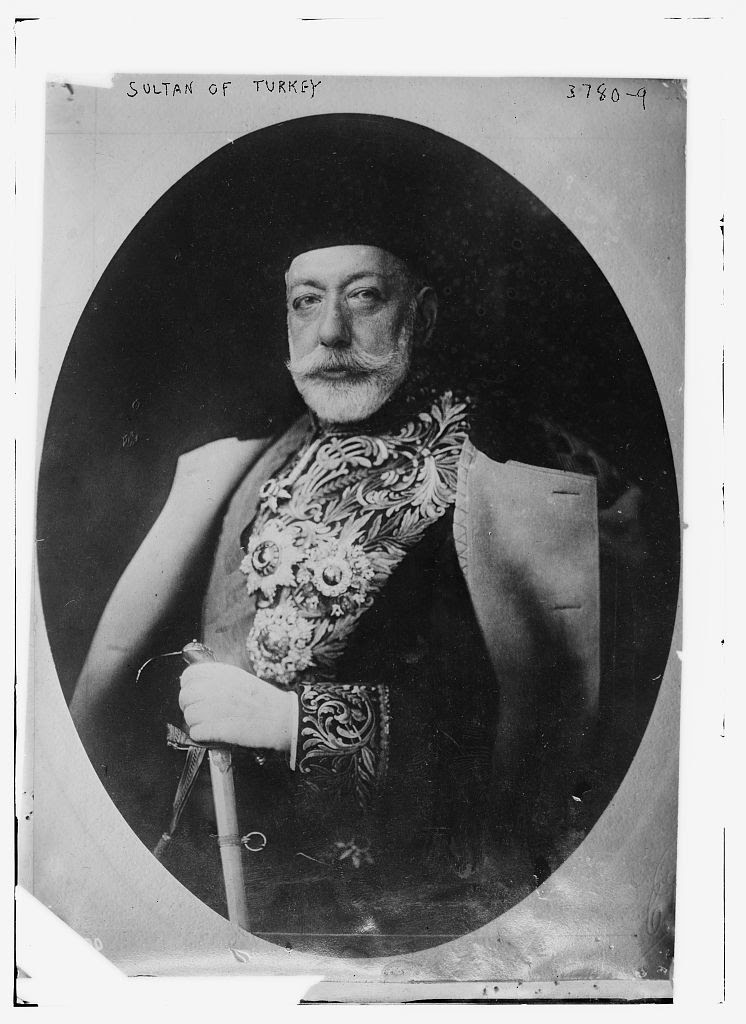
Mehmet V, Sultan of Turkey
A new agreement with Britain?
Meanwhile, it seemed that Britain was about to sign an agreement with Turkey. That felt dubious: Turkey’s behaviour towards the Greeks hadn’t been exactly exemplary (but then the Greeks had been pretty nasty back). Still, better to have bonds between nations than unresolved tensions: things would be best with peace and prosperity, so on balance he was glad that the Turkish Minister Talaat Bey had told a correspondent “... a complete agreement has been arrived at between the British Ambassador, Sir Louis Mallet, and ourselves, and that the agreement is on the point of being signed.”

“Arms for Dublin” was a less welcome headline. There’d been another seizure at the Isle of Man. If those weapons were heading for Dublin, then presumably they were for the nationalists, perhaps in response to the stocks being built up by Edward Carson’s Ulstermen.

“It’s always the same,” complained Martin, “we get some moves towards peace on the Continent, and then Ireland comes and bites us in the back.”

“Well, it’s our own fault,” said the Cynic, “take it out on Oliver Cromwell and William III. The sooner England gets out of Ireland, and that includes Ulster and its suspect loyalists, the better.”

“Hey, what sort of talk is that?” said one of the younger men. “Ireland is English, you know.”

“Tell that to the Irish. The armed Irish.”

There was a glimmer of hope over the Women’s suffrage question, but only a glimmer.

The foreign delegates to the International Suffrage Conference, which is being held in London, were received at the House of Commons yesterday afternoon by members of the party in the House in favour of women’s suffrage, comprising Liberal, Unionist, Nationalist, and Labour members.

Lord Robert Cecil and Mr. Ramsay MacDonald both expressed the opinion that the time was not far distant when women would be enfranchised. Mr. Acland (Under Secretary, Foreign Office) said he was convinced that the next Government would be obliged to deal with the question of women’s suffrage as a party measure in some shape or form.


So the only one who could have done something about the question, Francis Dyke Acland, a Minister in the current government, had put it off as a matter for the next. Even Robert Cecil, for the Conservatives, and Ramsay MacDonald, for Labour, neither of them in office, could only say that the time was “not far distant”.

“Jam tomorrow,” said the Cynic, “you want something now from government? You have to hold their feet to the fire.”

And then – what was this? “Lancashire did well to draw with Derbyshire at Derby yesterday.” The teams had last met only a few days earlier and Lancashire had won comprehensively. And now they had to “do well” just to secure a draw? Dismal.

Whatever else he would look back on 1914 for, it clearly wasn’t going to be with pleasure over the cricket.

Monday, 14 July 2014

Countdown to War, Day 17. 14 July 1914: "No Surrender", Mrs Pankhurst struggles on, and gentility is maintained at Birkdale and Southport. Viciously


One hundred years ago today, on Tuesday 14 July 1914, Martin the young railwayman and his friends might have read some historic words in the Manchester Guardian. Spoken by Sir Edward Carson, the leader of Unionism in Ireland, they were deliverd to a meeting in Drumberg as part of the 12th of July Battle of the Boyne celebrations. Faced with all those cheering people calling on him for leadership, he had asked himself:

What is the one lesson I ought to learn from all that I have seen to-day? And I think I can sum it up in the two old words you every one wish to say to me, “No surrender.” (Great cheers).


“No surrender”. A call for implacable conflict and words he felt might well echo down the decades.

While the Protestants were cheering Carson, at Castlebellingham in County Louth, 4000 Irish Volunteers were parading in military formation, as a photograph published by the paper attested. And so the descent towards civil war continued...

Things weren’t getting sorted out in the Levant either. The paper published another extract from a letter by an “Englishman in the Aegean Islands”:

It is, I confess, difficult for me to see how, if, as it seems, the expulsion of the Christian inhabitants of the coasts opposite Lesbos and Chios, was, so to speak, a simple move in the game, a simple retort to Greece, it might not have been carried out openly and diplomatically without the horrors that attended it. 


“More horrors,” said Martin. 

“With religion to fuel them,” said the Cynic, “to make sure they really cut deep. The Irish don’t know what delights they’re preparing for themselves.”

Meanwhile, Mrs Pankhurst, released from prison for four days, was going to be returned to gaol before she could address a planned suffragette meeting. Mrs Mansel had told a meeting of the Women’s Social and Political Union:


Mrs. Pankhurst was too ill to be able to go to the meeting except on an ambulance with her nurses and doctors. And what did the Home Secretary propose to do? Did he propose to tear her away from her nurses and doctors? ... Mrs. Pankhurst was going to the meeting on Thursday evening, and nothing could stop her. She was going to be there, and they were going to see that she was there. (Cheers)

It was impressive just how far people were prepared to go to attain their goals. Whatever it cost, even their own or others’ lives or liberty. Would he go so far for any of those causes? Ireland? Did it matter whether it stayed or went? Turkey and Greece? He didn’t understand their conflict, but did anyone else? The vote? Well that was worth a sacrifice, he agreed. But would he go through what Mrs Pankhurst had?

Croquet: genteel. And vicious
In a world where so much seemed to be going wrong, there was at least one area in which a sense of proper order and decorum was being maintained.

The eighth annual croquet tournament promoted by the Birkdale and Southport Croquet Club began yesterday, and will continue for the rest of the week. In spite of the fact that there are several other meetings in various parts of the country in progress at the present time the entry was much more numerous than usual, and the standard of the competing players was much higher.


“See?” said the older tracklayer, “what are you complaining about? Things can’t be going all wrong in a world which still has that much gentility in it.”

“What are you talking about?” asked the Cynic. “Bloody vicious game. Good preparation for war, if you ask me.”

Sunday, 13 July 2014

Countdown to War, Day 16. 13 July: votes for women, a force for peace?


One hundred years ago today, on Monday 13 July 1914, our Mancunian railwayman friend reading his Manchester Guardian, might have been impressed, and had his scepticism shaken, by the scale the movement for women’s rights was taking.

The International Women’s Suffrage Alliance conference had been meeting in London all week, and on the previous day had devoted some time to planning the next conference, in Berlin in 1915. The Berlin session would consider the relation of the vote to wages and prostitution, “with further consideration of wages to the social evil. Another question to be discussed at the conference relates to what women have done and what they can do in municipal government.”

That would make the Berlin conference particularly interesting for France, since “the women there are hoping very shortly to get the municipal vote.”

It might be time for Martin to overcome his reservations and accept that the momentum for women’s suffrage would ultimately prove irresistible. Besides, as it involved international meetings of this kind, it was a further guarantor of peace between nations. A conference in Berlin with support from Britain and France? That meant building bridges across some tense frontiers.

On balance, he was coming round to the idea that women should win the right to vote, and rather hoped that it might be extended to him, too.

Once again, things seemed to be heading for a resolution in one of the world’s trouble spots, Mexico. “Information has been received from Mexico City that General Huerta is about to resign in favour of Señor Carbajal, the newly appointed Minister for Foreign Affairs.” He had little understanding of the implications for ordinary Mexican citizens, but it sounded like a way to stop conflict and, surely, the twentieth century was not a time to settle differences by military means?


William III at the Battle of the Boyne
Pacifying Ireland in England's time-honoured style

That was a lesson still to be learned in Ireland, it seemed. The Ulster Hall in Belfast had seen a 3000-strong meeting of Orangemen to mark the twelfth of July. It was on that day that Protestant Irishmen celebrated the Battle of the Boyne, the moment in 1690 when William of Orange, William III of England, defeated James II, ensuring the Protestant Ascendancy on both sides of the Irish Sea.

Martin had met Irishmen in Liverpool who gave a far less attractive account of the battle and its consequences. As Catholics, they saw nothing to celebrate on 12 July. To the Orangemen, on the other hand, it was a high point in the calendar.

The Rev. Dr. Patterson, of May Street Presbyterian Church, who preached, based his discourse upon the text “And Moses said unto his people, ‘Remember this day.’” (Exodus xiii., 3). Israel, he said, was commanded to keep in remembrance her deliverance from the bondage of Egypt, and to-day hundreds of thousands throughout the English-speaking world were commemorating a great deliverance from the bondage of Rome – a bondage more terrible than that of Egypt.

Referring to the time of the Battle of the Boyne, he went on:

William led; in these days Edward leads, and he is in possession of the flag which went before William... God raised up Moses and Joshua to bring His people from Egypt to Canaan, and we do not question for a moment the fact that He raised up William III. in the seventeenth century to save Great Britain and Ireland from the hierarchy of Rome. Surely we have the same right to believe that Sir Edward Carson has been raised up in the twentieth century to save Ulster...

Well, if it was with the blessing of God that Sir Edward Carson was organising an illegal armed movement, then Ireland’s problems were far from over. It would, indeed, be trouble enough if his supporters merely believed that...

At least Lancashire had stuffed Derbyshire. By an innings and 25 runs. That at any rate was something over which Martin could feel unqualified pleasure.

Wednesday, 9 July 2014

Countdown to War, Day 12. 9 July: Guns for Ireland, torture of suffragettes, and parasols.


One hundred years ago today, on Thursday 9 July 1914, as Martin’s group of young railwaymen read the Manchester Guardian together, they would have discovered that a furniture removal van had arrived in Londonderry the day before, from Glasgow. It was searched but nothing was found. 

One of the officers, however, was not satisfied and noticing that the van was internally sheeted with wood screwed to the sides, insisted on a full examination. A screwdriver was applied, and at once there was an amazing disclosure... The van and its contents were at once seized and conveyed to the police barrack yard, where 250 rifles were counted, with a full supply of ammunition.

Meanwhile in England, Francis Dyke Acland, Under Secretary for Foreign Affairs, told a public meeting that ministers:

...were willing to turn a blind eye to preparations for civil war as long as there were any hopes of a peaceful settlement, but if force was used to paralyse the civil government and to prevent civil servants of the Crown from doing their duty, then force would be met by force, whatever the consequences.

According to the paper, the statement was met by cheers. Which was curious: who cheered a minister who’d been turning a blind eye to preparations for civil war?

Reginald McKenna: would never use
torture as a punishment
But, hey, if force feeding happened, well yes,
it could be punishing...
Meanwhile, the argument continued to rage against force feeding of suffragettes. Reginald McKenna, the Home Secretary, faced by denunciations of the practice by physicians:

...strongly repudiates the statement by them that “forcible feeding is being used as a punishment and as a deterrent’ and adds that ‘nothing he has ever said affords any justification for it.” That must, of course, be taken as conclusive so far as Mr. McKenna’s meaning is concerned in any statement that he has made. That is to say, he has never represented forcible feeding either as a punishment for offences committed or as a deterrent to their commission. That is perfectly true; and yet the fact remains that forcible feeding is being used and has been admitted by Mr. McKenna to be used as a deterrent, not indeed against the commission of crimes but against evading the penalty for them. ... The forcible feeding is there just the same, it becomes virtually part of the punishment, and it is used to break the will of the prisoner.

“Brilliant!” said Martin, “exactly true and a barefaced lie. We
’re torturing people. In the twentieth century, for God’s sake. And McKenna comes up with weasel words to mislead us.”

“He’s a banker, isn’t he?” said the Cynic.


Churchill and McKenna swap places,
at the Home Office and Admiralty in 1911
Beresford, Admiral and MP, was an outspoken
champion of the Navy and opponent of the government
Fortunately, the paper wasn’t devoid of good news. “The Parasol and its Possibilities” opened up some fresh perspectives on a key question for our working class lads in 1914. “This year we all wear flounces and tunics and so the parasol, as a matter of course, is flounces and tunics.”
A burning issue returned in 1914:
Parasols? Flounces? Both?
One of the young tracklayers read that piece out, in a good imitation of southern English, but on a clear and audible foundation of good, clean Manchester; another flounced around the room, hand on hip and elbow, to show just how he was wearing his tunic that year.

How they all laughed.


Bringing together two great questions of the year:
US suffragettes with their parasols