Showing posts with label Turkey. Show all posts

Wednesday, 8 January 2020

A hard-won government in Spain can teach us a lot

It’s been a long haul, but Spain at last has a confirmed government again.

That matters to me particularly because we now live in Spain, land of our Brexit exile. Others, though, might also find much of relevance in the difficult road that got us here, littered as it was with obstacles, many of them self-inflicted.

Pedro Sánchez addresses the Cortes
Let’s start with the positives.

Spain has its first coalition government since the end of the Franco dictatorship and the restoration of democracy in 1978. That brings it into line with most countries in Europe, where government always requires negotiation between parties and compromise to reach an agreement that commands broad support. It’s not the case in Britain, of course, where Members of Parliament are still elected by simple majorities in individual constituencies. As a result, parties with minority support nationally can command a huge majority in Parliament. As is the case today.

I’m not sure that this leads to better government.

Pedro Sánchez, now the confirmed Prime Minister of Spain after holding the role in an acting capacity since last April, and leader of the centre-left Spanish Socialist Workers Party (PSOE), has agreed a joint programme for progressive government with Pablo Iglesias, of the anti-austerity, harder-left Unidas Podemos Party (UP). That has kept the right well away from power, even though the far-right Vox now has a major parliamentary presence.

You read that right. A joint programme for progressive government. And the hard right out of power.

How many, in Britain, the United States, Poland, Hungary, Turkey or Brazil would give their eye teeth to have such a government? And how many, particularly in Britain, the United States, Poland, Turkey or Brazil would like to see the far right well away from government?

So, now the negatives. 

The Spanish left nearly didn’t pull the trick off, and its worst enemy was itself. As in Britain and the United States especially.

That joint programme between PSOE and UP was something that could have been agreed months ago. Say, straight after the General Election in April, which left the PSOE as the biggest single party in the Spanish Parliament – the Cortes – with 123 seats, while UP had 42. PSOE was up significantly, while UP had lost seats, but at least between them, they had 165 MPs, just 11 short of the 176 needed for a majority in the 350-seat Cortes.

They couldn’t reach agreement. After six months of negotiation, new elections had to be called in November. Both parties lost seats, three in the case of the PSOE, though it was still the biggest party in Parliament, while UP lost seven. Now their task had become far harder, since they’re now 21 behind the magic number for a majority.

Far worse still was the surge in support for the quasi-fascist Vox, which shot up from 24 to 52 seats to become the third biggest parliamentary presence.

The PSOE-UP failure to compromise before the November election meant that when they finally did, the two parties of the left were working from a weaker position, and against a far more vigorous opposition. Note and learn, British Labourites or American Democrats: you risk it all when you decide to dig your heels in and refuse to budge on principle. Insisting on doing it all may leave you unable to do anything at all. The price of intransigence can be a Trump or Boris government.

Sánchez has at least avoided that fate, but by the tightest of margins. He couldn’t win his investiture on Sunday (yes, Spanish MPs can work on Sundays) when an absolute majority was required, in the first vote; on Tuesday however, with the bar lowered to requiring simply more Yes votes than Noes, he squeaked through, by just two votes with eighteen abstentions.

Those abstentions were won through hard negotiation. Sánchez had to make agreements with eight parties, covering 313 different commitments, to secure those abstaining votes. Not all those commitments are compatible with each other. Government, with so much to deliver to keep minor parties at least neutral, and up against such a powerful right, isn’t going to be easy.

This is particularly true in the specific circumstances of Spain. Some of the commitments Sánchez has had to make concern the status of Catalonia and its desire for independence. That’s something he can’t grant and retain his support in the rest of Spain; it’s going to be challenging to give the Catalans enough, short of independence, to keep Tuesday’s abstainers in line.

With a powerful and ferocious right-wing Opposition, he and Iglesias are going to have torrid time implementing their programme. It’s going to be enthralling to watch. I’m at least glad they have the opportunity to try – after the crushing defeat of the British left in December, being able to do as much as Sánchez can in Spain seems a distant dream.

There were some good moments in the investiture debate.

One of the most moving was the standing ovation offered to Aina Vidal, who turned up to vote despite undergoing aggressive treatment for cancer.
Aina Vidal stands to acknowledge the ovation for her presence
Another was Sánchez’s reference to one of the iconic figures of the Second Spanish Republic, the one overthrown by Franco. Manuel Azaña told his compatriots, “we are all children of the same sun and tributaries of the same river”.

In Britain and the US, I can’t help feeling that we’re all children of the same deeply disrupted climate system, and tributaries to the same traffic jams.

Maybe the Spanish example can help us towards a more encouraging future.

Friday, 11 October 2019

Treason in the White House

The price of not being prepared for war can be an end to peace
Syrian Kurds flee the fighting as Turkey invades
Oh, say can you see,
By the dawn's early light,
What so proudly we hailed,
At the twilight's last gleaming?


The words of Francis Scott Key’s poem, which became the lyrics for the US national anthem, refer the American flag flying over Fort McHenry in Baltimore, Maryland, after a night’s bombardment from ships of the British Royal Navy in September 1814. The image of the flag still flying proudly in the dawn, despite such a battering from what was then the world’s leading naval power, is a tribute to the pluck of a still small nation standing up to the oppression of a far more powerful one.

I don’t believe that war is glorious, even less that it should be fought for glory. It should be fought as a last resort, and only because the principle at stake is so vital that even deliberately killing others is a price worth paying to protect it. That was the case in Fort McHenry, for instance.

Even better, however, is to be able to use the threat of military force to protect the principle, without actually activating it. The Principal of my first college was a former General, Sir John Hackett. He once told me that a military commander who has to give the order to open fire has already failed. The perfect military engagement, in his view, was one where the winning side deploys such overwhelming force that the other backs down without firing a shot.

Sometimes, indeed, the mere presence of a powerful nation’s soldiers in a potential war zone can deter other nations even contemplating military action.

These are principles known well in the United States. Let’s see what a few presidents have said on the subject.

George Washington declared that “being prepared for war is one of the most effective ways of preserving peace”. It wasn’t an original thought. The Romans had a similar saying, “si vis pacem, para bellum”, “if you wish for peace, prepare for war”, and the Greeks and Chinese voiced the same idea earlier still.

To be a great nation requires certain qualities. “We must dare to be great; and we must realise that greatness is the fruit of toil and sacrifice and high courage”. That’s true even without war, but it’s certainly true of war in particular. Being prepared for war requires being ready to engage in toil, to make sacrifices and to display high courage.

That was Teddy Roosevelt.

There’s another quality that great nations, like great individuals, enjoy and display. “I need loyalty. I expect loyalty,” as another President put it. And he’s right: without loyalty, high courage, toil and sacrifice will produce little worth having.

Who was that President? Why, Donald Trump. Interesting, isn’t it, that he talked about “I need loyalty”? He needs it from others. He doesn’t need to show any himself.

Which is why he’s suddenly pulled out of Syria, leaving his allies, the Kurds, at the mercy of Turkey. Which has prompted invaded.

The American presence was the classic case of simply being present. They weren’t there to fight the Turks. But their mere presence meant that an invasion couldn’t be launched – it might have led to American losses and a massive American retaliation. Trump could have preserved peace by being ready for war. Instead he claimed:

WE WILL FIGHT WHERE IT IS TO OUR BENEFIT, AND ONLY FIGHT TO WIN. Turkey, Europe, Syria, Iran, Iraq, Russia and the Kurds will now have to figure the situation out…

Figuring the situation out for the Kurds sounds like getting themselves massacred by the Turks. Which, incidentally, means they won’t be able to guard prisoners from the ISIS terrorist movement, now poised to escape and start their campaign again. After three years of US effort against them. That doesn’t sound like “FIGHT TO WIN” but much more like “FIGHT TO LOSE”.

The loss will be down to a failure to show precisely the loyalty Trump himself demands.

Let’s end with some other words from a US President, on the day after the Japanese attack on Pearl Harbor:

Yesterday, December 7, 1941 a date which will live in infamy the United States of America was suddenly and deliberately attacked by naval and air forces of the Empire of Japan.

We can add another date to the roster of infamy: 8 October 2019.

The day Donald Trump decided to pull out of Syria, without notice, betraying his Kurdish allies to the invading Turks.

Tuesday, 4 December 2018

Ignorance compounded by stupidity, and a longed-for homecoming denied

If I should die, think only this of me:
That there’s some corner of a foreign field
That is for ever England. There shall be
In that rich earth a richer dust concealed;
A dust whom England bore, shaped, made aware,
Gave, once, her flowers to love, her ways to roam,
A body of England’s, breathing English air,
Washed by the rivers, blest by suns of home.


A friend of mine once told me how little she liked those lines. Crass nationalism she found them, and I can see her point. After all, it doesn’t even talk about Britain but merely about England – as so often with the English, the Scottish, Welsh and (arguably) Irish are simply left out of account.

She may be right. And yet to me the key word is the last: ‘home’. These are lines expressing a wistful longing for home, and the speaker’s heartbreak at knowing it will never be realised. England is named only because he happens to be English.

The poet, Rupert Brooke, was indeed English. And he was never to return home. There is some corner of a Greek island that he’s made forever England. 

Rupert Brooke's grave on the Greek island of Skyros
In April 1915, he was shipped out to the far easternmost parts of the Mediterranean, to join an army that was tasked with landing on Turkish territory, on the Gallipoli peninsula that guards the entrance of the Dardanelles. This is the first part of the narrow waterway linking the Mediterranean with the Black Sea. Where it opens into the Bosphorus stands Istanbul, then capital of the Ottoman (Turkish) Empire.

The army’s mission was to seize that capital and force the Turks out of the First World War.

Some weeks ago, I had dinner in Berlin with a German-American colleague and her German partner. He, the partner, at one point said to me, ‘Have you read Lawrence in Arabia by Scott Anderson? Because if you haven’t, you should.’

It took the advice of a young German for me to discover a book by an American that would illuminate a strange and painful episode of British history.

Lawrence in Arabia isn’t the same thing as Lawrence of Arabia though it chiefly focuses on the same man. It’s a remarkable study of the duplicity and incompetence principally of the British, but also of the French and Turks, in the Eastern Theatre of World War One. It’s also an enthralling retelling of the stories of some extraordinary men: the Jewish agronomist and spy Aaron Aaronson, the American oil man and spy William Yale (yes, his family founded the university), the German anthropologist and spy Curt Prüfer and, above all, the larger-than life figure of the British warrior and spy, T.E. Lawrence, Lawrence of Arabia.

T. E. Lawrence in Arab dress
When the British decided to land their forces at Gallipoli, they did so against Lawrence’s advice. He argued for a landing instead at Alexandretta, modern day Iskenderun, where the Turks were desperately vulnerable – as they knew themselves, given that the roads were terrible and the railway in a desperate state following heavy flooding. For Lawrence, a force of only a few thousand could capture it and threaten to split the Ottoman Empire in two. Even less optimistic colleagues felt 20,000 would do it.

But the British chose the Dardanelles instead. They made several attacks before the main landings, giving clear warning of what was to come. It also made no sense to go for the end of the Gallipoli peninsula. The main German adviser to the Turks couldn’t believe his luck when they did, as he had expected them at a far more difficult spot to defend further up the Dardanelles. Scott Anderson points out that ‘one would be hard pressed to find a worse landing site most anywhere on the three-thousand-mile long Mediterranean coast of the Ottoman Empire’.

Yet it was here that they attacked. Their first day objective was to ‘secure a small village some four miles inland, and then to advance on the Turkish forts just above. Over the next seven months, the British would never reach that village, but would suffer nearly a quarter of a million casualties trying.’

A quarter of a million lost in failure when 20,000 might succeeded elsewhere.

Meanwhile, an army from British India went gaily up the Tigris with little idea of what lay ahead of it. At Baghdad, they were turned back and retreated to the town of Kut where they were surrounded and besieged. The British lost a golden opportunity to save their men when Indian troops stumbled into a Turkish citadel which had been left undefended, but were ordered out because it hadn’t been properly bombarded beforehand. When they tried to capture it later, they failed at a cost of 4000 men. Two relieving forces lost 10,000 each and the garrison at Kut was obliged to surrender ignominiously.

Lawrence himself would write, ‘British generals often gave away in stupidity what they had gained in ignorance.’

Rupert Brooke died even before his generals would compound their ignorance with stupidity. A mosquito bite became infected. In those pre-antibiotic days, sepsis was impossible to treat. He died aboard ship on 23 April 1915, two days before the landings started.

Lawrence also spoke of the simple soldiers sent out by Britain. ‘We were casting them into the fire of the worst of deaths, not to win the war but that the corn and rice and oil of Mesopotamia might be ours… All our subject provinces to me were not worth one dead Englishman.’

Not a single death was worth what the British Army had been sent out to win. Brooke had been washed by the rivers, blest by the suns of home. A lamentable waste that he and thousands of others weren’t left there to continue enjoying them.

Burying Turkish dead at Gallipoli


Monday, 13 February 2017

Birds of a Brexit feather?

Birds of a feather flock together, they say. Or to put it the way the French do, tell me who you hang out with, and I’ll tell you who you are.

Erdoğan, Trump and May. Birds of a feather? 
Germany has just elected a president of the centre-left, backed by both the two biggest parties, Angela Merkel’s Christian Democrats, and her coalition partners, the Social Democrats.

It was interesting to be in France last week. Support for the Conservative candidate for the presidential election in May has collapsed, following the publication of revelations about his use of nearly a million euros of public money to employ as political assistants his wife (who claims she did no work or him) and his children (who weren’t qualified for the work they were ostensibly asked to do. Meanwhile, the far-right candidate, Marine le Pen, may we have seen her support peak, at a shockingly high level – perhaps as high as 30% – but with a growing probability that she’ll struggle to raise it any higher and will therefore miss her chance at the presidency. This has raised hopes that  a moderate candidate of the centre left, Emmanuel Macron, may take the prize.

Following on from the defeat of the hard right candidate for the Austrian presidency, it begins to feel as though the unappetising xenophobic nationalism that has gripped Trump’s America and Brexit Britain may not after all be unstoppable. It may, indeed, already have reached its high-water mark.

There’s a glimmer of hope in the darkness, then. A sense that the infection that has been poisoning our societies can be resisted. A growing feeling, even, that Europe can pull together, stand united, and uphold the kind of values we thought, in pre-Trump days, were secure in the democracies.

Sadly, for those nations where the populist currents have already wreaked their toxic harm, that doesn’t make life any easier. Facing a cold, bleak world out there, Britain is having to go, cap in hand, to some dubious friends. In order that it can leave the EU and turns its back on the old friends who may soon be making a stand for the principles we previously believed Britons held dear.

Theresa May was proud to be the first foreign leader to visit Donald Trump. That’s the man who, on grounds of security against terrorism, has been trying to exclude foreigners from seven countries which have never been the source of an attack on American soil. Foiled by the judiciary in his first attempt to impose that diktat, he has resorted to attacks on judges worthy of autocrats anywhere. He’s not keen on journalists who dare to criticise him either.

His visitor, it seems, isn’t that keen on them either. It has been revealed that May’s government is planning legislation against whistle-blowers that threatens them, and journalists who publish the information they provide, with prison. Another hallmark of the authoritarian regime.

Which leads neatly into the tale of May’s next foreign visit, to Turkey. There she called on Recep Tayyip Erdoğan, the strong man who hasn’t merely attacked the judiciary in words, but has dismissed 125,000 people from their jobs, including police and judges, on no better grounds than a denunciation by anonymous informers. Indeed, he even has 45,000 in gaol facing terrorist charges.

Trump and Erdogan. These are the people Brexit Britain has to hang out with.

Does that tell us what Britain’s becoming? Because that feels like a pretty dismal picture of the nation.

Friday, 27 January 2017

Lesson for Trump: why not try generosity? It actually pays

It’s ironic that generosity and opening up to others can sometimes be as beneficial to the nation offering the gifts as to those receiving them.

Truman and Trump
The Statesman and ... the Donald
The winter of 1946-7 was desperately hard, with some of the lowest temperatures on record. For Europe, devastated by war, that was catastrophic. For the vanquished, inevitably – Germany with much of its urban landscape reduced to rubble and huge numbers of homeless among the worst hit – but victors too were suffering, with Britain still having to cope with rationing and struggling to bear the burden of war debts far beyond its resources.

At that time, Britain was still trying to pretend it could play a world role (echoes of today). It had, for instance, forces still deployed in Greece and Palestine. But Clement Attlee’s government began to realise that it was going to have to take a more realistic view of the weight of its (unlike Theresa May’s) . It warned the United States that it would have to start scaling down some of its military commitments, including in Greece.

The reaction of the Truman administration then in power in Washington was astounding and exemplary.

For better or for worse, it decided that resistance to Soviet influence in Greece and Turkey had to be maintained, and that it would therefore shoulder the burden itself, to the tune of $400m.

Far more to the point, it chose to use the newly appointed Secretary of State George C. Marshal, who chaired the chiefs of staff during World War 2, to investigate the state of the economies throughout Europe and to come to their assistance. This was the start of Marshall Aid. It came to over $12bn, corresponding to ten times that amount today.

Much of the money went to the erstwhile and newly-defeated enemy, Germany.

As Truman put it, “We are the first great nation to feed and support the conquered. We are the first great nation to create independent republics from conquered territory: Cuba and the Philippines. Our neighbours are not afraid of us. Their borders have no forts, no soldiers, no tanks, no big guns lined up.”

We’d have to question just how relaxed countries near the US truly felt. The giant to their North had shown itself perfectly prepared to flex its muscles and use its force to have its way, and they must have been a great deal more suspicious than Truman’s sanguine words suggest. Even so, it was an extraordinary act, to fund a defeated foe instead of taking from it. After all, at the conclusion of the First World War, well within living memory of most adults at the time, an intolerable burden of reparations had been imposed on Germany. That had undoubtedly been a contributing factor to the renewed world war twenty years later.

Marshall aid was an admirable and unprecedented act that deserves congratulations for that fact alone.

It was remarkable for far more than that, though. By allowing Europe to emerge from its ruins, and helping Germany, in particular, become prosperous and successful again, the US guaranteed itself good trading partners from which it too would benefit. It ensured that its presence and influence in the old Continent would remain as strong as ever, at least in the Western areas. Overall, it gave a huge stimulus to the world economy from which all nations, including the US, profited.

Generosity and strategic vision went hand in hand.

Now roll forward 70 years.

Faced with undoubtedly significant economic problems, Donald Trump has decided to use not generosity to advance his cause, but isolationism. He has decided not to try to win the support and trust of neighbouring nations, specifically Mexico, but to wall them off. Where Truman had boasted that Mexicans had needed no fortresses against the US, Trump will build a wall against them.

Trump plans to make Mexico pay for the wall, by taxing imports into the US. In reality, this means that US importers will pay for it. Even so, it will do great damage to Mexico. Far from making it a wealthy and successful nation he is, therefore, taking steps that will undermine its economy and weaken it as a trading partner.

He’s threatening similar action against other nations, notably Germany.

His is the opposite view to Truman’s. He wants walls, not openness. He wants trade barriers, not free business. He wants to take money, not offer it.

Marshall aid was astonishingly successful, stimulating the sustained boom of the post-war years.

It seems obvious that the opposite policy will have precisely the opposite effect.

But then, Trump probably doesn’t waste too much time learning stuff from history. Not even that of his own lifetime.

Sunday, 1 January 2017

Happy 2017

1861 was a lousy year for the United States.

It started with southern States tumbling over each other to get out of the Union. Then in April civil war broke out. That was followed in July by the inexplicable conversion of the major Union victory at the First Battle of Bull Run into a catastrophic Union defeat (though it should be said that the notions of ‘major’ and ‘catastrophic’ would have to be significantly revised later in the war).

It’s no surprise, then, that on 31 December diarist George Templeton Strong wrote:

Poor old 1861, just going. It has been a gloomy year of trouble and disaster. I should be glad of its departure were it not that 1862 is likely to be no better.

155 years on, I feel we can safely echo Strong’s words. Particularly as 1862 turned out not only to be no better than 1861 but was, in fact, considerably worse. A feat 2017 is likely to repeat with respect to 2016.

The year just ended was one where many people, tired of the consensus that has predominated since the Second World War, decided that building bridges was no longer the way to go and we should have some new walls instead.

In June, the British people voted to turn the Channel once more into a moat rather than a mere waterway. Those who knew the sixties and seventies will remember the troubled times in which a former imperial power struggled to find a new vocation. By joining what became the European Union, Britain seemed to find one: no longer merely a diminishing force in the world, it would be a major contributor to the emergence of the Continent as a world power.

In deciding to leave, it has chosen to go back to the time of its decline. Those were the days when Britain was regarded as the sick man of Europe, plagued by poor productivity and constant strikes, where only the wealthy could enjoy a good restaurant meal or a holiday abroad. The nation steadily sank through the economic league table, with Italy at one point celebrating il sorpasso, the moment when its economy overtook the UK’s.

The EU turned that around, but it also opened the doors to immigration from Continental Europe. Those arrivals continue to play a vital role across the British economy, in the health service, transport, farming and catering. Such, however, is todays fear of the outsider that most voters preferred to give up on the benefits of EU membership in the hope of controlling immigration. Ironically, the hope is likely to prove vain. The loss of benefit, however, will be real.

The American vote, however, was far more significant than Britain’s. It’s sad, though constitutional, that the victor took nearly 3 million fewer votes than his adversary. Donald Trump’s lack of a popular mandate is, however, going to have no impact on the way he exercises power in a democracy.

He’s the wall-builder extraordinary. Not that the one he promised, along the Mexican border, is likely to be built. Even if it is, he’s already made clear that much of it will be fence. But that’s part of his style: he feels he can make any promise he wants, without being bound to deliver – presumably, he has convinced himself that his intentions are pure and, in our post-truth society, honouring his word matters less than getting into a position in which he can mould it as he feels it needs.

His principal concern seems to be to make a friend of Vladimir Putin and an enemy of China. Whatever he does with physical walls, he has a metaphorical one in mind which will include Russia on his side and China firmly on the outside.

Aleppo: handiwork of Trump's pal Putin and his mate Assad
Putin has shown himself to be a strongman and supporter of strongmen, such as Assad in Syria or his new-found friend in Turkey, Erdogan. It’s telling that Trump wants to be associated with that club, perhaps because he also rather likes the homophobic, patriarchal and autocratic views it represents. If so, the US is going to become a considerable less pleasant place to be if you’re gay or a woman (how long will abortion remain a right?) and a great deal more unpleasant for African Americans, Hispanics or Muslims.

Meanwhile, we’d better hope that his attitude towards China represents another promise he has no intention of keeping. If he sticks to the collision course he’s plotted so far, the Trump presidency risks being not just bad but terminal.

Oh, well. George Templeton Strong survived 1862. He got through the end of the Civil War and Lincoln’s assassination. He saw the US reunited and prospering. We too may need to keep our nerve and nurse our patience and wait for better days to emerge in the future.

It happened for Strong, so it could happen for us.

In the meantime – happy New Year!

Monday, 18 July 2016

Cockup or conspiracy, and Turkey in trouble

Given the choice of explaining events in terms of conspiracy or cock-up, I’m always far more inclined to go for the latter.

This is because, while I’d never underestimate the sheer devious malice of many powerful people, I’m not as impressed as they are by their intellectual capacity. Nor do I have confidence in the ability of people to keep their mouths shut for long enough to pull off a really comprehensive conspiracy, especially if there are a great many of them involved or it lasts long enough to give them multiple opportunities to boast about it to their twelve best friends.

So I’m prepared to believe that 9/11 happened as a result of a conspiracy between a relatively small number of people headed by Osama Bin Laden, though even then I’m astonished that they were able to be quite so ruthlessly effective in their planning and secrecy. I’m utterly unable to believe that it was all a conspiracy stage-managed by the Pentagon, since that would have required 10,000 people to work in coordination, with not a single one of them spilling the beans since.

Why am I talking about all this now?

Because last Friday a coup was attempted in Turkey, a nation that was already well on the way to autocracy under the leadership of its remarkable and charismatic leader, Recep Tayyip Erdogan. In passing, let me saw it’s men like him that make charisma deeply suspect to me. 

He’s quick to defend democracy when it comes to defending his grip on power, which he indeed established by election. He’s much less so when it comes to protecting those other, less convenient if not downright irritating democratic values, such as the right to freedom of speech, to oppose to government or, even, to expose corruption.

Erdogan: smart operator who's been dealt a winning hand
But as briiliant as he believes? A champion plotter? I think not
Indeed, the Turkish experience is an excellent illustration of how holding elections, though a necessary condition for democracy, is far from a sufficient one.

The coup, as we all now know, fizzled out when the majority of the army failed to rally to it and Erdogan was able to call out large numbers of civilians to resist it. Now he’s in the wonderful position, for a man of his authoritarian inclination, to round up all his opponents – and he has some convenient little lists ready, of people who really wouldn’t be missed, at least by him or his followers. And he’s in the glorious position of being able to do it all in the name of democracy. To protect freedom from military intervention. To defend the core rights of the people to choose their government freely. Or at least, all those people, and it may be a majority, who vote for him.

Among the opponents he deals with over the next few weeks, you can be sure there will be quite a few who took no part in the putsch and were as opposed to it as he was. But they were opposed to him too and, sadly, by an unfortunate administrative error, they will be caught up in the post-coup oppression too.

Since only he seems to have benefited from the coup attempt, and it’s given him just the opportunity to move against the opponents he was targeting anyway, it is indeed easy to imagine that he was behind it in the first place. Who does it benefit, we ask? Him, obviously, so isn’t it possible that he or his agents ensured the attempt was made and crushed, to strengthen the strong man? 

It’s a tempting hypothesis. But not to my taste. I just can’t believe that Erdogan is quite that intelligent. He’s a highly effective bully, and perfectly smart enough to pull a faction together and use it to crush his adversaries. However, smart enough to get people who hate him to act in precisely the way he wants them? To go out on a limb and, as it now appears, put their lives on the line by doing something so completely half-baked, all because they’d fallen for Erdogan’s snake oil selling skills?

I don’t see it. On the other hand, my faith is deep and unshakeable in the capacity we all share to delude ourselves. It strikes me as far more likely that the men who led the putsch thought they’d get away with it. Just like the men in the dying days of the Soviet Union who thought they’d overthrow Gorbachev, and only got Yeltsin instead – with Putin not far behind.

In both cases, rebels got their tanks out without being sure of the backing they needed. They went into battle against men whose skill exceeded theirs only far enough to ensure they had more support than their opponents. These were not brilliant poker players turning the cards they were dealt into winning hands; these were one set of cheats outsmarted by the other.

In both cases, the ultimate victim was any hope of democratic development. Back then, the final price was paid by the Russian people, as now it will be by the Turkish. But it was down to cockup by putschists, not conspiracy by their opponents. Opponents and beneficiaries.

Wednesday, 23 March 2016

Responding to the Brussels attacks: how to get it wrong

It’s Brussels this time. At least another 31 deaths and over 200 injured. Harrowing, dismal events, and the latest in a series of them.

The scene at Zaventem airport, Brussels, soon after the explosion
That’s bad enough, but then it gets worse. As usual, our own reaction will magnify the damage and give the terrorists a victory they’ve done nothing to merit.

The Belgian government, for instance, will go way over the top with security measures, making life much safer but far less convenient. People will have to leave earlier to get to work on time, earlier to catch a plane. So as well as the tragedy inflicted on the families immediately involved, the terrorists will leave a lasting mark on the economy of a major European capital, making it more difficult to run.

The British government has added to the mix by advising against travel to Brussels. I have no particular reason to go to Brussels at the moment, but fear of terrorism wouldn’t stop me: the place is going to be one of the safest on earth for the new few weeks or months. Just a pig to get around.

In any case, it would be nonsense to fear Brussels, since I commute into London. That city has to be facing a risk of terrorism at least as high as at any time since the IRA campaign of the eighties. But I still feel I’m much more likely to be involved in a traffic accident than caught up in a terrorist outrage; since I’m not going to stop crossing roads or driving a car, it makes no sense avoiding London.

Besides, refusing to be deflected denies the terrorists an easy win.

There are other, still more vital ways, of denying them. One of the most important is to resist the urge to bomb them out of existence. It was that kind of thinking that got us into our difficulties in the first place: an illegitimate, unnecessary war in Iraq spawned ISIS. The Syrian civil war has become a proxy for East-West clashes as well as tensions inside the Middle East, that are wreaking havoc in Libya and Yemen too. We’ve brutalised a great many young men, and not a few young women, and given them something to avenge.

Staffan de Mistura, UN Special Envoy on the Syria crisis, told the Guardian that, following the Brussels attacks:

The message we are drawing out is that we need to end the fires of war. We need to find a political solution in Syria to make sure we can all concentrate on what is the real danger, in the world and in Syria.

Take away the underlying conflict, and you take away its expression in other countries – in Turkey, which suffers more often than most, but also in Europe.

Going a step further, we also have to resist the temptation to blame the outrages on Islam or Molenbeek, the district of Brussels from which the attacks against both Brussels and Paris came. Donald Trump is naturally attacking immigration itself as the source of such terrorism, trying to blame entire populations for the work of a handful of people; in Britain, the far-right UKIP attacks open borders in Europe, ignoring the fact that Salah Abdeslam, who led on the logistics of the Paris attack, was stopped at the Hungarian-Austrian border in September 2015, but was allowed to drive on. The failure wasn’t due to the Schengen groups open borders but to lousy intelligence.

Stigmatising a European Muslim population of several million for the actions of a tiny minority simply creates more enemies for us; targeting Molenbeek would be just as counter-productive, since what makes the district generate aggression so easily is precisely that it’s so poorly assimilated. 30% are out of work. One in three of the population is foreign. Increasing its pain will do no one any good.

The IRA campaign in Northern Ireland was waged by a few hundred activists. Behind them, however, there were probably many thousands of passive supporters who provided the active members with information and shelter as necessary.

Eventually, once Westminster had woken up to a more intelligent approach to the province than military repression, huge sums were invested into Northern Ireland to revive the economy. A long campaign led to reasonably fair access to jobs, housing and education for Protestants and Catholics. The effect was to drain the swamp that gave the activists their support.

At the same time, intense and highly competent intelligence work enabled the security services to break up IRA groups and thwart attacks. After all, if the IRA had to depend on many thousands, it was impossible not to have leaks to the police, and good intelligence took advantage of them.

It’s clear, if only from the fact that Abdeslam escaped arrest in Molenbeek for several months, that there’s an extensive passive support network there too. Again, there must have been leaks. But were the security forces set up to take advantage of them? Belgium is, for instance, coming to terms with the fact that the police force has far too few Arabic speakers.

Whatever Trump may say, Molenbeek doesn’t demonstrate a failure of the Community, merely a failure of Community policing.

Will we be smart enough to apply the lessons of Northern Ireland elsewhere in Europe? To respond to the latest attacks not with increased repression but with investment and highly-competent intelligence work? To help all our sad little Molenbeeks, across the continent, out of their misery rather than drive them deeper into it?

Which boils down to one simple question: will we avoid giving the terrorists yet another undeserved victory?

Saturday, 12 December 2015

Cameron: dithering on airports, confused on the Middle East, fumbling on Climate Change. Business as usual

Some enthusiasm may be in order, as the world adopts the Paris Agreement on global warming. It won’t go far enough, or be binding enough, but it may just be the first step towards breaking the logjam, and allowing action to save the planet on which we all depend.

Laurent Fabius brings down his gavel at the Climate Change Conference
and declares the Paris Agreement adopted
Here in Britain we have been debating for nearly a decade the need to increase the capacity for air travel in South East England. Any business organisation significant enough to make its voice heard has been calling for airport expansion. Our exciting Conservative government reacted to a report recommending a further runway at Heathrow, with a promise to make a decision before the end of the year.

Well, David Cameron has kept that promise. His government has made a decision. A firm irrevocable decision.

To put off deciding until next June.

Boris Johnson, the present Conservative Mayor of London, opposes Heathrow expansion. So does Zac Goldsmith, the Tory candidate to replace him. It’s clear that a decision in favour of Heathrow would damage Goldsmith’s chances to keep London, a predominantly Labour city, in Tory hands.

Perish the thought that such considerations may have weighed with Cameron, in his glorious decision not to decide.

In any case, that tendency to dither is by no means out of character for Cameron. He’s never been good at making up his mind. Sometimes, he makes it up and then has to unmake it a while later.

The best example concerns military action in the Middle East.

On 29 August 2013, David Cameron told the British House of Commons:

“…on this issue Britain should not stand aside. We must play our part in a strong international response; we must be prepared to take decisive action to do so.”

On 2 December 2015, the same David Cameron told the House of Commons:

“The question is this: do we work with our allies to degrade and destroy this threat, and do we go after these terrorists in their heartlands, from where they are plotting to kill British people, or do we sit back and wait for them to attack us?”

You’ve got to admire the consistency, don’t you? That full-hearted commitment to action. The determination to wipe out a clearly identified redoubtable enemy. And Britain must help. Unfortunately, in 2013 Cameron was talking about action against Syria’s vile dictator, Bashar al-Assad. One of the groups fighting Assad was ISIS who would doubtless have been delighted to see missiles raining down on the President.

In 2015, the action was against the execrable terrorist group ISIS, one of whose enemies is Syria’s vile dictator, Bashar al-Assad. Who must be delighted to see airstrikes being flown against his rebellious foes.

Ah, well. Cameron knows his own mind. Well, he knows the state it’s in today. More or less. Though it might be better if you asked in six months.

With his sureness of touch, Cameron’s more than ready to cope with the situation he’s plunging into, in the Middle East.

There we see the Russians running airstrikes, alongside the US, British and French, though to be honest the Russians have been doing rather a lot of bombing up in the North West, where there aren’t any ISIS people, though there are anti-Assad rebels. Those are the rebels that France, Britain and the US support. After bombing them, Russian planes fly close to the Turkish border and, according to the Turks, on occasions they stray across it. So when this happened once to often for Turkish tastes, they blew the plane out of the sky.

Meanwhile, Turkey has been training Sunni and Kurdish forces in Northern Iraq to fight ISIS. Back home, Turkey is fighting Kurdish rebels. And Iraq would really rather like Turkey to withdraw its troops from Iraqi soil. However, Iraq doesn’t have an army forceful enough to impose its will within its own borders. Shia dominated, the government is dragging its feet over incorporating Sunnis into that army, leading to delays in giving itself an effective military. The delays were deplored by the British Defence Secretary, Michael Fallon, who knows that airstrikes alone won’t achieve victory against ISIS. He needs someone to put in forces on the ground; Iraq can’t; Syria can, but its army’s controlled by Assad.

Confused? So are the Tories. How many sides are involved in this fighting? How many agendas are being followed? What would “victory” look like?

How can any of us know when the job is done? What are our objectives and how shall we know when we’ve hit them? What’s the exit strategy? That same Fallon calls progress “agonisingly slow.” That’s code for “we have no idea of where we’re going or how long it’s going to take to get there.”

Par for the course for the government Cameron leads. And the non-decision on airport expansion in South East England makes the point. Because, at the time of the historic Paris Agreement on Climate Change, only one option should really have been recommended: no expansion at all. In fact, we ought to be working on reducing our excessive dependence on air transport.

That option, sadly, wasn’t even on the table.

Tuesday, 24 November 2015

It's urgent to get stuck into the Syrian War. Or should we think a little first?

It’s fascinating to watch all the noise that’s been generated over whether or not Britain should take part in air strikes against ISIS in Syria. It’s as though this was becoming an acid test of one’s commitment to democratic rights and rejection of terrorism. Back the bombing of Syria or give up any hope to be taken seriously as an opponent of ISIS, that sort of thing.

No one seems to want to stop and think whether adding Britain’s really rather limited punch to what’s already going on would actually make any serious difference. After all, the US, France and some reluctant, on-off allies from the Arab world have been bombing ISIS for months. As the Paris attacks showed, that’s not really degraded its capacity to act, has it?

It’s not surprising that it’s been so ineffective. Take the French effort after the Paris attack: they flew sorties across the weekend after and announced, with pride, that they’d killed 31 militants. Since estimates range up to 200,000 in ISIS, at 31 dead ever two days, it was going to take a terribly long time to reduce its force seriously that way.

In fact, the only serious reverses to ISIS have been in places like Sinjar, where Kurdish forces have retaken the city from ISIS. Air strikes were vital to that victory, but they couldn’t achieve it alone. It took Kurdish ground forces. 

What’s true in Sinjar is true in Raqqa too. Air strikes will cause inconvenience, and will kill innocents (written off as “collateral damage”) but they will not drive ISIS from their unofficial capital.

No one’s calling for British, French or US forces entering ISIS territory on the ground. Rightly. After all, we put forces on the ground into Iraq, and look how that worked out: our actions directly contributed to the rise of ISIS. The last thing we should do now is to try that again. Far better to back local forces to recapture what is, after all, their land.

I say that though I know that even local forces don’t always do the job we want: there have been accusations of ethnic hostility directed against Sunnis in Sinjar since the Kurds took the city.

In any case, the problem is that in Iraq only the Kurds seem to be capable of putting effective forces in the field. The Shia dominated government is unable to build an army able to take on ISIS. As for the Sunni opposition, rather too many of them seem to have decided that their poor treatment by the government can only be met by backing ISIS.

As for Syria, who on earth can we put our trust in? Who can play the role that the Kurds have played in Iraq? That role may be limited, but in Syria, gripped by a three-way civil war, no one can play it at all.

Which brings us back to the question of the air strikes. Because even in the air, the situation is as confused as on the ground.

We have the US and France with occasional allies bombing ISIS positions. We have Russians claiming to bomb ISIS position but, apparently, focusing more of their action on other, non-ISIS opponents of President Assad – indeed on the anti-Assad forces that the US, France and Britain support. 

To the North lies Turkey, ally of the US, France and Britain, in NATO. But it has Kurdish opponents within its own territory – Kurdistan extends into Iraq, Syria and Turkey. So our ally Turkey has little time for the only force that is making progress against ISIS in Iraq. If the enemy of Turkey’s enemy is Turkey’s friend, one has to wonder how they really feel about ISIS.

And that takes us to the latest development, the downing of a Russian fighter on the Turkish-Syrian border. A long way, incidentally, from the nearest ISIS positions. At first Turkey claimed the strike, on the grounds that the plane had entered its airspace. But later Turkoman rebels in Syria claimed they’d brought down the plane.

Russian jet brought down probably by Turkey.
Adding to the sense of chaos
So we have Russia running bombing strikes against ISIS nowhere near ISIS positions, and we have Turkey, or possibly Syrian rebels aligned with Turkey, bringing down one of the planes.

Confused? Yes, it’s a frighteningly confusing situation. Multiple actors with different agendas, including unavowable objectives kept hidden from their allies, and sometimes running directly contrary to the war aims of those allies.

But in Britain the debate has been boiled down to just one question: when are we going to join the US and France in bombing ISIS in Syria?

Isn’t it time that we started asking a few more questions? Perhaps more sophisticated ones? And maybe do a little thinking about the complexities of the situation before we leap into action?

Especially since such action isn’t likely to do a lot of good, and could create further dangerous incidents, like the downing of the Russian jet.


PS, on a lighter note

If it was the Turks that brought down the Russian plane, it does occur to me that they might have limited themselves to issuing warnings and following up with a stiff diplomatic note afterwards. That would at least have avoided the risk of precipitating a major international incident.

All that reminds me of a story told me by my Genevan uncle-in-law. 

During WW2, British bombers attacking Italian targets would apparently take a shortcut through Swiss airspace. The Swiss were neutral, but flying around took too long and consumed too much fuel.

Every time they did it, Swiss anti-aircraft crews would radio the RAF planes.

“You’re overflying Swiss territory, you’re overflying Swiss territory.”

The RAF crews would radio back.

“We know, we know.”

The Swiss gunners would open fire and the RAF would radio them again.

“You’re firing too far to the left, you’re firing too far to the left.”

“We know, we know,” would reply the Swiss.


Tuesday, 9 June 2015

After Scotland and Turkey, do we all have to become nationalists?

What a joy it is to see a people, saddled with a centralising, increasingly autocratic ruler, turn out and vote to stop him gathering still more power to himself.

That’s what happened on Sunday in Turkey. The HDP, generally described as “pro-Kurd” – the difference from a Kurdish party is that the HDP, under its co-Chairman Selahattin Demirtaş, wants to extend its appeal beyond the Kurdish 20% of the population – took enough seats in the general election to deny the ruling party a parliamentary majority. Suddenly, Recep Tayyip Erdoğan, the former Prime Minister who had moved to the symbolic office of President in the hope of turning the post into something with real executive power, has to go back to the drawing board.

Selahattin Demirtaş of the HDP
which put Erdogan firmly in his place this weekend
So an essentially nationalist party, albeit one that has decided to broaden its appeal outside its region, has, without coming even close to winning the election, made such a breakthrough as to transform the political atmosphere.

Of course, that’s a phenomenon we know sadly well in Britain too. Here, as in Turkey, a nationalist party representing one part of the nation, has won a sweeping victory in its own region, Scotland. The Scottish National Party has reduced, for now at least, the previously dominant Labour Party to only one seat. And, like the HDP, it has found a way to articulate a message that is more than nationalist – indeed, its leader, Nicola Sturgeon, has emerged as a more committed evangelist for moderate social democracy than anyone the Labour Party has found in recent years.

That’s not to say that everyone in the SNP is particularly nice. I had this from a supporter, probably a member, on Twitter the other day: “…your [Labour’s] demise in rUK [the rest of the UK, without Scotland] is also assured. You have as much future as the UK – none.” It’s intriguing that someone can take so much gloating pleasure from the notion that the rest of the UK has no future – a prospect that would cost us dear, but gain him nothing.

Incidentally, that is the classic definition of envy: delight in harm to someone else, for its own sake. So when it comes to the politics of envy, this statement perfectly expresses it.

Nevertheless, it does seem that in its majority, and at the top of the party, the SNP manages to offer a real alternative to the traditional, rather monolithic and uninspiring parties that have dominated the scene for so long. Like the HDP in Turkey. It’s true that the SNP remains entirely nationalist – Scottish, where the HDP is simply pro-Kurd – but it does seem as though nationalist politics might, at the moment, be quite an incubator for social-democratic or liberal thinking.

Sadly, nationalism is also an incubator for far less agreeable things (perhaps rather like my Twitter acquaintance). The far-right, xenophobic, homophobic United Kingdom Independence Party is nothing if not deeply nationalistic. So is the Islamophobic, authoritarian Front National in France. Like the HDP and the SNP, these are parties that are gaining support and upsetting the excessively comfortable political arrangements that suited our leaders in the past.

The uglier face of nationalism:
Marine le Pen of the FN in France, like Nigel Farage of UKIP in England
Does that mean if we want to see some change, we have to choose nationalists of the left or right?

How dismal the prospect would be if the answer to that question were yes. Because, and again my SNP-supporting adversary seems to make the point, it doesn’t take much for a nationalist of the left to flip into something pretty hateful and little different, in brutality of outlook, from a nationalist of the right.

Which means that we need to find that flame that lights up the HDP and SNP and light it in our old, non-nationalistic parties of the Centre-Left. The next few months are going to be crucial in Britain, to see if we can pull that trick off with Labour. But we need to see it happen in a great many other countries too.

In the meantime, though, we can at least celebrate the result in Turkey. it doesn’t matter that the HDP has nationalistic roots. At least it has given an increasingly autocratic politician a bloody nose.

To be fair, one even has to have a little sneaking admiration for Erdogan himself. For the moment, at any rate, he seems at least to have accepted the people’s verdict. There are plenty of countries – Russia for instance – where that couldn’t be guaranteed.

Tuesday, 15 July 2014

Countdown to War, day 18. 15 July: Will Socialism prevent war? Hope for Suffragettes. Oh, and Ireland again...


One hundred years ago today, on Wednesday 15 July 1914, Martin the Mancunian railwayman might have taken some encouragement from a piece in the Manchester Guardian he shared with his workmates. 

Headlined “Franco-German Friendship. Socialist Hopes and Beliefs”, it reported on a congress in Paris of supporters of a Unified Socialist movement, preparing for a full Congress to take place in Vienna the following month.

It was heartening to see the socialists working for unity across the Franco-German border. It was only that week that he’d been reading about Hansi, the artist who’d had to flee German-occupied Alsace because he’d agitated for its reincorporation into France. It would take a movement like socialism, with its inherently internationalist standpoint, to break down that kind of tension and guarantee the peace Europe badly needed to maintain. That the world needed. A French delegate in Paris, Mr Renandez, had said as much: “it was Socialism alone which was qualified to speak in the name of all countries.”

There had been a British presence too, a Bruce Glasier, speaking for the British Independent Labour Party. Not the mainstream Labour Party, perhaps, but not far distant. It made him proud to be associated with such people.

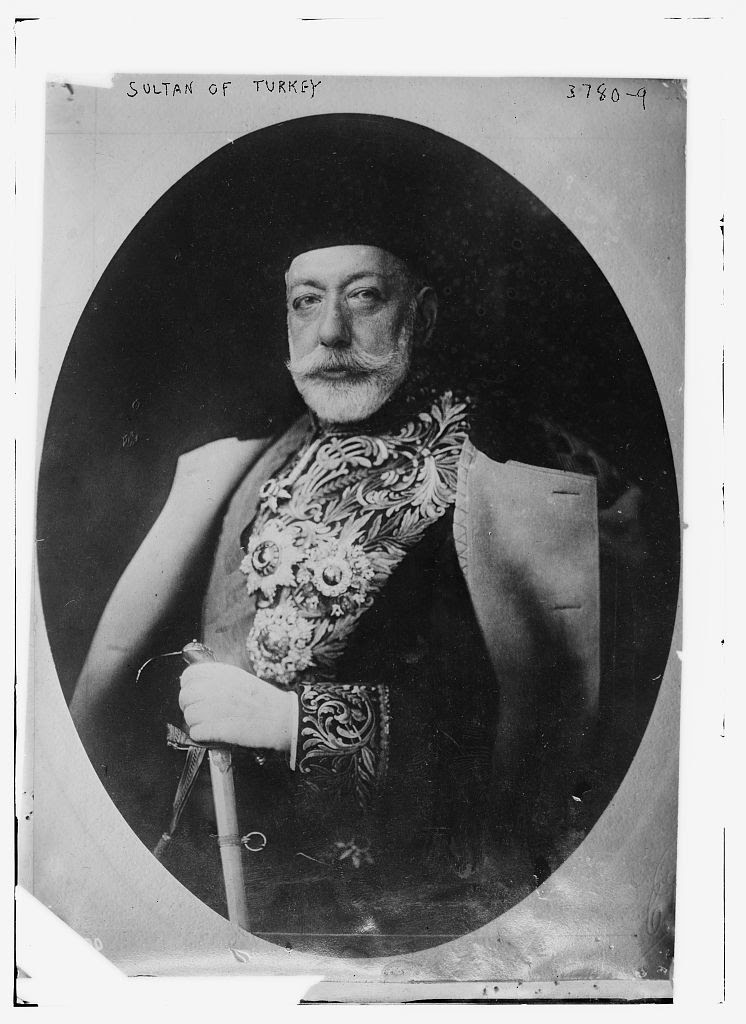
Mehmet V, Sultan of Turkey
A new agreement with Britain?
Meanwhile, it seemed that Britain was about to sign an agreement with Turkey. That felt dubious: Turkey’s behaviour towards the Greeks hadn’t been exactly exemplary (but then the Greeks had been pretty nasty back). Still, better to have bonds between nations than unresolved tensions: things would be best with peace and prosperity, so on balance he was glad that the Turkish Minister Talaat Bey had told a correspondent “... a complete agreement has been arrived at between the British Ambassador, Sir Louis Mallet, and ourselves, and that the agreement is on the point of being signed.”

“Arms for Dublin” was a less welcome headline. There’d been another seizure at the Isle of Man. If those weapons were heading for Dublin, then presumably they were for the nationalists, perhaps in response to the stocks being built up by Edward Carson’s Ulstermen.

“It’s always the same,” complained Martin, “we get some moves towards peace on the Continent, and then Ireland comes and bites us in the back.”

“Well, it’s our own fault,” said the Cynic, “take it out on Oliver Cromwell and William III. The sooner England gets out of Ireland, and that includes Ulster and its suspect loyalists, the better.”

“Hey, what sort of talk is that?” said one of the younger men. “Ireland is English, you know.”

“Tell that to the Irish. The armed Irish.”

There was a glimmer of hope over the Women’s suffrage question, but only a glimmer.

The foreign delegates to the International Suffrage Conference, which is being held in London, were received at the House of Commons yesterday afternoon by members of the party in the House in favour of women’s suffrage, comprising Liberal, Unionist, Nationalist, and Labour members.

Lord Robert Cecil and Mr. Ramsay MacDonald both expressed the opinion that the time was not far distant when women would be enfranchised. Mr. Acland (Under Secretary, Foreign Office) said he was convinced that the next Government would be obliged to deal with the question of women’s suffrage as a party measure in some shape or form.


So the only one who could have done something about the question, Francis Dyke Acland, a Minister in the current government, had put it off as a matter for the next. Even Robert Cecil, for the Conservatives, and Ramsay MacDonald, for Labour, neither of them in office, could only say that the time was “not far distant”.

“Jam tomorrow,” said the Cynic, “you want something now from government? You have to hold their feet to the fire.”

And then – what was this? “Lancashire did well to draw with Derbyshire at Derby yesterday.” The teams had last met only a few days earlier and Lancashire had won comprehensively. And now they had to “do well” just to secure a draw? Dismal.

Whatever else he would look back on 1914 for, it clearly wasn’t going to be with pleasure over the cricket.