Showing posts with label Keir Starmer. Show all posts

Thursday, 25 June 2020

The thing about lying is that it works

The very people who most complain about lying politicians, seem to be the most inclined to believe their lies.

Trump’s supporters, in particular, went along with his slogan about ‘draining the swamp’. That suggested that it was Washington DC that was the breeding ground of all the ugliest and most dangerous lies. Now, since Trump has been in place, with a mandate of sorts to drain that swamp, he has massively raised the level of mendacious toxicity of the very swamp he occupies, which is clearly his most suitable habitat.

Hardly a day goes by without his coming up with some new lie. The latest was to nearly double the number of attendees at his Oklahoma rally, and to claim he was satisfied with the outcome, despite his obvious expression of crushed dejection.

Trump defeated by the poor turnout in Oklahoma
Hope for us all in November


Despite all that, some people keep on backing him. They swallow the lie.

The same is true in Britain.

In my view, Keir Starmer, as leader of the Opposition, had much the better of his exchanges in Parliament with the Prime Minister, Boris Johnson, at Prime Minister’s Questions (PMQs) on the 24 June. Above all, Starmer took the approach so many of us have demanded from our politicians for years or decades: calm, well-informed, moderate. He offered praise for where things had been done well in combating Coronavirus, and then focused on a genuine problem on which he called for clarity from the government.
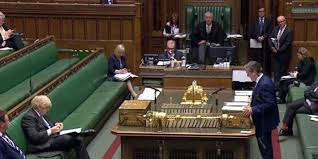
Keir Starmer, on his feet, questioning
Boris Johnson, left


In other words, like the American voters who wanted the swamp drained, he rose to the challenge many UK voters have set politicians.

He asked:

Yesterday, the Government announced the next stage of easing lockdown restrictions. If that plan is to work—and we want it to work—we need an effective track, trace and isolate system. The Prime Minister promised that a world-beating system would be in place by 1 June. The latest figures from yesterday’s press conference hosted by the Prime Minister show that 33,000 people are estimated to have covid-19 in England. The latest track, trace and isolate figures show that just over 10,000 people with covid-19 were reached and asked to provide contact details. I recognise the hard work that has gone into this, but if two thirds of those with covid-19 are not being reached and asked to provide contact details, there is a big problem, isn’t there?

Did the Prime Minister respond in kind? Did he heck. Here’s what he said:

On the contrary. I think that the right hon. and learned Gentleman has been stunned by the success of the test and trace operation. Contrary to his prognostications of gloom, it has got up and running much faster than the doubters expected. They are getting it done—Dido Harding and her team have recruited 25,000 people and so far they have identified and contacted 87,000 people who have voluntarily agreed to self-isolate to stop the disease spreading.

In other words, he gave a purely old-style politician’s answer: on the attack, and dodging the question altogether. As Starmer pointed out:

The Prime Minister just has not addressed the question I put to him. I was not asking about those who have gone into the system—the 10,000—or those who have been contacted; I was asking about the two thirds of the 33,000 with covid-19 who were not reached. That is a big gap.

Clear, simple and focused on the key matter. If only 10,000 are being tested then, on the government’s own figures of 33,000 infected, two-thirds are not being reached. This is bad news. And Johnson’s response? He went back on the attack: “I hesitate,” he claimed without hesitation, “to accuse the right hon. and learned Gentleman of obscurantism. He is misleading on the key point.”

The accusation of misleading is serious in Parliamentary terms and the Speaker had to call on him to withdraw it.

The exchange moved on to the matter of the tracking app, promised for 1 June, then abandoned, now promised again, using commercial software, perhaps some time after September.

Boris Johnson was having no criticism on that front:

I wonder whether the right hon. and learned Gentleman can name a single country in the world that has a functional contract tracing app—there isn’t one.

Strangely enough, the right honourable and learned Gentleman Keir Starmer certainly could name one:

Germany. It had its app working on 15 June and it has had 12 million downloads—I checked that overnight.

So now the decks were cleared for Johnson to move from the lie circumstantial to the lie direct:

I am afraid that the right hon. and learned Gentleman is completely wrong, because no country in the world has a working contact tracing app.

Faced with a clear, verifiable fact, Johnson merely resorted to denial. A blatant, easily refuted lie.

And here’s the sad thing. He won’t be called on it.

Many have demanded that politicians find more honest ways of doing their job, for instance denouncing Blair for lying over Iraq.

They claim to want them more straightforward and thorough.

They called for less aggressive exchanges between them, more focused on solid, reliable information.

Yet a large number of them will rally to Johnson now. They will claim he bested Starmer. They’ll praise his style instead of denouncing his lies.

My only hope? That in neither the United Kingdom nor the United States will they constitute a majority.

So we really can drain the swamp and move to a healthier brand of politics.

Saturday, 4 April 2020

Keir Starmer's challenge

Just twenty minutes before the results of the election for a new Labour leader were announced, I was still on tenterhooks. The signs had all been hopeful, but I’ve been disappointed by election results too often before. It was conceivable that the Party membership might have decided that the best person to replace Jeremy Corbyn as leader would be another Corbynist.

After two general election defeats under Corbynist leadership, it seemed insane to try our luck at a third. But was a presumption of sanity justifiable?

I’m glad to say that ultimately it was. Despite my anxiety, the new leader was Keir Starmer, elected on the first ballot with 56.2% of the vote. A comprehensive victory and a solid mandate.
Keir Starmer (right)
with Jeremy Corbyn, whom he replaces as Labour leader
Starmer is a former of Director of Public Prosecutions, leading all public criminal prosecutions in England and Wales, a role he played with great effectiveness.

Before that he had been a defence barrister, notably defending the McLibel case, where McDonald’s threw all its weight as a major international corporation, into persecuting two individuals who had protested against them.

He was elected to Parliament in 2015. That meant being caught up at once in the string of crises that started with Jeremy Corbyn’s election as leader, followed by the 2016 referendum that led to Brexit, general election defeats in 2017 and, crushingly, in 2019, and finally the Coronavirus pandemic. If Starmer had been hoping for a quiet life, he must have been badly disappointed.

He served in Corbyn’s team for three years, even though he’s no Corbynist. That’s a key quality: without being a member, he’s established that he can work with a wing of the party which, though reduced to a minority now, still holds massive sway amongst the membership.

Corbynists were keen to drive non-Corbynist MPs out of Parliament. It’s deeply unpleasant and damaging to the party, forced to focus in on itself and riven by factionalism. That’s why, though there are understandable calls within the new Labour majority to retaliate in kind, they need to be resisted.

No purges has to be the watchword, and I think Starmer is well-placed to issue it.

That isn’t only for ethical reasons. A pure, homogeneous party is far too narrow. The insistence by Corbynism on its own version of socialism has driven many out of the party. Much more seriously, it has driven voters away. As Phil Wilson, a former Labour MP who lost his seat in the December 2019 debacle, puts it:

There was no need for Corbynistas to listen to them [voters]; they needed to listen to the Corbynistas. Corbynistas knew what was best.

We need to reach out to voters. That means that we need to reach out to those who walked away from the Corbynist Labour Party, without losing those who stuck with it because of Corbyn. We need to embrace all wings of the party.

In other words, we need to rebuild Labour as a broad church. That means including the Corbynists. Ironically, the very expression ‘broad church’ was treated as practically obscene in Corbynist circles.

This is a paradox. Starmer has to rebuild the Labour Party with the Corbynists but in spite of the Corbynism. Why? Because it’s the hard Left, most recently represented by Corbynism, that has ensured that Labour has held power in only thirteen of the last forty years.

In my lifetime, I’ve twice lived through an experience I would have hoped not to live through even once. That’s Labour falling under the control of the hard Left. It happened first in the early 1980s. In the 1983 election, Labour won fewer seats in parliament than in any other election since 1935.

Making the Party electable again took fourteen years. The bulk of that work was done by a leader from the soft Left of the Party, Neil Kinnock. He had the misfortune of losing two elections himself, but at each of them he increased the tally of Labour MPs. That prepared for Tony Blair’s victory in 1997.

In 2015, Labour did it again. We let the hard Left take control. And, lo and behold, the result is that we’ve once more been reduced to the lowest number of Parliamentary seats since 1935. Worse even than 1983: 202 seats compared to 209.

Keir Starmer, like Neil Kinnock, is a man of the soft Left. He’s indicated his willingness to unite the party, claiming he would neither trash the achievements of the Blair Labour government nor those of the Corbyn period.

He has pledged to work with the government to combat the Coronavirus pandemic, but to oppose it actively when it does too little, or the wrong thing, or the right thing too late.

He seems to have all the right attributes. He could indeed rebuild the Party. Whether he can do it in time for the next election remains to be seen – Corbynism has left us low indeed. But he might.

What he, and the Party generally, must do, however, is learn from this experience as, apparently, we didn’t learn from the experience of 1983.

It’s important to keep the hard Left on board. They must be free to act as a ginger group, they must be able to influence policy, they deserve respect and cordiality.

But the hard Left must never be allowed to take sole control of the party again.

Once was an error. Twice was ridiculous. Three times would be suicidal.

Saturday, 7 March 2020

Labouring to get to the concert

Some young people in a small country town heard of a concert in the rather bigger town next door. They decided to go on the following Friday and borrowed a camper for the purpose.

One of them announced that he would drive. Several were a bit concerned: he was a bit of a know-it-all and his ideas weren’t always good. In particular, he was known to get lost and they were afraid he might not get them there in time.

However, most of them felt he’d be fine and it was agreed he’d drive.

As they set out, he announced that he wasn’t going to take the usual main roads to get to the next town.

“There’s a small road after the next village not many people know about and it’ll take ten minutes off the trip.”

One of the people who’d been concerned about him driving was unenthusiastic about the suggestion.

“I know that road,” he said, “and it’s only made up for the first mile or so. After that it’s a mess, with huge potholes and mud everywhere.”

Several others shared his concerns, but most of them agreed with the driver and so they took the minor road.

As they’d been warned, the tarmac ran out after a few minutes and they were forced to drive round huge potholes and avoid patches of mud and loose gravel. Eventually, the inevitable happened and they ended up in a colossal hole, and there was an ominous cracking sound as the front of the camper went in. And there was no way of getting back out.

They had to wait several hours for a tow truck to arrive and get them to a garage. They missed the concert and also had to fork out for the significant cost not only of the tow but of the extensive repairs the camper needed.
The aftermath of a shortcut that went wrong
A few weeks later, another concert was announced, and the group decided to try again. This time, the previous driver agreed to let someone else drive. In fact, he even chose someone, a young girl, to take over the steering wheel from him.

Some of the others were sceptical.

“You won’t go down that minor road again, will you?”

“Oh, yes,” she said, smiling brightly, “it’s much the best way to go.”

“But look what happened last time!”

“That wasn’t because of the road we chose. It was because you guys dug an especially big pothole in the way. And because you wouldn’t give your full support to the route we’d suggested. But I know how to avoid the potholes, because I’m particularly gifted that way. And if you get behind me instead of trying to sabotaging me like you did the last driver, we’ll be fine.”

So what would they do?

Were they dumb enough to try again what had failed the last time?

Or would they learn from experience and demand that the driver chosen should be someone who could be trusted to take the main road?

After all, as one of them pointed out, it was better to take longer driving there but actually get to concert, than to take a shortcut and not get there at all.

Well, the camper, as you’ve guessed, is the Labour Party.

The first driver, with the shortcut, is Brother Jeremy. And his chosen successor is Rebecca Long-Bailey, who wants to have another go at doing just what he did last time. Which ended up in the pothole of the 12 December election, for which her supporters advance any excuse to avoid blaming the man at the wheel.

The sensible one suggesting that the longer but safer route is Keir Starmer.

So the question for us is the same as for the young people.

Are we dumb enough to learn nothing from experience and try again, with exactly the same attitudes that worked so badly last time?

We’ll find out on 4 April whether we’re that dumb or not.

Monday, 27 January 2020

How Italian sardines kept the left's wall solid

A triumph for the left it maybe wasn’t. But a colossal setback for the hard, populist right it certainly was. And that’s the next best thing.
Demonstration in Rome by the Sardines movement
Mobilising against Salvini and showing him the door in Emilia-Romagna
Matteo Salvini is the leader of the populist, right-wing Italian party, the League. Until last year, he was deputy Prime Minister in a coalition, but then he pushed his luck too far. He brought down the government in the hope of precipitating an election he looked set to win, but his coalition partners switched to working with Democratic Party (Partito Democratico, PD), roughly equivalent to British Labour, though substantially more centrist.

Salvini is on record committing that he would “defend the natural family founded on the union between a man and a woman”. He also declared that he was “sick of seeing immigrants in the hotels and Italians sleeping in cars”. Or again, “The problem with Islam is that it's a law, not a religion, and it's incompatible with our values, our rights, and our freedoms.

On Sunday, elections were held in Emilia-Romagna, the region around Bologna, in north-central Italy, a longtime bastion of the left. It is rather like the “red wall” on which Labour counted for decades in the North of England, and which suffered such heavy losses at the election in December: seats fell to the Tories that had been Labour since they were first created.

Curiously, the PD uses rather similar language. But it’s in a position to apply it in very different circumstances: after the results came in, they could declare that “the wall held”.

The governor of the region was re-elected, and with a small but absolute majority. Stefano Bonaccini took 51.4% of the vote, his nearest rival 43.6%.

Salvini had spent much of his time in recent months campaigning around Emilia-Romagna. He claimed he was about to ‘liberate’ the region. But after the elections, Bonaccini could reply that the region had already had its liberation, 75 years ago, at the end of the Second World War – since when, in one form or another, the left has been in unbroken power there.

To what does he owe his success?

To start with, the PD is no party of the hard left, and Bonaccini is certainly no Corbyn. He’s a moderate leftist who can attract voters from the centre, rather than frightening them into the arms of the right. That’s important when you’re trying to protect you wall from a determined onslaught by the hard right.

But something special came out of the campaign in Emilia-Romagna. It led to the emergence of the kind of mass, popular movement that Corbynism inspired. Known as the ‘sardines’, from their ability to fill public squares to capacity at their rallies, they generated a huge momentum for the left – or at least against the right – that had been the exclusive preserve of right-wing populism in the past.

That combination, a moderate leader who could draw votes from the centre, with a groundswell of popular support from below, proved unstoppable in Emilia-Romagna. Even more encouraging, in December the sardines brought together a rally of 100,000, in Rome, a long way from the region where the movement was born. It may begin to make itself felt at national level now.

It’s far too early to be thinking of victory over a vicious, far-right movement in Italy. The national government, where the PD is in an unstable coalition with the bizarre and declining 5-star movement, could fall and let Salvini in. But the result on Sunday does at least give a glimmer of hope that he can be kept out.

And there’s a lesson for other countries too. Combine electability in the leader with a dynamic, mass movement and you can get the far right on the run. That’s the elusive formula we need to find in the US, in the EU, in the UK.

In Britain, in particular, it means that we too have a historic chance. If we replace Corbyn by an electable leader of the Labour Party, and Keith Starmer, the front runner for the moment, seems to be just that; if that leader can then retain and sustain the movement that Corbynism built; then we too can in time drive out the hard-right government Corbyn let in last December.

The movement doesn’t have to chant “Oh, Keir Starmer”, like it used to chant “Oh, Jeremy Corbyn”. There was something repellent about that cultish behaviour. Instead, it just needs to be as effective as the Sardines have been in Italy.

And working for a leader who can command real electoral support

Thursday, 2 January 2020

Please, Daddy, leave me my Corbyn blindfold. It's so comfortable

It has been obvious since the earliest days of Jeremy Corbyn’s Labour leadership, that his supporters have been wearing rose-tinted spectacles.

Indeed, it is their very inability to imagine any kind of flaw in their hero that marks them out as forming not so much a political current within the Labour Party, as a veritable Cult. Members have urged me to “have faith” in the leader or to “believe” in his vision for the future. That’s the very language of religion, and it leaves no place for the rational, questioning thought essential in politics.
Keir Starmer (l) and Jeremy Corbyn
Colleagues but not mutual admirers
Given that Corbynism was a Cult, it was obvious that when Jeremy led us to inevitable defeat, his worshippers would quickly set out to find explanations that cleared him of all responsibility.

In passing, I should say that the sheer scale of he defeat surprised me. I hoped right to the end that, even when defeated, we might at least deny Boris Johnson a majority. I knew that would take a miracle, but I kept hoping. It struck me as much more probable that Boris would emerge with a majority of up to 40. In fact, his majority was 80, while Labour was reduced to just 202 parliamentary seats, our worst result since 1935.

That will certainly see the Conservatives safely through to the next election and, quite probably, to the one after. Only twice, in single general elections, has Labour gained the more than 124 seats it would need for even a bare majority next time. Once, in the landslide it won under Attlee after the Second World War, it did so after a period in government as Churchill’s coalition partners; just once has it done it from Opposition, in 1997 under Tony Blair.

Labour has a mountain to climb from the pits where Corbynism has consigned it.

If the scale of our defeat was greater than I expected, I have also been surprised by the sheer relentlessness of the Corbynists in pursuing their alibis. The preferred line at first was that much-loved whipping boy, the media. Vicious, biased coverage of the election in particular, and Corbyn’s leadership more generally, had undermined Labour and handed Boris Johnson his victory.

But that was only one of many ‘the dog ate my homework’ excuses. Today another seems to be gaining ground. It is that it was Labour’s endorsement of a second Brexit referendum that lost if for us. The argument goes like this:

  • Labour did ‘very well’ at the 2017 election. I’ve put ‘very well’ in quotes because one Corbynist said exactly that to me today. Just in case anyone reading this doesn’t know, Labour lost in 2017, so ‘very well’ doesn’t seem terribly accurate. ‘Less badly than expected’ I will, however, allow.
  • In 2019, Labour went to the country with the same leader and broadly the same manifesto, and it lost massively.
  • The only thing that had changed in between was that Labour had endorsed the Second Referendum position. So that’s what caused the rout.

QED

Unsurprisingly, the argument does, however, omit to mention one or two other key factors. The stance on the referendum wasn’t the only change between the two elections. Here is a small selection of others:

  • Corbyn had become better known to the electorate. The more they knew him, the less voters trusted him. By the time of the election, he was the most unpopular Opposition Leader since records began.
  • The 2017 election had been flattering to Corbyn because Theresa May, then Prime Minister, turned out to be by far the weakest campaigner I had ever seen at the head of the Conservative Party. By the time of the 2019 election, she had been dumped.
  • Boris Johnson, her successor, was utterly unscrupulous, entirely deceitful and ruthlessly effective in campaign mode and, as many of us forecast, ran circles around Corbyn.

So why are the Corbynists coming out with this line about its all being down to the Second Referendum stance?

It may not be unrelated to the fact that Keir Starmer has now emerged as at least the initial frontrunner to replace Corbyn as leader of the Labour Party. He has a large lead in a poll of Labour members over his nearest rival, the Corbynist candidate. He is, of course, one of the chief architects of the endorsement of a Second Referendum

Naturally it suits Corbynists to paint him as the villain of the piece.

But it isn’t just to favour their candidate that they do this. It’s also because it is another piece in the Denial Wall they’re building around their Corbyn Dreamland. It was that nasty Keir that snatched our defeat from the jaws of victory. The Cult guru remains as flawless as ever.

We’ve seen that this belief takes some wilful blindness to inconvenient facts. That wilfulness is forcing me to revise my view that they wear rose-tinted glasses. It’s beginning to look to me as though they’re wearing a blindfold.

One that’s made of velvet, of course. It’s beautifully comfortable. Which is why they dread the idea of being forced to take it off.

Friday, 13 December 2019

A bad awakening on Friday the thirteenth

Friday the thirteenth. Unlucky for some. Unlucky for the British Labour Party. Above all unlucky for those the Labour Party is intended to protect.

A party goes into an election seeking a fourth successive victory, something that has only happened once previously since universal suffrage was introduced in Britain. It does it after nearly a decade of ruinous austerity leaving the nation unprotected by a police force starved of resources, and with its national health service struggling even to survive. It does it under the leadership of Boris Johnson, a man entirely exposed as a liar and a cheat.

Such a party with such a leader stands not a chance of success.
Boris Johnson: gloating, entitled, triumphant
The face of Britain for maybe five years, and maybe more
And yet Boris has not merely succeeded, he has emerged with a comfortable majority. Why? Because the forces arrayed against him were so utterly inept that they couldn’t win an election that was offered up to them on a platter.

The Liberal Democrat party had a new leader, Jo Swinson, who ran a lacklustre campaign which left her party with ten fewer seats at the end that it had had at the beginning. One of the seats lost was her own.

Outside parliament, the People’s Vote campaign, far from uniting all the forces favouring continued British membership of the European Union, fell into faction squabbling and purges. Other Remain organisations came up with recommendations for tactical voting to keep the Tories out which contradicted each other. An unedifying, chaotic babble of voices with no clear leadership.

The worst of all, though, was Labour, because it was the biggest party and therefore had the most responsibility.

Jeremy Corbyn consolidated his place in Labour history as the second worst leader the Party has had, behind only Ramsay MacDonald, its first Prime Minister, who betrayed everything it stood for by forming a coalition government with the Tories in 1931. His action reduced the party’s parliamentary presence to just 52.

Corbyn campaigned as a man of principle, but wouldn’t tell the electorate where he stood on the biggest question of his time, Brexit. Most suspected that he remained what he’d always been, a Brexiter, but he compounded that suspicion by making it clear that his refusal to say was designed to avoid alienating either Leave voters or Remainers. Since both sides knew he was equivocating in order to make them both think he was on their side, both sides turned against him.

Few voters understood what was honest about that kind electoral opportunism.

Equally, Corbyn failed to act on allegations of anti-Semitism in the party. At first, my sense was that he was just extremely indolent and couldn’t bring himself to move quickly on the charges that were brought. But then I realised that there were skeletons in his closet too. For instance, he wrote a foreword for the reissue of Imperialism: A Study by John Atkinson Hobson, in which he described the book as “brilliant”. The book talks about European finance being controlled “by men of a single and peculiar race, who have behind them many centuries of financial experience,” which puts them “in a unique position to control the policy of nations”. No prizes for guessing which race Hobson meant.

Was that Corbyn’s problem in dealing with anti-Semitism? He might have had to take action against people expressing views like those he had endorsed in this foreword.

I don’t think many British voters care all that much about us Jews, either for or against. But they’re quick at identifying equivocation and evasion, and what Corbyn was doing over anti-Semitism was extremely dodgy. It wasn’t the anti-Semitism itself that killed him, it was the dodginess.

In the same way, it wasn’t the position he took over Brexit that damaged him, it was the sense that it wasn’t straight.

He compounded these strategic errors with tactical ones, starting with agreeing to the election being held on 12 December, to suit Boris Johnson’s timetable rather than his own. Corbyn, it strikes me, is not particularly bright and didn’t see that if Boris wanted the election now, that was an excellent reason for saying no. Instead, Corbyn went ahead and got creamed.

This is the second time we’ve been through this in my lifetime. The first was in 1983, the last occasion on which the hard left took control of Labour, and was reduced to its smallest parliamentary representation since 1935. That 1935 election, by the way, was significant because it was the first step back towards office by the Labour Party, after its catastrophe of 1931.

The election of 1983 was appalling, therefore. But it has been outdone by the 2019 one. In 1983, Labour emerged with 209 MPs, in 2019 with just 203. The 2019 election has taken over from 1983 as the worst for Labour since 1935.

The common theme Corbyn’s and the others’ dismal attempts to confront Boris was lack of leadership. None of them could rally the disparate forces opposed to his plans into a focused movement against him. Now he’s in with a vengeance, and his vengeance will be terrible.

He will, of course, now force Brexit through. Since it is not the fact of leaving the EU that will be hard or soft, but the nature of the trade agreement we negotiate or fail to negotiate with the EU, we are by no means yet safe from a hard Brexit.

Next will be the continued attacks on the poor and on public services. Boris will continue to promise greater investment in the police, in social care and in healthcare, but the reality will be otherwise. After a few years, the poor and many of the not-so-poor will be a great deal less well off than they are today.

What does all this mean? 

The fightback starts today.

The first step is to take back control of the Labour Party. Though Corbyn has said he will not lead Labour into another election, there are signs that some Corbynists at least will attempt to retain their dominance in the party. That may be less easy for them to do than they think. Some of the most zealous will certainly stick with the project but others may drift away, disappointed by the results. Others may simply realise that they would do better to work with other currents inside Labour, that a compromise that gives some of what they want is better than purity which gives them none of it.

Assuming that we can pull together to elect a leader who actually leads – and there are people who meet that requirement in Labour, such as Yvette Cooper or Keir Starmer – then a long slow process begins. After the crushing defeat of 1983, Labour lost two more elections before winning one. Can we win more quickly this time? Let’s hope so, but let’s remember what a long haul it was back then.

The other crucial step is to start the process of getting Britain back into the EU. That will certainly be a generational matter. I don’t expect to live long enough to see it myself, but it needs to be started. It is linked with the first step, since Labour has a crucial role to play in the process, and can’t while led by closeted Brexiters.

There are difficult times ahead. But difficulties aren’t overcome by not confronting them – Corbyn’s experience on Brexit and anti-Semitism shows that. A real leader will confront them, and real leadership is what we need.

Above all, we have to learn from our mistakes. Weve been through it twice, in 1983 and 2019: the hard left takes charge and we’re thrashed in the subsequent election. That demonstrates the principle that if you don’t learn from your mistakes, you merely repeat them.

Two such routs were bad enough. Let’s make sure we don’t have a third.

Monday, 24 September 2018

The four-stage strategy for dodging a bullet

In ‘A Victory for Democracy’, one of my favourite episodes of that excellent series from the eighties, Yes Prime Minister, Sir Humphrey Appleby, Cabinet Secretary, and Sir Richard Wharton, Permanent Secretary at the Foreign Office, outline the standard Foreign Office response in a time of crisis. 

This takes the form of a ‘four-stage strategy’.

In stage one we say nothing is going to happen.

In stage two, we say something may be going to happen, but we should do nothing about it.

In stage three, we say that maybe we should do something about it, but there's nothing we
can do.

In stage four, we say maybe there was something we could have done, but it's too late now.

Donald Pickering as Wharton and Nigel Hawthorne as Appleby
explaining the Foreign Office Four-stage Strategy
I’ve always found this one of the best pieces of writing in the series, a hard-hitting satire on British politics, cynical but somehow believable.

What makes it believable is that it’s a great way for people who are more comfortable sitting on a fence to avoid being forced off it. Thats happening right now in Britain. Just look at the top of the Labour Party, over the question of Brexit. The top of the party is made up of lifelong Eurosceptics, almost certainly in favour of Brexit, but who dont dare say so. After all, they lead a party that is massively anti-Brexit, to the tune of nearly 90% of the members. These leaders claim to want to give power over policy back to the membership, so they can hardly admit to wanting to override their wishes on this key question of our time.

So instead they just try to avoid taking a position. Their resolution is beginning to crack, with two close Corbyn allies, the trade union leader Len McCluskey and the MP John McDonnell, both saying that any new referendum on the EU should exclude the option of remaining a member. Even so, they would rather not have to say openly that they back Brexit.

What this does for their claim also to represent a new, refreshing and honest approach to politics I leave it to you to judge.

Honest or not, they need a way out of their conundrum. I humbly submit that they are, in fact, following their own four-stage strategy.

Let them to allow nature to imitate art and adopt a four-stage strategy of their own. Keir Starmer, the Party's Brexit spokesman, has come up with six tests for any Brexit deal the government negotiates. He’s made it clear that they will not back any deal that does not meet those tests.

Let’s leave aside for now the minor objection that it’s not quite clear what ‘not backing’ a deal means. Will they propose an alternative? No one has said yet.

The tests includes this one:

2. Does it deliver the “exact same benefits” as we currently have as members of the Single Market and Customs Union?

I’ve quoted it as it always appears, with quotation marks around “exact same benefits”. What’s that about? Quotation marks usually suggest that the statement within them is open to suspicion. So are we saying that we don’t really mean exactly the same benefits?

Because if we do mean exactly the same, we already know that no deal the EU will accept can meet that test. The EU has been absolutely unambiguous on the subject: the only way to enjoy the exact same benefits as conferred by membership is by remaining a member.

Maybe that’s why the leadership doesn’t want to be drawn on what it would propose as a deal that would meet its tests. Because the only realistic proposal would be to remain in the EU. That’s hardly a position Eurosceptics can adopt.

What they may therefore want is that Theresa May comes up with a disastrously bad deal so late that Britain is forced out on lousy terms, at which point the government falls and Labour wins the the general election that follows. That way Jeremy Corbyn, John McDonnell and co get to form a government without ever having to address the thorny issue of Brexit, because it’s already done.

Without their ever having to get off the fence.

Smart, isn’t it? They could then pursue the radical agenda of massive public investment and job creation that they propose. The only circle they would still have to square is how they could fund such a programme after the British economy has tanked following Brexit. They may not yet have cottoned on to the fact that far from creating new jobs, in government they would be spending all their time minimising the job losses Brexit will entail.

Ignorance is bliss. They’re clearly enjoying their moment of denial. So, in the meantime, they gaily pursue this four-stage strategy:

In stage one, we say we have our six tests and we will not support any Brexit deal that doesn’t pass them.

In stage two, we say this deal may not pass the six tests but we should do nothing about it for the moment.

In stage three, we say that maybe we should actually propose a deal that passes the six tests, but since we’re not in government, there’s no point so there
’s nothing we can do.

In stage four, we say maybe there was something we could have done even in opposition, but it’s too late now that Brexit has already happened.


Most amusing. If only it weren’t for the victims who’ll be left picking up the pieces for the next generation or two.

Wednesday, 13 December 2017

Doug Jones: a key victory. One to emulate in Britain

What a relief – an unexpected one, to me at least – to see Doug Jones beat the alleged sex abuser and paedophile Roy Moore for a Senate seat in Alabama.

A famous victory. We need more of them. Here too.
The state is solidly Republican, so for a Democrat to win is extraordinary in itself. But Doug Jones isn’t just any Democrat. He proclaimed on his campaign website that, “I will defend a woman’s right to choose and stand with Planned Parenthood”.

He adds, “I believe in science and will work to slow or reverse the impact of climate change” putting a gulf between himself and Donald Trump. And, again flying in the face of far right views including the President’s, he proclaims that, “discrimination cannot be tolerated or protected. America is best when it builds on diversity and is welcoming of the contributions of all.

These are bold statements of a liberal outlook. Just the kind of views that sink most candidates in the US, especially in the Bible Belt. But despite all that, Jones was elected.

Of course, he was helped by the fact that his opponent was mired in shocking, disgraceful scandal. But then, Trump had made claims to have engaged in much of the same behaviour in his past, and that didn’t stop him getting to the White House. It seems that the mood has changed in the United States, and when moral bankrupts like Moore run, it takes only courage and decency to beat them.

That’s great news. Congratulations to the US for a step back towards a more civilised polity. But also a comfort for the rest of us, who still have to strike out along that road.

Because in Britain we too face a government that is weak and indefensible. Not because it has been engaging in shameful sexual behaviour – some Members of Parliament have but most MPs seem not to have been caught up in that scandal, including the current Ministers, with one exception (Damian Green, deputy Prime Minister in all but name, is having a torrid time at the moment).

No, in Britain, the tribulations of the government are down to the ineptitude with which it’s handling the biggest question of our time for this country: Brexit. Again and again, Ministers and not least the Prime Minister, Theresa May, find themselves ill-prepared, inconsistent in their approach, incapable of presenting an argument effectively.

As a result, the other EU nations – the EU 27 – constantly out-negotiate the government and leave it having to make concessions.

I’m not particularly upset about that. The concessions seem to take us towards softening Brexit. They may in the end leave us able still to enjoy many of the benefits of EU membership (at the cost of having to comply with some of its obligations), making Brexit a somewhat less damaging prospect.

On the other hand, it leaves the government looking like damaged goods. Weak. Adrift. Inept. Bereft of leadership.

In other words, for different reasons, the British government looks like a target easy to strike. Ripe for an effective campaign from its adversaries. An open goal, virtually.

If that puts the government in the role of Roy Moore, who do we have to play Doug Jones? That, sadly, is where the analogy breaks down.

Up against the British government we have an excellent shadow Brexit secretary, Keir Starmer, putting up a powerful, coherent narrative and, frankly, running rings around the incumbent Brexit secretary, David Davis.

However, this is an issue of such importance that the Prime Minister, rightly, has taken a directing role in the negotiations. Her Brexit Secretary handles the detail, but the broad thrust is in her hands. What we need in front of her is a figure capable of running rings round her like Starmer does round Davis.

And what do we have? Jeremy Corbyn. Who seems to have taken a Trappist vow of silence on Brexit. He has nothing to say. Even when journalists pressure him to take a stance, he refuses to do so. Doug Jones proclaiming his commitment to a woman’s right to choose? Sadly, nothing that bold, radical or powerful is coming from Corbyn.

A friend and Corbyn supporter tells me he’s “keeping his powder dry”. The words “put your trust in God, my boys, and keep your powder dry” is often attributed to Oliver Cromwell, as an exhortation to his soldiers.

If they’d kept their powder dry by never using it, Cromwell would have died on the scaffold instead of Charles I.

Trust me. If the powder is ever going to help, you have to keep it dry, certainly. But then you actually have to open fire with it.

Doug Jones did. Look at the result. When will Jeremy?

Thursday, 22 December 2016

Labour Pains

The Labour Party’s travails continue. The French call it the ‘parti travailliste’ which seems particularly apt these days. Though the Labouring Party works as well.

The latest blow is the departure from parliament of Jamie Reed, Labour MP for Copeland in Cumbria. It’s a blow not because he’ll be particularly missed – I’m sure I’m not alone in having reacted to hearing his name with the word “who?” No, the damage is that it forces another by-election on the Labour Party, and a difficult race.

The odd thing is that he justifies his decision to leave parliament, for a job in the nuclear industry, by claiming it will allow him to do more for his community than he could as a Labour MP. That feels to me like arguing that burning down a house is the best response to not being able to fix the leak in the roof. But Reed came from the nuclear industry in the first place and he may view it as less toxic than I do.

Sellafield, in Jamie Reed’s county of Cumbria
An easier place to help the Community, apparently, than Parliament
He says it’s not about money. His pay will be higher than as an MP, but only marginally, he claims. Some cynics, however, have suggested that it may be more a matter of job security. The rumours persist of a possible snap election in May and it’s possible Reed is so uncertain of winning his seat back that he prefers to take a job with a better guarantee of tenure.

Others might feel that the people who say that aren’t so much cynics as realists.

There are two reasons to feel a little concerned about a possible snap election.

The first is that, as many commentators have pointed out, it’s likely to be first and foremost a Brexit election. We know where UKIP stands on Brexit: they want Britain out of the EU the hard way – out of the Customs Union and Single Market as well as the European Union itself, bravely forging ahead in a world where foreign nations will applaud British grit, see the far greater opportunities offered by a 70-million strong population over half a billion, and rush to sign new trade deals on terms massively favourable to the UK.

The Tories are far from clear where they stand, except that they’re absolutely resolute that Brexit means Brexit. But since no one know what Brexit means Brexit means, supporters of the hard position can fancy the Tories are on their side, but so can supporters of a softer exit, with Britain staying at least in the Customs Union, possible even in the Single Market. All things to all voters, or at least all Brexit voters, an enviable position.

The Liberal Democrats have also come out for an explicit position. They oppose Brexit altogether. It’s a courageous stance, since it appeals only to the 48% of the electorate who voted to stay in the EU. Still, they’re alone in taking that position, so that trend in the electorate’s all theirs, and when you’re on 8% in the polls, 48% must look highly attractive.

That leaves Labour. Its spokesman on Brexit, Keir Starmer, has taken a highly intelligent position. He accepts the electorate voted to leave and accepts we therefore must. He however feels we can sensibly argue for a soft exit which will damage the economy least.

Unfortunately, his position is not being echoed at the very top of the Party. The leader, Jeremy Corbyn, maintains a Trappist silence. His closest ally, the Shadow Chancellor of the Exchequer John McDonnell, says little though a few weeks ago he did talk about the great opportunities offered by Brexit.

Those cynics we were talking about before, among whom on this occasion I count myself, suspect this is because they are temperamentally inclined to the Leave side, but had to hide the fact since they were at the top of a party committed to remaining in the EU. However, these are people who make it a point of pride to be strictly honest in politics, so the cynics like me must surely be mistaken.

Sadly, though I know that, I can’t free myself of the nasty suspicion.

The result is that the top of Labour Party, which is the bit most voters look at, is firmly glued to the fence. They neither back Brexit nor oppose it. That means they take a symmetrical position to the Tories: rather than all things to all voters, they are no thing to any of them. And it shows.

At this stage of the 1992-1997 parliament, Labour had a lead of 20% in the polls. It went on to win a comprehensive victory at the next election.

At this stage of the 2010-2015 parliament, Labour had a lead of around 2 or 3%, but went on to a depressing defeat.

A few days ago, a fellow Labour Party member took pleasure in pointing out to me that the Conservative lead had fallen to a mere 7%.

There’s a great line in the film Sully about everything being unprecedented until it happens for the first time. All the precedents may be against Labour winning from this position, but the unprecedented can always happen.

Still. Sounds like Jamie Reed doesn’t feel that way. But maybe he’s a rotten old cynic.