Showing posts with label Washington Post. Show all posts

Sunday, 10 February 2019

Fake news and the MSM

Donald Tusk, President of the EU Council, wondered this week about the ‘special place in hell … for those who promoted Brexit without even a sketch of a plan how to carry it out safely.”

In Dante’s Inferno the deepest circle in hell is reserved for traitors. Sounds about right for people who lure their nation down a road with no idea where it leads.

There was, inevitably, an outcry in response to Tusk’s comments. But an EU source confirmed that he stood by his words. “He remains of the view that while the truth may be more painful, it is always more useful.”

That’s not just true, it’s far more significant than the “special place in hell” remark it followed. The truth isn’t always comfortable. Indeed, it’s often challenging.

That’s something that needs to be said and repeated . Especially today. There is a spirit in the air that says “only what I want to hear is true”. The spirit is entirely non-partisan, embracing both left and right. Corbynistas in Britain or Trumpists in the US are as eager as each other to denounce the ‘MSM’ (mainstream media) for peddling ‘fake news’. But when you look more closely, you find that what they’re really objecting to is news that makes them uncomfortable.

There is, for instance, an inclination in certain circles of the left to feel that the government of Venezuela deserves unqualified backing because it proclaims itself to be Socialist, and in such circles, merely to make the claim is enough to win support. It isn’t true of everyone. Emily Thornberry, for instance, the Labour Party’s foreign affairs spokesman recently pointed out that, while calling himself a socialist, President Maduro has betrayed every principle of socialism.
Emily Thornberry gave a thoughtful and thought-provoking speech on Venezuela
and, remarkably, the Guardian reported on it fairly and extensively
It was interesting reading the report of her speech, in that MSM outlet the Guardian, which gave it balanced and extensive coverage. For instance, she argued, in my view courageously and convincingly that, for all Maduro’s failings, it was wrong to recognise the legitimacy of the self-proclamation as interim president of his opponent Juan Guaidó:

We need to give them time, and that offer has been made internally and externally. We need to ensure that happens – that is the best way to proceed, rather than to suddenly say: ‘That’s it, we’ve had enough. We recognise X. We do not recognise Y any more.’ It’s not the way to treat another country, even a country in as desperate a situation as Venezuela.

Such good sense and moderation isn’t universal in the Labour Party. Many in Labour still claim that the desperate state of Venezuela is all the fault of US sanctions. They refuse to accept that Venezuela is an oil economy and has faced sanctions for a far shorter time than Cuba, which does at least manage to feed its people and provide them with healthcare.

But these people don’t read MSM papers like the Guardian. Instead, they read outlets like vezenuelaanalysis.com which tell us that what is happening in Venezuela is an attempted coup against Maduro. And what is this source of information? It’s an online paper founded with money from the Venezuelan government and which claims to be supported today entirely by its readers – though we don’t know who those readers are. A recent reposting of a link to one of these stories included the comment “You won’t see this in Western media”. Well, that’s true. And I would hope not. Because the media I read – the Guardian, the Independent, the Washington Post, the New York Times, and others who aspire to professional journalism – don’t take their information from sources whose background is unclear, whose standards are unknown, and whose bias is obvious.

But the beauty of this Venezuelan paper is that it tells its readers what they want to read. And to many people that’s what matters today: not to learn from what they read, as I did from Thornberry’s remarks, but to have their faith confirmed. Because they aren’t looking for evidence, they are driven by belief. And that seems to be a deeply ingrained need in many circles today.

Look at the anti-vaxxer movement. It is having some success, with vaccination rates too low in more and more countries. But somehow anti-vaxxers see no connection between those low rates and the rising numbers of infections, and even deaths, from entirely preventable diseases.

We even see believers in a flat Earth growing in numbers, even though in one instance at least, their very attempts to prove their faith depends on systems based on the Earth being round.

There’s a widespread thirst for belief, not knowledge. Independent of evidence.

The other end of the political spectrum is entirely symmetrical. In the US, the National Enquirer is trying to pressurise Jeff Bezos over some compromising texts and images a hacker has passed them. There can be differing views over whether or not Bezos should have sent those messages. What, however, seems clear is that he is being targeted because he’s the owner of the Washington Post or, as Trump calls it, the Amazon Washington Post (Bezos is also the founder of Amazon).

Here’s the Tweet in which Trump reacted to the first announcement of the revelations about Bezos:

So sorry to hear the news about Jeff Bozo being taken down by a competitor whose reporting, I understand, is far more accurate than the reporting in his lobbyist newspaper, the Amazon Washington Post. Hopefully the paper will soon be placed in better & more responsible hands!

What doesn’t Trump like about the Washington Post? In the same way as the Maduro fans who can’t cope with Guardian, he hates the fact that the Post sometimes publishes information that isn’t – how shall I put this? – entirely flattering about him.

Both the Maduro supporters and the Trump fans reject the ‘mainstream media’ that sometimes challenges their beliefs with evidence – because those pesky publications insist on standards which involve such boring things as confirmation of sources and careful editing of material for accuracy. That’s not to say they never make mistakes – they certainly do – but it does mean they don’t just spew out propaganda.

No good if you’re flat earther. And the anti-vaxxers, Trump worshippers and Corbyn cult adepts aren’t much different from the flat earthers. Belief trumps information. The truth, as Tusk made clear this week, can sometimes be more painful, and they don’t want that pain.

But the truth’s also much more useful. As I found from Thornbery, in the Guardian this week, when she opened my eyes to another way of seeing things.

A salutary experience which, sadly, the true believers deny themselves.

Saturday, 5 January 2019

Nancy and Bobby: what leadership looks like

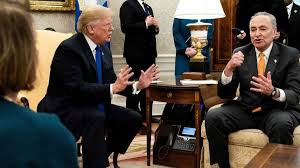
On 11 December 2018, Donald Trump tried to ambush the Democratic Party leaders, Nancy Pelosi and Chuck Schumer, by turning a photo opp at the White House into a political debate in front of the cameras.

Pelosi was having none of it. In a few well chosen sentences she demolished the President, even mentioning the need to avoid a ‘a Trump shutdown’ of government. That riled the president who rose to the bait. If he didn’t get the funding for his precious border wall, he knew just what he was going to do.

I will shut down the government. I am proud to shut down the government. I will take the mantle.

She had entirely wrong-footed him.
Trump meeting his match
He has, as usual, changed his tune since. Far from taking ‘the mantle’, he now denies all responsibility for the shutdown, blaming the Democrats instead. But today Pelosi is the Speaker of the House of Representatives and she can keep the pressure on him. The first step has been to pass a finance bill with no money for Trump’s wall, putting the onus back on the Republicans to keep the shutdown going.

It’s wonderful to see such gutsy and principled leadership in a world that is sadly short of it. Let’s hope Pelosi stays as firm as she promises to. It’s time that Trump had a lesson in the kind of treatment he can expect from a real leader.

I felt for Pelosi and Schumer in that White House meeting. At my own far less exalted level, I’ve also had the experience of talking to a hostile audience. Funnily enough, I find those sessions the most exciting and the most memorable. Generally, I present to customers, and if one of them attacks me, there’s no question of responding in kind. I have to be strictly polite, even deferential. It’s a fascinating challenge to stay that way while giving absolutely no ground.

The best outcome from such a confrontation is to see the critic, or critics, change their position and end up supportive or at least neutral towards us. That isn’t always possible, in which case the aim has to be to win the support of the rest of the audience that is watching the debate. If they leave concerned – even apologetic – for their colleague’s behaviour, and open to my arguments, then I’ve done as much as I could in the circumstances.

Now, Pelosi wasn’t going to win Trump around. Or even the Trump cult followers watching on TV. But she could hope that her performance would consolidate the backing of her base and win the support of some neutrals. That is the way to beat Trump and at the moment she seems to be handling the campaign superbly.

Sometimes, though, as I’ve suggested, one can actually change minds in an audience. And thinking about that reminded of one of the most remarkable instances of leadership I’ve seen in my lifetime, which indeed changed the minds of many of those listening.

On 4 April 1968, Martin Luther King was murdered. That evening, Robert Kennedy, brother of the murdered President, who had not long previously announced that he was running for the Democratic nomination himself, was due to speak to a rally in Indianapolis. It was being held in a strongly African-American neighbourhood. Kennedy’s advisers and relatives, even the police, told him he should not go, such was the anger in particular amongst the black population. The police had even had reports of young black men with weapons seen near the venue for the speech.

But, as I’ve mentioned beforeKennedy went anyway. He spoke from rough notes he made in his car. And he made what is arguably the best speech of his career. He started, unhesitatingly, by going straight to the news he was breaking.

I have some very sad news for all of you, and, I think, sad news for all of our fellow citizens, and people who love peace all over the world and that is that Martin Luther King was shot and was killed tonight in Memphis, Tennessee.
Bobby Kennedy breaking the bad news
It’s worth listening to the speech, if only to hear for the visceral moan from the crowd when he spoke those words.

Kennedy had made a point of not speaking about his brother’s death in public before. But that night he made an exception.

For those of you who are black and are tempted to fill with hatred and mistrust of the injustice of such an act, against all white people, I would only say that I can also feel in my own heart the same kind of feeling. I had a member of my family killed, but he was killed by a white man.

Abie Washington, a young man in the crowd, then only 26, told the Washington Post fifty years later:

I was upset, to put it mildly. I was pissed. Something needed to be done and I wanted to do it.

But as he listened his feelings changed.

My level of emotion went from one extreme to another. He had empathy. He knew what it felt like. Why create more violence?

That night, there were race riots in 100 cities across the United States. In Washington DC alone, a dozen people were killed. But in Indianapolis, there was nothing. The crowd went home after Kennedy’s speech.

That’s the leadership we need today. I hope Pelosi can provide it. And others too, like Alexandria Ocasio-Cortez, the youngest woman elected to Congress, or indeed Beto O’Rourke who ran a barnstorming campaign for the Senate in Texas, coming closer than anybody might have expected to unseating Ted Cruz.

In Britain, we need it in the Labour Party, but that’s going to need a major change at the top.

Still, at least we can admire Pelosi. Or that extraordinary speech in Indianapolis. And hold up as a model the leadership offered by Bobby Kennedy.

Who was dead, himself the victim of an assassin, only 63 days later.