Thursday, 3 September 2015

Refugee crisis: if only we helped as much to make peace as to make war...

Have you seen the film Charlie Wilson’s War? 

It may not be Aaron Sorkin’s best screenplay, but his work’s so good that even a minor piece is worth more than what most others produce.  

Based on historical events, by the end we see Charlie Wilson, a far from pure Democratic Congressman from Texas, managing to bargain up the minimal support the US was prepared to give the mujahideen fighting Soviet forces in Afghanistan, into a billion-dollar subvention providing, among other things, the missiles they could use to bring down Russian assault helicopters. Wilson had, in effect, engineered a victory for the anti-Soviet forces.

Then, however, he goes in search of a mere million to help build a school and is unable to win a hearing anywhere. For war, he could find money. For help in peacetime, none.

That’s interesting, given that within the mujahideen the US backed, were the Taliban who eventually seized control of Afghanistan, with lamentable results for the West. As we all know. A million for a school? Chickenfeed. A billion for weapons? Impressive but hardly breathtaking. How about nearly a trillion dollars spent by the US fighting its erstwhile Afghan allies up to the end of last year?

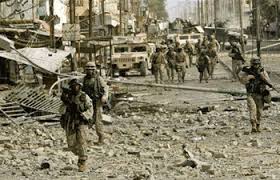
We too, in Britain, share this Western love of astronomic expenditure on war. The war in Iraq cost Britain £8.4 billion. That’s trivial compared to the US Defense Department’s estimates of its own direct expenditure of $757 billion, and Brown University’s estimate of total costs at $1.1 trillion, but it’s still a massive expenditure for a smaller country less used to making that kind of military outlay.

Tony Blair, the chief figure responsible for Britain’s involvement in that war as the Prime Minister of the day, still maintains it was worth fighting. The world, he has always claimed, is better without Saddam Hussein. That’s true enough – as long as what replaced him was an improvement.

We live in perpetual fear of the next terror attack in the West. But in neither Britain nor the US has anyone died in a terror attack so far in 2015 (unless you count US gun crime). In contrast, in Iraq there have been 3500 deaths already.

Far more serious still, the election of a government representing the majority of the population – a good thing – has led to the arrival in power of Shiite leaders and the exclusion to the point of alienation of the former rulers, Sunnis – not such a good thing. That in turn has been a fertile breeding ground for ISIS, which now controls a large part of Iraq and neighbouring Syria.

Tony Blair may be right that getting rid of Saddam Hussein was a good thing, but his replacement by a failing state subject to constant terrorism, and above all the rise of ISIS, undo any good that came from it.

This is becoming increasingly critical today in Europe, as refugees driven from the region by ISIS atrocities begin to flood our borders. We’ve actually been fortunate not to have experienced the problem in its full intensity before: Lebanon, for example, with 4 million inhabitants has already taken a million refugees.
Refugees piling into trains in Hungary, aiming for Germany
What our £8.4bn – and the US trillion – bought us
Out £8.4 billion bought us a growing refugee problem. In an increasingly xenophobic country, that’s a terrible difficulty for a right wing government that isn’t particularly friendly towards immigration to start with, but likes to think of itself as Christian. In the face of a humanitarian catastrophe, clearly calling for a Good Samaritan response from anyone claiming to share the values of Jesus, David Cameron’s government is tearing around in panic trying to make it more difficult for migrants to reach the country.

This is in the face of a few thousand trying to reach Britain, compared to the 800,000, now expected to reach a million, forecast to be making for Germany.

The government claims to be doing more than one might think. It points to 5000 Syrians given asylum in this country, but fails to state that a great many of them were already here and were simply unable to return to their own country. In other words, they were students or tourists or businessmen – reasonably well off and probably able to cope with their exile. These were not the desperate individuals clinging to inflatables for the tricky crossing from Turkey to the Greek islands.

In one respect, though, the British government has adopted an intelligent policy: it feels the long-term solution lies in helping the home countries of the refugees to improve conditions, so that fewer leave in the first place. That’s certainly the best approach. However, when the government points to its investment of nearly £900 million over the next four years or Syria, one can’t help feeling it’s a little low compared to the £8.4 billion spent on war.

Equally, though the government is trying to make up for its passivity so far over the refugee flows by agreeing to take a few thousand from the camps inside Syria, that seems inadequate given that over 3 million have already left the country.

Isn’t that Charlie Wilson’s War again? So much to spend on war. So little on help.

Which reminds me of Aldous Huxley: ”that men do not learn very much from the lessons of history is the most important of all the lessons of history.”

Tuesday, 1 September 2015

Being principled is great. In the right cause

It’s not enough to have a conscience.

We all tend to respect honesty and principle in politicians. Well, we don’t get that much opportunity to do so, since in the age of spin and soundbites, it’s hard to find a politician that displays much of either. Which perhaps makes us all the more admiring of those who do.

But honesty and principle, like courage, have much in common with a gun: what matters isn’t so much the thing in itself, as where it’s pointing. It would be hard to deny that Margaret Thatcher showed great courage, resolution, pure grit, but she used it to destroy communities up and down the country. Back in 1970, I taught in a mining village in South Yorkshire; today the population has fallen by over a third, and rates of unemployment or invalidity are frighteningly high. The price of the crushed miners’ strike…

Maggie: grit and courage misapplied
I can think of no better example of misapplied honesty and principle, analogous to Thatcher’s misapplication of courage and resolution, than the case of Robert E. Lee. He occupies a place of honour today, for many, as one of the great generals of history, although he fought, indeed became the leading military figure, on the Confederate side in the American Civil War. That’s the defeated side, and generally now felt to be the wrong side (except by a few diehards in the southern US).

That meant he fought on the side of states defined by slavery – it was their one common point – although he called it “a moral and political evil” and personally freed his slaves. He fought against the Union, although he considered the so-called right of states to secede as “idle talk.”

So why did he fight on the slave-holding Secessionists’ side?

His father, “Light Horse Harry” Lee died a disgraced bankrupt, but in his youth he’d been a dashing cavalry commander in the army George Washington led to fight for independence from Britain. The father had claimed “Virginia is my country; her will I obey, however lamentable the fate to which it may subject me.” Virginia came first.

Likewise, Robert Lee, the son, claimed “if the government is disrupted, I shall return to my native State and share the miseries of my people, and save in defence will draw my sword on none.”

So Lee turned down the opportunity to take overall command of the forces of the Union to which he was ostensibly committed, even though it was offered to him not just by a Northerner, the President, Abraham Lincoln, but by the Commanding General of the Army, Winfield Scott – who was a Virginian like Lee. Indeed, another Virginian, George H. Thomas, had a distinguished career as a general on the Union side, and a distant cousin of Lee, Samuel Phillips Lee became an Admiral in the Union navy.

Many admire Lee’s commitment to the principle that he could not fight against his own country, which he saw as being Virginia rather than the United States.

I however have real trouble with that notion. He was undoubtedly a man of conscience, and it’s apparently honourable to live by one’s conscience. But surely the admiration ends when doing so leads to your fighting for two bad causes, secession and slavery, especially if you believe in neither?

Robert E. Lee: principled and honest,
but for the wrong cause – which he didn't even believe in
It’s like Thatcher’s courage. It would have been wonderful, employed in furthering a good cause. it was lamentable when used for a bad one.

It isn’t abstract principle that counts. It’s the concrete application made of it.

Sunday, 30 August 2015

Jeremy Corbyn: I may have got him wrong. So I changed my mind

When you've got something wrong, you just have to admit it and put it right.

For weeks, I believed that electing Jeremy Corbyn Labour leader would damage the party’s electoral chances. His views on a wide range of issues seemed out of tune with far too many voters, and his image generally seemed too eccentric, for him to be electable Prime Minister.

It didn’t particularly help that, when taxed with this charge on TV, he replied that he clearly wasn’t unelectable since he’d been returned to Parliament again and again, by the electors of Islington, over 32 years. It’s not that the answer wasn’t well delivered – it was a refreshing change from the speak-by-numbers evasions most politicians seem to produce. But the implication was that he thought England was all like Islington and, while it might be a good thing if more of England resembled that fine London Borough, for the moment it certainly doesn’t.

However, later I heard him replying to the same question again. This time he told the BBC that we ought to wait and see, that the Conservatives were in for a torrid time with economic difficulties ahead, and they might not find re-election as easy as some think. Now that struck me as a highly intelligent response. I’ve also felt the same for a while: the Tories have had an easy ride of it, but haven’t done well (far from reducing debt, it they have nearly doubled it since they came to office). They could be put through the wringer in the coming years.

More generally, Corbyn had avoided saying any of the things I feared he might to frighten the children. He dislikes NATO, but he accepts that many people disagree and he believes Labour is a broad grouping within which compromises have to be made – it sounded to me as though there might be a debate about NATO, which is long overdue, not a commitment to leave, which might be perceived as rash.

Time, I felt, to change my mind
He’s unhappy about much of what happens in the EU, but again he doesn’t seem to have made up his mind to that Britain ought to go. Many supporters of the EU are also unhappy with they way it currently operates, but most of us feel that it needs internal reform and, above all, a new leadership.

Some of his views on nationalisation seem to strike a chord with the electorate, rather than putting them off.

I’m far from certain about his notion of “people’s quantitative easing”, i.e. printing money to fund investment: that’s never worked well in other countries when it’s been tried – the hyperinflation to which it leads leaves little of the benefits it’s designed to generate – but it feels to me as though he can be persuaded to take a more dependable approach. Borrowing to invest, as opposed to the Tories’ borrowing to fund day-to-day expenditure, strikes me as a far more sensible policy, especially when interest rates are at a historic low.

More broadly, when it comes to economics, my feeling that he wasn’t the candidate to vote for was shaken when I saw that 41 economists had endorsed his anti-austerity stance, especially as one of them was the outstanding David Blanchflower.

I’d looked with envy to Scotland during the General Election campaign earlier this year, wishing that we too in England had a leader who spoke out against austerity policies as effectively as Nicola Sturgeon of the Scottish Nationalist Party – the runaway victors of the election, north of the border. Austerity has caused enormous pain among sections of the population least able to suffer it, and failed dismally in its objectives, as the constantly rising debt shows. It suddenly occurred to me that Jeremy Corbyn might be just our answer to Sturgeon.

In any case, I’m reminded of the advice of someone who was one of the most remarkable statesmen ever, while still being a supremely astute political operator, Abraham Lincoln:

The true rule, in determining to embrace, or reject any thing, is not whether it have any evil in it; but whether it have more of evil, than of good. There are few things wholly evil, or wholly good. Almost every thing, especially of governmental policy, is an inseparable compound of the two; so that our best judgment of the preponderance between them is continually demanded.

I can’t expect to agree with Corbyn on everything; I just have to decide whether on balance he has more in his favour than against him. And both in his policies, in which he has proved himself surprisingly moderate and open to compromise, and in his dealings with the media, where he has proved himself honest and straightforward, I’ve been impressed by his performance.

By contrast, the other candidates, though some are effective, still look too much like the products of a spin-dominated machine. Nor do they speak out against austerity as we need them to. It’s now beginning to feel to me as though they simply can’t mobilise the support we’re looking for, reversing my earlier notion about Corbyn: I now suspect that he may be better placed to inspire people, gaining more support than he puts off, and therefore help Labour advance.

Besides, Tony Blair came to my rescue, stilling any doubts I might have had. He writes in the Observer of the effect on supporters of any piece penned against Corbyn, that it “actually makes them more likely to support him.” And then he writes another one against him.

Well, if even Blair is now contributing to the Corbyn campaign, what could possibly stop me?

So he got my vote.

Thursday, 27 August 2015

Not easy to reach full womanhood

The transition to womanhood’s never easy. Especially for women. But it isn’t altogether smooth even if you’re of the canine persuasion. Our poodle Luci started her first heat this week, and it’s left her more than a little perturbed.

“She may be a little clingy,” said the veterinary nurse during her routine checkup.

Clingy? I’ll say. She’d never jumped onto my lap before, but since Monday it’s either a leap or, if the chair’s just a tad too high, scrabbling at my knees until I lift her up. Once there she sits content and at ease, surveying all around her, her boiling anxiety temporarily and partially assuaged.

Let me up! Let me up! It's lonely down here
Previously, she was happy just to lie down next to us, on the sofa. But now she’s become a lapdog in the full sense of the world. And, if my lap is covered, as it frequently is, by a laptop, she’ll just walk around on the keyboard until I remove it. It’s a great relief for her when Danielle’s home: far less of a fidget than I am, and less inclined to use her laptop, she provides a more satisfactory place to relax and calm the roaring hormones.

Other aspects of this experience remind me of an old friend who told me, “you’re lucky. As the father of a son, you have to worry about a boy. I, as the father of a daughter, have to worry about every boy in the neighbourhood.”

Our garden is reasonably fenced in. There are, however, points where contact between the bottom of the fence and the ground isn’t quite as hermetic as one might have wished. That’s never been a problem before. Luci, who’s now completely mastered the use of the cat (and “small dog”) flap in the kitchen door, lets herself out when she needs to do, as the received euphemism has it, her business, or when she just feels like wandering out. But as a sensibly timid dog, she’s never been tempted to grub away under the fence and let herself into the neighbour’s garden (though she likes the neighbour, and if ever we’re chatting to her with the two gates open, she dashes into the house, with never so much as a by your leave.)

Now, however, we’re worried not about Luci doing the digging, but about any stray male in the neighbourhood. Like my friend, we have to worry about all the boys around. So the cat flap has to be locked, at least if we’re both out of the house.

This can have unplanned, unwanted consequences. I discovered as much the other day, after returning from an errand. I was tapping away at my keyboard when I began to get that terrible feeling – you must know it – that I was being surveyed with intensity and little goodwill. I looked up and saw, sat quietly on his haunches, completely still and yet deeply baleful, our cat Misty. Reproachful, that look was, I’d say, perhaps even accusatory.

It took me only an instant to realise what this was about.

“What have you done to my cat flap?” he was saying, “I can’t get out into the garden. This is not the level of service to which I’ve become accustomed. Or regard as my minimal entitlement.”

You did what to my cat flap?
I naturally dropped everything, scattering laptop and lapdog in different directions, and ran to the kitchen. I unlocked the cat flap, but Misty wasn’t having any of it. He still looked at me suspiciously.

“It’s OK, Misty, really,” I assured him, and pushed the cat flap with a finger. He watched it flap open and shut with the customary sound. Then he wandered up to it himself and tried it with a paw. When the result of his own test – why trust the person responsible for the initial disappointment, after all? – he consented to stick his head through, and when that went well, slid his whole body out into the garden.

Picture my relief. I’d allayed Misty’s ill-humour, and without even being scratched or bitten. A bigger success than you might imagine.

I could now go back to Luci and stroke her again, consoling her as best I could for the overwhelming changes taking place inside her.

Not easy, the passage into womanhood. Worst for the individual concerned of course. But no one in the environs escapes wholly unaffected.

Tuesday, 25 August 2015

The powerless need a champion. The right champion.

Today in Britain we live with a government which has held wages down for the powerless while presiding over a huge explosion in “earnings” for the most powerful (the quotation marks around “earnings” are there because I really don’t believe any individual, however mighty, truly “earns” twenty or forty times what, say, a teacher earns – not if by “earn” we mean receiving a merited reward for a contribution).

The powerful are powerful precisely because they have the means to buy themselves power. They are the great contributors to political parties, particularly the Conservatives. The nakedness of the deal is clear from such steps as the reduction of the top rate of tax, in the last government, from 50% to 45%.

Economically, it made no sense: the government’s stated policy was to reduce government deficits and therefore debt, and a reduction in tax ran entirely counter to that objective; the number of individuals involved was far too small to justfiy the move even as a means to garner votes; so the only conclusion was that it was a measure to satisfy the people who donated the most to the predominant party in government at the time, now the sole party in government, the Tories.

What’s true in Britain is threatening in the United States too, where a crowded field of contenders for the Republican presidential nomination is made up of candidates committed to backing the wishes of the sadly downtrodden rich, against the pampered poor.

So it’s wonderful to read this denunciation of the kind of government such people favour. Though aimed at that abuse in the US, it applies equally well to the UK.

It is to be regretted that the rich and powerful too often bend the acts of government to their selfish purposes. Distinctions in society will always exist under every just government. Equality of talents, of education, or of wealth cannot be produced by human institutions… [but] every man is equally entitled to protection by law; but when the laws undertake to … make the rich richer and the potent more powerful, the humble members of society – the farmers, mechanics, and laborers – who have neither the time nor the means of securing like favors to themselves, have a right to complain of the injustice of their government. There are no necessary evils in government. Its evils exist only in its abuses. If it would confine itself to equal protection, and, as Heaven does its rains, shower its favors alike on the high and the low, the rich and the poor, it would be an unqualified blessing.

Doesn’t that have a certain ring to it? “The rich and powerful too often bend the acts of government to their selfish purposes.” Apart from those who share, and indeed champion, those selfish purposes, who would dissent from that sentiment?

So it’s both refreshing and encouraging to hear a voice raised in such clear tones against that kind of abuse.

Sadly, we won’t ever actually hear that voice. The words were spoken by the seventh president of the United States, Andrew Jackson, in the 1830s. That of course only makes it all the more remarkable that they preserve all their freshness and, above all, their relevance today.

More sadly still, even if it were possible to get Jackson back, it’s far from clear it would be desirable. Jackson spoke up for the people, but he defined the people to suit his own bigotry: male, certainly, but above all white.

So when South Carolina announced it would nullify any federal laws it regarded as unconstitutional, Jackson was having none of it: he mobilised the army to bring the State to heel. But when South Carolina decided that it would block the distribution of anti-slavery literature, even though it was being carried by the US post office, a federal and not a state institution, he didn’t lift a finger – though the measure clearly conflicted with the First Amendment of the Constitution guaranteeing freedom of speech.

He was quite picky about the issues over which he would uphold the Constitution.

The Trail of Tears
As pictured by J.J. Peabody
His view on Native Americans was nothing short of tragic. They had no role, in his view, in lands occupied by Whites. They had to go. That led to an act of barbarous ethnic cleansing, as the tribes were driven across the Mississippi, in what came to be known as the trail of tears. The Cherokees, the last to go, lost between 2000 and 6000 along the way, of the 16000 who were expelled.

No, Jackson was not particularly nice.

From which I think we can draw a double lesson. Firstly, we still need a champion of the little man against the arrogant, as much today as nearly two centuries ago, in Jackson’s time. And secondly, we need to be careful who we pick to be that champion – they’re not all quite as savoury as we might wish.

Saturday, 22 August 2015

Misty's Diary: Call that a jump?

Misty and his diary again, talking about life with Luci, and jumping.


August 2015

Well, life’s certainly become less dull since Luci moved in with us. 

Not always in a good way. She likes to say “hello” to me pretty well every time she sees me. That’s fine, except that she’s clearly decided it’s important to establish some kind authority over me. So she does silly things like trying to pin me down with her forelegs, as though I couldn’t just throw her off with a shake of my shoulders.

Not that it’s as easy as it always was. With the amount of food the domestics keep giving her, it’s no surprise that she’s starting to put on a bit of weight. Still, that’s done no more than move her from the featherweight to lightweight category – no challenge to a fine figure of a cat like me.


A fine athletic figures of a cat
Even so, sometimes she needs a slightly harsher reminder of who’s in charge. Just the other day, I got the teeth out, not something I often do with her. Got her on the nose. Can’t really have hurt – I didn’t bite down properly and she has so much hair, even on her nose, that it’s hard to get at anything I could hurt if I tried. Still, she squealed, but that’s just her way.

And what’s even more her way is that she came back for more punishment. Crazy animal. What does she think’s going to happen if she keeps bugging me? Fortunately, I’ve got the domestics reasonably well trained: when number 2 saw what was going on, he shouted at Luci, “leave him in peace, Luci, come away.” And, when she’d gone trotting over to him, like the dutiful little creature she is, “you know you could end up getting hurt if you push him too hard.”

He’s certainly got that right.

Honestly, though, I can’t believe how he talks to her. And she takes it all to heart.

“He said to me the other day, ‘who’s a lovely little dog, then?’ Isn’t that good? Isn’t that good? Isn’t it, isn’t it?”

“Err… yes, it’s great, if that’s the kind of thing you like…”

“Well, think about it, just think about it, Misty. There aren’t any other dogs. He has to mean me, doesn’t he? It’s got to be me who’s lovely. Isn’t that good?”

“Yeah, right, it’s fantastic. But… err… like you said… there aren’t any other dogs around, are there? So he’s not really got a whole lot to compare you with, has he?”

“No, no, but so what? It’s still good.”

“And did you hear him say, ‘who’s a crazy dog, then?'” 

 “A crazy dog? Do you think that’s me too? That can’t be right. Crazy’s not such a great thing to be, is it? Is it, Misty?”

“If the fur fits, wear it,” I told her, “now let me get back to sleep.”

But she wouldn’t. So I jumped the back gate, which she can’t, and went round to the front of the house and my bed of leaves which is great to lie on.


My bed of leaves
Warm, comfortable and out of Luci's reach
Jumping’s quite a thing, actually. The domestics are training her to jump. They’ve got this hoop that they hold up for her. It’s got to be about half her height off the ground. They hold half a pathetic little dog treat on the other side, and – surprise, surprise – she jumps through the hoop to get it.

And this is some kind of major achievement? You should hear them cooing about it. “Good girl! Well done! You’re really getting it.”

“Look at me, Misty, look at me,” she likes to cry, “I’m jumping! And so high!”

So I jump up on the table and look down at her, vainly struggling to follow me.

“Very impressive,” I say, “Now come and join me up here.”

“I can’t, I can’t, Misty,” she says, “but didn't I do a great jump?”

In fact, I quite often show her how jumping’s really done. I leap up to get at my food. Now that’s three or four times her height. And the reward isn’t half a treat. It’s a bowlful of proper food. And, what’s more, it’s got this brilliant system which means whenever it gets close to empty, more flows in from above.

Now that’s what I call jumping. And that’s what I call a purpose for a jump.

You should see her face. At the bottom. Looking up pathetically. So funny.

Thursday, 20 August 2015

Immigration: time to get the question right

In 1951, Rosalind Franklin took a series of pictures of DNA which a colleague, J.D. Bernal, described as “amongst the most beautiful X-ray photographs of any substance ever taken.” They led to the finding of the double-helix structure of DNA.

In 1995, Michael Portillo reached the pinnacle of his political career, when he was appointed Defence Secretary.

In 2004, Kelly Holmes took gold medals in both the 800 and 1500 metre women’s races at the Athens Olympics, the first time a British athlete had won two golds at one Olympics since 1920.

What do these three stories have in common? They all concern Britons of immigrant stock, remote or recent. Franklin came from a long family of British Jews. Portillo is the son of a Spanish refugee from Franco. Holmes’s father is Jamaican.

Admire them or not, they’ve all notched up significant achievements in Britain. We need to remember them especially in today’s atmosphere, when all we seem to talk about is the terrible danger posed by immigrants gathering ominously in Calais and threatening to invade our shores. You’d think they were a latter day Wehrmacht, from the tone of the debate, ready to undermine all we hold dear to us.

They are a “swarm” to Prime Minister David Cameron, they’re “marauding” according to Foreign Secretary Philip Hammond.


The joy of an immigrant camp in Calais
In reality they are 5000 underfed, ill-lodged, unfortunates trying to find somewhere they can rebuild their lives after fleeing their homes. Most of them come from Iraq, Syria, Lybia, Somalia. These are countries devastated by war, often initiated or sustained from outside, by nations such as the US, Britain, Russia, even Kenya.

You might think that those at least whose homelands have directly suffered at the hands of Britain, notably Iraq and Libya, might expect more tolerant treatment. But our behaviour towards them is shameless: we bombed you into the dark ages, we seem to be saying, now live with it.

In any case, it’s extraordinary what a fuss we’re making about them in Britain. Only a small proportion of those 5000 will ever make it across the Channel. By contrast, Germany is expected to take 750,000 asylum seekers this year alone. And yet Britain squeals as though mortally wounded by a somehow unique crisis.

Our response is simple, too. We invest money in building more fences in Calais. We send over police to enforce the law. We treat what’s happening as a security problem, not a humanitarian one. In that respect, I’m reminded of the “war against drugs”, perceived almost entirely as a law and order issue. We make penalties more stringent, we lock up people for longer. We pay no attention to the evidence that all this effort is producing no useful results, and drug consumption stubbornly refuses to go down.

We’re coming up with the wrong answer, because we’re asking the wrong questions. The right questions are about protecting people from exploitation and helping them to find a better solution. The wrongs ones are about police action.

That’s equally true of immigration. Fences and police won’t do it. Indeed, the problems are going to get a lot worse, as immigration grows many times in the face of the effects of global warming: violent weather, food shortages, even lack of water.

Do we really want to do something about it? Then we need to make a genuine effort. Above all, on ourselves. Principally by learning generosity.

First, we need to stop making such such casual, ill-judged use of military force. Many of the migrants in Europe today have been displaced by our incompetent interventions in the Middle East.


The Iraq War:
solved nothing and contributed to the migrant problem
Next we need to invest more in the countries from which most migrants come. It’s true that as well as refugees, there are economic migrants trying to get into the advanced economies. Well, help develop their home economies and fewer of them will go looking for a better future in strange countries whose language they don’t speak and whose customs they don’t know.

So if you’ve ever whinged about overseas aid, now would be a good time to stop. It’s money well spent, and we need to spend more. As much for our sakes as for the recipients: it takes the pressure off our borders.

The other form of generosity is even more important. We need to treat incomers with humanity. They need help, and we should provide it, because we can. Who knows, some of them may turn into tomorrow’s Roger Bannister or Mo Farah, the immigrants we can celebrate. Even if they don’t, we’d do well to emulate a German woman I heard this week. As she dropped off a donation at a refugee camp, she told the BBC that there was already more than enough evil in the world, and showing a little kindness to the most unfortunate would make it a better place for all of us.

That attitude would be a great starting point to work out the right questions about immigration. Because for now we’re coming up with entirely the wrong answers.