Showing posts with label Calais. Show all posts

Thursday, 20 August 2015

Immigration: time to get the question right

In 1951, Rosalind Franklin took a series of pictures of DNA which a colleague, J.D. Bernal, described as “amongst the most beautiful X-ray photographs of any substance ever taken.” They led to the finding of the double-helix structure of DNA.

In 1995, Michael Portillo reached the pinnacle of his political career, when he was appointed Defence Secretary.

In 2004, Kelly Holmes took gold medals in both the 800 and 1500 metre women’s races at the Athens Olympics, the first time a British athlete had won two golds at one Olympics since 1920.

What do these three stories have in common? They all concern Britons of immigrant stock, remote or recent. Franklin came from a long family of British Jews. Portillo is the son of a Spanish refugee from Franco. Holmes’s father is Jamaican.

Admire them or not, they’ve all notched up significant achievements in Britain. We need to remember them especially in today’s atmosphere, when all we seem to talk about is the terrible danger posed by immigrants gathering ominously in Calais and threatening to invade our shores. You’d think they were a latter day Wehrmacht, from the tone of the debate, ready to undermine all we hold dear to us.

They are a “swarm” to Prime Minister David Cameron, they’re “marauding” according to Foreign Secretary Philip Hammond.


The joy of an immigrant camp in Calais
In reality they are 5000 underfed, ill-lodged, unfortunates trying to find somewhere they can rebuild their lives after fleeing their homes. Most of them come from Iraq, Syria, Lybia, Somalia. These are countries devastated by war, often initiated or sustained from outside, by nations such as the US, Britain, Russia, even Kenya.

You might think that those at least whose homelands have directly suffered at the hands of Britain, notably Iraq and Libya, might expect more tolerant treatment. But our behaviour towards them is shameless: we bombed you into the dark ages, we seem to be saying, now live with it.

In any case, it’s extraordinary what a fuss we’re making about them in Britain. Only a small proportion of those 5000 will ever make it across the Channel. By contrast, Germany is expected to take 750,000 asylum seekers this year alone. And yet Britain squeals as though mortally wounded by a somehow unique crisis.

Our response is simple, too. We invest money in building more fences in Calais. We send over police to enforce the law. We treat what’s happening as a security problem, not a humanitarian one. In that respect, I’m reminded of the “war against drugs”, perceived almost entirely as a law and order issue. We make penalties more stringent, we lock up people for longer. We pay no attention to the evidence that all this effort is producing no useful results, and drug consumption stubbornly refuses to go down.

We’re coming up with the wrong answer, because we’re asking the wrong questions. The right questions are about protecting people from exploitation and helping them to find a better solution. The wrongs ones are about police action.

That’s equally true of immigration. Fences and police won’t do it. Indeed, the problems are going to get a lot worse, as immigration grows many times in the face of the effects of global warming: violent weather, food shortages, even lack of water.

Do we really want to do something about it? Then we need to make a genuine effort. Above all, on ourselves. Principally by learning generosity.

First, we need to stop making such such casual, ill-judged use of military force. Many of the migrants in Europe today have been displaced by our incompetent interventions in the Middle East.
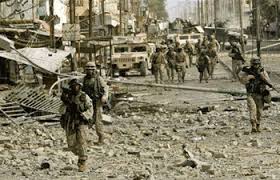

The Iraq War:
solved nothing and contributed to the migrant problem
Next we need to invest more in the countries from which most migrants come. It’s true that as well as refugees, there are economic migrants trying to get into the advanced economies. Well, help develop their home economies and fewer of them will go looking for a better future in strange countries whose language they don’t speak and whose customs they don’t know.

So if you’ve ever whinged about overseas aid, now would be a good time to stop. It’s money well spent, and we need to spend more. As much for our sakes as for the recipients: it takes the pressure off our borders.

The other form of generosity is even more important. We need to treat incomers with humanity. They need help, and we should provide it, because we can. Who knows, some of them may turn into tomorrow’s Roger Bannister or Mo Farah, the immigrants we can celebrate. Even if they don’t, we’d do well to emulate a German woman I heard this week. As she dropped off a donation at a refugee camp, she told the BBC that there was already more than enough evil in the world, and showing a little kindness to the most unfortunate would make it a better place for all of us.

That attitude would be a great starting point to work out the right questions about immigration. Because for now we’re coming up with entirely the wrong answers.

Sunday, 2 August 2015

Time to "rediscover what it is to be human."

It’s good to see religious leaders standing up to denounce immorality – especially when for once it isn’t sex they’re talking about.

It’s particularly welcome when it is a Christian leader revealing how deeply unchristian David Cameron is, despite his frequent professions of faith. In this instance, the speaker was the bishop of Dover, Trevor Willmott, commenting on the so-called crisis of migrants in Calais.

I say “so-called” because there are at most 3000 of them (compared to the 60,000 who turned up in Italy in the first six months of this year), and it isn’t even clear that all of them want to come to England. I heard one interviewed by the BBC, saying she hoped the world might hear them, and maybe someone in the world might find it in their heart to help them.

Even so, Cameron has decided to provide dogs and guards and better fences to Calais, to make sure that none of these immigrants make it to Britain. So for him the question is merely to be met with security measures, rather than to be treated as a social and political issue, that needs to be handled with compassion towards people who are fleeing some of the worst dangers on the face of the Earth.

What underlined the moral problem was Cameron’s description of the people in Calais as a “swarm of migrants.” It was that use of the word “swarm”, as though we were dealing not with humans but with locusts, that caused the worst shock.

The bishop, talking with the support of the Church of England, pointed out that “we’ve become an increasingly harsh world, and when we become harsh with each other and forget our humanity then we end up in these standoff positions. We need to rediscover what it is to be a human, and that every human being matters.”


Not an infestation, not a swarm
Just humans facing desperate hardship
A salutary reminder. And here’s another – a reminder of a previous time when we in Britain closed ranks to resist swarms of immigrants.

“The way stateless Jews from Germany are pouring into this country from every port is becoming an outrage. I intend to enforce the law to the fullest.”

Thus spake a magistrate in 1938, quoted with approval by the Daily Mail, the paper which supported the Nazis in Germany at that time, and the British Union of Fascists in its own country.

Recently, the Czech Republic honoured Sir Nicholas Winton who brought 669 children out in the “Kindertransporte”, to save their lives in Britain. This was felt to be only what he deserved, including by the right wing press. They’re correct, of course, but it’s worth remembering that we’re talking about under 700.

For the first six years of the Nazi regime, the only Jews affected were in Germany, Austria and parts of Czechoslovakia. These were Jews that could have been helped, in a way that when it came to Poland, rescue was impossible: the Nazis appeared in their country so rapidly, and Britain in any case declared war on Germany. But something could have been done about German Jews.

There were a little over 500,000 of them when the Nazis came to power. By 1941, around 160,000 of them were still there. They were, almost without exception, murdered. Jews who left for other European countries, like France, which later fell under Nazi control, were also mostly killed.

Britain took about 40,000 of the Jews who got out. That’s about 10% of the total. Under 10% of the whole Jewish population of Germany. About a quarter as many as those who were killed. So while it’s wonderful to recognise men like Nicholas Winton, it would be unfortunate if we allowed sentimentalism about those 669 children to blind us to the fact that we left so many to face the horror of the gas chambers.

“We need to rediscover what it is to be a human, and that every human being matters,” said the bishop of Dover. That was something we forgot in the 1930s, when powerful men decided that the arrival of German Jews in Britain was “becoming an outrage.”

Learn the bishop’s lesson and we might avoid behaving so shamefully this time round.

Friday, 20 December 2013

They order these things ... differently in France

Every few months, when our stocks of wine are growing perilously low, Danielle (occasionally with me in tow) heads off for a day trip to Calais to stock up again.

French wines still offer unrivalled variety and impressive quality, and it
’s advantageous to buy them in France. As a mid-week day-return crossing is stupidly cheap, it becomes a bit of a no-brainer, down here in the South East, where the run to the coast is easy (apart from the traffic).

Danielle took the ferry yesterday with our friend Moira. It all went swimmingly (it didn’t involve any swimming) until they came to travel back. There were high winds in the Channel, though for once that had nothing to do with our worthy ConDem ministers whipping up yet another storm of hot air. 


The boat was delayed by an hour.

Now during our ten year residence in France, we were occasionally struck by the slightly different attitude towards service in the country from what’s regarded as the norm (not, by any means, always achieved) in the Anglo-Saxon world. France has a wonderful system of employee protection in place, a system which in principle excites my envy – I’m after all a salaried employee myself – but occasionally it does make things rather more oriented towards producers than consumers.

‘Is there anywhere we can get a bite to eat?’ Danielle and Moira asked, ‘while we wait for the boat?’

It turns out that each of the blocks that contained the toilets also had a coffee vending machine that served quite reasonably priced hot water the colour of mud, and in some cases another that served overcharged crisps.

‘What about a proper meal?’

That was only available from one of the designated cafés, or the restaurant in a building right down at the end of the harbour area. Ten or fifteen minutes walk away. But Danielle and Moira decided it was worth the slog.

‘Hold on, hold on,’ called the official they’d been questioning, ‘don’t forget your tickets and passports. You can’t get back here without them.’

‘It’s a passenger restaurant and it isn’t accessible from the passenger area?’

He gave a Gallic shrug.

‘Certainly it’s accessible. But not without papers.’

They set off. They tried a couple of the cafés which turned out to be just small counters in the usual toilet blocks, without exception shut with their steel shutters firmly, forbiddingly down.

Cafés with a less than inviting aspect
So they kept going to the restaurant.

Which was massive and well-appointed. Probably room for 150 clients. With not a single one present, though several hundred passengers were waiting for their boat. 


A restaurant to kept with pride.
Though presumably hardly at a profit, for customers or owners
It even had a games area, which suffered from none of the problems of noise or overcrowding so common in such facilities. 

Anyone for pool? Apparently not
Amazingly, the place was, however, staffed. By a waitress who was somewhat less than rushed off her feet though she might have been if some of the other waiting passengers had been there.

‘Do you have petits pains au chocolat?’ Danielle asked. That’s pretty much a standard in any café/restaurant associated with travel.

‘We have only cakes,’ they were told.

Some other customers – would-be customers – struggled in. They looked through the menu, deciphering the odd spellings. Corn was shown as ‘mais’ in French, which actually means ‘but’ (the correct word is ‘maïs’), and had been translated into English, with complete though baffling accuracy, as ‘but’. 


'But' on the menu. But nothing the customers wanted to eat
Unsurprisingly, the English clients weren’t particularly attracted to the idea of making a meal of a conjunction (I suppose only astrologers do that sort of thing). None of the other items that caught their fancy was available, so they ordered drinks instead of food.

‘Could we have some ice?’ they asked.

‘No ice,’ they were told.

Put off by their experience, they pulled some food out of their bags and started to eat it.

‘What are you thinking of?’ The waitress came down on them like an avenging angel. ‘You cannot make the picnic here. This is a restaurant.’

They looked at her, astonished. It couldn’t serve them a meal from its menu, or even ice for their drinks, but it was still in some sense of the word, a restaurant? But there was no arguing and the irate waitress marched them off the premises.

She explained to Danielle that it was the Calais Chamber of Commerce that was holding back the development of the port area as a business. Which rather suggests that the word ‘commerce’, like ‘restaurant’, means something different there from what we
’ve come to expect on this side of the Channel.

At least it explains why Napoleon thought that England was a nation of shopkeepers. Certainly, if the port of Calais is anything to go by, the contrast with France is pretty stark.

Saturday, 26 January 2013

Want to remember your big six-oh? Celebrate in a desert

There are times when you just have to do something memorable, and there’s nothing much more memorable than plunging into a desertic, volcanic landscape, desolate though not barren, as life clings on to the surface of an apparent wilderness.

Especially memorable if you’re going there for lunch.

Timanfaya national park: just the place for a memorable lunch

One of my sons summed it up. ‘It’s really lunar, isn’t it?’ Unfortunately he then confused me by adding, ‘It looks martian.’ Still, I think I got the message.

Yes, I won’t forget my sixtieth birthday in a hurry. It’ll be like remembering where I was when I heard that JFK had died, though as it happens I don’t think I actually do remember where I was. Still, you get the message.

The national park of Timanfaya (pronounced to rhyme with ‘I’m on fire’, as long as you stretch out ‘fire’ in a bit of a southern drawl) is on Lanzarote, the island a whole bunch of us are visiting in the Canaries at the moment.

On the highest point of the highest peak of the park, stands a restaurant where you can get volcano-grilled barbecue. No burgers as it happens, but hey, why would I want a burger? I always think of them as belonging to Calais in Northern France and coming in a six-pack.

Rodin's Burghers of Calais. In Calais. Of course
Magnificent but hardly appetising.
So instead we had sardines or chicken, steak or Argentinian sausage, according to taste. All excellent, though I couldn’t help feeling that bringing sausages all the way from Argentina was perhaps taking a demand for the esoteric in gastronomy a little too far.

The grill sits above a vent down into the heart of the volcano. It generates quite enough heat to singe your meat more than adequately. I’m not sure whether it’d be hot enough to destroy a ring of power and bring down the Dark Tower, but as it happened no-one had one on them to try the experiment.

I guess rings of power aren’t that easy to come across. Presumably, they all hang around waiting for one ring to rule them all, one ring to find, one ring to bring them all and in the darkness bind them. And it was nothing like dark enough today.

That didn
’t stop it being a great and memorable experience. As was dinner last night, overlooking the port at Playa Blanca (the ‘white beach’ turned out to be a short strip of perfectly ordinary sand laid down artificially – honestly, people will say anything if they think it’ll bring tourists). The food was outstanding and the evening provided just as memorable a celebration for the birthday of one of my sons; on Tuesday we’ll go and celebrate the birthday of another; the third made the error of being born in the summer, so he’ll just have to tag along and drink toasts to the the rest of us, but he seems to be doing that with gusto so I imagine he doesn’t see it as a hardship.

Then, the birthdays over, I suppose we’ll just have to find some other way of entertaining ourselves for the rest of the week on this charming little island. Not that I expect that’ll prove to be too much of a hardship either.

Monday, 8 October 2012

A day's French leave with some great NHS people

Who’d be a healthcare manager today? 

I don’t mean the high-flying executive types who are busily laying about themselves sacking people to generate cost reductions. No, I’m talking about the middle and junior managers who either become the victims of such initiatives or are left trying to clear up the mess in their wake.

These people tend to be given a terrible press because whenever the pressure comes on for economies, the hue and cry goes up to axe the back-room staff. That’s because everyone knows that doctors and nurses really contribute to healthcare, while they believe that the managers are merely leeches on the system. Unfortunately, what they leave out of account, is that someone has to make sure that the arrival of a patient is recorded, that tests get carried out and the results logged somewhere, that the patient is discharged with the right medications, that people who need to know – such as a GP – are told.

The fewer people there are to do these jobs, the more the work will devolve onto clinical staff. This is a doubly sad: clinical staff should be concentrating on clinical work and they often cost a great deal more than those who would otherwise be undertaking these tasks.

All this makes me feel a great deal of sympathy with the administrative staff in the NHS, and that in turn makes me pleased that Danielle, my wife, has joined them.

To be honest, though, what makes me most pleased is that the team Danielle has joined is made up of such extremely likeable people. They’re so well worth knowing that I was delighted to be invited to join a group of sixteen or seventeen of them (all women) for a day trip Danielle organised to Calais. Delighted even though it meant getting up at 4:00 in the morning on a Saturday to be on the coach at 5:00.

It was a day packed with incident and enjoyment.

One of the high points came when the coach driver couldn’t restart the engine when we docked in Calais harbour. A tow truck came on board to help us off but, sadly, there was nowhere to fix a tow rope at the front and no manual on board to tell us where any parts might have been stored. Fortunately, while wandering disconsolately around the coach, we found a towing ball at the back. However, that meant turning the vehicle around.

By this time, cars were already driving on to the ferry for the trip back across to Dover so we had to move fast. We called for everyone to leave the coach. Reactions were fascinating: most people collected their possessions first and then went and stood on one side watching while three or four of us pushed the coach (OK, mini-coach really) round by main force. One of Danielle’s colleagues had been so slow collecting her belongings that she was still on board when we started the manoeuvre. She sat back down and bestowed a series regal waves on us, very like our dear old queen; you can imagine how that encouraged us.

But nothing did as much for our morale as the group of ten or twelve others forming our audience. They clapped and cheered as they watched us pushing. It was a spectacular vindication of the benefits of team work.

One of the people watching us had the presence of mind
to record the moment for posterity
Picture's a bit out of focus but, hey, is this really an event to focus on?
Another glorious memory was forged for us all when we wandered through the sunshine in a local market, admiring and occasionally buying the extraordinary variety of food and clothes on sale there. Eventually we gravitated to a bar off the market square where we ran into two men who were reinforcing themselves with strong drink, perhaps to recover from the experience of having sold us some excellent garlic and met Danielles redoutable skill in bargaining prices down to cut-throat level. Perhaps in vengeance, they spent the next twenty minutes negotiating a price at which they could purchase one of her colleagues in our party.

The target of their interest seemed to find the process highly amusing, despite the mildly embarrassed presence of her daughter, though she made it clear that not even the promise of a lifetime’s supply of garlic would persuade her to take the plunge.

An excellent and languid meal through the afternoon left us little time to get to the beach but we managed half an hour all the same, paddling in the shallow surf and then posing for a group photograph in which, as the only male present, I adopted an appropriately semi-detached stance. On seeing the picture later, however, what horrified me the most was the quintessentially Englishman-at-the-seaside image I had inadvertently adopted.

All in all, though, it was a brilliantly successful day out. It brought home to me two salutary lessons: that it’s as wonderful as ever to spend a day in France when one can, and that those much maligned NHS managers are perfect company on any occasion one can do so. Just as long as you don’t expect them to help with heavy manual work.

France will no doubt continue pretty much unchanged despite its difficulties. I only hope NHS staff will be able to do the same, rising above the offensive and ill-informed attacks so often heaped upon them these days.


A great NHS team (and some daughters).
Together with an Englishman abroad