Showing posts with label Libya. Show all posts

Sunday, 2 July 2017

A small act in a large cause

It’s not often you get the chance to make a gesture of refusal, however small, to the Trumpists, Brexiters and other xenophobes. 

A recent business trip took me to Imperia in North West Italy. The most convenient way to get there was to fly to Nice in Southern France and then take a train for the short trip across the border and down the coast.

On the way back, I had to change at Ventimiglia, in Italy but just a few minutes by rail from Menton in France. Really. It feels as though if you ignored the rules by wandering off the end of the platform and along the track a bit, you’d have inadvertently crossed the border.

I haven’t entirely mastered the train system between Imperia and Nice. There are Italian trains, there are French trains, there are regional trains that could belong to either country without my having the faintest idea which. Delays on the way back only deepened my confusion. At 11:22, was the train at platform 2 the delayed 11:14 or would that be the one drawing in to platform 6? One way or another, I managed to miss the regional train I was booked on for Nice.

In the meantime, I’d started a conversation with a young man as lost as I was. He addressed me in broken English.

“I am Younis. I from Libya,” he assured me earnestly. I nodded. “You see? Black?” he added, pointing to his arm. 

There was no doubt about it. Not just his arm but all parts of his skin exposed to view were dark enough to qualify for what we call black.

Younis at Ventimiglia
I hope he gets to Paris safely
“Libya not good now,” he continued, perhaps with a view to furthering my education. I told him I’d heard reports to that effect.

“I have brother in Paris. At one o’clock from Paris.”

Did he mean an hour from Paris? I didn’t pursue it as it hardly seemed useful to debate expressions of time in English. He was, after all, heading for France where they were unlikely to be helpful

“I go to Nice. I get to Nice from here?”

I told him yes, I thought so, that we were on the right platform as far as I could tell. I didn’t add that I’d been wrong before. I felt we both needed our optimism kept up.

Eventually a train pulled in. Judging by the name of the company on the side and the direction it was travelling, I felt emboldened to go out on a bit of a limb.

“I think this is the Nice train.”

“Nice?” he said. He had a fetching smile and turned it on me at full beam. Then he leaped through the nearest door onto the train.

I was more cautious and walked up the platform to check with a guard first.

“Yes, yes,” he said, “this is the Nice train. But you can’t use your regional ticket on it. You’ll need a new one.”

I got on and found a seat.

A few minutes later we pulled into Menton.

“This is a service stop only,” the loudspeakers announced, “do not leave the train here. The stop is only to allow the police to carry out security checks. Please have your documents ready if asked for them.”

It occurred to me that things might not go well for Younis, who had assured me that he had “no papier”, that “in Italian they just…” and he made the pantomime of taking a photo, “and they…” with a pantomime of taking prints of all his fingers.

Just then he reappeared and I waved at him. He gave me another beaming smile and walked down the carriage to sit opposite me.

“Where we are?”

“Menton,” I said, “France.”

“France? We in France?”

I didn’t think the beam could be increased in intensity but it was.

“Why we stop?”

“The police are checking papers,” I said, and the beam switched off.

“I no papier…” he repeated, “Italian just…” and he did the finger-printing thing again.

“I know,” I said, “we just have to hope.”

“I no trouble with police,” he assured me, by which I think he meant that he had committed no crimes.

“I’m sure,” I replied, disinclined to explain that to police forces around Europe just being black and undocumented was more than crime enough. He would probably discover that quite soon – I only hoped it wouldn’t be in the next few minutes.

I looked up the carriage. There were no police in sight though there was someone almost as baleful: a ticket collector. He reached us.

“I think I have to buy a new ticket,” I told him, showing him the one I had.

“I’m afraid so,” he said, “that’ll be €12.50.”

A corporate card backed by a company that is tolerant of its staff, even when they get things wrong, put me in a position of some privilege. But then the collector turned to my travelling companion.

“Your ticket, please?”

“What he want?” he asked me.

“A ticket for this train. It’s twelve euros fifty.” I looked at him expectantly.

“I don’t have it,” he said, apparently as distraught as I was unsurprised. 

He’d got into France, a big step towards realising his dream of joining his brother. He’d avoided the police. And now he was going to be plunged into trouble with them, for want of the cost of two coffees in a station cafe.

“I’ll buy his ticket,” I told the collector, pulling out my personal card.

Once the transaction was complete, the collector told me I was very kind, without any obvious trace of sarcasm.

That surprised me. Most officials, in my experience, disapprove of helping people in what was obviously Younis’s position. But, in any case, I didn’t feel I’d been kind at all. Real generosity would have been to make a long-term commitment to help Younis, and I was doing nothing of the kind. I doubt our paths will cross again. Besides, the sum I’d parted with wouldn’t get me from Nice station to the airport. It wouldn’t cover the price of the meal I had there. I’m not sure it would feed my dogs for more than a day (and they’re little dogs).

Instead, for a small price, I was enabled to do three things that mattered to me:

  • Distance myself from Brexiters who, for all their rationalisations, are merely offering cover to xenophobes if they’re not xenophobes themselves
  • Reject the Trumps, Farages, le Pens and others who feel they can loudly proclaim their defence of Christian values, despite having had their sense of human compassion surgically excised
  • Provide a little assistance to a man who had struggled across the Mediterranean and was now attempting to travel several hundred miles on no money, to make a better life for himself in a nation which, along with my own, had militarily meddled the heck out of his.

Cheap at ten times the price. Now I only wish I’d thought of buying him a ticket all the way to Paris. A missed opportunity.

Wednesday, 23 March 2016

Responding to the Brussels attacks: how to get it wrong

It’s Brussels this time. At least another 31 deaths and over 200 injured. Harrowing, dismal events, and the latest in a series of them.

The scene at Zaventem airport, Brussels, soon after the explosion
That’s bad enough, but then it gets worse. As usual, our own reaction will magnify the damage and give the terrorists a victory they’ve done nothing to merit.

The Belgian government, for instance, will go way over the top with security measures, making life much safer but far less convenient. People will have to leave earlier to get to work on time, earlier to catch a plane. So as well as the tragedy inflicted on the families immediately involved, the terrorists will leave a lasting mark on the economy of a major European capital, making it more difficult to run.

The British government has added to the mix by advising against travel to Brussels. I have no particular reason to go to Brussels at the moment, but fear of terrorism wouldn’t stop me: the place is going to be one of the safest on earth for the new few weeks or months. Just a pig to get around.

In any case, it would be nonsense to fear Brussels, since I commute into London. That city has to be facing a risk of terrorism at least as high as at any time since the IRA campaign of the eighties. But I still feel I’m much more likely to be involved in a traffic accident than caught up in a terrorist outrage; since I’m not going to stop crossing roads or driving a car, it makes no sense avoiding London.

Besides, refusing to be deflected denies the terrorists an easy win.

There are other, still more vital ways, of denying them. One of the most important is to resist the urge to bomb them out of existence. It was that kind of thinking that got us into our difficulties in the first place: an illegitimate, unnecessary war in Iraq spawned ISIS. The Syrian civil war has become a proxy for East-West clashes as well as tensions inside the Middle East, that are wreaking havoc in Libya and Yemen too. We’ve brutalised a great many young men, and not a few young women, and given them something to avenge.

Staffan de Mistura, UN Special Envoy on the Syria crisis, told the Guardian that, following the Brussels attacks:

The message we are drawing out is that we need to end the fires of war. We need to find a political solution in Syria to make sure we can all concentrate on what is the real danger, in the world and in Syria.

Take away the underlying conflict, and you take away its expression in other countries – in Turkey, which suffers more often than most, but also in Europe.

Going a step further, we also have to resist the temptation to blame the outrages on Islam or Molenbeek, the district of Brussels from which the attacks against both Brussels and Paris came. Donald Trump is naturally attacking immigration itself as the source of such terrorism, trying to blame entire populations for the work of a handful of people; in Britain, the far-right UKIP attacks open borders in Europe, ignoring the fact that Salah Abdeslam, who led on the logistics of the Paris attack, was stopped at the Hungarian-Austrian border in September 2015, but was allowed to drive on. The failure wasn’t due to the Schengen groups open borders but to lousy intelligence.

Stigmatising a European Muslim population of several million for the actions of a tiny minority simply creates more enemies for us; targeting Molenbeek would be just as counter-productive, since what makes the district generate aggression so easily is precisely that it’s so poorly assimilated. 30% are out of work. One in three of the population is foreign. Increasing its pain will do no one any good.

The IRA campaign in Northern Ireland was waged by a few hundred activists. Behind them, however, there were probably many thousands of passive supporters who provided the active members with information and shelter as necessary.

Eventually, once Westminster had woken up to a more intelligent approach to the province than military repression, huge sums were invested into Northern Ireland to revive the economy. A long campaign led to reasonably fair access to jobs, housing and education for Protestants and Catholics. The effect was to drain the swamp that gave the activists their support.

At the same time, intense and highly competent intelligence work enabled the security services to break up IRA groups and thwart attacks. After all, if the IRA had to depend on many thousands, it was impossible not to have leaks to the police, and good intelligence took advantage of them.

It’s clear, if only from the fact that Abdeslam escaped arrest in Molenbeek for several months, that there’s an extensive passive support network there too. Again, there must have been leaks. But were the security forces set up to take advantage of them? Belgium is, for instance, coming to terms with the fact that the police force has far too few Arabic speakers.

Whatever Trump may say, Molenbeek doesn’t demonstrate a failure of the Community, merely a failure of Community policing.

Will we be smart enough to apply the lessons of Northern Ireland elsewhere in Europe? To respond to the latest attacks not with increased repression but with investment and highly-competent intelligence work? To help all our sad little Molenbeeks, across the continent, out of their misery rather than drive them deeper into it?

Which boils down to one simple question: will we avoid giving the terrorists yet another undeserved victory?

Thursday, 20 August 2015

Immigration: time to get the question right

In 1951, Rosalind Franklin took a series of pictures of DNA which a colleague, J.D. Bernal, described as “amongst the most beautiful X-ray photographs of any substance ever taken.” They led to the finding of the double-helix structure of DNA.

In 1995, Michael Portillo reached the pinnacle of his political career, when he was appointed Defence Secretary.

In 2004, Kelly Holmes took gold medals in both the 800 and 1500 metre women’s races at the Athens Olympics, the first time a British athlete had won two golds at one Olympics since 1920.

What do these three stories have in common? They all concern Britons of immigrant stock, remote or recent. Franklin came from a long family of British Jews. Portillo is the son of a Spanish refugee from Franco. Holmes’s father is Jamaican.

Admire them or not, they’ve all notched up significant achievements in Britain. We need to remember them especially in today’s atmosphere, when all we seem to talk about is the terrible danger posed by immigrants gathering ominously in Calais and threatening to invade our shores. You’d think they were a latter day Wehrmacht, from the tone of the debate, ready to undermine all we hold dear to us.

They are a “swarm” to Prime Minister David Cameron, they’re “marauding” according to Foreign Secretary Philip Hammond.


The joy of an immigrant camp in Calais
In reality they are 5000 underfed, ill-lodged, unfortunates trying to find somewhere they can rebuild their lives after fleeing their homes. Most of them come from Iraq, Syria, Lybia, Somalia. These are countries devastated by war, often initiated or sustained from outside, by nations such as the US, Britain, Russia, even Kenya.

You might think that those at least whose homelands have directly suffered at the hands of Britain, notably Iraq and Libya, might expect more tolerant treatment. But our behaviour towards them is shameless: we bombed you into the dark ages, we seem to be saying, now live with it.

In any case, it’s extraordinary what a fuss we’re making about them in Britain. Only a small proportion of those 5000 will ever make it across the Channel. By contrast, Germany is expected to take 750,000 asylum seekers this year alone. And yet Britain squeals as though mortally wounded by a somehow unique crisis.

Our response is simple, too. We invest money in building more fences in Calais. We send over police to enforce the law. We treat what’s happening as a security problem, not a humanitarian one. In that respect, I’m reminded of the “war against drugs”, perceived almost entirely as a law and order issue. We make penalties more stringent, we lock up people for longer. We pay no attention to the evidence that all this effort is producing no useful results, and drug consumption stubbornly refuses to go down.

We’re coming up with the wrong answer, because we’re asking the wrong questions. The right questions are about protecting people from exploitation and helping them to find a better solution. The wrongs ones are about police action.

That’s equally true of immigration. Fences and police won’t do it. Indeed, the problems are going to get a lot worse, as immigration grows many times in the face of the effects of global warming: violent weather, food shortages, even lack of water.

Do we really want to do something about it? Then we need to make a genuine effort. Above all, on ourselves. Principally by learning generosity.

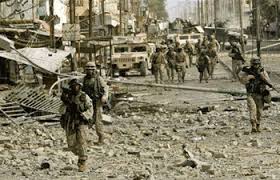
First, we need to stop making such such casual, ill-judged use of military force. Many of the migrants in Europe today have been displaced by our incompetent interventions in the Middle East.


The Iraq War:
solved nothing and contributed to the migrant problem
Next we need to invest more in the countries from which most migrants come. It’s true that as well as refugees, there are economic migrants trying to get into the advanced economies. Well, help develop their home economies and fewer of them will go looking for a better future in strange countries whose language they don’t speak and whose customs they don’t know.

So if you’ve ever whinged about overseas aid, now would be a good time to stop. It’s money well spent, and we need to spend more. As much for our sakes as for the recipients: it takes the pressure off our borders.

The other form of generosity is even more important. We need to treat incomers with humanity. They need help, and we should provide it, because we can. Who knows, some of them may turn into tomorrow’s Roger Bannister or Mo Farah, the immigrants we can celebrate. Even if they don’t, we’d do well to emulate a German woman I heard this week. As she dropped off a donation at a refugee camp, she told the BBC that there was already more than enough evil in the world, and showing a little kindness to the most unfortunate would make it a better place for all of us.

That attitude would be a great starting point to work out the right questions about immigration. Because for now we’re coming up with entirely the wrong answers.

Saturday, 25 April 2015

Drowning migrants: when irritation is made to matter more than disaster

It shouldn’t be difficult to draw a line between disaster and mere irritation. And yet, oddly, there are many who seem incapable of telling them apart.

This week I listened to a young East African explaining to the BBC how he and his wife had decided to make for Europe, illegally, paying an exorbitant sum to people traffickers to take them on board a hopelessly overloaded boat from Libya. The boat capsized during the crossing; he briefly had a grip on his wife but as he found himself floundering in the water, they lost touch and she drowned.

“I didn’t know anything about how to save her,” he explained from her grave in Italy. 

Now, that’s a disaster.

Behind it lies a long history of ill-advised and badly conducted interference by Western powers, who should know better, in Africa or the Middle East. The West, having for decades tolerated or even, on occasions, positively encouraged a dictator in Libya, Muammar Gaddafi, decided to do away with him in 2011. Military support to internal rebel groups led to his overthrow and eventual assassination.

The West then went home, leaving it to the Libyans to sort themselves out, which they’ve singularly failed to do. We have replaced a toxic and dangerous dictatorship by toxic and dangerous chaos. Sound familiar? It should. It’s Iraq all over again. And the same kind of chaos afflicts many other countries, with or without Western help. Somalia. Mali. Syria. Yemen.

Refugees from all those countries have been travelling to Libya, where they join the many thousands of locals also trying to get out. Why Libya? Because it’s about as close as you can get to the southern border of Europe, in Italy.


Desperate migrants attempting to cross to Europe
In grossly inadequate boats
Our possibly well-meaning, but generally ill-judged interventions have massively added to the crisis in those countries. There’s no doubt that, in that way, our nations have contributed to turning huge numbers of people into victims of people smugglers. And therefore to a great many of them drowning when their grossly inadequate boats sink.

In 2014, nearly 3500 migrants drowned in the Mediterranean. This year, in under four months, estimates are that there have been nearly 1500 deaths.

So disaster has been compounding disaster.


The Aftermath
Now for the irritation. At the end of last week, Ed Miliband, campaigning to oust David Cameron as British Prime Minister on 7 May, said that a lack of “post-conflict planning” for Libya, by the Western governments, including Britain’s, involved in the overthrow of Gadaffi, had contributed to making the crisis worse.

That annoyed Cameron and his friends in the media. “Shameful” they called Miliband’s comments. “Ill-judged.” And they preferred to focus their attention on that, rather than on the drownings. The suggestion seemed to be that the hurt to Cameron’s feelings was more important than the loss of life among the migrants.

You see? An annoyance that mattered more than a disaster.

The reality, of course, is that even the annoyance was minimal. If Cameron made such a song and dance about it, his only reason was that he saw votes in it. “Look,” he was saying, “Miliband’s being rude to me. How can you vote for a man who says such unworthy things?”

And the other bit of reality is that, if Miliband had genuinely wanted to put he boot in, he could have been far harsher still.

Back in October, the Italian government gave up on its “Mare Nostrum” search and rescue operation in the Mediterranean. Over the twelve months for which it ran, it saved 150,000 lives. But the Italians decided that they couldn’t afford to keep running it on their own.

The British government, headed by David Cameron for the Conservatives and his Liberal Democrat deputy Nick Clegg, was outspoken among those in the EU who blocked any move to help Italy fund search and rescue missions.

Now that certainly led to the present upsurge in deaths. And what was Cameron’s justification for indirectly contributing to the drowning of so many people? That to keep providing rescue services would only encourage more to come.

Cameron is being outflanked by anti-immigration UKIP, which has many sympathisers on the right of his own party. So to placate them he refused help to desperate, exploited migrants left to drown. For electoral reasons.

Interesting that the word “shameful” was used of Miliband’s words. When these have been Cameron’s actions.

Wednesday, 19 September 2012

Syria: when the West sits on its hands

It’s harrowing to watch the news footage from Syria. A warplane turns gracefully in the sky, taking its time to choose a target before it glides in and bombs another house, killing some more children, a family, some old people, occasionally a rebel or two. On the ground men and women scream and cry and plead for help from the West. 
Syrian warplane gracefully killing women and children in Aleppo


Of course they call on us: in their position my anger at the wealthy and powerful nations who are sitting on their hands would be exactly the same.

‘Why don’t you intervene?’ I would scream, ‘Why don’t you help? Is it because we don’t have oil? After all what’s happening here is just what you set out to prevent in Libya.’

But that’s just the point at which natural sympathy for a people being massacred by a vile government has to pause a moment and take stock.

Because how well did that go in Libya? Did our military intervention there usher in a new era of peace and democracy? With the US Ambassador, Chris Stevens, killed there a week ago, is that even a question worth asking?

There are no doubt people in Libya keen to build a new nation conceived in liberty. But there seem to be many looking for something quite different. Perhaps a theocratic autocracy. Perhaps an opportunity to settle scores with another tribe. Perhaps just the perpetuation of a low-intensity conflict which serves them well.

The idea of perpetual conflict is hardly unrealistic. The fighting shows no sign of ending in Afghanistan. Today we learned that NATO has decided to suspend joint patrolling with Afghan forces in small units, since there have been so many occasions when Afghan soldiers have rounded on their supposed colleagues in NATO and killed them: 36 attacks this year costing 51 lives.

And what about the longest-standing of the Western attempts to force enlightenment on the Arab-speaking world? In a burst of optimism, Iraq brought in a power-sharing regime in 2005. Tareq al-Hashemi served as Vice President under a Shia President. Last December he fled for his life, a decision he presumably regards as one of his more judicious, since last week he was sentenced to death in his absence. Only on Monday, he accused his former colleagues in government of helping Iran pass weapons through to the Syrian government, rather confirming the widespread view that if there was a victor in the Iraq War, it was the Tehran regime which hugely extended its influence in the country.

Coincidentally, Monday was also the occasion of the latest in the unbroken series of bombings that have rocked Iraq ever since Dubya Bush declared his ‘mission accomplished’. The latest left at least seven dead in Baghdad and 24 injured.

The West has proved itself good at taking military action but lamentable at building a legacy behind it. At least, not the kind of legacy anybody would honour.

Meanwhile, back in Syria itself, a report issued on Monday by Human Rights Watch suggests that there are elements of the rebel army whose behaviour is no more commendable than the government’s: they have been torturing and killing their opponents just as the regime tortures and kills its own. Perhaps we are beginning to discover, in time on this occasion, what we discovered far too late in Libya: just opposing Basher al-Assad or Muammar Gaddafi doesn’t necessarily make you a nice guy.

Supporting disreputable characters wouldn’t be new in the history of Western intervention in the region. Let’s not forget that the West spent a long time supporting and arming the Taliban against the Soviets in Afghanistan before we decided these erstwhile friends were a pretty nasty bunch too. If you haven’t seen Charlie Wilson’s War make a point of watching it now (and not just for the lesson: the script’s by Aaron Sorkin, of West Wing fame).

That news footage from Syria is as harrowing as ever. But, though my heart goes out to them, when I hear the persecuted civilians on the ground calling out for Western help, my inclination now is to say ‘be careful what you wish for.’ We’re good at delivering poisoned chalices but they’re not good presents.

It sounds heartless to say it, but bad though things are, I firmly believe that the West should hold to its present attitude and stay sitting on its hands. The alternative could be a lot worse. And last a lot longer.