Saturday, 4 February 2017

Under and over dressing in Luton

Wandering back towards my car through central Luton yesterday, I was surprised to hear a woman shout at a figure further down the road, “oh, put some clothes, why don’t you?”

I looked up and there, indeed, was a man coming the other way, stark naked. He wasn’t even wearing shoes. And yet it wasn’t as though he had no clothes. On the contrary, he was carrying shirt and trousers and, as far as I could tell from a quick glance, other items of clothing, neatly tucked under his arm. In the other hand, he was dangling a pair of shoes.

He seemed to be providing something of a public service. People had stopped to comment on his passage, giving them a moment’s distraction from their usual chores. Though, mostly, they were expressing disapproval.

“There are kids around. They might see him.”

It was difficult to understand what harm the sight might do them. I don’t like to stare at people’s genitals, especially if they’re not wearing clothes, but even a glance was enough to establish that he had some. They were, however, in a perfectly – how shall I put this? – quiescent state. Nothing about him suggested sexual appetite, let alone sexual threat.

Further up, his body, though not that of a young man, was in exceptionally good form. Abdominal muscles well delineated, good pectorals. A matter not of condemnation but of envy. I suspect I couldn’t have come near that level of bodily fitness had I gone far more regularly to the gym than I ever have, even starting from a lot younger than I am.

Still, all around me I heard disapproval being voiced. Some, like the woman I first heard, were shouting advice at him. Much of it was ribald.

It all strikes me as bizarre. Surely none of us can be unfamiliar with the structure of the human body. What’s our problem with seeing it? It was unusual, certainly, to put one on display in that way, but why should it be shocking? To me, it seemed the man was more to be wondered at than condemned: I certainly wouldn’t have wanted to lay aside a single stitch of the clothing I was wearing, on a cold, grey February day. Nor would I want to walk the streets of any town in bare feet.

Besides, given the weight of disapproval any such act of non-conformism with common standards is likely to attract, I’d have to wonder about the mental state of a man who willingly incurs it. If he’s deliberately, rationally attacking convention, good luck to him. If he’s making a desperate plea for attention out of a place of unhappiness, he deserves sympathy, surely, far more than reprobation.

I’d have liked to illustrate this post with a picture of the man, if only to prove that the incident happened. But to have taken a photograph would, I felt, be to line up with those who felt it was strange. Or possibly to attract attention to myself for entirely the wrong reasons.

So instead I’ve picked a picture of some who are more heavily dressed. I’m not sure, however, it would appeal much more to the shocked observers I saw yesterday than he did. But then, there’s no pleasing some people.


What are you complaining about? They're fully dressed.

Tuesday, 31 January 2017

Crossing borders

It’s curious how two business trips provided me with two angles on the same issue. With only one conclusion.

On the first trip, I visited a couple of hospitals in New Jersey. To get there, I flew to Philadelphia, which isn’t in New Jersey, so I was a bit surprised. I shouldn’t have been: if I’d been better informed on the geography I’d have known that Philadelphia is right on the Pennsylvania-New Jersey border and the hospitals I was going to were close by.

Nothing more natural, then. My destination was in a different state, but the same nation. And yet, it might not have been. In the early years of the United States, that name was definitely a plural – people talked of “these” United States. Only later did USA become a singular noun, as the federation increasingly subsumed the states.

And yet I suspect that had the states remained separate, I would nonetheless have flown to Philadelphia to reach southern New Jersey. The Americans are pragmatists. Their pragmatism would have demanded open borders and easy travel across them for business.

In the second trip, I attended a meeting of Italian doctors in the Alpine resort of Cortina d’Ampezzo. It’s in the Veneto, the province of Venice, and perhaps it would have made sense to fly there and drive up. Somehow, though, I didn’t feel like doing that and taking the long haul up from the plain into the mountains.

Perhaps I just didn’t like the idea of a plane to a plain.

So instead I flew to a mountain airport, at Innsbruck. That however isn’t even in Italy. It’s in Austria. Hiring a car there to drive to Italy simply wasn’t a problem, though. Indeed, within half an hour of leaving the airport I was driving over the spectacular countryside of the Brenner Pass and crossing the border into Italy. However, I only knew that I’d entered another country because a road sign told me: no one flagged me down, no one checked my papers, no one made any more fuss about that border than about the one between Pennsylvania and New Jersey.

The change in language might have been striking, but not even that was entirely the case. Innsbruck is in the Austrian Province of Tirol. The other side of the border was the Province which has a double name, Süd-Tirol or Alto Adige, with the first, German name, given before the second, Italian one. What was true of the Province was true of the towns, such as Kiens/Chienes, Brixen/Bressanone and several gloriously literal ones, such as Neunhäusern (literally nine houses)/Nove Case (I leave the translation as an exercise to you).

Frozen Alpine lake:
Lago di Landro also known as the Dürrensee
Cortina, though, is just out of that area and into Italian-Italy. Even there, however, there are memories of the long association, and the tensions, with the Austrian neighbour to the north. The hotel where I stayed proudly displayed a portrait of Austrian Emperor Charles I (or actually ‘Karl der Erste’, in German). Not far away there was a memorial to General Antonio Cantore, who met his death while in command of a Division of ‘Alpini’ (Italian Alpine troops), struck down by an Austrian bullet in 1915.

That was during the First World War which brought to an end the Austro-Hungarian Empire he’d been fighting with, as one of its consequences, the detachment of Süd-Tirol from Austria and its incorporation as Alto Adige into Italy.

The monument to General Cantore
at Cortina d'Ampezzo
Today there are, no doubt, still Austrians and maybe even South Tirolese who regard that incorporation as an injustice and would like it reversed. It isn’t going to happen, though. Why bother, after all? If an Innsbrucker wants to visit Sankt Lorenz/San Lorenzo in Sebato, she jumps in a car and goes there. No Alpino division bars her journey. No Austrian sharpshooter is tasked with killing its commander.

It’s rather like Pennsylvania and New Jersey. It strikes me, at least, that things are altogether better that way. Free travel, open borders, easy communication. It feels better than walls and bullets.

That leaves me troubled by one question. Given all that, why on earth has a majority of my countrymen opted not to support the organisation that makes all that possible, the EU, by remaining a member? Why has it decided instead to withdraw and prefer barriers to passes?

And why on earth have the Americans elected a man who specifically wants to build a wall along the southern border, instead of seeking solutions in good neighbourliness and openness?

Sunday, 29 January 2017

Brexit: independence – or the most demeaning dependence?

Trump’s travel ban is a shameful indulgence in toxic Islamophobia. Sure, he seems to be targeting nations not a religion, but don’t be fooled. That’s just a fig leaf to make it less difficult to charge him with religious discrimination.

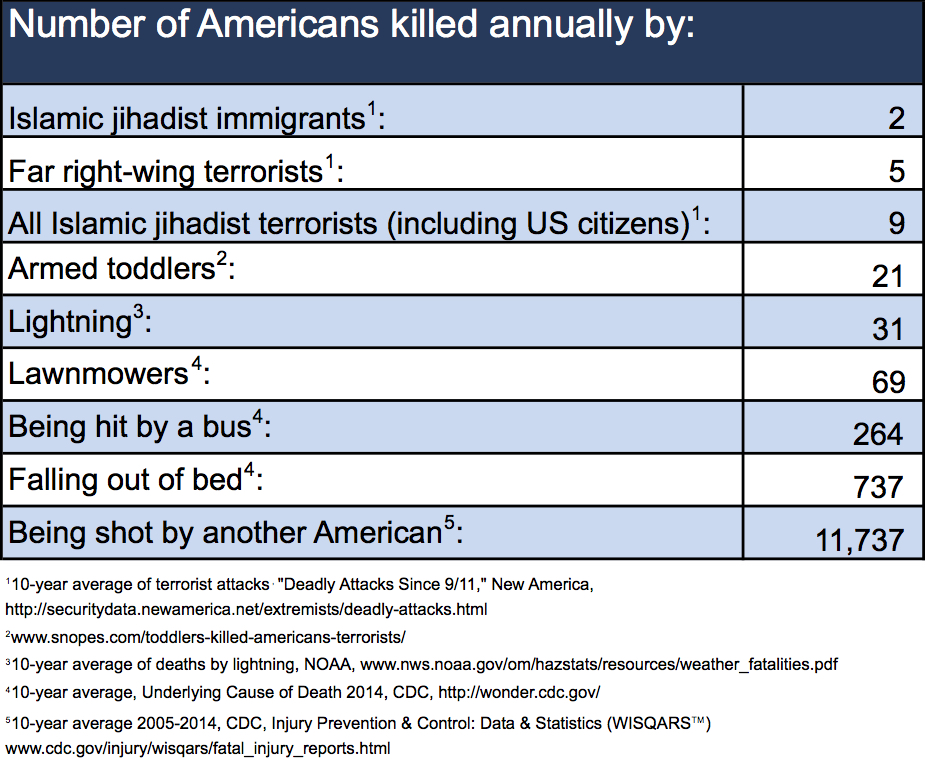
The ban has nothing to do with security and everything to do with a campaign against Muslims. As the Huffington Post points out, the number of Americans killed annually by Islamic jihadists is 9, only 2 of them by jihadist immigrants. 737 Americans die by falling out of bed, but Trump isn’t planning to make bed rails obligatory. 11,737 are shot dead by another American, and Trump certainly isn’t planning to do anything about cutting back on guns.

The Huffington Post sets the context for us
No, this is another attempt, like the Nazis’ in the twenties, to blame a group for ills you can’t solve and for which you don’t want to take responsibility yourself. It’s the Muslims, dummy, so let’s ban them.

In Britain, we’re not just sickened by Trump’s behaviour but shamed by May’s fawning on him. She held his hand at the White House and wants him to come over on a State visit. Many of us rightly feel this demeans us and makes us complicit in his disgrace.

I chose my words with care there. “Many of us” can rightly feel that way. Not all, though. Many others, shocked by Trump’s behaviour, have to bite their tongue and live with it. If you voted for Brexit, if you support it today, then you contributed to making our craven attitude towards Trump inevitable.

Many who voted for Brexit did so in the name of restoring British independence. That would be particularly true of the far-right party, UKIP – the United Kingdom Independence Party. Ironically, it is the leader of UKIP at the time of the Brexit referendum, Nigel Farage, who became the first UK politician to dance attendance on Trump. He proved so loyal and obsequious to him, indeed, that Trump called on the UK government to appoint him ambassador to the US.

Theresa May found enough courage to resist that call. But now she has become Farage’s rival in the deference stakes – instead of denouncing Trump’s travel ban, she resisted all attempts to get her to speak out against it, until the pressure became so overwhelming that she weakly assured the country:

Immigration policy in the United States is a matter for the government of the United States, but we do not agree with this kind of approach and it is not one we will be taking.

Why is she refusing to denounce Trump in the round terms he deserves?

Because we are leaving the EU. The belief of Brexiters is that Britain, freed from EU control, can establish new trading relationships with other nations that will enable it to preserve its commercial position. No trading partner could be more important than the US.

We come to the US as supplicants in these circumstances. We need the deal. We have to pay the price.

Clearly, part of that price will be to give up on our right to speak out against the abuses of the Trump administration. Others will come along: dropping our standards on carbon emissions or food hygiene (you liked our ban on genetically modified foods from the States? Wave goodbye to it). We have to defer to him in the hope that he’ll look after us. That’s the cost of throwing ourselves into such dependence on the US.

Because dependence is the word.

You thought Brexit would give us independence? The opposite, I’m afraid. We have made ourselves more massively dependent on the US than we have ever previously been in peacetime. Just in time for Trump’s inauguration.

Shamed by May’s fawning on Trump? Anyone with a sense of decency would be. But did you vote for Brexit? You voted to make us bow our heads to Trump.

That may not have been what you wanted when you cast your vote. It is, however, what you got. And, sadly, we all have to live with the unwanted consequences of your choice.

Friday, 27 January 2017

Lesson for Trump: why not try generosity? It actually pays

It’s ironic that generosity and opening up to others can sometimes be as beneficial to the nation offering the gifts as to those receiving them.

Truman and Trump
The Statesman and ... the Donald
The winter of 1946-7 was desperately hard, with some of the lowest temperatures on record. For Europe, devastated by war, that was catastrophic. For the vanquished, inevitably – Germany with much of its urban landscape reduced to rubble and huge numbers of homeless among the worst hit – but victors too were suffering, with Britain still having to cope with rationing and struggling to bear the burden of war debts far beyond its resources.

At that time, Britain was still trying to pretend it could play a world role (echoes of today). It had, for instance, forces still deployed in Greece and Palestine. But Clement Attlee’s government began to realise that it was going to have to take a more realistic view of the weight of its (unlike Theresa May’s) . It warned the United States that it would have to start scaling down some of its military commitments, including in Greece.

The reaction of the Truman administration then in power in Washington was astounding and exemplary.

For better or for worse, it decided that resistance to Soviet influence in Greece and Turkey had to be maintained, and that it would therefore shoulder the burden itself, to the tune of $400m.

Far more to the point, it chose to use the newly appointed Secretary of State George C. Marshal, who chaired the chiefs of staff during World War 2, to investigate the state of the economies throughout Europe and to come to their assistance. This was the start of Marshall Aid. It came to over $12bn, corresponding to ten times that amount today.

Much of the money went to the erstwhile and newly-defeated enemy, Germany.

As Truman put it, “We are the first great nation to feed and support the conquered. We are the first great nation to create independent republics from conquered territory: Cuba and the Philippines. Our neighbours are not afraid of us. Their borders have no forts, no soldiers, no tanks, no big guns lined up.”

We’d have to question just how relaxed countries near the US truly felt. The giant to their North had shown itself perfectly prepared to flex its muscles and use its force to have its way, and they must have been a great deal more suspicious than Truman’s sanguine words suggest. Even so, it was an extraordinary act, to fund a defeated foe instead of taking from it. After all, at the conclusion of the First World War, well within living memory of most adults at the time, an intolerable burden of reparations had been imposed on Germany. That had undoubtedly been a contributing factor to the renewed world war twenty years later.

Marshall aid was an admirable and unprecedented act that deserves congratulations for that fact alone.

It was remarkable for far more than that, though. By allowing Europe to emerge from its ruins, and helping Germany, in particular, become prosperous and successful again, the US guaranteed itself good trading partners from which it too would benefit. It ensured that its presence and influence in the old Continent would remain as strong as ever, at least in the Western areas. Overall, it gave a huge stimulus to the world economy from which all nations, including the US, profited.

Generosity and strategic vision went hand in hand.

Now roll forward 70 years.

Faced with undoubtedly significant economic problems, Donald Trump has decided to use not generosity to advance his cause, but isolationism. He has decided not to try to win the support and trust of neighbouring nations, specifically Mexico, but to wall them off. Where Truman had boasted that Mexicans had needed no fortresses against the US, Trump will build a wall against them.

Trump plans to make Mexico pay for the wall, by taxing imports into the US. In reality, this means that US importers will pay for it. Even so, it will do great damage to Mexico. Far from making it a wealthy and successful nation he is, therefore, taking steps that will undermine its economy and weaken it as a trading partner.

He’s threatening similar action against other nations, notably Germany.

His is the opposite view to Truman’s. He wants walls, not openness. He wants trade barriers, not free business. He wants to take money, not offer it.

Marshall aid was astonishingly successful, stimulating the sustained boom of the post-war years.

It seems obvious that the opposite policy will have precisely the opposite effect.

But then, Trump probably doesn’t waste too much time learning stuff from history. Not even that of his own lifetime.

Wednesday, 25 January 2017

The debt Britain owes Gina Miller

The trouble with populists is that they’re always in a hurry.

When they’ve seen that something needs to be done, they want to do it now. They don’t want to have to waste time with the niceties of consensus building and scrutiny – they take so long and delay necessary action. You can see it with Trump in the States: he wants to reintroduce torture as a weapon of policy, and wants to do it quickly, by means of an executive order.

The Guardian quotes Steve Kleinman, retired air force colonel and chairman of the research advisory committee to the High Value Detainee Interrogation Group (HIG):

“If the US was to make it once again the policy of the country to coerce, and to detain at length in an extrajudicial fashion, the costs would be beyond substantial, they’d be potentially existential. We’ve seen how [torture] promotes violent extremism, how it degrades alliances. We’ve seen how it only serves to provide information that policymakers want to support [desired policies], not what they need,” Kleinman said.

“A lot of these people who weigh in heavily on interrogation have no idea how little they know, [and do so] because of what they see on television,” said Kleinman, who emphasized that he was not speaking for the HIG.


But populists are in a hurry. They don’t want to have to stop to take such annoying and delaying objections into account.

It was always so. Julius Caesar marched on Rome because it was time to do away with the corrupt and inefficient republic. Napoleon launched a coup d’état because it was time to restore order to France and let her be great again. The war clique in Japan in the 1930s did away with the opposition to its rule because it knew it was time for the Empire to astonish the world with its military prowess.

Sadly, a little opposition might have avoided outcomes far worse than the problems they were trying to fix. Caesar’s actions replaced a rotten republic by an Empire which again and again became a bloodthirsty tyranny. Napoleon led France to momentary glory then utter failure, on the retreat from Moscow and the field of Waterloo. Japanese militarists won spectacular victories throughout 1942 and then were forced step by step to the loss of all they had gained and the destruction of much of what they had at home.

Now, one of the things about populists is that they’re often popular. They can frequently put together a popular majority (not Trump, as it happens, but he did win the election despite that). As democrats, we’re obliged to go along with the majority view (or the electoral win, at any rate, in the case of Trump).

But the lesson of those cases is that even when they have popular support, and they’re in a hurry, we should not on any account slacken in our scrutiny of the measures they propose.

In Britain, a popular majority decided in June of last year that Britain should leave the European Union. It was a misguided decision, as the country will discover over the next decade or two. But the decision has been taken and I see little or no chance of its being reversed. Britain will leave the EU.

The process starts with triggering what is known as Article 50. The Prime Minister, Theresa May, decided that she would do so. After all, the people had spoken. As Prime Minister, she could take that step using prerogative authority, a hangover of truly monarchical power, now exercised by ministers rather than the crown.

Gina Miller: staunch champion of British constitutional rights
Any true democrat must therefore be immensely grateful to Gina Miller. She launched a case, later joined by a number of other plaintiffs, demanding that the government should not act without the authority of parliament. She won the case and the government’s appeal against that judgement has now been rejected by the Supreme Court.

By a majority of 8 to 3, the Court ruled that leaving the EU would have a major impact on British laws, and only Parliament can make, change or revoke laws.

The effect on the Brexit process will be nil. Parliament will certainly approve the triggering of article 50. Britain will still take the senseless and self-destructive step of leaving the EU. But at least we have established that government, on major, law-making matters, can’t simply by-pass our elected representatives. It must win their consent to such steps.

That may be slow and dull. It’s horribly frustrating for the hurried populists and their supporters. But, as the examples of Caesar, Napoleon and the Japanese Empire demonstrate, the alternative is far worse.

Trump seems likely to prove the point again over the next few years.

Gina Miller has suffered horrible abuse in social media and the press. Any Brit that cares about the constitutional settlement of the country, and believes that any idea, good or bad, ought to be subject to scrutiny, should be deeply grateful to her.

Thanks, Gina. The personal cost to you has been immense, I know. I salute your courage and principled determination.

Sunday, 22 January 2017

Toffee's diary: when Number Two went away

Something odd happened, and I couldn’t work out why, or what it meant.

We were all just fine. That’s Luci my sidekick poodle, Misty our mighty cat, our two humans, and me. That’s – two humans. And then suddenly there was just one. Our number two just vanished. Gone. No sign of him.

No one said anything. It was like they didn’t want to mention it. Weird. After a while, I even started to forget about it. After all, we still had the number one human and she’s the one who understands about dogs and looks after us properly. But it was a bit sad not to see number two anymore, because he’s, well, he’s…

“He’s a wimp.”

That was Misty our cat, who has this way of stalking me when I don’t know he’s there. He was reading my diary over my shoulder, which is pretty sneaky really, and he shouldn’t do it.

Anyway, “wimp” sounds a bit nasty. Our Number Two’s not bad. I’d say he’s a softy, which is a bit sad, but good for us. I mean, there’s no one better for treats. He gives Luci and me treats for having our leads put on, and for having our leads taken off, for reaching the park, for getting back home, sometimes just for being us. If we want an exra one, all we have to do is give him our sad look. That always works.

Besides, no one else lets us lick their face or bite their fingers. Got to be good to have a human that lets you do that, isn’t it? I was sorry that he was gone.

Well, he came back! It was great. Luci and me were jumping all over him and even Misty came out to say hello (he doesn’t do much jumping at people, our Misty).

I decided it was silly not to talk about things, so this time I asked.

“What was all that about? He was gone and all that? And we didn’t say anything about it?”

“Not mentioning the human in the room?” said Misty with the tone of voice he uses when he’s being funny, but I have no idea what he meant.

“Sometimes,” he went on, much more seriously, “people go away. And don’t come back. A long time before you were here, before Luci was even here…” 

He seemed quite sad. I was trying to understand: Luci’s aways been here.

“Before even Luci was here we had a nice dog in the house called Janka. She was fun. Not noisy little runts like you and Luci. She knew how to behave properly to a cat. But then she went away. She’s never come back. That’s why I don’t talk about it when people go away. You don’t know if they’re coming home.”

“So… what happened?”

“For a while there was just me and the Domestics, and I thought that was terribly sad. Until Luci turned up and then you, when I realised I should have been happy when things were quiet. Be careful what you wish for, that’s the lesson I learned.”

“Oh, Misty, you don’t mean that.”

“Huh,” he said, and stalked off. He’s very good at stalking, including stalking off.

Still, he must have been happy to see Number Two back because he went and lay in the suitcase with all the human clothes in.


Misty occupying the suitcase.
But is it really to stop Number Two clearing off?
“That’ll stop him leaving,” he explained.

“That’s good of Misty,” I told Luci.

“Yeees,” she said, in that tone of voice that doesn’t really mean yes, “it’s kind of him to think of keeping Number Two at home for us all. But I think he may have other reasons for doing it.”

“Other reasons? What do you mean?”

“Well, he’s always running the humans down, calling them the Domestics and everything, but he’s a lot more attached to them than he makes out, and there’s nothing he likes better than resting surrounded by their smells. That’s why he likes to climb into their wardrobe.”

It’s true. I’d noticed he did that.

“So… the suitcase… it’s like the wardrobe?”

“I think there’s a bit of that.’

“But that’s not what he says.”

“You can’t always trust what people say.”

“What?” I asked, thinking I was being clever, “not even you?” 

“You’ll have to make up your own mind about that.”

Anyway. It’s fun having number two back. He’s taken us for a couple of walks and there were lots of treats. But there was one boring thing too: he made me put on a coat to go outside.

He calls me “Toughy Toffee” which is right enough. So why does he think I need a coat? Luci doesn’t wear one. He thinks I can’t cope with a little cold? I’m tough. Cold means nothing to me.


Me in my silly coat. And look, Luci doesn’t have to wear one
He’s a softy, but not soft enough, I think. Training, that’s what it’ll take. He’s accompanying me to the class on Tuesday. I’ll start knocking him into line there.

He may be nice, but he needs to learn what being Toughy Toffee means. The hard way, if necessary.

Thursday, 19 January 2017

Saying goodbye to the US at the end of the pre-Donald era

It’s the day before the US Presidential inauguration. I’m at the end of a two-week packed stay in the States, full of small but telling experiences in the run up to the country being Trumped, the end of what I suppose we shall have to think of as the pre-Donald era, an era we may shortly look back on with nostalgia.

I’ve always liked the character of Blanche Dubois in Tennessee Williams’ A Streetcar named Desire. She “always depended on the kindness of strangers” and, when I’m travelling alone, so do I. They’re not always kind, of course, but on this trip I met many that were.

In a Boston museum, I became aware of a woman pushing another in a wheelchair (her mother? I think it might have been). I sped up a little to get to the door ahead of us and hold it for them but, before I even got there, I heard the mother say, “why, thank you,” and when I looked around, she explained, “I see your intention.” I could only tell her I was pleased to have had it correctly interpreted.

In a restaurant, the Italian colleague who was with me on that occasion chose to apologise for a misunderstanding over our order by saying, “I am sorry. We are both foreigners.”

“Please don’t confuse me with Donald Trump,” came the answer.

Both in Boston and further up the coast north of the city, I could find no one with a kind word for the soon-to-be 45th President. But this of course is Massachusetts, which voted by a nearly two-to-one majority against him. In any case, as my mother pointed out when I told her, she had found it practically impossible to find anyone who had voted for Nixon when she was living in New York in the seventies, “and he was elected twice.”

Later I travelled to Philadelphia, in Pennsylvania which voted for Trump, giving a Republican the preference for the first time since Ronald Reagan. There I visited the hall where a bunch of insurgent liberals gathered back in 1776 and decided they’d had quite enough of British Tory government, just as I have today. It was ironic that it was in the city where Thomas Jefferson wrote the ringing appeal for liberty in the Declaration of Independence, that I first came across open backing of the Trump presidency.

Where the Declaration of Independence was adoptedCould they imagine they were preparing a Trump presidency?
I had lunch in a simple cafe where I had to return to the counter to fetch my meal. The tables were packed close and I must have bumped the man at the next table to mine. I didn’t hear what he said to me but apparently he’d sworn at me aggressively. When I returned, the young women at the table on the other side of mine pushed it aside and invited me to come through that way and not chance provoking the hostile diner. I thanked them.

“Strange things are happening to our country,” one of them replied.

It struck me as a neat metaphor of the division in the US, between brutality on the one hand and a degree of tolerance on the other.

Later that day, I was sitting in an alcove of a hotel bar when a mother and daughter (yes, another pair) came in and took the seats opposite me. Most of the time they talked about everyday matters – you know, “well, you can always phone me”, “oh, I don’t want to disturb you, I know how busy you are”, the usual family things – but at the end they came to politics.

“Obama demeaned the presidency,” Mum assured us, “I’ve never seen the presidency reduced so low.”

There was a shocked pause, which struck me as the appropriate reaction to such an assertion.

“You mean…,” the daughter replied, “you expect Trump to raise the standing of the presidency?”

It seemed that was exactly what she expected. “He’ll speak for the nation, and won’t let special interests push him around or buy him off.”

As she was leaving, she pointed out that I’d probably listened to the conversation, and asked my view.

“I’m from the other side of the Atlantic,” I told them, “you won’t find many of us over there who are keen on the Trump presidency.”

The daughter smiled.

“Well, we are,” said Mum, with emphasis. “Friday. You’re going to see. We’re on the way back and not a day too soon. We have a lot to fix.”

Oh, well. That Friday’s nearly on us. Trump and his team start “fixing” things tomorrow. It should be quite a spectacle.

I’ll be watching it from a distance. I fly back on the eve of his triumphal entry to the White House. Back to the relative safety of Britain.

Where can I have the joy of watching my own country embrace its version of Trump: the ghastly retreat into walled-off isolation we call Brexit.

I see nothing to justify my indulging any sense of superiority over our American cousins...