Showing posts with label Boston. Show all posts

Saturday, 30 March 2019

Tense about language, easier about life

Ah, Valencia. Charming city. Full of surprises – the convent that has become a bar and restaurant where you can eat Asian street food and drink a glass of wine under the stars and the palm trees, for instance, or the park that’s kept so clean that it can be hard to find a stick to throw for the dogs.

Valencia gets Spring going
It’s not all magic, of course. There are downsides. One is that Spain works at a higher volume than Britain. People don’t simply meet and have a discreet chat in subdued tones. They seem to feel that they haven’t fully demonstrated their joy at being with friends unless they talk loudly enough to be heard three blocks away. That can be a little tedious in the street during the day, but at 2:00 in the morning in the flat next door to ours, it can be a real bane.

But the benefits vastly outweigh these minor inconveniences. If nothing else, it was sheer joy to be enjoying Spring there, a point driven home to me here in Boston (Massachusetts, not Lincolnshire), where I’m looking out on a cold winter’s day under grey, rain-laden skies.

Danielle and I both feel that, to fit into our new life, we need to master the language. As it happens, I already speak a little Spanish, so my new tutor’s first action was to assess my level (far from high). She came up with some curious conclusions.

One was that I sometimes drift into an Italian accent. Not altogether surprising, since I was born in Italy. But, to be honest, I have no idea what an Italian accent sounds like in Spanish. To my tin ear, both accents sound Mediterranean. Which is perhaps a measure of just how much I have to learn.

What’s more, it’s a little exasperating. To sound Italian when I speak Spanish might be more acceptable if I didn’t sound so English when I spoke Italian. Why can’t I have an Italian accent in Italian?

But my tutor’s major concern was over my mastery – or rather lack of mastery – of the past tenses. I keep using the wrong one, she tells me, in rather a random way. It’s not as though I always use the imperfect when the simple past would be more appropriate, say, which would be a far more comprehensible error, and far more easily corrected.

The truth is that I can never remember how the verbs work in the past, so I just use whichever form comes to mind first. I make an approximate stab at the tense, in the hope that the person I’m talking to will translate it to what I actually mean, understand me, and make allowances. 

For an Englishman who sometimes sounds Italian.

Since my command of the future tense in Spanish isn’t a great deal better, that leaves me comfortable only with the present.

This is ironic since a character flaw of mine is always trying to get ahead of events, planning what I’m going to do and what steps I have to take to make it happen. This sort of hankering for the future is what the French call fuite en avant and the Germans Flucht nach vorn, both of which mean a flight – in the sense of escape – forwards. It’s odd that there’s no real term for it in English, since Anglo-Saxon nations are no more immune to this sad disorder than anyone else.

Equally, I have a tendency to live too much in the past, for instance spending too much time concerned with a period, within my own lifetime, when the Brits were rather more open to others and generous in their tolerance than they’re proving right now. So forwards or backwards I go, to the serious detriment of the here and now.
The Rubáiyát of Ommar Khayyám
Lots of good advice, not always easy to follow
“Unborn tomorrow and dead yesterday, why fret about them if today be sweet?” asks Edward Fitzgerald’s version of the Rubáiyát of Omar Khayyám. Excellent advice, but I’m not good at following it.

Except, it seems, in Spanish. Apparently that’s a language in which I truly live for the moment. Poor mastery of the future, none at all of the past.

It’s almost enough to make me wonder whether I really should pursue my studies of the language. If my current limited skill allows me to tackle a deeprooted character flaw, is that perhaps a price worth paying? Maybe I should just learn to live with being a foreigner who sounds English and occasionally Italian, and can’t account coherently for what he was doing yesterday. And stop constantly planning for a future that may never happen, or regretting a past that’s gone for good anyway.

Curious what language learning can tell you about yourself.

Saturday, 1 September 2018

US Railways. Or Railroads. Oh, how are the mighty fallen

The United States didn’t invent the railways. That was Britain. It’s like football, where Brits invent something and then watch foreigners do it better.

The Americans don’t even call them railways, instead using the word railroads, but hey, they didn’t invent the things so why should they get the name right?

When Abraham Lincoln first emerged from crushing poverty, he made some money as a railroad lawyer, as did Clarence Darrow who later became one of the best defence lawyers ever. And major fortunes were made in the sector – one thinks of Cornelius Vanderbilt or EH Harriman, for instance.

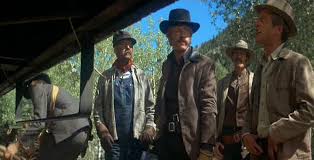
Actually, I have to say that when I think of EH Harriman, what comes to mind is the classic film Butch Cassidy and the Sundance Kid. Do you remember the pathetic figure of Woodcock, the train guard Butch calls on to open the door of the freight car carrying the money, so his gang can take it? Butch warns him that he could get blown up when they dynamite the car, and Woodcock explains:

… you gotta understand that Mr E H Harriman himself of the Union Pacific Railroad gimme this job and I never had such responsibility before and since he entrusted me to get the money through, I got to do my best, don’t you see?

Sundance and Butch trying to persuade Woodcock to open the door
rather than be blown up
It didn’t work out well for him. Or for the money. But fine for Butch and Sundance.

Today, that’s all gone. US trains, where there is a service at all, are infrequent, shabby and slow. As I discovered, or rediscovered, during the trip to Boston from which I’ve just returned.

It was when I travelled to the town of Framingham. That’s ‘Framing’ to rhyme with ‘naming’, not with ‘hamming’. I had some trouble explaining where I was going before I understood that one.

It was dark when I headed back. The station was deserted bar two or three sinister-looking young men, but I suppose that when you’re 65 any large young man looks a bit sinister at night. There was no café or waiting room. Or staff.

Framingham Station in the gloom
with the painfully high footbridge in the background
There are two platforms (or tracks, as they say) at the station. When I arrived from Boston, I left the train at one of them, so I thought the train back might arrive at the other. But a metal sign suggested that trains from that platform only travelled away from Boston. And a similar sign on the other platform suggested it was for ‘Inbound’ trains. Which was odd, since I’d arrived at it from an outbound one.

They like those metal signs. There was another which said ‘stand back, train approaching’. Since it was a permanent sign, it didn’t seem to be particularly helpful. After all, I can testify that there were long periods when trains were anything but imminent. Unless that includes half an hour away.

There were also scrolling LED signs. They might have told me where the next train was heading and when it would arrive. Not at Framingham. There they just informed us that the car park charges had ‘changed’.

Don’t you love that euphemism for ‘gone up’?

Destinations? Times of trains? Possible delays? Nothing. Nada. Zilch.

The problem at Framingham is that the only way across the tracks was over a high bridge. I decided to position myself at the bottom of the stairs on the side I guessed the train might use, ready to tear up, over and down if I had to.

As it happens, the train did come in on the platform I chose, though I had to do some tearing all the same, because the train stopped a long way from the footbridge.

To give credit where it’s due, the train was bang on time. But that’s all the credit it deserved. The interior was unprepossessing. Minimalist. Barely utilitarian.

Boston suburban trains. Not the height of luxury
I sat across the aisle from a young woman sleeping stretched out over three seats. We trundled uneventfully through the Massachusetts night for several stops. But then the young woman woke up. She decided to listen to music on her phone. But, it seems, she either didn’t have, or didn’t want to use, earphones. And she liked her music loud.

I wouldn’t have liked her music if it had been soft. Loud it was painful.

But I was tired and didn’t feel like a confrontation. The train had several other carriages. Moving would be easy.

Or so I thought.

I had no sooner tried to enter another carriage than the guard called out, ‘Hey, sir!’

Isn’t it odd how disrespectful the word ‘sir’ can sound if you really want it to?

‘The other carriages are closed,’ she told me severely. Which was manifestly not physically true, since the doors were wide open. I suppose I have to admire her fine grasp of metaphor.

The result was that I spent the last few stops hearing, though I tried not to listen to, that objectionable young woman’s music.

Eventually we arrived into Boston, much to my relief. A little late despite being so punctual at Framingham. Not even in that respect was the service impressive.

Lincoln wouldn’t have been proud. Nor Clarence Darrow. And I don’t imagine even Woodcock would have found much to celebrate in that sad little descendant of the fine trains Butch Cassidy used to rob as he tried unavailingly to defend them.

Wednesday, 29 August 2018

Transatlantic travel and comparisons

One of the pleasures of my job is that it gets me to the US from time to time. Specifically, to Boston and Massachusetts generally, which is great, not least because they’re pretty much the antithesis of Trumpland.

It was great flying across. The trip was uneventful, as flights generally are these days, out of Russian missile range. Air travel has become routine, with neither much sense of risk (thank God) or of luxury (small price to pay).

We landed half an hour early, which was no benefit at all. Traffic at Boston is so heavy there are never any gates free so arriving early means waiting for the previous plane to leave your designated gate. Half an hour early? You get half an hour wait on the tarmac.

The Americans have massively improved entry into the country. It used to be a painful process. But I’ve managed to get myself on to the Global Entry programme, so I glided through with ease. Besides, the officials at Boston are friendly, which isn’t the case at every US airport, so arriving here’s unusually pleasurable.

Getting through passport control quickly means you get to the baggage hall sooner. I know I should learn to travel with hand luggage only, especially for just three nights like this trip. But I hate having only tiny tubes of toothpaste or micro-bottles of shampoo, and I love getting rid of my case, so I check it in, small though it is.

The airlines have a great system so that if you travel with them often enough, they grant you certain privileges. My bag now gets a ‘priority’ tag when I check it in. This is a huge boon, since it means it’s now hardly ever the last case offloaded.
The great privilege of a 'Priority' label
Which does... pretty well nothing
On this occasion, about three-quarters of the luggage had appeared before my priority case. That unfortunately meant that it didn’t make the cut: it didn’t reach the carousel before the entire luggage belt broke down. This is the land of superfine, superfast technology, so when it fails, it fails spectacularly.

Ah, well. We went from super-early to pretty late, but who cares? At least I had the chance to go for a rest, where rest is what Americans take in a restroom. I loved the symbolism used though, I have to confess, I couldn’t conform since my bag still hadn’t arrived and I couldn’t put a bowtie on.
Tough dress conventions for this 'rest' room
After that, all I had to do was head for the hotel. Which was on the waterfront, so I was able to have a relaxing walk before crashing out. That was quite an experience: I associate Boston with bitter cold, but on my walk just before midnight, it was 30 Celsius rather than 30 Fahrenheit.

A pleasant walk on a balmy night
At 30 C, nearly barmy
Breakfast is one of the better US institutions. I enjoyed it over a copy of the New York Times. That’s the ‘failing New York Times’, according to the President of this fine country. The fact that the hotel provided that paper and no other was in keeping with what happened the previous evening, when I checked in. The clerk gave me instructions for logging on to WiFi. After selecting the service, the suggestion was that I call up CNN.com to get the hotel login page. That’s quite amusing, because I always use BBC.co.uk for the same purpose. Of course, both CNN and the BBC are just the kind of news outlets Trump detests.

Not just Trump. I notice that Jeremy Corbyn’s supporters use much the same language as the Trumpists to denounce the media and its supposed unfair hounding of the blessed leader. Interesting how people at the centre of personality cults, whether of Left or Right, always hate anyone who questions them. And as for dissent, that can only come from traitors. I recently read these edifying words:

We know who the conspirators are; who their backers are; where they are and why they want to destroy [our man and our movement].

Was the writer talking about Trump or Corbyn? It’s hard to tell. The threatening tone of ‘we know where they are’ is like Trump whipping up hatred against journalists at a rally. In this case, the words were a Corbynista’s.

Breakfast also reminded me of the meal on the flight over. It included ‘Butler’s Secret’ Cheddar. Sounds enticing, doesn’t it? Marketing people love the notion of secrecy. Odd, seeing as their work is all about publicity. Somehow, nothing’s so exciting as the notion of secret ingredients.

What turned up was something that looked, felt and, I can testify, tasted like perfectly ordinary Cheddar. And since its wrapping stated what it was, I couldn’t really see anything secret about it.
Butler's Secret. Proclaimed on the packaging.
Which was a relief, to be honest. After all, if I want transparency in anything, it has to be about what I’m eating. Why would I want the producers to keep what they’re putting in my food secret?

Still. At least I don’t suspect them of engaging in collusion. Which is a lot more than I can say for Trump.

Monday, 16 April 2018

Baseball Trumping Patriots

It was odd to discover that some colleagues from the US wouldn’t be able to join a meeting I’d called, because it was ‘Patriots’ Day’.

That’s not Patriots’ Day in the US, you understand. It’s not even Patriots’ Day in Massachusetts. It’s Patriots’ Day in the City of Boston and in that city alone.

It’s the day the population of that fine city celebrates the moment when its English inhabitants showed, with valour and tenacity, that it would not be denied the rights of Englishmen, forcing out the troops sent there by the English King.

A man increasingly crazed, of limited intellect and devoured by his autocratic inclinations

Although one of my colleagues seemed to blame me personally for the misdeeds of the British troops (apparently, I should have been nicer to the colonists – I promise to do better next time), I am fully in sympathy with the rebels. They set a fine example and one we latter-day Englishmen would surely do well to emulate. In fact, I only regret that all their courage and self-sacrifice have only been crowned, sadly, by their descendants being saddled with a Trump as head of state.

A man increasingly crazed, of limited intellect and devoured by his autocratic inclinations.

That being said, I’m fond of Boston. I’ve not been there that often but each time I’ve got to know it better and the experience has only reinforced by initial liking of the place.

On my last visit, my boss took several us to see a Red Sox baseball game. Now, I’m not going to say that was the high point of the visit, since naturally it was the work we did at our meetings that formed the true high point. Perhaps I’ll just say that had there not been those meetings, it would have been right up there at the pinnacle.

I’d never been to a baseball game before so it was a great educational experience. It’s a bit like cricket, only the advantage lies far more with the man with the ball in his hand, rather than the poor unfortunate holding the bat. Things are rather the other way around in cricket.

Apart from that, and a slight truncation in the time it takes to complete a match, much of the spirit of the game is similar to that fine English game. As, I suppose, befits a nation founded by fine Englishmen.

It wasn’t just the game itself that amused me, however. I’ve always liked the film Field of Dreams. You know, “if you build it, they will come”. You may remember the moment when Kevin Costner talks James Earl Jones into accompanying him to a game at Fenway Park, home of the Red Sox.


A scene from the film. 
With the green monster - the wall at the back - clearly in view
It was a joy to sit in the stands and look out at the same scene that they saw. Nothing surprising maybe – the filmmakers shot the scene on location. But still it sent a tingle up my spine just to be where those characters had sat and see much the same sights that they saw.


A scene from (my) real life
Ditto
Wonderful. It wasn’t on Patriots’ Day, as it happens. Still, from a purely personal point of view, it was just as worthy of celebration in my eyes.

Of course, as it happens Patriots’ Day is also the day of the Boston Marathon. Which was run this year in temperatures down to -1 (that’s -1 in real money – Celsius). Making it a pretty miserable experience.

But then, since we’ve already sad that the legacy of the original patriots is now in the hands of the Donald, that may not be wholly inappropriate.

Sunday, 21 January 2018

A break from the tedium of air travel

Passenger planes are just busses of the air these days. Any idea, from the early days of aviation, that air travel was luxurious has long been lost.
The joy of air travel: waiting, waiting, waiting
It's the queues that are worst, whether for check in, for security or for the plane itself. So picture me, if you will, combating boredom as I waited to board a flight home from Boston the other day. And imagine my relief when the monotony was interrupted by a pleasurable experience.

I was right behind an English couple that was deciding where to store its duty-free purchases. In his carry-on bag? In hers? Some in one, some in the other? I wasn't that interested in the debate but was following it in a desultory sort of way, as preferable to merely chafing against impatience. But as the man turned towards me and I saw his face, a strange sensation came over me. He seemed familiar. Could it be that I knew him?

As the thought occurred to me, I noticed that he too had noticed me and was looking at me more intently than one might expect from a stranger in a queue.

"Gary?" I asked.

"Good Lord. Mr Beeson. Imagine meeting you here."

We couldn't talk for long. Now I would have liked to have a few minutes to chat with them, which naturally meant that the crawling speed of the queue suddenly felt far too quick. Still, we could catch up on a little news, and I learned that Gary had just completed an impressively long consultancy project that had kept him in Boston for four and a half years.

I last met him nearly three years ago. At the time, I was looking for a new job, a state in which I've found myself far too often in the course of a long, varied and not always entirely fulfilling career. He helped me get a couple of interviews with his company - just being invited to interviews, as anyone who's been unemployed knows, is no easy task - and if they didn't lead to an appointment, that was in no way a reflection on his efforts on my behalf, but entirely down to my not having the right mix of experience (and possibly skill, if I'm entirely honest).

However, I first met him long before that. Over quarter of a century ago. We shared a boss then, in a company where I handled marketing and he handled sales.

He was one of the most colourful figures in the long panoply of salesmen I've come to know. A glowing example from the column of those I class as 'successful and deserving congratulation'. There have been plenty in the opposite group, the ones I see as 'inept and in urgent need of firing'.

As an example of the latter type, I was thinking only the other day of Richard, a salesman with whom I had the misfortune of working some years ago. We visited a client who at one point told us, "It looks like a good service, but I'm worried that…"

Before he could go on, Richard interrupted.

"There's something else I want to show you which I'm sure you'll like…"

I wanted to kick him. The client had been about to voice an objection. Nothing is more precious for a salesman. To be told an objection? So you can address it? What could be more helpful? In many cases, clients tell you nothing about what they don't like, but do tell ten other people. And my colleague had stopped this client telling us.

But if Richard couldn't listen, Gary had another fault which was a virtue in disguise: he couldn't hear. That is, he could hear a great deal, but had an invaluable selective deafness to things it was no advantage to hear.

I was in an office where he was talking on the phone. He was apparently talking to the secretary of a senior executive (yes, it was those long-ago days when executives still had secretaries).

"I'm afraid I just don't understand," he was saying. "Yes, yes, I have his letter, but I don't know what he means. I really need to see him again, so we can get to the bottom of what he's thinking."

She was clearly telling him that her boss wouldn't give him an appointment, but he was insistent that he had to have one. And eventually his persistence paid off. After ten minutes, he at last got the appointment he wanted.

I was intrigued by what had been so incomprehensible to him. How obscure could a letter be if even Gary, who was certainly bright, couldn't follow it? I wandered over to take a look.

The letter was a single paragraph. A couple of sentences at most. I can't remember the exact words used, but the gist could not have been plainer. It was saying "no". The client didn't want our product. And he could not have said it more clearly.

A salesman who can't hear the word "no"? I appreciate, in these post-Harvey Weinstein days, that an inability to hear that word is an inexcusable failing in certain contexts; in the sales environment, however, it's a huge asset.

I don't remember whether Gary actually picked up the order in the end. It doesn't matter - he was highly successful across many clients so, even if this one didn't come through, he had an attitude that clearly worked well overall.

It was a great pleasure to run into him again. As well as a comforting break from the monotony of airline queues. If only I could guarantee an experience as enjoyable every time I fly.

Thursday, 18 January 2018

The Season in the US

It’s always a pleasure to spend a little time in the States. It’s a nation of such diversity that more or less by definition it has to be entertaining to visit. But often it’s the details that I find most amusing.

My present trip took me to Boston first, and then to Chicago on an internal flight with American Airlines. At one point, a flight attendant told us, “as a reminder, please fasten your seat belts”. Unfortunately, she never explained what fastening our seat belts was supposed to remind us of.

She also asked us to sign up with the airline, at aa.com. AA?  Isn’t that Alcoholics Anonymous? Devoted to helping people recover from a debilitating and self-destructive addition? In my experience, there’s nothing addictive about American Airlines. On the other hand, they could do a lot worse than launch their own kind of twelve-step programme. As a public service, here are a few modest suggestions for six they could use to get started:
  • Admit that they are powerless over their lateness and their schedules have become unmanageable.
  • Come to believe that a power greater than themselves, such as proper management, could restore them to sanity.
  • Mastern the notion that sub-freezing temperatures are likely to make de-icing necessary and start the process before the passengers have all boarded.
  • Humbly ask that their inadequacies be removed so that it takes them less than half an hour to get suitcases delivered to a terminal.
  • Admit that it’s completely cheesy to sing ‘happy birthday’ for someone waiting to board a plane and it’s worse still to sing it twice because they’d left someone out the first time.
  • Train passengers to stow their hand luggage fast and get out of the aisle so it doesn’t take twenty minutes to get a plane boarded. And start the de-icing.
The internal flight was to Chicago. People had warned me that the weather in Boston was bitter and balmy it certainly wasn't. Barmy, indeed, would have been an appropriate term for anyone inclined to hang around much outside. But it took Chicago to show me what winter really felt like.
Frozen in Chicago. Though  at least the lake was still liquid
The lakeside was glorious. On the other hand, it was frozen, to the point that staying upright was an interesting challenge. I think I invented a new kind of dance, as I twisted and turned to stay upright as I began to fall backwards, and then did some more exciting pivots and twirls to right myself when I found myself tipping forwards instead. The cold, though, was nowhere as bad as in the city itself: tall buildings cut off the sun and without even that weak heat to warm us, conditions became positively polar. Unwelcoming would certainly go some way to describe it.

Nowhere, though, was quite as unwelcoming as the Trump Tower, with its owner’s name in letters two floors high across the front.
Sign of a stable genius
You might almost believe that the present incumbent of the White House was an utter narcissist entirely obsessed with self.

Then it was back onto American Airlines and a flight back to Boston. Where the temperatures were a lot more comfortable. Making the hour-long delay, apparently pretty much par for the course in the winter schedule, a price worth paying for the improved weather conditions. 

For this second week, I'm staying outside Boston in a New England Bed and Breakfast, where I was greeted by a curious sign in the bathroom. It asked me, politely, to use a particular cloth to remove makeup. Such a courteously worded request is one I'd like to comply with but, since I haven’t worn makeup since I last took part in amateur dramatics in the late seventies, I find it hard. A real quandary.
A polite injunction. But difficult to obey
New England has delivered milder conditions than Illinois did but, for this inhabitant of old England, where snow happens occasionally and generally lasts only a day or two, it has provided further reminders of what winter means. That made for spectacular views from the windows of the training room where I spent most of the day.

Ah, yes. As I said. Always fun to cross the Atlantic.

Friday, 12 January 2018

How can others trust me if I don't trust myself?

Trust. It’s impossible to live without. And yet it’s so hard to win.

This all came to mind recently as part of the process I’ve been going through to try to make it easier to get into the United States on visits. Honestly, if a European want to understand how ghastly it is for non-Europeans to get into, say, Britain – you know, those demoralizingly long queues at immigration full of unhappy people combating boredom and jetlag – you need to try to get into the US as a non-citizen or resident. You wind backwards and forwards in long lines between stretched ribbons and, as often as not when you finally get to the front of one, you just go through one process – having your retina scanned and fingerprints checked, say – only to step into the next queue.

Which is what happened to me when I arrived in Boston last Sunday.
Smiles, but not that comforting
Trump and Pence: the men whose trust I need
I have therefore applied for inclusion in the US Trusted Traveller Program. This allows you to use a shorter queue and therefore, one hopes, to get in a little more quickly. It does, however, require winning the trust of the United States government.

Now I appreciate that the US only needs convincing that I don’t plan to engage in any criminal activity. It’s not my intention to carry weapons: I own rather fewer than most Americans (none at all). Nor do I plan to smuggle any banned substances, such as drugs – really not my scene: “drugs cause cramp”, Dorothy Parker assures us, and there are some fairly unpleasant penalties associated with carting them around too. Indeed, I won’t even be bringing in simple foodstuffs: we did travel with bananas once, which we’d forgotten to eat in the plane and dutifully handed over the customs officer when we arrived, by which time they’d been reduced to an unappealing brown mass anyway.

In that limited sense, I think I’m worthy of the US government’s trust, even one headed by the notoriously paranoid Trump.

Trust, though, must cover more than simply a reasonable endeavour to avoid downright criminal behaviour. One can’t help feeling that a trustworthy individual can also be relied on in everyday life. And there, sadly, I’m not wholly convinced I can even wholly trust myself.

For instance, when I was waiting to check in my bags for the flight to Boston, the thought occurred to me that I really didn’t need a winter coat for the flight. I took it off, emptied the pockets into my laptop bag, and packed the coat. That left me feeling pleased with myself for being so farsighted, but only until I got through security and decided to buy something.

That’s when I discovered that my wallet wasn’t in my bag. What’s worse, the pouch where I’d put the other things wasn’t properly closed. I cursed my carelessness.

Doubts assailed me. Had I left my wallet in the coat? Or had it fallen out of the laptop bag without my noticing? Worse still, how could I possibly find out?

The answer, of course, was that there was no way. I just had to spend the next eight or nine hours, until I got my case back, combating the ever-returning fear that I’d lost the wallet. An easy flight turned into a far less pleasant experience.

As it happened, the wallet was indeed still in my coat. I needn’t have worried. But it rather undermined my trust in myself – after all, had I concentrated a little more for a minute or two, I could have spared myself several hours of pain.

Not my idea of a trusted traveller.

Still, I’m glad to say the US has agreed to award me that status despite my own doubts. On the other hand, another shock awaited me as I walked into the building when my interview was to take place. Up there on the wall were portrait photos of Donald Trump and Mike Pence.

It’s odd. I’ve naturally seen Trump on TV again and again since he was sworn in. Practically every day there’s some new appalling revelation about the man. Inevitably, I knew perfectly well that he was President.

And yet, somehow, it was seeing those portraits that really brought it home. I’ve seen Federal buildings with portraits of Obama and Biden before. I’ve seen photos of many presidents. They strike me as entirely mundane sights, just what one would expect. But to see Trump up there – well, it really forced me to realise the ghastly truth: that hideous clown really had succeeded Obama in the White House.

In the short term, it wasn’t as chilling a realisation as the discovery that my wallet was apparently missing.

In the longer term, though, it may have far more frightening consequences.

Thursday, 19 January 2017

Saying goodbye to the US at the end of the pre-Donald era

It’s the day before the US Presidential inauguration. I’m at the end of a two-week packed stay in the States, full of small but telling experiences in the run up to the country being Trumped, the end of what I suppose we shall have to think of as the pre-Donald era, an era we may shortly look back on with nostalgia.

I’ve always liked the character of Blanche Dubois in Tennessee Williams’ A Streetcar named Desire. She “always depended on the kindness of strangers” and, when I’m travelling alone, so do I. They’re not always kind, of course, but on this trip I met many that were.

In a Boston museum, I became aware of a woman pushing another in a wheelchair (her mother? I think it might have been). I sped up a little to get to the door ahead of us and hold it for them but, before I even got there, I heard the mother say, “why, thank you,” and when I looked around, she explained, “I see your intention.” I could only tell her I was pleased to have had it correctly interpreted.

In a restaurant, the Italian colleague who was with me on that occasion chose to apologise for a misunderstanding over our order by saying, “I am sorry. We are both foreigners.”

“Please don’t confuse me with Donald Trump,” came the answer.

Both in Boston and further up the coast north of the city, I could find no one with a kind word for the soon-to-be 45th President. But this of course is Massachusetts, which voted by a nearly two-to-one majority against him. In any case, as my mother pointed out when I told her, she had found it practically impossible to find anyone who had voted for Nixon when she was living in New York in the seventies, “and he was elected twice.”

Later I travelled to Philadelphia, in Pennsylvania which voted for Trump, giving a Republican the preference for the first time since Ronald Reagan. There I visited the hall where a bunch of insurgent liberals gathered back in 1776 and decided they’d had quite enough of British Tory government, just as I have today. It was ironic that it was in the city where Thomas Jefferson wrote the ringing appeal for liberty in the Declaration of Independence, that I first came across open backing of the Trump presidency.

Where the Declaration of Independence was adoptedCould they imagine they were preparing a Trump presidency?
I had lunch in a simple cafe where I had to return to the counter to fetch my meal. The tables were packed close and I must have bumped the man at the next table to mine. I didn’t hear what he said to me but apparently he’d sworn at me aggressively. When I returned, the young women at the table on the other side of mine pushed it aside and invited me to come through that way and not chance provoking the hostile diner. I thanked them.

“Strange things are happening to our country,” one of them replied.

It struck me as a neat metaphor of the division in the US, between brutality on the one hand and a degree of tolerance on the other.

Later that day, I was sitting in an alcove of a hotel bar when a mother and daughter (yes, another pair) came in and took the seats opposite me. Most of the time they talked about everyday matters – you know, “well, you can always phone me”, “oh, I don’t want to disturb you, I know how busy you are”, the usual family things – but at the end they came to politics.

“Obama demeaned the presidency,” Mum assured us, “I’ve never seen the presidency reduced so low.”

There was a shocked pause, which struck me as the appropriate reaction to such an assertion.

“You mean…,” the daughter replied, “you expect Trump to raise the standing of the presidency?”

It seemed that was exactly what she expected. “He’ll speak for the nation, and won’t let special interests push him around or buy him off.”

As she was leaving, she pointed out that I’d probably listened to the conversation, and asked my view.

“I’m from the other side of the Atlantic,” I told them, “you won’t find many of us over there who are keen on the Trump presidency.”

The daughter smiled.

“Well, we are,” said Mum, with emphasis. “Friday. You’re going to see. We’re on the way back and not a day too soon. We have a lot to fix.”

Oh, well. That Friday’s nearly on us. Trump and his team start “fixing” things tomorrow. It should be quite a spectacle.

I’ll be watching it from a distance. I fly back on the eve of his triumphal entry to the White House. Back to the relative safety of Britain.

Where can I have the joy of watching my own country embrace its version of Trump: the ghastly retreat into walled-off isolation we call Brexit.

I see nothing to justify my indulging any sense of superiority over our American cousins...