Showing posts with label Clarence Darrow. Show all posts

Saturday, 1 September 2018

US Railways. Or Railroads. Oh, how are the mighty fallen

The United States didn’t invent the railways. That was Britain. It’s like football, where Brits invent something and then watch foreigners do it better.

The Americans don’t even call them railways, instead using the word railroads, but hey, they didn’t invent the things so why should they get the name right?

When Abraham Lincoln first emerged from crushing poverty, he made some money as a railroad lawyer, as did Clarence Darrow who later became one of the best defence lawyers ever. And major fortunes were made in the sector – one thinks of Cornelius Vanderbilt or EH Harriman, for instance.

Actually, I have to say that when I think of EH Harriman, what comes to mind is the classic film Butch Cassidy and the Sundance Kid. Do you remember the pathetic figure of Woodcock, the train guard Butch calls on to open the door of the freight car carrying the money, so his gang can take it? Butch warns him that he could get blown up when they dynamite the car, and Woodcock explains:

… you gotta understand that Mr E H Harriman himself of the Union Pacific Railroad gimme this job and I never had such responsibility before and since he entrusted me to get the money through, I got to do my best, don’t you see?
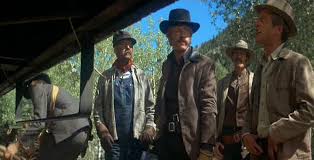
Sundance and Butch trying to persuade Woodcock to open the door
rather than be blown up
It didn’t work out well for him. Or for the money. But fine for Butch and Sundance.

Today, that’s all gone. US trains, where there is a service at all, are infrequent, shabby and slow. As I discovered, or rediscovered, during the trip to Boston from which I’ve just returned.

It was when I travelled to the town of Framingham. That’s ‘Framing’ to rhyme with ‘naming’, not with ‘hamming’. I had some trouble explaining where I was going before I understood that one.

It was dark when I headed back. The station was deserted bar two or three sinister-looking young men, but I suppose that when you’re 65 any large young man looks a bit sinister at night. There was no cafĂ© or waiting room. Or staff.

Framingham Station in the gloom
with the painfully high footbridge in the background
There are two platforms (or tracks, as they say) at the station. When I arrived from Boston, I left the train at one of them, so I thought the train back might arrive at the other. But a metal sign suggested that trains from that platform only travelled away from Boston. And a similar sign on the other platform suggested it was for ‘Inbound’ trains. Which was odd, since I’d arrived at it from an outbound one.

They like those metal signs. There was another which said ‘stand back, train approaching’. Since it was a permanent sign, it didn’t seem to be particularly helpful. After all, I can testify that there were long periods when trains were anything but imminent. Unless that includes half an hour away.

There were also scrolling LED signs. They might have told me where the next train was heading and when it would arrive. Not at Framingham. There they just informed us that the car park charges had ‘changed’.

Don’t you love that euphemism for ‘gone up’?

Destinations? Times of trains? Possible delays? Nothing. Nada. Zilch.

The problem at Framingham is that the only way across the tracks was over a high bridge. I decided to position myself at the bottom of the stairs on the side I guessed the train might use, ready to tear up, over and down if I had to.

As it happens, the train did come in on the platform I chose, though I had to do some tearing all the same, because the train stopped a long way from the footbridge.

To give credit where it’s due, the train was bang on time. But that’s all the credit it deserved. The interior was unprepossessing. Minimalist. Barely utilitarian.

Boston suburban trains. Not the height of luxury
I sat across the aisle from a young woman sleeping stretched out over three seats. We trundled uneventfully through the Massachusetts night for several stops. But then the young woman woke up. She decided to listen to music on her phone. But, it seems, she either didn’t have, or didn’t want to use, earphones. And she liked her music loud.

I wouldn’t have liked her music if it had been soft. Loud it was painful.

But I was tired and didn’t feel like a confrontation. The train had several other carriages. Moving would be easy.

Or so I thought.

I had no sooner tried to enter another carriage than the guard called out, ‘Hey, sir!’

Isn’t it odd how disrespectful the word ‘sir’ can sound if you really want it to?

‘The other carriages are closed,’ she told me severely. Which was manifestly not physically true, since the doors were wide open. I suppose I have to admire her fine grasp of metaphor.

The result was that I spent the last few stops hearing, though I tried not to listen to, that objectionable young woman’s music.

Eventually we arrived into Boston, much to my relief. A little late despite being so punctual at Framingham. Not even in that respect was the service impressive.

Lincoln wouldn’t have been proud. Nor Clarence Darrow. And I don’t imagine even Woodcock would have found much to celebrate in that sad little descendant of the fine trains Butch Cassidy used to rob as he tried unavailingly to defend them.

Tuesday, 5 July 2016

Angels and Demons, and the Labour leadership

The road to hell, they say, is paved with good intentions.

Sometimes it’s paved with sterling values. Like decency, gentleness and loyalty.

Labour Party members are mostly good people (there are, of course, exceptions). Loyalty is one of their admirable qualities. It was put to the test in the last Parliament when, despite all the evidence that he was failing to make a mark on his adversaries, we stuck by our leader Ed Milliband, right to the bitter end.

And bitter it was. After five years of lamentable government, a Tory party led by men principally driven by their sense of entitlement, not only beat Labour for the second time but went from having to rely on a coalition partner to having a working majority and governing alone.

A poor reward for all our loyalty. But a lesson from which we could learn.

We seem not to have. We’ve given ourselves a leader, Jeremy Corbyn, who has even more desirable qualities than Milliband did. He voted against the Iraq War. He’s firmly against the austerity policies that are crucifying the whole of Europe. He even has the guts to oppose the renewal of the Trident nuclear missile programme, which only gives a sense of security by being so expensive the assumption is that it has to be useful.

Sadly, few voters see him as a potential Prime Minister. Just like Milliband, he leaves barely a scratch on Cameron when he takes him on. His performance in the European Referendum campaign is often described as lacklustre, but in reality it was practically invisible. The debate came to be seen as an internal Conservative spat, pitting Cameron against Boris Johnson. Corbyn barely impinged.

Things have got so bad that a vote of no confidence in him was passed by 80% of the Parliamentary Labour Party. Outside Parliament, however, the loudest in the Party continue to back him. “60% of members voted for him,” they proclaim. 

I was one of those members. I voted for him because the alternatives were so uninspiring and because I felt we ought perhaps to give somebody different a chance. Well, we have given him a chance. It seems to me that if our leader hasn’t managed, over nine months, to unite the Parliamentary Labour Party, his most immediate collaborators, and hasn’t persuaded a majority of voters to see him as a future Prime Minister, then he’s unlikely to do it in the next four years. The Milliband experience underlines how important it is to make such a change quickly.

So why do the other members stick with him? They seem again to be driven by excessive loyalty. They also have their own sense of entitlement: “we are the members, we elected him.” Unfortunately, though members may elect a leader, it’s voters who elect a government. Maybe we’d do better to listen to them.

Naturally, dumping Corbyn now is unfair. But Labour doesn’t exist to be fair to its leaders. It exists to make life fairer for the vulnerable, the voiceless, the people who are paying the price of the current government’s policies. They and only they deserve our loyalty. Their cause needs a real fighter on its side. Corbyn is honest, decent, earnest, but if the European referendum campaign’s anything to go by, he’s no fighter. 

That puts me in mind of the words of one of the finest trial lawyers of all time, Clarence Darrow. He repeatedly emerged as the American champion of the left, of the underdog, of the trade unionist. He knew a thing or two about what it took to be a good labour leader.

Back in 1907, “Big Bill” Haywood, of the Western Federation of Miners, was put on trial for a murder he didn’t commit. Darrow won his acquittal, much to the establishment’s shock and anger. In the course of his summing up, he outlined what it took to be a leader of a working class movement:

I don’t claim that this man is an angel. The Western Federation of Miners could not afford to put an angel at their head. Do you want to hire an angel to fight the Mine Owners’ Association and the Pinkerton detectives, and the power of wealth? Oh, no, gentlemen; you better get a first-class fighting man who has physical courage, who has mental courage, who has strong devotion, who loves the poor, who loves the weak, who hates iniquity and hates it more when it is with the powerful and the great; and you cannot win without it, and I believe that down in your hearts there is not one of you would wish him to be an angel. You know an angel would not be fitted for that place, and I make no claim of that; but he is not a demon.

Big Bill Haywood. No angel, but certainly a fighter.
And he even had a way with words, wouldn’t you say?
Ah, yes. That’s what we need at the head of the British Labour Party: a leader who hates iniquity and loves the poor, but who is also a first-class fighting man (or woman). Not a demon who might take us into an illegal war inflaming decades of terrorism. But we don’t want an angel, either, without the killer instinct to knock out the other side.

Sadly, it looks like we’ve saddled ourselves with an angel for now.