Showing posts with label Maggie Thatcher. Show all posts

Wednesday, 20 May 2020

Boris Johnson second rate? No way.

When I look at the behaviour of the Johnson government, the thought “second rate” always springs to mind. Only to be replaced by, “that’s so unfair”. Followed by a swift reassessment.
Gentle humour, charmingly readable
Decades ago – oh, it was probably the seventies – I discovered the books of George Mikes. Most English speakers pronounce the name as though it were the plural of the nickname ‘Mike’. Or rather, since practically no English speaker even remembers him, perhaps I should say that they used to pronounce the name that way.
He was Hungarian by birth, though he lived most of his life in England. Strictly his name ought to be pronounced something like Mick-esh or possibly Meek-esh. But I like to think of him as Mikes.
He wrote a whole series of books commenting on the different nations he visited, starting with his adopted country, Britain. Just the title of the first of those books gives a feel for his style: How to be an Alien: a handbook for beginners and more advanced pupils. His books were light-hearted, humorous reflections on the behaviour and attitudes of various countries.
In one of his books, and I certainly wouldn’t be able to find the passage now, he mentions that a critic had called his writing second rate. He rejected this notion as a wild exaggeration. By way of explanation, he gave a ranking of authors, which again I don’t remember, but here’s a similar, if partial and entirely personal, ranking of my own.
In the ‘first rate’ I’d want to include Jane Austen, George Eliot, Elizabeth Gaskell, Graham Greene, George Orwell, Harper Lee, Salman Rushdie and Terry Pratchett.
So in the ‘second rate’ I’d have to have Charles Dickens, Edith Wharton, Joseph Conrad, Joseph Heller, John le Carré and Hilary Mantel.
I’m not going to bore you by going down a whole list, but simply point out that the second rate is made up of outstanding writers, whose names will ring down the ages, and who produced extraordinary books.
Mikes reckoned that he was at best tenth rate, which is probably about right. He’s down there with other writers who entertain and help you wile away a dull hour – you know, John Grisham and Nevil Shute – good writers (well, Shute was a lousy writer but a great story teller) who hit the spot but are a long way behind the best.
Now we can take the same approach to government. We need to be careful, however, because there are more factors to take into account. Competence is crucial, but competence applied to do harm is a defect, not a virtue.
On those grounds, while Abraham Lincoln in the US, Clement Attlee in the UK or Pierre Mendès France in 1950s France, were all first rate, we’d have to say that Tony Blair, whose government might have been first or second rate without Iraq, tuned out at best third rate in the end.
Because they were competent and did more harm than good, I’d have to put the Wilson governments up into second rate. Equally, the Callaghan government didn’t do too much wrong, entitling his time in office to be viewed as third rate.
Maggie Thatcher was extremely able and powerful, but did huge harm, wiping out whole communities (a few years ago, I revisited a village in Yorkshire which was once thriving when it its mine was running, to find it run down, shrunk in population and with 40% of the population on either unemployment or invalidity benefit, victims of Thatcher’s vandalism).
Twelfth rate at best.
When the amateur burglars pay a call
A fine metaphor for the inept playing at Thatcher
I remember an advert from a long time ago for an insurance company. It showed a devastated living room, with books and records all over the floor, amongst the ruins of broken furniture, devices and pictures. The catch phrase was something like, “If you think professional burglars are a threat, wait until the amateurs pay you a visit”.
Well, if we think that the competent Thatcher was a damaging presence, we now need to absorb just how much damage an incompetent version of the same can do. Think of a government that stumbles from crisis to crisis with no plan or guiding philosophy except its own self-aggrandisement, that takes its decisions too late and applies them too weakly, that sacrifices lives to profits in cruel indifference to the suffering and bereavement it causes, and then seeks to blames its advisers for its shortcomings. Yep. You’ve got it. That’s the Johnson government. Thatcher redux, without the ability.
Second rate, this lot? Way beyond their reach
Shall we say twentieth rate for the Johnson government? Or, OK, let’s be generous, maybe nineteenth. But second rate? Nah. They’re nowhere near that good.
As Mikes made clear, second rate is pretty remarkable.
The Johnson crowd comes way, way down below that on the Mikes scale.

Saturday, 25 April 2020

Time for more women leaders?

Two impressive performances have left me wondering whether we need more women at the top of politics. Not just because equality of rights is desirable, which it is, but also because they seem to be doing a lot better than most of the men.

That’s not all women leaders. Theresa May was convinced that she was right and, impervious to all calls to change course, steered her government straight onto the rocks. And Margaret Thatcher set a new benchmark in the kind of sociopathic government that has no compassion for the victims of the suffering it inflicts. No. Some women leaders are admirable, others anything but.

The two women who impressed me this week did so because the greatest measure of a politician’s worth is how they react to a crisis, and they have risen strongly to the challenge Coronavirus presents.

Neither of them is Jacinda Ardern. As I’ve written before, Ardern may be the most outstanding leader the world has today. My only regret is that, in New Zealand, she leads a country of just 5 million people. Imagine if she were leading the country of 330 million, currently mismanaged by the overgrown toddler in the White House?

So here are the two other women I feel are handling things well.

One was Nicola Sturgeon, Scottish First Minister. I was impressed by her quiet, firm and yet encouraging way of delivering bad news. She tweeted:

I know lockdown gets tougher as we head into the weekend, and the weather gets better (even by Scottish standards). But it really matters that we stick with it – we’re seeing some progress but it will be quickly reversed if we ease up. So PLEASE, #StayHome – it will save lives.

A little humour helps communicate a message – we all know the (not entirely undeserved) reputation of the weather in Scotland. As for the message itself, it’s firm but optimistic. It’s what one expects from a true leader.

She reminds me of a particularly potent speech by Churchill. He made it after the British victory at the battle of El Alamein, significant because it was the first time the German army had been defeated on land in World War 2, but still minor because the North African theatre was something of a sideshow compared to the titanic clashes that were taking place in Russia.

Churchill knew how to present the success in a way that was encouraging without exaggerating its importance:

Now this is not the end. It is not even the beginning of the end. But it is, perhaps, the end of the beginning.

Isn’t that what Sturgeon was saying? The lockdown’s getting tougher, but we’re seeing progress. It isn’t time to relax, but there’s reason for hope.
Merkel, Ardern, Sturgeon
Good to have more of them
Funnily enough, the other woman leader who impressed me used words even closer to Churchill’s. Angela Merkel, Chancellor of Germany, told her Parliament:

We are not in the final phase of the pandemic, but still at the beginning. Let us not now gamble away our achievements and run the risk of a setback.

Now there’s a tough statement. Germany’s not even at the end of the beginning, but still at the beginning itself. I’m sure she’s right. I wish some of the men we have leading major nations were prepared to be as open about where we stand.

Donald Trump, for instance, keeps trying to undermine the lockdown restrictions, even supporting demonstrators who (rashly) turn out to protest against them. We know that he believes he needs the economy humming again if he is to have a chance of re-election in November, and to achieve that, he seems willing to sacrifice more lives. That’s despite the US already having more Covid-19 deaths than any other, country in part because of his delays in launching counter-measures.

In the UK, Boris Johnson also worked hard to undermine social-distancing steps. On 3 March, he boasted that he was still shaking hands, even in the hospital he’d just visited where CVid-19 patients were being treated. Providing a useful demonstration of how irresponsible that was, he fell sick with the virus himself. Since he refuses to hand over to someone else even temporarily, but hasn’t been able to work for the last three weeks, the UK is now facing this crisis with no one to exercise the authority of a Prime Minister.

Not that I’m calling on him to hand over to a woman. That might mean the present Home Secretary, Priti Patel. If anyone could make Maggie Thatcher look like an exemplar of gentleness and empathy, it would be Patel.
Thatcher, May, Patel
No need for any more of them
No, not all female leaders are admirable. Just as not all male leaders are as lamentable as Bush or Boris: Sánchez in Spain or Conte in Italy, among others, have shown guts and determination in dealing with the virus, even if they were late getting started. But the women have been more uniformly impressive.

I’m not alone in noticing this. Jon Henley and Eleanor Ainge Roy in the Guardian, for instance, point out that only some of the male leaders, but all of the women, have handled the epidemic well.

That sounds like a lesson we ought to learn.

Thursday, 27 February 2020

Preparing for the pandemic

A crisis! A crisis! It’s a time to rise to a challenge, to show your mettle, to confront and overcome whatever life throws at you.

Of course, the first thing is admitting that theres a crisis at all. I’ve always preferred what might be called the Jim Callaghan approach, after the Labour Prime Minister of Great Britain, who in 1979 is said – wrongly as it happens – to have declared, “Crisis? What Crisis?”

The nice thing about that kind of denial is that it allows you to show your mettle by returning to the sofa and having another glass of wine.

The problem with denial, unfortunately, is that while comfortable, it doesn’t actually solve any problems. Jim Callaghan discovered that to his cost a few months later when Maggie Thatcher gave him a drubbing in the 1979 General Election.

Danielle and I decided that it was time at last to treat the Coronavirus threat with a little respect. I have to admit that a part of me still says that it’s what an Italian Minister called an ‘infodemic’ rather than an epidemic. That’s a spreading pool of anxiety, if not panic, caused by the sheer volume of information, and mostly rather shrill information, swilling around all the conceivable media today.

Still. It’s certainly true that many communities are already facing the tedious inconvenience of quarantine. So it struck us that, while we can’t do much about the disease itself except cross our fingers and hope it doesn’t get us, we could at least take some steps towards preparing ourselves for isolation, just in case it happens to us too.

We are, therefore, beginning to build up some stocks. We’ve got quite a lot of water, though I do feel we ought to add some beer, preferably Corona, if only out of a sense of appropriateness. We’ve also bought a lot of flour, so Danielle can make bread, and a lot of pasta and rice, plus various tins, so we can cook some basic meals if the need arises.
Flour, rice, pasta, tins: our Coronavirus quarantine survival kit
It seems to me that we’ve probably assured our survival. Surviving isn’t quite the same as living, though, is it? I suppose I can still pop out to buy some more wine. Or I might just have to reconcile myself to the idea that the idea isn’t to have a good time, it’s just get through it.

We can live on pasta with tomato sauce, alternating with rice with tomato sauce, with a tin of something thrown in from time to time for variety. And bread for breakfast, since we have enormous stocks left of Danielle’s excellent marmalade, made just a few weeks ago.

Overall, I’m reasonably satisfied that we’ve made some adequate preparations.

It’s true, though, that we’ve only got enough for about three weeks. That may not seem long. On the other hand, on such a diet, I can’t help feeling that it might seem more than long enough.

Beyond three weeks, I’m not sure whether Coronavirus infection might not start to seem the lesser evil.

Thursday, 23 January 2020

Thinking of choosing the hard left? You'll end up with the hard right

According to a leftie who keeps on at me on Twitter, the problem for Labour is that the 2019 election merely represents a continuation of its decline over many years now, with the 2015 result an anomalous blip in that downward trend.
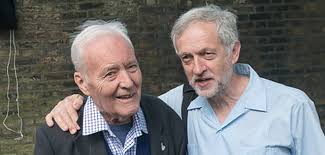
Tony Benn and Jeremy Corbyn: architects of Labour misfortunes
That stance got me interested in taking a longer-term view of British politics. So I looked at percentages of the popular vote in eleven elections over the forty years between 1979 and 2019. Clearly, the relative strengths of the two main parties, Labour and the Conservatives, would be of interest. It struck me, though, that it might also be useful to set them in the context of the overall landscape of parties of the broad right (the Conservatives, but also the hard right parties of today or their earlier embodiments, Brexit Party, UKIP, the British National Party) or of the broad left (Labour, the LibDems and their earlier forms, the Alliance or Liberals, the Greens or Ecology Party, the SNP and Plaid Cymru).
How the left (broadly) performs against the right
compared with Labour alone
What emerges is a curious picture. The ‘left’, in this broad definition (orange line), consistently outperformed the ‘right’ (black line) except in 2015. That surge for the right was principally down to UKIP’s 12.6%; the Conservative result was still an anaemic 36.8%.

With either proportional representation or some arrangement between the constituents of the ‘left’, the ‘right’ would have had a majority of the popular vote for only two years out of the last forty.

Now popular votes don’t necessarily translate into Parliamentary majorities. But if big enough, they can deliver victory, and the ‘left’ tends to be significantly ahead of the ‘right’ most of the time. That suggests that if Labour, the SNP, the Liberal Democrats and the Greens could have pulled together, the Tories would have been out of power for most of the last 40 years, instead of in power for 27 of them.

Interestingly, Labour alone (red line) only outpolled the combined right for three elections – unsurprisingly, the three when Blair was leader and in government. The leftie on Twitter, and others of his ilk there or on FaceBook, are also constantly assuring me that Blair was the lowest of the low and worthy of nothing but contempt. However, if we’re interested in keeping the Tories out of power, it’s worth remembering that he was the only leader in four decades able to ensure that Labour could do that on its own.

For the rest of the time, it would have had to work in partnership with others to oust the Tories. That’s clear from the second graph comparing Labour’s performance (red line) directly with the Tories’ (blue line). Again, only under Blair did Labour outperform the Tories. Otherwise, we’re consistently behind.
Labour performance alone against the Conservatives
Interestingly, the worst results are not under Corbyn. The worst of all, naturally, is 1983. Then Labour was led by Michael Foot, although Tony Benn, the deputy leader, was the main architect of our overwhelming defeat.

Since then, our lowest percentages of the popular vote came in 2010 and 2015. The Tories, however, were down then too, winning by small margins. Looking instead at the gap between Labour and the Tories, the worst elections of all were 1983 and 2019, Benn’s and Corbyn’s. Indeed, it is Corbyn’s greatest achievement to have gifted the Tories their second-highest vote share in that forty-year period. The only higher result was Maggie Thatcher’s first win in 1979.

The significance is that her victory was the first in a series. Johnson’s was the fourth in a row for the Tories, and the first time since the nineteenth century that any party has increased its Parliamentary representation in a fourth election victory.

Corbynists always said that Jeremy would do something remarkable. He has. Although I’m not sure this is what they meant.

This takes us to the nub of the problem for the hard left. One told me recently that whatever we learned from the 2019 election, we should not on any account ‘abandon the programme’. For Corbynites, no compromise is possible on Corbynist policies. That makes any hope of collaboration with other parties impossible. And that, as the last eleven elections demonstrate, means that the right would continue to outperform us.

Above all, with the kind of programme championed by Corbynites now or Bennites in 1983, we ensure not just a Tory win, but a colossal one. Why does this happen? Because Bennites and Corbynites want Labour to mirror their views, not those of the electorate. And the electorate has no time for their policies.

In the current leadership election, we need to choose a leader who reverses that. We need a leader who listens to the voters and goes to them with a programme that they can endorse, even though that means compromise, even giving up on some cherished policies. That way we can win back Labour voters. And if, in addition, we can compromise enough to attract other parties to our banner, why, we could kick the Tories out for a generation.

The alternative is to choose Bennite or Corbynite orthodoxy.

And we know what that gets us: the likes of Maggie or Boris.

Friday, 18 October 2019

Scargill and Corbyn: sad memories and disturbing premonitions

An old friend came to visit us recently, and it was a delight to have her with us. Among many other conversations, we remembered many of our early experiences together, including the time when her husband, whom I shall call Alan, and I would travel in and out of work with a third friend, and talk at length in the long commute through appalling traffic.
The Miners’ strike
Great courage defeated by brutal opposition and lousy leadership
It was 1984, and in England the great miners’ strike was raging. Alan was something of a champagne socialist: from a wealthy background, he’d attended one of the great (and expensive) schools and had never lacked the money to indulge his sense of social conscience. He stood hard and fast on the left and one of his fundamental stands was unqualified and entire support for the miners.

“I support the miners too,” I would assure him, “just not their union leader.”

The union was the National Union of Mineworkers (NUM), the leader Arthur Scargill.

Many years previously, I’d spent some time in one of the mining villages, Conisbrough, of one of the great English coalfields, South Yorkshire. I’d come to know a few miners and when they struck in 1972 and 1974, I was overwhelmed by their courage, their determination and their superb organisation. They won both strikes and I was delighted with their victory.

In 1984, their courage and determination were as powerful as ever. Not so, however, the organisation.

Firstly, the strike started in March. You don’t have to know a lot about the economics of the energy sector to guess that the time of greatest demand for any kind of fuel would be the winter. In March, the peak period of demand was just passing and the country was about to enter the time of lowest need for coal. In other words, there could be no time better selected for the opponents of the miners to be able to weather (literally) any strike. In fact, to wear the strikers down until, exhausted, they could carry on no longer.

In addition, the 1972 and 1974 strikes were so effective because the miners were united across the country. The NUM had a strict rule book and it explicitly specified that a national strike could only be called with a 55% majority of all those voting in a ballot of the entire union. Scargill knew he wasn’t going to get that majority, so he resorted to a cunning plan. He would have the regions strike, one by one, which only required a simple majority in each of them.

Naturally, like most such devious plans, it failed. Some regions refused to strike and, in particular in the Midlands, a large number of miners kept working throughout.

With support for the strike split even within the NUM, other unions didn’t come out in support themselves. That meant that the strike became a struggle between some of the miners – a majority but still too few – and the government of Maggie Thatcher. With the miners so weakened, the timing so poor, and up against an enemy so strong-willed, there could only be one outcome to the strike.

The miners struggled on but, almost a year to the day after the start of their great battle, they were beaten and went back to work, unsuccessful, defeated. Over the next few years, the government took apart coal mining in Britain, shutting down nearly all the collieries. It was one of the worst defeats the working class movement has suffered in the country.

Alan, of course, didn’t see things that way. He saw the miners as right and anyone who dared to criticise the timing or leadership of the strike, as a backsliding reactionary enemy of the noble working class. So I was entirely wrong and Arthur Scargill deserved our unqualified support.

The commute in that car began to feel even longer than it actually was.

Curiously, after the strike was finally lost, Scargill did two things which, in my mind, mark him for the kind of man he truly was. He had himself named President of the NUM for life, so no one else could ever take over from him at the head of the shadow of a union he still nominally led. And he moved into a luxurious home the NUM owned in London, which he occupied until the remnants of the union finally to took him to court to drive him out.

In other words, he had all the sense of entitlement of any man of the right (think Boris Johnson), while claiming to belong to the radical left.

Why do I mention all this today? Because within Labour I’m up against a huge number of people who could be Alan’s heirs. They demand total, unbending, unquestioning allegiance to the party leader, Jeremy Corbyn. This is because they believe him incapable of ever being mistaken, just as Scargill was sure he could never be wrong. 

In my view, however, Corbyns as poor a leader as Scargill was. Up against a deeply unpopular government, he has led the party into a poll position that is constantly behind, possibly by as much as ten points.

In other words, it feels to me as though this man of the radical left is intent on doing to Labour exactly what Scargill did to the NUM. And now, just as then, those of us who don’t share the enthusiasm of his supporters, are regarded as traitors.

I can’t end this without mentioning one particular irony. Corbynism is keen on taking Britain into an era of socialism. A key element on that journey is nationalising major industries. The belief seems to be that a nationalised industry is owned by the public. That was a belief that was pardonable before we’d really tried nationalisation, back in the forties. Now, though, we know that a nationalised industry belongs to the state, not the people. What therefore matters is who controls the state.

Against what body do today’s Scargillites or Corbynists think the NUM struck? It was the NCB, the National Coal Board, the nationalised coal extraction industry. It proved itself just as vicious and forceful an enemy of organised workers as any private company. In its final victory over the NUM, it proved itself even more effective.

Nationalised industries are a stepping stone to socialism? If you can still believe that after what happened with the NCB, I’m afraid you’re as prone to self-delusion as Alan was, as Scargill’s admirers were and, sadly, as Corbyn’s are today.

Saturday, 3 August 2019

Do we need more spies? And more traitors?

Treason is a terrible offence. Why, even after the British abolished the death penalty for murder, one of the few offences for which it was retained was high treason. That was the case until the incorporation of the European Convention on Human Rights into British law finally did away with capital punishment altogether. But I suspect most of us still think of betrayal as one of the basest of crimes.

Perhaps the most notorious of British traitors, and the most fascinating, is Kim Philby. For the best part of thirty years, he was an agent of the Soviet Union's KGB, who was deeply embedded inside Britain’s own secret intelligence service, MI6. Any information of importance known to MI6 was immediately known to the KGB too. Since James Jesus Angleton, then a rising star of the CIA, was in the habit of confiding pretty much everything he knew to Philby, that meant that most of the CIA’s secrets were also being shared with the KGB.

Some of the missions Philby betrayed inspire little sympathy in me. 

For instance, I have no time for joint MI6 and CIA operations which sent young Albanian men being to their home country, to carry out actions that would be most generously described as sabotage, more harshly as terrorism, in order to weaken the Communist regime and ultimately foment an uprising against it. On the other hand, I find it somewhat nauseating that every single one of those missions was betrayed by Philby. Possibly 200 of these young men were captured and put to death, often in the most atrocious way. Even worse, the number rises to some 2000 when you include the friends and relatives, and even the unfortunates who happened to share the same surname as a captive, who suffered the same fate.

What Philby did was by no means pretty. But there’s no doubt that he showed a lot of guts and ingenuity, with which he turned MI6 inside out, and made some of the most senior figures in the CIA look pretty silly too. It’s a remarkable story, extremely well told by Ben MacIntyre in his book A Spy Among Friends. The title neatly expresses the thinking that put Philby above suspicion among people, his friends from childhood, who ran the secret service and regarded him as ‘one of us’.
Oleg Gordievsky in 1994
Photo from The Times
MI6 wasn’t, however, without its riposte to the KGB for Philby. In his latest book, The Spy and the Traitor, Ben MacIntyre tells another story, rather less well-known than Philby’s but fully as compelling. In Oleg Gordievsky, MI6 recruited its own double agent, deep within the KGB – he ended up with the rank of colonel – who was Philby’s mirror image, ostensibly serving the KGB, in reality betraying its secrets to British intelligence.

The book is well worth reading, an excellent tale of intrigue, peril, betrayal and loyalty. But one of the most interesting stories it tells is of the visit by Mikahil Gorbachev, then the newly appointed General Secretary of the Soviet Communist Party, to Britain in 1984. It was one of the most successful, and above all cordial, visits by a Soviet leader to the West. Maggie Thatcher, then British Prime Minister, declared that Gorbachev was someone with whom the West “could do business”.

At the time, Gordievsky, by then a well-established MI6 agent, was head of the political intelligence department in the KGB station (rezidentura) in London. This put him in a pivotal position for the visit. As MacIntyre explains:

As head of political intelligence in the rezidentura, he would be responsible for briefing Moscow on what Gorbachev should expect; as a British agent, he would also be briefing MI6 on Russian preparations for the visit. Uniquely in intelligence history, a spy was in a position to shape, even choreograph, a meeting between two world leaders, by spying for, and reporting to, both sides.
Ben MacIntyre and his excellent book on Gordievsky
The same man was briefing both the British and the Soviets. And far from leading to the collapse of the talks, it ensured their success. Unlike Philby, Gordievsky betrayed no one to his death. But in this operation, as in several others that were nearly as significant, he did a great deal more than Philby to advance the cause the Soviet agent claimed to serve: making the world a safer place. And yet Gordievsky was just as assuredly committing treason.

Makes you wonder, doesn’t it? Perhaps the greatest danger to world peace is state secrecy. And one of the best ways of countering that danger is to have talented spies betraying those secrets, effectively and repeatedly.

Treason is a terrible crime. But, paradoxically, maybe we need rather more spies keeping everyone informed of what everyone else is doing. 

And rather more traitors, not fewer.

Saturday, 29 December 2018

A likeable rogue and a spy scandal

Maybe it’s the Christmas season, with all its nostalgia, but I seem to be having experience after experience reminding me of things long ago.

35 years ago, on 4 January, 1983, I started my first job in the private sector. I was greeted by the chairman and owner of the company, whom I shall call Nathan, a wonderful, warm-hearted bear of a man, tall and broad, effusive and generous. He had appointed me after telling me, at my interview, that I was ‘ideally unqualified’ for the position. That was enough to predispose me to like him.

I was, at that time, facing a bit of an emergency, part biological, part political. The politics were down to Maggie Thatcher, then Prime Minister and leader of the Conservative Party. Giving expression to the widespread xenophobia which would grow over 33 years to its full toxicity in the 2016 Brexit vote, she had brought in new legislation which made it more difficult to obtain British nationality.

What about the biology? Danielle, now my wife of 35 years – as you’ll discover, there is no coincidence behind that figure – was by then getting close to bursting with what would turn into the young man, today 35 – again, no coincidence – who is my son Michael. If he emerged before we were married, he would have no guarantee of British nationality, thanks to the iron lady: Danielle was (and is) French and Maggie wasn’t prepared to extend the precious gift of Britishness to the illegitimate child of a foreigner, even if born on British soil.

You may feel that being British didn’t really matter that much, since he would be French anyway. That’s true enough. But I have the Jew’s enthusiasm for multiple nationalities – you never know when you might need a bolthole – and I thought it would be good for the child to have two. Besides, there was a chance it would be a boy – we didn’t actually discover until he was born – and at that time young Frenchmen were still liable to military service at 18. The British bolthole would spare him that particularly useless experience.

Anyway, I quite liked the idea of my child inheriting my nationality.

‘I have to say this,’ I told Nathan, ‘and I hope it won’t give you a terrible impression of me, starting work one Tuesday and asking for leave on the next…’

I saw his face fall.

‘But I have to get married and our registry office doesn’t do weekend weddings.’

He threw himself back in his chair and roared with laughter.

‘David,’ he said when hed got his breath back, ‘there are few excuses I could have accepted, but that’s one of them.’

He went on to tell me his definition of a bachelor, as a man who refuses to make the same mistake once, and returned later in the day with a cheque as a (generous) wedding present.

He was easy to like. Though something of a lovable rogue: the kind of man who spent money as though it was going out of fashion, even though the company was selling next to nothing. He was a maverick who tried to live by his own rules, even when they directly conflicted with economic law – or simply financial good sense.

Those days all came back to me recently when Danielle and I caught up with an old friend from back then. Naturally, we did some reminiscing though none of us had any news of Nathan, which is a pity. I wonder what he’s up to?

He was South African and (naturally, with a name like that) Jewish. Indeed, he would tell me later that the Apartheid regime in South Africa had put him under some pressure to become an officer in the army.

‘Well, they felt a Jewish officer might help them tone down the accusations of racism,’ he told me.

He refused. He saw no reason to provide the regime with a figleaf. He got out of the army as soon as his compulsory service was over, and went into publishing, ultimately in the company where I joined him.

That didn’t mean, however, that he did nothing for the regime. It wasn’t until after I left the company, just before it went under, that I learned how much he’d done.

It turns out that South African intelligence services – the Department of Information and the Bureau of State Security, infamous as BOSS – had a great need for a publisher or two. One of them was Nathan. Huge funds were put at his disposal and his partner’s to start buying into British publishing groups. The aim, ultimately, was to influence the editorial line of their magazines or newspapers into something more sympathetic to South Africa.

Enough money was spent to buy a large stake in a British publishing group, but never enough to take it over completely. The problem? The money was all clandestine and no one was keeping close enough tabs on how it was spent. Inevitably, it all ended in a corruption scandal.
The scandal breaks
Nathan probably embezzled none of the funds himself. Although he certainly lived the high life on them. And, frankly, if someone was ripping off BOSS, I really can’t imagine a victim I’d sympathise with less. At any rate, he was never charged. Lots of others were, in what came to be known as the ‘Muldergate’ scandal, after the then Information Minister Dr Connie Mulder. Heads rolled, including the State President John Voster’s, but Nathan’s wasn’t one of them.

Which I was pleased about. He was, after all, highly likeable. But, as the Muldergate story revealed, even more of a rogue than I’d guessed.

It was fun, in any case, remembering those times. After all, they brought me closer than I’ve ever been to a major spy scandal and the toppling of the head of a racist state. It was fun to reminisce about it all again.

Sunday, 8 April 2018

The poignancy of memory

I keep on working through my old photos, a process constantly slowed down by the reawakening of memories of moments long past, of people long missed and of events long gone.

There was a morning in 1982 when Danielle announced to me that she really ought to have a pregnancy test. By the time the afternoon was nearing its end, I’d forgotten all about it and when I rang her I began talking about all sort of indifferent matters. Eventually she interrupted me:

‘Don’t you want to hear about the test?’

I managed to bite off the words ‘what test?’ and simply answered, ‘Oh, yes, of course,’ although her tone of voice made it fairly clear what the result had been.

‘Positive,’ she told me.

It wasn’t a shock but it certainly was an overwhelming piece of news. The kind that you know at once is going to leave absolutely nothing the same. And, from this first intimation of his arrival, I have to say that Michael has affected the nature of my life pretty fundamentally ever since (aided and, I like to think, abetted by the arrival of his brother Nicky just eighteen months after him).

One of the first things we had to do was get married. I appreciate that these days it’s far from unusual to have a child outside marriage, but this was 1982 and the dear, sainted Maggie was Prime Minister and making it ever more difficult to acquire British citizenship. We didn’t know the sex of the child at that time. The problem would arise if it was a boy, as indeed turned out to be the case: the French still imposed on young men that ghastly waste of time known as military service and if the child was born, even in England, he wouldn’t inherit British nationality from me – and therefore the escape card from the French military – unless I was married to Danielle first.

As it happens, by the time he turned eighteen French military service had been reduced to a day and he did it anyway. Though it turned out to be as complex as getting married had proved nearly nineteen years earlier. Which is another memory that brings me great pleasure...

So we didn’t actually need to get married, although I’m not at all sorry we did, 36 years on…

The problem with getting married was that Danielle needed a divorce first. You know the Oscar Wilde saying about a second marriage proving the triumph of hope over experience? Danielle was about to demonstrate it.

Her first husband made no problem about the divorce but he spoke no English and all the documents were in that language. It proved difficult to get him to sign in the right place, but eventually he did. We were married on 11 January 1983 and Michael was born on the 29th, so it was a close-run thing.

Incidentally, thereafter I became the specialist in remembering our anniversary, Danielle in forgetting it. That lasted until 2005 when our first grandchild – Aya – was born to my stepson David and his wife Senada also on 11 January. Danielle’s never forgotten Aya’s birthday so she now remembers our anniversary too.

It was a small wedding organised in a hurry. We had some close friends and family there and naturally took photos of them.

Leonard, my father, to the left in his trademark black tie
Alasdhair to the right, in a far-from-trademark beard
The smiles reflect their personalities...
The one I came across the other day was of my father and my old friend Alasdhair. My father was a man of extraordinary gentleness as well as courage and he was an inspiring presence in my life. Alasdhair I had met when we were both 13 and we had remained close through our school days and university. Later, he moved to the US but we kept in contact all the same, seeing each other from time to time but, above all, each remaining a constant known presence in the life of the other.

The photo therefore represents some precious memories to me.

But they are poignant too. My father lived only just over four more months after that picture was taken. Alasdhair did better but succumbed, to cancer, just over two years ago.

The joy is tinged with sadness. I suppose that’s what the passage of 36 years is bound to bring. But the pleasure of finding the photo was undiminished for all that.

Wednesday, 28 June 2017

Oaks rather than mere iron

It’s always fun, or at least more often fun than it is instructive, to work your way through those self-help books that teach you all the wisdom you need to succeed in business, society or indeed life generally.

They tend to pick anecdotes carefully to illustrate their points. That makes me think of a vital principle from that unquestionably valuable book, Daniel Kahneman’s Thinking fast and slow, “what you see is all there is”. We chuckle over one anecdote that seems to make an author’s point and conclude that it’s representative, rather than exceptional, and therefore proves a law. Often that’s a wild presumption.

Ryan Holiday’s The Obstacle is the Way is the latest of these texts that I’m working through, and it’s certainly proving fun. That doesn’t mean I’m convinced: he argues, for example, that we need to focus on the thing in front of us, the task to be undertaken immediately, and not be distracted by visions of the remote goal. I’m convinced that it wouldn’t take long to find a book arguing, with equal conviction, for the opposition point of view, backing some variant of “not seeing the wood for the trees” to argue that without a vision of the whole, the work on any detail is likely to be misguided.

One of Holiday’s better anecdotes concerns Sam Zemurray. In the early years of the twentieth century, he was involved in a struggle with one of America’s leading corporations, United Fruit, for ownership of 5000 acres of land in Guatemala, ideally suited to the growing of bananas. The problem was that two individuals were in dispute for ownership of the land, so who could sell it?

United Fruit shipped in high-powered lawyers and set to work examining all the documents so they could establish, beyond all doubt, who had title to the land. This was an array of resources their competitor couldn’t match. That was a game they were bound to win.

Zemurray simply called in both putative owners and bought the land off both of them. So he paid twice. But he had the land. 

He beat them by playing a different game.

What Holiday doesn’t mention is that Zemurray later engineered a coup in Guatemala and eventually won control of United Fruit himself. A role model? I think perhaps not.

Still, he showed great ingenuity in winning that first battle. Ingenuity and above all, flexibility. That’s the notion I want to focus on.

Another book I’m not so much reading as listening to – one of the beauties of dog walking – is a biography of George Thomas. He was, in my view, probably the best of the US Civil War generals, and perhaps even one of the best generals of any war, anywhere in the last couple of centuries. He never lost a battle, he won the Union’s most comprehensive victory, and he never wasted his men’s lives in hopeless, glorious, criminal charges.

One of the generals who served with him, and later became President of the United States, James A. Garfield, said of him that he was “not a man of iron but of living oak”. That description struck me as highly attractive. Unlike iron, living oakwood is strong and yet adaptable, in that it will bend with the wind to avoid breaking, though it can also withstand a great deal. Above all, it is, as Garfield’s words especially underline, alive with all that implies of warmth and openness to other living beings.

That in turn got me thinking of a more recent time when “iron” was used as an epithet for character. The “Iron Lady” was Maggie Thatcher. She was truly iron in just the way that Thomas was not. Inflexible, sure she was right, she purused the objectives her ideology dictated to her inexorably and without compassion.

Her baleful shadow hangs over us still . Britain has been pursuing Thatcher-style austerity for seven years, with the stated aim of reducing debt – which has doubled. It still regards “regulation” a dirty word – and the terrible fire that killed at least 80 in Grenfell Tower has shown where that leads.

The difference now is that signs are beginning to emerge of a tiredness with this dogmatism. Far more people voted against the Tories in the recent general election than many of us expected. The most recent social attitudes survey shows opinion beginning to harden against austerity . And the decision to prosecute people, 30 years on, for the deaths of 96 people at the Hillsborough football stadium disaster interestingly includes charges that health and safety concerns were ignored, as at Grenfell Tower. Generally, the terms “health and safety” tend to be followed by the words “gone mad”, to make the notion a favourite butt of the anti-regulation crowd.

Well, maybe just as people are realising that austerity can be bad for your health, they’re also waking up to the fact that health and safety are to be cherished rather than despised.

Could this be the dawning of a time for people of living oak rather than iron ladies?

Those who emulate the ingenuity and flexibility of Zemurray, rather than Thatchers obstinacy?

Although perhaps we needn’t going quite so far i following him as to back coups in vulnerable foreign nations...

Monday, 7 November 2016

Thatcher and Brexit: voters sometimes get it wrong

Here’s an article not to miss: Larry Elliott in The Guardian on a study into the hollowing-out of manufacturing in Britain. From a peak of 8.9m jobs, industrial employment has fallen to 2.9m jobs over fifty years. That trend and, in particular, its harshest period in the 1980s, has cost the nation dear. Indeed, the authors maintain they can quantify the cost as between £20bn and £30bn a year.

A lot of the cost is in benefits being paid in communities where there is no longer a hope of a job, together with the corresponding loss in income tax revenue.

Back in March 2009, I wrote about the town of Conisbrough in South Yorkshire, where I had lived and taught for seven months in 1971. It was a mining village and, when I was there, it had a population of 16,000. By the time I came to write about it, the mine had closed and the population had fallen to 10,000. Within that population, close to 30% were either unemployed or classified as disabled or ill, often a way of veiling unemployment. A thriving community had been broken.


Cadeby Main, Conisbrough. Drew its last coal in 1987
So Larry Elliott’s article struck a chord for me. What I hadn’t realised was the extent of the harm the destruction of Britains industrial base had caused. That figure of £20-30bn represents about half of the government’s deficit. We have been through six years of devastating austerity policies that have generated mover poverty, ostensibly to reduce the deficit, and yet we could have avoided half of it just by not wrecking our industrial bedrock back in the 1980s.

Who was in government at that time? When the worst damage was done? When mining was effectively ended? Why, the sainted Margaret Thatcher. The woman still revered today, and certainly supported by a sufficient numbers then to give her healthy majorities in parliament at election after election. That fixation among voters has left a legacy of deep economic damage and, as a result, far more acute suffering now as we struggle to recover from the crash of 2007–8.

It seems that the electorate doesn’t always get things right.

That’s why I smile wryly when people tell me that we who oppose Brexit have to go with the will of the people expressed in the referendum of 23 June. My view is that Brexit too is going to have devastating economic consequences.

Many are saying that the catastrophe forecast by the Remain campaign in the runup to the vote hasn’t materialised. But those forecasts were always nonsense. They were propaganda weapons used by ministers, in particular David Cameron and his Chancellor of the Exchequer George Osborne, who lacked the energy or the intellectual horsepower to make a cogent case for remaining in the EU. Instead, they resorted to fear tactics, and failed.

Economic damage doesn’t manifest itself in a few weeks or months. It can take years. Inflation hasn’t taken off yet but we can already see the upward pressure caused by a falling pound. Unemployment has barely moved but we can see a big increase in businesses delaying investment decisions. We don’t yet have to contend with the loss of trade that our actual departure from the EU will entail (let’s remember that we are still members for now) but we’re already seeing Narendra Modi, Indian PM, pressurising Theresa May to relax visa restrictions in return for new deals – Brexiter claims that Britain will be negotiating from a position of strength are due to be sorely disappointed.

Incidentally, there is a delicious irony in May offering concessions on visa regulations for India – a move I favour, incidentally – since many Brexiters claim that leaving the EU would allow the UK to strengthen border controls.

But the biggest point of all is that the damage to the economy will be similar to what we experienced when Thatcher wrecked our manufacturing base. It wasn’t immediately obvious how deep the harm would be, though many warned about it. Now, thirty years on, we’re living with the consequences and the study Larry Elliott talks about quantifies them for us.

In thirty years’ time Britain will be living with the consequences of Brexit on top of the legacy of Thatcher. The pain will be all the greater.

And you’re telling me I’m being anti-democratic to oppose going down that route because 52% of the population against 48% think we ought to?

Voters have a democratic right to make a mistake and I raise no objection to that. However, the Thatcher experience shows us that they sometimes get it disastrously wrong. Then we all have to pay the price, even if we were in the minority. In the Thatcher case, and I expect the Brexit case, even if weren’t born at the time. 

So why shouldn’t those of us who don’t agree keep saying No?

Friday, 29 July 2016

Clinton: showing how to beat reaction

They do say that, in politics, you shouldn’t build a campaign on nostalgia for the past, but on promise for the future.

It was the problem faced by John Major, British Tory Prime Minister after Maggie Thatcher, when he launched his “Back to Basics” campaign. Going “back” is never appealing. And there’s nothing particularly inspiring about “basics” either.

As a slogan, it had none of the spark of Tony Blair’s “tough on crime, tough on the causes of crime.” The truth is that once he was in power, Blair concentrated on being tough on crime and much less determined in rooting out the causes, but as a slogan, it certainly had appeal, helping position him to take on the Tories and win.

Hillary: wrong on some things, right on many others, turning
into quite a campaigner. And hugely to be preferred to the alternative
That all came back to me when I saw Hillary Clinton’s acceptance speech at the Democratic National Convention. Because, faced with Donald Trump’s slogan, ‘Make America great again’, so easy as to be simplistic, she answered with words suggesting that America is great still.

We have the most dynamic and diverse people in the world.

We have the most tolerant and generous young people we've ever had.

We have the most powerful military, the most innovative entrepreneurs, the most enduring values, freedom and equality, justice and opportunity, we should be so proud that those words are associated with us.


Now, you can agree or disagree with the sentiment. You can’t question the impact. Trump is looking backwards, to a supposed time when America was great, just as Major hankered after days when, allegedly, we were back with basics. Clinton proclaims the greatness of America today. And because she believes in today, she can paint an appealing picture of tomorrow.

Democrats, we are the party of working people.

But we haven't done a good enough job showing we get what you're going through, and we're going to do something to help. So tonight I want to tell you how we will empower Americans to live better lives.

My primary mission as president will be to create more opportunity and more good jobs with rising wages right here in the United States.

From my first day in office to my last, especially in places that for too long have been left out and left behind, from our inner cities to our small towns, from Indian country to coal country from communities ravaged by addiction, to regions hollowed out by plant closures.

And here's what I believe. I believe America thrives when the middle class thrives. I believe our economy isn't working the way it should because our democracy isn't working the way it should.


Clinton’s not naïve though, or a newcomer to politics. While she wisely presented a positive, forward-looking programme, she also knew that it was no use being good and kind and decent in politics. To win supporters, you also have to beat the other guy. When that guy’s Trump, that’s all the more important than ever, but also a lot easier for the opportunities he gives you.

… don't believe anyone who says I alone can fix it.

Yes, those were actually Donald Trump's words in Cleveland. And they should set off alarm bells for all of us. Really? I alone can fix it? Isn't he forgetting troops on the front lines, police officers and firefighters who run toward danger, doctors and nurses who care for us, teachers who change lives, entrepreneurs who see possibilities in every problem, mothers who lost children to violence and are building a movement to keep other kids safe? He's forgetting every last one of us.

Americans don't say "I alone can fix it." We say "we'll fix it together!"


And I particularly liked:

He spoke for 70-odd minutes, and I do mean odd...

That got a furious Twitter reaction from Trump. Rather confirming something else Hillary said:

A man you can bait with a tweet is not a man we can trust with nuclear weapons!

She was feisty, she was positive, she was forward-looking. She’s well ahead in the polls. She may not say all the things you, or I, would like but she has a message worth listening to. And boy, she's preferable to the alternative by light years.

Let’s hope she’s stays in front, right through to polling day and beyond.

And for us, back here in Britain, let’s hope we too can find a campaigner as effective as she is.