Showing posts with label Ramsay MacDonald. Show all posts

Friday, 13 December 2019

A bad awakening on Friday the thirteenth

Friday the thirteenth. Unlucky for some. Unlucky for the British Labour Party. Above all unlucky for those the Labour Party is intended to protect.

A party goes into an election seeking a fourth successive victory, something that has only happened once previously since universal suffrage was introduced in Britain. It does it after nearly a decade of ruinous austerity leaving the nation unprotected by a police force starved of resources, and with its national health service struggling even to survive. It does it under the leadership of Boris Johnson, a man entirely exposed as a liar and a cheat.

Such a party with such a leader stands not a chance of success.
Boris Johnson: gloating, entitled, triumphant
The face of Britain for maybe five years, and maybe more
And yet Boris has not merely succeeded, he has emerged with a comfortable majority. Why? Because the forces arrayed against him were so utterly inept that they couldn’t win an election that was offered up to them on a platter.

The Liberal Democrat party had a new leader, Jo Swinson, who ran a lacklustre campaign which left her party with ten fewer seats at the end that it had had at the beginning. One of the seats lost was her own.

Outside parliament, the People’s Vote campaign, far from uniting all the forces favouring continued British membership of the European Union, fell into faction squabbling and purges. Other Remain organisations came up with recommendations for tactical voting to keep the Tories out which contradicted each other. An unedifying, chaotic babble of voices with no clear leadership.

The worst of all, though, was Labour, because it was the biggest party and therefore had the most responsibility.

Jeremy Corbyn consolidated his place in Labour history as the second worst leader the Party has had, behind only Ramsay MacDonald, its first Prime Minister, who betrayed everything it stood for by forming a coalition government with the Tories in 1931. His action reduced the party’s parliamentary presence to just 52.

Corbyn campaigned as a man of principle, but wouldn’t tell the electorate where he stood on the biggest question of his time, Brexit. Most suspected that he remained what he’d always been, a Brexiter, but he compounded that suspicion by making it clear that his refusal to say was designed to avoid alienating either Leave voters or Remainers. Since both sides knew he was equivocating in order to make them both think he was on their side, both sides turned against him.

Few voters understood what was honest about that kind electoral opportunism.

Equally, Corbyn failed to act on allegations of anti-Semitism in the party. At first, my sense was that he was just extremely indolent and couldn’t bring himself to move quickly on the charges that were brought. But then I realised that there were skeletons in his closet too. For instance, he wrote a foreword for the reissue of Imperialism: A Study by John Atkinson Hobson, in which he described the book as “brilliant”. The book talks about European finance being controlled “by men of a single and peculiar race, who have behind them many centuries of financial experience,” which puts them “in a unique position to control the policy of nations”. No prizes for guessing which race Hobson meant.

Was that Corbyn’s problem in dealing with anti-Semitism? He might have had to take action against people expressing views like those he had endorsed in this foreword.

I don’t think many British voters care all that much about us Jews, either for or against. But they’re quick at identifying equivocation and evasion, and what Corbyn was doing over anti-Semitism was extremely dodgy. It wasn’t the anti-Semitism itself that killed him, it was the dodginess.

In the same way, it wasn’t the position he took over Brexit that damaged him, it was the sense that it wasn’t straight.

He compounded these strategic errors with tactical ones, starting with agreeing to the election being held on 12 December, to suit Boris Johnson’s timetable rather than his own. Corbyn, it strikes me, is not particularly bright and didn’t see that if Boris wanted the election now, that was an excellent reason for saying no. Instead, Corbyn went ahead and got creamed.

This is the second time we’ve been through this in my lifetime. The first was in 1983, the last occasion on which the hard left took control of Labour, and was reduced to its smallest parliamentary representation since 1935. That 1935 election, by the way, was significant because it was the first step back towards office by the Labour Party, after its catastrophe of 1931.

The election of 1983 was appalling, therefore. But it has been outdone by the 2019 one. In 1983, Labour emerged with 209 MPs, in 2019 with just 203. The 2019 election has taken over from 1983 as the worst for Labour since 1935.

The common theme Corbyn’s and the others’ dismal attempts to confront Boris was lack of leadership. None of them could rally the disparate forces opposed to his plans into a focused movement against him. Now he’s in with a vengeance, and his vengeance will be terrible.

He will, of course, now force Brexit through. Since it is not the fact of leaving the EU that will be hard or soft, but the nature of the trade agreement we negotiate or fail to negotiate with the EU, we are by no means yet safe from a hard Brexit.

Next will be the continued attacks on the poor and on public services. Boris will continue to promise greater investment in the police, in social care and in healthcare, but the reality will be otherwise. After a few years, the poor and many of the not-so-poor will be a great deal less well off than they are today.

What does all this mean? 

The fightback starts today.

The first step is to take back control of the Labour Party. Though Corbyn has said he will not lead Labour into another election, there are signs that some Corbynists at least will attempt to retain their dominance in the party. That may be less easy for them to do than they think. Some of the most zealous will certainly stick with the project but others may drift away, disappointed by the results. Others may simply realise that they would do better to work with other currents inside Labour, that a compromise that gives some of what they want is better than purity which gives them none of it.

Assuming that we can pull together to elect a leader who actually leads – and there are people who meet that requirement in Labour, such as Yvette Cooper or Keir Starmer – then a long slow process begins. After the crushing defeat of 1983, Labour lost two more elections before winning one. Can we win more quickly this time? Let’s hope so, but let’s remember what a long haul it was back then.

The other crucial step is to start the process of getting Britain back into the EU. That will certainly be a generational matter. I don’t expect to live long enough to see it myself, but it needs to be started. It is linked with the first step, since Labour has a crucial role to play in the process, and can’t while led by closeted Brexiters.

There are difficult times ahead. But difficulties aren’t overcome by not confronting them – Corbyn’s experience on Brexit and anti-Semitism shows that. A real leader will confront them, and real leadership is what we need.

Above all, we have to learn from our mistakes. Weve been through it twice, in 1983 and 2019: the hard left takes charge and we’re thrashed in the subsequent election. That demonstrates the principle that if you don’t learn from your mistakes, you merely repeat them.

Two such routs were bad enough. Let’s make sure we don’t have a third.

Monday, 27 May 2019

Aftermath of a rout: calling time on Corbynism?

Question: what’s worse than a politician who sacrifices political principle to attract a few more votes?

Answer: a politician who sacrifices his principles and doesn’t even get those votes.

Despite being technically leader of the Labour Party, Jeremy Corbyn has spent three years avoiding all leadership on Brexit, the biggest political question of his generation. He has, instead, tried to attract both sides of the debate, explaining that he wants Labour to be the party of both Leavers and Remainers. Apparently, he thinks he has only to express the wish for it to be so.

Unfortunately, and only Corbyn fans will be surprised by this discovery, attempting to please both sides of a bitter debate only puts both off.

Conservative collapse, Labour rout
Those who back Brexit have deserted Labour for the Brexit Party, which came top in last week’s elections to the European Parliament.

Those who oppose Brexit, and there are far more of them among Labour supporters, have abandoned Labour to vote for openly and actively anti-Brexit parties. Encouragingly, for those of us on the Remain side, though none of those parties individually outscored the Brexit Party, taken together they came well ahead of the total anti-EU vote, covering both that party and UKIP.

As for Labour, across the country it came third behind the Brexit Party and the Liberal Democrats.

Of course, Labour’s was not the worst performance of the night. The Conservative Party came fifth. It notched up the lowest popular vote it has had in its history, since its foundation in 1834. Both the big parties are in desperate trouble, with a mountain to climb to win back voter trust.

But, if Labour did less badly than the Conservatives, it nonetheless had a historically awful result.

The Labour Party first presented candidates in a national election in 1900. By 1910, at its fourth election, its share of the vote was struggling towards 10%. In 1920, its fifth campaign, it leaped forward to over 20%. It never fell below that level again until the European Election campaign of 2009. That was the tail end of the government led by Labour’s Gordon Brown. He was a good statesman, notably in the major steps he took towards eliminating child poverty, but he was a lousy politician, finding it hard to build empathy with voters. He achieved 15.2% of the popular vote in 2009 and was roundly, and rightly, criticised for that lamentable performance.

So it’s an extraordinary testimony to the Corbyn era that, in these most recent elections, he managed to reduce Labour’s proportion of the popular vote to an even lower level than Brown did: just 14.6%. The lowest level since 1910. It’s worse even than 1931, when Labour split after its leader, then Prime Minister Ramsay MacDonald, entered into a coalition government with the Conservatives. At the General Election that followed, Labour was reduced to 52 MPs, but it achieved over twice the percentage of the popular vote that Corbyn clocked up last week.

That’s not as impressive as the Conservatives, achieving their worst result in 185 years, but it’s still remarkable: Labour’s weakest performance for 119 years.

What makes this particularly ironic is that Corbyn’s supporters like to point to the increase in the popular vote Labour achieved under Corbyn in the General Election of 2017. It was the biggest increase since the end of the Second World War (though, and they sometimes seem to forget this, he didn’t actually win). His fans attribute that growth in support entirely to him.

I have to admit that I was surprised by the 2017 result. I had expected him to be crushingly defeated. Because I got it so wrong, a sense of shame kept me quiet at the time over what I believed had actually happened. Corbyn was still an unknown quantity that many felt offered them hope. He was also up against one of weakest campaigners I’ve ever seen, Theresa May, our soon to be ex-Prime Minister.

In addition, the Liberal Democrats had done themselves potentially irreparable damage by joining a coalition with the Conservatives in 2010, making them complicit in much of the harm inflicted on Britain in the name of austerity. At the time, I thought it might take a generation for them to come back.

Well, last week normal service resumed. Corbyn is no longer an unknown figure. Voters have seen him and they don’t like what they see. Weak and vacillating, he no longer inspires trust or hope. The damage I expected Corbyn to inflict in 2017 he did instead in 2019. Why, he even pulled off the extraordinary feat of making the Liberal Democrats electable again, only four years after the end of their coalition with the Conservatives, not twenty as I’d expected.

After nearly nine years of austerity, with millions dependent on charity to avoid hunger, the NHS withering for lack of investment, and the most vulnerable driven to despair by benefit cuts, Britain has never needed Labour in government more. But Corbynism has almost certainly left it unelectable.

Corbyn could and should go. He’s trying to change position to back a new referendum on Brexit, but after three years of resisting the proposal, will anyone think him sincere?

A leader who has failed as he has enjoys no right to cling on. The problem, however, is that Corbynistas still have a death-grip on the party. It’s not enough to part with Corbyn, if the Corbynistas can simply impose another of their inept favourite sons on Labour. It’s not clear how we do it, but we need to prise their fingers off Labour, or give up on it altogether.

Which would force anyone looking for a progressive alternative to turn to the Liberal Democrats. The Greens might be preferable, but the Lib Dems seem closest to power. On the other hand, they’re tainted by their association with the Conservatives. Can we trust them not to play the same trick on us again?

Well, we may not have much choice. If Corbynism continues to strangle Labour, what else can we do? We might just have to take our chance on Liberal Democracy.

Interesting times ahead.

And not in a good way.

Sunday, 25 March 2018

Age of midgets

As Britain staggers into an ill-considered Brexit, it feels to me that future generations, struggling with its painful consequences, will look back and wonder at the age of midgets that led them there.

Corbyn, Cameron, May
Do we really deserve no better?
Britain has been here before. Neville Chamberlain trying to buy peace from Hitler. Anthony Eden taking Britain into war over Suez. John Major crashing out of the European Exchange Rate Mechanism. Second or third-rate Prime Ministers failing to meet their challenges.

These are Tory examples, but Labour has its own spectacular mediocrities to add to the mix.

Ramsay MacDonald, as Prime Minister in 1931, led Labour into coalition with the Tories. His austerity policies crucified the people Labour was set up to defend. Tony Blair, though a giant when with Gordon Brown he battled child poverty and invested in the NHS, chose to be a moral pygmy when he obsequiously followed the US into a needless, harmful and unjustified war in Iraq.

It’s such midgets who dominate the British political scene once more.

In both main parties, leaders are giving precedence to the health of their parties over the wellbeing of citizens. Britain is sleepwalking into Brexit, a slow-motion car crash which the rest of us can only watch with growing horror because we don’t have a leader with the guts to step on the brake or turn the wheel.

The Tories are the most culpable. David Cameron, the previous Prime Minister, called an unnecessary referendum in the hope that a comfortable victory for continued EU membership would see off the toxic and insurgent Eurosceptic wing of his party.

Unfortunately, as we know, the result went the other way.

That result was deeply flawed. And not just because the victory was wafer thin.

First of all, it was a choice between a single option – there was just one way to stay in the EU – and a myriad of others – leaving the EU with no relationship in place (hard Brexit), agreeing a trading arrangement, staying in the Customs Union, staying in the Single Market, and there may be others. A plethora of Brexit campaign groups testifies to the diversity of views.

Secondly, Brexiters made false promises. Far from saving money, Brexit will cost us more. New trade agreements will be harder to sign than was claimed, and the terms will be less favourable than those we are giving up. It’s unclear how we can avoid a hard border between Northern Ireland and the Republic.

It seems likely that once the real nature of Brexit is known, the level of dissatisfaction would produce a majority for the Remain side at least as big as the Brexit camp won in 2016.

There’s a majority in parliament for staying in the EU, though making it effective would require cross-party cooperation, with pro-EU Tories and Labourites voting together. Against the Tory leadership of Prime Minister Theresa May, but also against the Labour leadership of Jeremy Corbyn.

Alongside Cameron, these are the other two midgets of our time.

May claims to be pro-EU but refuses to oppose Brexit. Corbyn’s a long-term Eurosceptic, but his party has a 2:1 Remain majority. Though his fans trumpet his honesty and courage, he refuses to come clean as a Brexiter or to endorse a Remain position. Again, his fans like to underline the contrast between him and Tony Blair, but this kind of spineless prevarication is like nothing so much as the spin Blair fed us on Iraq while proclaiming his honesty and demanding our trust.

May won’t oppose Brexit for fear of splitting her party. Corbyn won’t oppose it for fear of losing a number of supporters for his own. Both hide behind the ‘will of the people’ as expressed in the referendum. However, Britain isn’t a plebiscitary democracy but a parliamentary one. We elect MPs and delegate decisions to them, reserving the right to remove them next time if they go against our wishes. Constitutionally, nothing stops MPs voting against the referendum result.

That may be too much to ask. Still, the referendum said nothing about what kind of Brexit we should accept. Once the real terms of Brexit are clear, what’s to prevent a specific question being asked about them? Voters could choose between accepting the terms, going for a hard Brexit instead, or staying in the EU. A new referendum would protect MPs from the accusation of rejecting the people’s will.

What would be the harm?

May’s ruled it out. She feels, probably rightly, that it would deepen the rifts in her own party.

Corbyn’s ruled it out too. Though, as is his wont, in no consistent way. When Diane Abbott, a supporter within his leadership team, called for a second referendum he took no action. That was odd, because she has a trail of public relations disasters behind her, for which most Shadow Cabinet members would have long ago been sacked. When, on the other hand, his rival Owen Smith made the same suggestion, he was fired at once. It seems that Corbyn, a serial rebel – 500 votes against the party leadership before taking the leader’s mantle himself – is happy to be a top-down autocrat when it suits him. He also endorses the conservative principle of collective cabinet responsibility over the national interest, when he can use it as a weapon against an opponent.

Like Blair, he prefers pragmatism to principle and personal authority over the national interest. He also seems committed to preserving another fine tradition, that of political double standards.

So the midgets at the head of both parties keep the country firmly on the road to Brexit and the slow-motion car crash continues to unfold before our fascinated but impotent gaze.

The final judgement will be made by later generations. It is they who will suffer the consequences of Brexit. I suspect they’ll be asking, ‘how did our parents choose such petty and incompetent leaders when we so badly needed figures of stature?’

Which is my own question precisely.

Tuesday, 30 August 2016

Labour: getting back to its roots. But which roots?

“The only lesson to learn from history,” to paraphrase the German philosopher Hegel, “is that no one learns any lessons from history.”

In the course of the great debate over the leadership that is currently rocking the UK Labour Party, the supporters of Jeremy Corbyn frequently tell me that we need to get the party back to its roots. It’s because we’ve abandoned them for the last forty years – a precise figure quoted to me on Twitter, though what specifically happened in 1976 I’m not quite sure – that we’re in the mess today.

It never strikes me as a particularly good approach to call for a move “back to” some set of values. John Major, British Prime Minister between 1992 and 1997, Thatcher’s successor, launched a “back to basics” programme that was criticised even within his own party. Generally, it’s best to be moving forward and getting ready to deal with the next set of challenges, for which we’re likely to need different attitudes than worked when we faced the last.

Still, even in a forward-looking process, it’s useful to to see if we can at least learn enough from the past not to make the same mistakes again. Perhaps being aware of our roots might be a more useful approach than getting back to them. However, if we’re to do that well, we need at least to make sure we’re remembering them correctly. A mythical past isn’t going to help us at all in planning our future. It would be a pity to go back to the wrong roots, wouldn’t it?

What, then, were the roots of the Labour Party?

The great historic leader of the early days, and Labour’s first MP, was James Keir Hardie. He died long before Labour had its first chance to form a government, but he had among his advisers a young man, full of fine rhetoric and powerful views, who would lead Labour in government for the first time: Ramsay MacDonald was an early intellectual of the party and one of its most effective voices. He had principles too, and stuck to them: he was a pacifist and nothing could persuade him to back Britain’s involvement in the First World War. So, though he was one of the earliest Labour MPs, elected in 1906, he paid the price for his beliefs, losing his parliamentary seat in the elections at the end of the war.


Ramsay MacDonald: watered the roots of the Labour Party
But it didn’t end well, did it?
MacDonald came back, though, leading the first two Labour governments. Sadly, his second administration took office in 1929 and had to deal with the Great Depression. MacDonald, man of principle, thinker, left-winger, champion of the socialist cause, decided that was needed was a sound-money policy and reduced public spending. So he slashed unemployment benefit, to the fury and dismay of his Labour colleagues. In order to cling on to power, he formed a coalition with the Conservatives and remained Prime Minister, at the head of a government dominated by the party he’d always opposed, until 1935.

Are those the roots we’re supposed to get back to?

To be fair, when people talk about the Labour Party’s roots, they’re much more likely to be thinking of the great, reforming post-World War 2 government led by Clement Attlee. In particular, they’re probably thinking about one member of that government: Aneurin ‘Nai’ Bevan, founder of the NHS. They probably don’t remember that when someone mentioned to Ernest Bevin, Foreign Secretary in the same government, that Nai was his own worst enemy, Bevin growled back “not while I’m alive, he ain’t.”


Nai Bevan, father of the NHS. Much easier to get enthusiastic about.
As long as you’re not too worried abut nuclear disarmament.
Actually, that’s one of those stories that comes up again and again in different contexts, with different speakers. Another version has Bevin saying it about a different fellow Minister, Herbert Morrison. Then again, it was apparently said of Franklin Delano Roosevelt by his fellow Democrat “Cotton” Ed Smith. What all these versions have in common, though, is that they all reflect deeply destructive internal divisions in parties of the centre-left.

Sadly, we’re in exactly the same position today, but surely again this isn’t where we want to be, is it?

Much more significant than any comment of Bevin’s on Bevan, though, is a remark of Bevan’s himself. Jeremy Corbyn has made himself a bit of a name by his resistance to the renewal of the Trident nuclear missile programme. Interestingly, for a man and a member of a movement that swears by the sanctity of party decisions, he took that stance against Labour policy. He nonetheless enjoyed widespread support among his fan base, who tend to be pretty keen on Bevan too. So perhaps they need to ponder the words Nai spoke at the Labour Conference of 1957, during the debate on unilateral nuclear disarmament:

I knew this morning that I was going to make a speech that would offend and even hurt many of my friends. I know that you are deeply convinced that the action you suggest is the most effective way of influencing international affairs. I am deeply convinced that you are wrong. It is therefore not a question of who is in favour of the hydrogen bomb, but a question of what is the most effective way of getting the damn thing destroyed. It is the most difficult of all problems facing mankind. But if you carry this resolution and follow out all its implications and do not run away from it you will send a Foreign Secretary, whoever he may be, naked into the conference chamber… You call that statesmanship? I call it an emotional spasm.

Curious, isn’t it? That a past idol of the left referred to the policies espoused to the policies of today’s idol of the left as an “emotional spasm.”

So – are those the roots we’re supposed to be getting back to?

Saturday, 9 January 2016

Betrayal, obscurity, radicalism, disaster: the various models of British government facing Britain today

It’s a hallmark of the political left that its failures often take the form of betrayals.

That’s not surprising. After all, the left is there to speak for the little man against the master class. But, however much we may resent his power, we all tend to admire the master – perhaps Freud would prefer the word father – so we often end up seeking his approbation at least as earnestly as we oppose his authority.

That was Tony Blair through and through. He wanted to oppose the British Conservative Party, but wanted to win their grudging admiration as he beat them. He needed to show, for instance, that he was capable of being at least as patriotic, at least as warlike in his patriotism, as they were. So he’s left a legacy which, despite its many and striking achievements – on child poverty, on healthcare, on human rights – will forever be overshadowed by his catastrophic war in Iraq. A war he waged with overwhelming support from the Conservatives, and against widespread opposition in his own party and across the nation.

That betrayal was only the second worst in Labour history, however. The greatest was carried out by the first Labour Prime Minister, Ramsay MacDonald. A fine radical figure and even a pacifist, he began to show that fatal desire to be approved by the establishment when he agreed to wear pompous (and expensive) court dress in order to be presented to the King. A trivial matter, but an important symbol: he showed his willingness to bow down, for all his radicalism, to the master and his (allegedly) quaint customs.

Ramsay MacDonald, the first Labour Prime Minister
But the smiles would later turn to tears
The truly substantial betrayal came in 1931. 

Facing a crisis as we did in 2009, he decided, as the present Conservative government has, to tackle it through austerity. That meant cutting spending, including unemployment benefit at a time when unemployment was rocketing; that wasn’t a policy Labour could back, so he formed a so-called National government in coalition with the Tories. Only he and two others of his Ministers joined the new government, however, and it was dominated by the Tories. The 1931 general election saw the Labour Party reduced to just fifty seats in parliament.

With the right, in Britain at least, things tend to be different. You get three kinds of Tory government: the ones which do nothing much at all, just widespread meanness without vision; the ones that leave a deplorable mark in history; and the third kind which are even meaner than the first, but with spectacular success.

Maggie Thatcher is the iconic figure for that last kind of Tory. If you were gay, if you were a miner, if you were poor, if you were a trades unionist, you could expect nothing but the cruellest treatment from her. Why, even if you were Nelson Mandela, you only received contempt. But she did it all with style, with ruthless determination, and she achieved a great many of her objectives. 

Far too many.

The first kind of Conservative is represented by figures who have drifted into well-deserved obscurity. Stanley Baldwin, for instance, who joined the so-called National Government under MacDonald, and emerged as the openly Conservative Prime Minister in 1935. No one remembers much about him, but his time in office was marked by such events as the Jarrow hunger march. It protested against a state in which cities in the North of England had unemployment rates of 70%. Britain was the hub of a great Empire, but had citizens dying of starvation.

Baldwin was followed by the man who is the prime example of the disastrous Tory, Neville Chamberlain. He signed the agreement with Hitler which he claimed would guarantee “peace in our time.” World War 2 broke out a year later. When he presented the agreement to parliament and Arthur Greenwood, deputising for the absent Labour leader Clement Attlee, rose to reply in a House of Commons silent with shame at the government’s cravenness, Leo Amery cried out from the Conservative benches, “speak for England, Arthur.” Such was the depth of the humiliation that even Tory supporters of a Tory government had to call on Labour to reassert some pride.

Why is any of this interesting today?

We have a radical leading the Labour Party. But many among his parliamentary colleagues are mired in the belief that we still need to win the approval of their masters. So who will win? Will he stand firm against the failures of the Tory representatives of that master class and continue to reject what they stand for? Or will he be brought down and replaced by another Ramsay MacDonald?

On the other side, the question is more about what type of Tory government we’re looking at. It certainly won’t be the Thatcher kind. After five years in a coalition administration, and nearly a year on their own, there’s no sign of any great radical act to mark its tenure. Today these Tories look like Baldwins: nasty, but without either courage or conviction. They have, on the other hand, put themselves in a position where they have to hold a referendum on British membership of the European Union, probably later this year. That could well lead to the disastrous outcome of Britain leaving.

In the Middle East, they’re to be pursuing the same Blair approach of reliance on military muscle – and we know where that got us in Iraq.

Baldwins, so far, then. But it looks as though they may be setting out on a different course. Could they be about to turn into Chamberlains after all?

Monday, 4 August 2014

Countdown to War, Day 38. 4 August: German incursions in France; a fateful session of the House of Commons


One hundred years ago today, on Tuesday 4 August 1914, Martin and his mates would have discovered from the Manchester Guardian that the Continental Powers had taken another fatal step the day before.

Reuter’s Agency is informed by Prince Lichnowsky, the German Ambassador in London, that he is authorised by the Imperial Chancellor to state officially that all news about a German invasion of French soil is without foundation.... On the other hand, several official reports had been received about French troops crossing the German frontier...

Reuter’s Agency is requested by the French Embassy to deny officially German allegations of an alleged violation of German territory by French officers.


“The fog of war,” said Martin.

“Its first casualty,’ replied the Cynic and, when Martin looked blank, added, “the truth.”

Reuter’s further reported:

A German patrol entered French territory, and came into collision with a French force near Joncheray. The officer in command of the invaders killed one of the French soldiers, whereupon he himself was slain by one of the dead men’s comrades...

This morning a fairly strong force of German cavalry advanced towards Suarée... three kilometres from the frontier...

According to official telegrams received here... German troops advanced on Herzerange and Langlaville, in the neighbourhood of Longwy.


A welcome cup of water served by a peasant woman
to French soldiers on the march
“So what’s happening?” asked a voice.

“No one seems to know,” replied the reader, and read a quotation from a French official in an article on “the spirit of France”

”The state of Franco-German relations is unprecedented. Germany has not only violated the neutrality of Luxemburg, but has also entered French territory at two points... Yet the German Ambassador remains in Paris...”

“So – are they at war or aren’t they at war?”

“Of course they’re at war,” said the Cynic, “it doesn’t suit the Germans to admit it yet so they’ve left the Ambassador in place.”

“They’re not feeling cheerful in Vienna, apparently,” went on the reader.

Government quarters here contemplate the situation as superlatively critical...

To-day everybody seems to feel that the life of Austria-Hungary as a State may depend upon the outcome of the impending struggle, and in any case the sacrifices of blood and money which it will impose on the population far exceed anything foreseen when only Servia was pitted against the Dual Monarchy.


“Yes,” said the Cynic, “Austria-Hungary’s bitten off more than it can chew, fighting Germany’s battles with France and Russia, instead of just its own with little Serbia.”

“Italy’s staying neutral,” said Martin pensively, “so it can be done.”

“What, you’re still clinging on to that hope, are you?” asked the Cynic, “here, pass me the paper.”

The Cynic leafed through until he’d found an article headlined “A Fateful Sitting of the Commons.”

Leading members of the Liberal Government but leading hawks
David Lloyd George (left) and Winston Churchill
Rather less than two hours sufficed to-day for the essential passages of the strangest, the most moving, and in every sense of the word the most fateful sitting of Parliament within living memory...

As Ministers came to their seats those whose names had been associated with rumours of resignation were greeted with general cheering. Both Mr. Churchill and Mr. Lloyd George were thus welcomed, and it was noted that the part taken in their ovation by the Opposition was particularly marked. Some time passed before Mr. Asquith joined his colleagues. Even in cheering their careworn leader members scrutinised his grave and impassive face with eager curiosity, as if in search of some sign of hope. None was visible.


Not much to smile about
The last Liberal Prime Minister,  Herbert Asquith
He would be replaced by Lloyd George at the end of 1916
The Cynic paused. 

“Churchill and Lloyd George are the war party in government. Everyone thought they’d resign if we decided on neutrality. They haven’t so now they’re being cheered by the war party in the Commons, the Tories.”

He went on.

... Sir Edward Grey rose to take the nation into the confidence of the Cabinet...

On the surface the earlier part of his statement seemed to be a justification for neutrality or relative inaction... in commenting on the obligations in honour by which France was tied to Russia in the war, Sir Edward Grey frankly admitted that such obligations could not apply in the same way to this country... Even so, our long-standing friendship with France – “And with Germany,” interjected a Liberal member – had led to arrangements which, in Sir Edward’s opinion, involved us in certain responsibilities.

Of those, the heaviest turned out to be the undefended condition of the northern and western coasts of France, due to the withdrawal of the French fleet to the Mediterranean. Here a hypothetical case was presented – the possible event of an attack on those coasts by the German fleet and of ourselves looking on as dispassionate spectators. With greater energy than he had hitherto shown, Sir Edward, raising his voice and speaking with unusual emphasis, utterly dismissed the latter hypothesis and declared that in such an event we could not possibly stand aside. Amid the general cheering evoked by this declaration the Nationalists made their voices unmistakably heard. “Hurrah for France!” shouted Mr. William Redmond...


William Redmond?” asked Martin.

“Brother of John,” explained the Cynic, “also an MP. What? You thought the Irish were above dynastic politics? Just because they want to be rid of us doesn’t make them any better. You watch: Ireland will have just the same kind of trotters in the trough behaviour as anywhere else, in or out of the United Kingdom.”

“And now they want us in this war...” said Martin.

“It’s all going to come down to Belgium,” went on the Cynic.

... there was the more serious question of the invasion of Belgian territory – a question, as the Minister showed, which earlier in the crisis had been the subject of unsatisfactory diplomatic negotiations...

“Didn’t anybody speak out against?” asked Martin.

“Of course they did. Your mate for one,” answered the Cynic and went on reading.

Some impatience was shown while Mr. Ramsay MacDonald, in his firm yet temperate manner, was giving voice to the determination of the Labour party to have no part in a policy of war...

“Well, at least we can count on Labour,” sighed Martin, “one party that’ll never take this country to war against the will of its people.”

“Probably best never to use the word never, young man,” said the Cynic.

...the House listened in sombre stillness to speech after speech from the Liberal benches, all, with scarcely an exception, severely critical of the Foreign Minister’s arguments and actions.

“A Liberal government has lost the support of Liberal MPs,” said Martin sadly.

“And has to rely on the Tory Opposition to take us into war.”

The Cynic held up the paper to show another headline:

GREAT BRITAIN TO MOBILISE

War Office announce the intended proclamation.


“We’re mobilising already,” he said, “how long can it be?”

“It’s already happening,” said a young man who’d just walked in, “it’s on the telegraph back at the station.”

“What do you mean?” asked Martin.

“The authorities are taking control of the railways. We work for the government now.”

There was a shocked silence broken by the Cynic laughing.

“So now our jobs will be to keep the cannon fodder moving round the country. Until we become cannon fodder ourselves.”

Friday, 1 August 2014

Countdown to War, Day 35. 1 August: Russian and Germany at war. Any hope still for British neutrality?


One hundred years ago today, on Saturday 1 August 1914, Martin and his tracklayer friends would have been hard put to it to find much good news in the Manchester Guardian.

“THE CATASTROPHE APPROACHES”.

At least that was a headline that didn’t mince its words.

Europe is very near war. Last night even the firmest friends of peace were almost without hope.

Little doubt remains that all Russia’s forces are being mobilised. In the House of Commons yesterday Mr. Asquith, on the authority of Berlin, announced the extension of the partial Russian mobilisation reported several days ago. He understood that Germany would issue like orders...

A most serious message came yesterday from the meeting-place of the German, Russian, and Austrian frontiers. It reported on what is described as official authority the destruction by the Russians of the neighbouring bridge over the Austro-Russian frontier, between Granitza in Russia and Szczakowa in Austria...

German news is equally grave. Official announcement is made of the suspension of the international train services into the Empire; telephone communication with Denmark and Belgium has been stopped...

Our Paris correspondent, in a late message, says at a Council of Ministers yesterday orders were given for six army corps on the German frontier to mobilise...

Italy is said to have decided to remain neutral...


German troops heading to attack the Russians
“It’s all falling apart,” said Martin.

“Oh, don’t be so gloomy,” exclaimed one of his friends, “It’s time to get stuck in. We’re going to show them who’s boss and we’ll have some fun. It’ll be over by Christmas.”

“Get stuck in?” asked another, “which side would you like us to join?”

“Why – the Germans of course. They’ve got proper soldiers.”

“You haven’t been listening, have you? Ours is the other side. With the Frogs.”

Martin intervened. “Neither side
s our side. The whole thing’s nothing to do with us. We need to stay neutral just like Italy.”

“We’re nothing like Italy,” said the Cynic, “you watch. We’ll go in. It won’t be over by Christmas. And it won’t be fun.”

The Guardian wasn’t yet prepared to give up on British neutrality.

Evidence grows that public opinion is becoming shocked and alarmed at the thought that this country could be dragged into the horrors of a general European war, although she has no direct interest in it and is admittedly bound by no treaty obligations to take part in it.

Martin found it hard to take much encouragement from these words. He was beginning to suspect that the Cynic might be right: the government wanted to go in, and no amount of opposition was going to stop it. Indeed, elsewhere in the Guardian journalists seemed close to that position themselves. The leader writer, in particular, argued that:

... there is in our midst an organised conspiracy to drag us into the war should the attempts of the peace-makers fail. “Conspiracy” we say because it is disloyal to Parliament, which is the constitutional guardian of the national interests in times of crisis. The conspirators prefer the confidence of selected newspaper editors to that of the representatives of the people. The objects of the conspirators are now openly avowed. We are to join in, not under certain conditions or in defence of this or that British interest which may happen to be threatened, but in any case.

Against the conspirators, the Socialist movement on which Martin had counted had taken a serious blow. The Frenchman Jean Jaurès had been one of its most prominent leaders internationally, and a major opponent of war, like Ramsay MacDonald in the British Labour Party. But fate had been less kind to him. There was a report from Paris:

The Government has decided to placard the following proclamation on the walls of Paris:

“Citizens, – 
An abominable attack has just been made on M. Jaurès. The great orator, who was such an ornament of the French public platform, has been basely assassinated. Personally, and in the name of my colleagues, I bow before the fall, so premature, of the Socialist Republican who fought for such a noble cause, and who in these troublous days has, by his authority, supported the action of the Government in the interests of peace.

Jean Jaurès at his best
Jaurès had been a leading contender for socialist collaboration between the peoples of France and Germany to prevent the war.

“Just when we needed him most, he
’s been bumped off,” said Martin.

“Because you thought he was getting somewhere? The people rising? Stopping the war?” asked the Cynic.

In any case, however clear the question of which side Britain was on might be to some people, it really wasn’t that obvious. The leader writer quoted with approval the nineteenth-century politician John Bright, who referred to the long-term objective of British foreign policy, 
the “balance of power”, as a “will o’ the wisp”. However inappropriate that balance was as a goal, a supposed ally of Britains might well overthrow it in the coming war, while the likely enemy might reinforce it.

If Russia wins there will be the greatest disturbance of the balance of power that the world has ever seen. The whole conditions of our continued existence as an Asiatic Power will have be revised, and all over the world, wherever we come into contact with Russia, we shall have a repetition of the self-effacement which we have witnessed in Persia. The victory of Germany, on the other hand, would in effect be a victory for the principle of the balance of power. If we believed in this principle – which we do not, – then we might be for intervention on the side of Germany.

Those urging war seemed particularly concerned with the notion of the “neutrality of Belgium”, now “it is assumed, ... in danger from Germany, and from her alone.”

“I don’t give a damn about the neutrality of Belgium,” declared an older tracklayer in the crew, “just the neutrality of Britain.”

Martin agreed. And it felt to him as though that neutrality wouldn’t be guaranteed for long.

And on top of all that? Another headline proclaimed “Lancashire outplayed by Warwickshire.” The match ended as a draw but only because time ran out. Lancashire had been heading for disaster otherwise.

What a year.

Tuesday, 15 July 2014

Countdown to War, day 18. 15 July: Will Socialism prevent war? Hope for Suffragettes. Oh, and Ireland again...


One hundred years ago today, on Wednesday 15 July 1914, Martin the Mancunian railwayman might have taken some encouragement from a piece in the Manchester Guardian he shared with his workmates. 

Headlined “Franco-German Friendship. Socialist Hopes and Beliefs”, it reported on a congress in Paris of supporters of a Unified Socialist movement, preparing for a full Congress to take place in Vienna the following month.

It was heartening to see the socialists working for unity across the Franco-German border. It was only that week that he’d been reading about Hansi, the artist who’d had to flee German-occupied Alsace because he’d agitated for its reincorporation into France. It would take a movement like socialism, with its inherently internationalist standpoint, to break down that kind of tension and guarantee the peace Europe badly needed to maintain. That the world needed. A French delegate in Paris, Mr Renandez, had said as much: “it was Socialism alone which was qualified to speak in the name of all countries.”

There had been a British presence too, a Bruce Glasier, speaking for the British Independent Labour Party. Not the mainstream Labour Party, perhaps, but not far distant. It made him proud to be associated with such people.

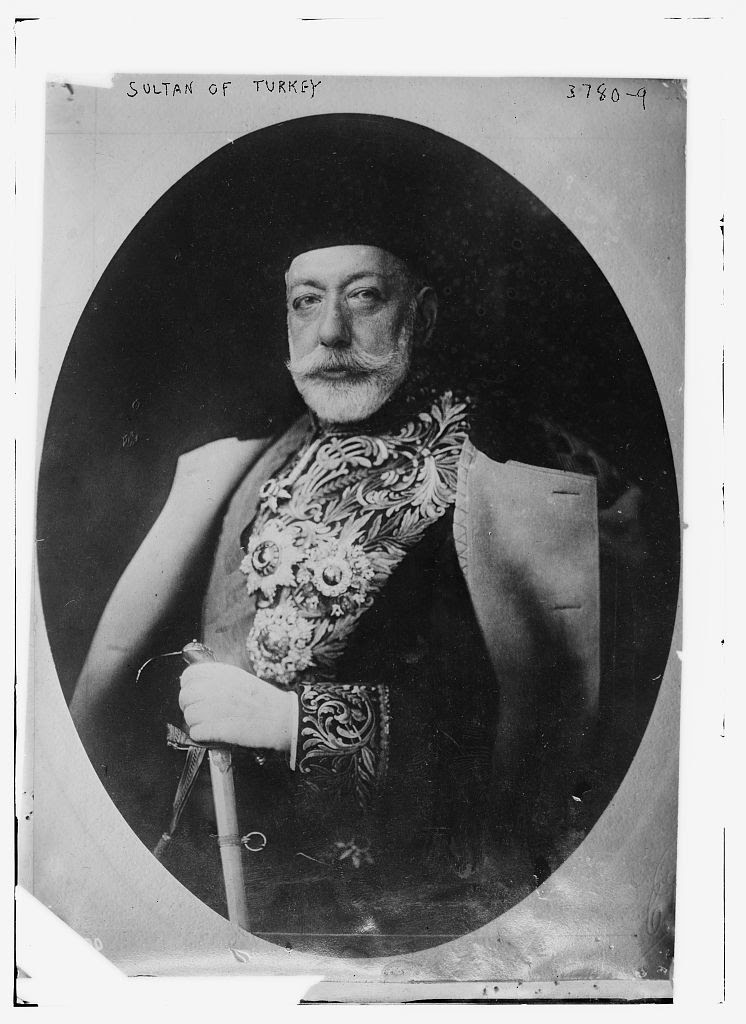
Mehmet V, Sultan of Turkey
A new agreement with Britain?
Meanwhile, it seemed that Britain was about to sign an agreement with Turkey. That felt dubious: Turkey’s behaviour towards the Greeks hadn’t been exactly exemplary (but then the Greeks had been pretty nasty back). Still, better to have bonds between nations than unresolved tensions: things would be best with peace and prosperity, so on balance he was glad that the Turkish Minister Talaat Bey had told a correspondent “... a complete agreement has been arrived at between the British Ambassador, Sir Louis Mallet, and ourselves, and that the agreement is on the point of being signed.”

“Arms for Dublin” was a less welcome headline. There’d been another seizure at the Isle of Man. If those weapons were heading for Dublin, then presumably they were for the nationalists, perhaps in response to the stocks being built up by Edward Carson’s Ulstermen.

“It’s always the same,” complained Martin, “we get some moves towards peace on the Continent, and then Ireland comes and bites us in the back.”

“Well, it’s our own fault,” said the Cynic, “take it out on Oliver Cromwell and William III. The sooner England gets out of Ireland, and that includes Ulster and its suspect loyalists, the better.”

“Hey, what sort of talk is that?” said one of the younger men. “Ireland is English, you know.”

“Tell that to the Irish. The armed Irish.”

There was a glimmer of hope over the Women’s suffrage question, but only a glimmer.

The foreign delegates to the International Suffrage Conference, which is being held in London, were received at the House of Commons yesterday afternoon by members of the party in the House in favour of women’s suffrage, comprising Liberal, Unionist, Nationalist, and Labour members.

Lord Robert Cecil and Mr. Ramsay MacDonald both expressed the opinion that the time was not far distant when women would be enfranchised. Mr. Acland (Under Secretary, Foreign Office) said he was convinced that the next Government would be obliged to deal with the question of women’s suffrage as a party measure in some shape or form.


So the only one who could have done something about the question, Francis Dyke Acland, a Minister in the current government, had put it off as a matter for the next. Even Robert Cecil, for the Conservatives, and Ramsay MacDonald, for Labour, neither of them in office, could only say that the time was “not far distant”.

“Jam tomorrow,” said the Cynic, “you want something now from government? You have to hold their feet to the fire.”

And then – what was this? “Lancashire did well to draw with Derbyshire at Derby yesterday.” The teams had last met only a few days earlier and Lancashire had won comprehensively. And now they had to “do well” just to secure a draw? Dismal.

Whatever else he would look back on 1914 for, it clearly wasn’t going to be with pleasure over the cricket.

Saturday, 8 May 2010

When you dine with the devil, take a long spoon

The results of Thursday's British General Election continue to fascinate and entertain.

I’m wondering whether we’re about to witness what I’d think of as a ‘Ramsay MacDonald’ moment.

Some of us are longstanding supporters of the British Labour Party. I say this with some pride because it certainly isn’t easy. The Labour Party does everything it can to put us off giving them their support, like having senior figures describing themselves as ‘intensely relaxed about people getting filthy rich’, which is an interesting re-interpretation of the principles of egalitarianism that are supposed to inspire the party, or going to war in Iraq for no better reason than being told to by an American leader who combined deeply right wing views with unparalleled incompetence.

To those of us who maintain our tribal loyalty to this difficult party, the name ‘Ramsay MacDonald’ has powerful echoes even today. He was the first Labour Prime Minister. In office in 1931, he decided to form a coalition with the Conservatives and headed a government in which they had a majority of the ministers. This action split the Labour Party and left the Conservative Party, the Tories, in power either alone or in coalition until 1945.

Curiously, this wasn’t the first time in the century that a party of the Centre-Left had split itself over collaboration with the Tories, leaving them the ultimate victors. In 1906 the then Liberals (today’s Liberal Democrats being essentially their heirs) formed a government with a colossal parliamentary majority. In 1916, in the middle of the First World War, with the government failing to impress, the Prime Minister Asquith was toppled by his Chancellor of the Exchequer Lloyd George, who formed a coalition with the Tories, splitting his party in the process. That government stayed in power after the war, until 1922 when the remaining Liberals were unceremoniously dumped by their Tory ‘partners’.

Getting into bed with the Tories doesn’t seem to be designed to do much for the health of progressive parties in this country. On the other hand, it does the Tories a world of good. I once had the ‘privilege’, if that’s the word I’m looking for, of having lunch at the Carlton Club. This is one of those leftovers of a bygone age, a gentleman’s club where members can lunch, dine or even stay the night. The Carlton Club is the one particularly favoured by the Tory Party, another leftover of a bygone age which, like the Club itself, continues to thrive to the despair of the rest of us.

As I was being shown around, I was told with pride ‘we have the portraits of all the Prime Ministers on the walls’.

I looked around and spotted a few gaps.

‘Surely only the Tory ones?’ I asked innocently.

‘Prime Ministers are Tories,’ I was told with all the charm that real smugness can inspire.

Sadly, the implication of what he was saying was right. For 66 of the 100 years of the last century, the Tories were in power, alone or with a partner. The other 34 years were shared by the other two parties, Liberals and Labour.

Today we’re contemplating a landscape in which the Tories have more MPs than any other party, but lack a majority. In coalition with the Liberal Democrats, they would have the votes to form a majority government. Nick Clegg, the Liberal Democrat leader, is in negotiation with them. He knows, however, that there are huge areas of disagreement between his essentially progressive party and the Conservatives. He knows that he will have terrible trouble selling a coalition with the Tories to his fellow party members. He could even split the party and find that he has given the Tories a huge hold on power, for the sake of little more than a brief period in a seat at the cabinet table.

Will he do it? Will he resist? Think Lloyd George, Nick. Think Ramsay MacDonald.

And a postscript

There was a portrait of Margaret Thatcher in the Carlton Club when I went there – naturally: for most Tories, she remains one of the iconic leaders of their Party. But she herself was only granted the status of ‘honorary member’ – it really was a gentlemen’s club. Only in 2008 were women given the right to become full members (if I can stretch the word ‘right’ that far).

And another

It’s a curious reflection on British attitudes that since the election commentators have been regularly saying that the only two-party coalition that would command a majority would be one between the Conservatives and Liberal Democrats. This is patently untrue. Another that would have a massive majority would be a coalition between Conservatives and Labour. I don’t favour it, in particular for the reasons I’ve mentioned, but it’s fascinating that no-one in Britain even considers the possibility: after all, there have been two such coalitions in the past, and Germany was most successfully run by an equivalent ‘Grand Coalition’ of Christian Democrats and Social Democrats from 2005 until just last year.