Showing posts with label Arabs. Show all posts

Saturday, 22 February 2020

Romans, Arabs, Fascists and hard drinks

Organising events is something a great many of us have done at some time. 

It might be a bring-and-buy-sale. It might be some worthy public meeting, or a concert, or a festival stand, perhaps raising money to defend women’s rights, or protect the polar bear, or prepare the overthrow of capitalism. It might just be an amateur dramatics evening.

What I think few of us are likely to have done is organise a stand at risk of being attacked by Fascists, or to make a major archaeological discovery as we do so. But that’s what our friend Marisa did.

The thing about Marisa is that she’s extremely bright and frighteningly well-informed. She also happens to be a Valencia City guide, by which I don’t mean that this is what she really is in any essential way, only that among the many things she does is act as an official guide around Valencia. In either English or Spanish, naturally, as monolingualism would be far too limiting.

Her brightness and depth of information make her tours particularly fun, so we join them whenever we can.

Regular readers of this blog will know that Terry Pratchett is one of my favourite writers. Ankh Morpork is the biggest city in his fictional Discworld. In Men at Arms, he says of it:

Technically Ankh-Morpork is built on loam, but what it is mainly built on is Ankh-Morpork; it has been constructed, burned down, silted up, and rebuilt so many times that its foundations are old cellars, buried roads and the fossil bones and middens of earlier cities.

As with most of Pratchett’s comments about the Discworld, this one is equally true of a lot of the world we inhabit. Especially its older cities. What the centre of the city of Valencia is built on is Valencia. Or, more accurately, Valentia.
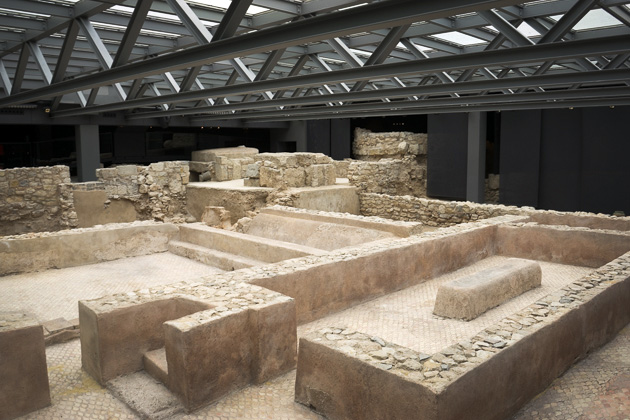
The baths of Roman Valentia
Underneath the present city. Naturally
Valentia was founded by the Romans and, as Marisa explained, it was used to settle former soldiers of the legions that had fought the Lusitanians under their iconic commander Viriathus. Those Lusitanians had been too benighted to appreciate that the Romans were there to liberate them from their primitive way of life and initiate them into the wonder and glory of life as Roman citizens.

The Romans were prepared to go to great lengths to help them attain civilisation, even if that meant massacring them in large numbers to attain that noble goal.

To be fair, the Romans were enlightened enough to settle quite a few of Viriathus’s soldiers in Valentia. After all, they were veterans too, weren’t they? Besides, as a boss of mine once told me when I mentioned we were buying our first house, “the best way to make a man a conservative, is to give him something to conserve”.

It didn’t work with me, I’m glad to say. We sold that house, anyway.

It didn’t work that well for the early Valentians either, or at least not for that long. 75 years later the city was razed in the Civil War that raged throughout the Roman possessions, to decide which of two power-hungry autocrats, backed by big money and large armies, should rule over them.

Can you imagine? A state of the world in which ordinary people have their lives wrecked because plutocrats are fighting each other for power. How sad it would be if the same kind of thing happened today.

It took half a century, but eventually the city was rebuilt, on top of the Roman ruins and sometimes using stones from them, as is traditional. Eventually it morphed into Spanish Valencia.

Which is just as well, as we might have found it difficult to live here otherwise.

In between, it spent a time under Arab rule. After Marisa had shown us some of the Roman remains under the modern-day city, she asked whether we’d like to visit the fragments of Arab wall that can still be seen in certain basements.

Well, we decided we would, so we did. In particular, she took us to the place where, back in the 1980s, there was a patch of wasteland with a slowly collapsing house at the back of it. At that time, Marisa was a student at the art school, then called the Royal Academy of Saint Charles.
The Fallas are the great festival of Valencia
They're about to come around again
A latter-day Valencian tries the traditional costume
One year, when the great annual festival of the ‘Fallas’ came around, she and some of her friends decided to organise a drink stand to raise a little money. The Council gave them permission to use the wasteland.

It was full of rubbish that people had been throwing there for years, if not decades. The first job was a long and tedious clean-up of the whole site. In particular, they had to clear the stairs that led down into a basement where they were planning to sell their drinks. When they got there, they found that one side of the basement was made of what looked like old, strongly cemented and thick walls.

They thought little of it and went ahead selling soft drinks, along with Agua de Valencia, which looks like orange juice but isn’t, and is certainly not soft. It all went well, in general. Their only problem was that this was the eighties and there were still a lot of unreconciled Fascists around, who hadn’t accepted the return to democracy after the death of the dictator Franco.

Sadly, some of these people are making a comeback again today, with the hard right surging in the polls. That’s one of the biggest issues that Spain, like many other countries, now has to face.

Back then, some of these Fascists identified, correctly as it happens, the students on the drink stand as left-wing and decided that they would make a great target for violent attacks. Ultimately, the students had to hire a security guard to protect them.

I’ve worked on drink stands before, but I’m glad to say I’ve never needed to protect myself from physical injury.

What was most remarkable, however, was the wall. Eventually, the students decided that it might be rather more significant than they had originally imagined. They mentioned it to the council.

It turned out that what they’d stumbled across was one of the best-preserved segments of the old Arab wall around the city, significantly bigger in Arab than in Roman times, lying under the newer buildings.
Marisa, with the Arab wall she helped uncover, behind her
It was a privilege to have one of the people responsible for its discovery showing us that stretch of wall, now well-preserved and set up for visitors to admire. Especially as they’d uncovered it in order to sell Agua de Valencia, a drink it strikes me as particularly apt for celebrating such a find.

It just goes to show. Facing down Fascist violence can have some remarkable consequences. Though this has to be one of the least expected.

Monday, 28 October 2019

A touch of Arab genius to perfect a multicultural experience

It’s not especially fashionable any more, but I’m an old-fashioned sort of guy, so I still feel attached to the idea of multiculturalism.
Carlos Bonell binding his spell
With an Alhambra guitar and RC strings. And an Arab wall behind him
The other day, Danielle and I travelled into Valencia, the Spanish city on whose outskirts we now live, for a guitar concert in one of University’s buildings. The city offers these, and many other cultural activities, free to anyone who cares to show up. Plenty do: the room was packed. Coming from austerity England, where fundamental necessities – such as a police service, refuse collection or adequate healthcare – are increasingly rare, it’s refreshing to be somewhere that still values culture enough to offer it free to citizens.

That’s especially striking since the national income per head in Spain is a third lower than in Britain.

Nor, I should say before anyone decides I’m making a partisan point, was the funding entirely public: two companies, one making guitars and the other the strings, had subsidised the concert. Long may Spain maintain that kind of collaboration between sectors of the economy; let’s hope that Britain can, some day, find it again.

What made the concert particularly satisfying for an unreformed multiculturalist like me, was that it was given by an outstanding guitarist, Carlos Bonell, of Spanish parentage but born and trained in England, where he still lives. Among other more highbrow pieces by contemporary or nearly contemporary composers, he also played his own arrangements of two Beatles songs. He explained that a guitarist brought up in England has that music ingrained in him, though he also played some classic Spanish music to restore the balance.

What’s more, the concert took place in a room where one of the walls was built by the Arabs, at the time of the Moorish occupation. The room is in a basement now, but the wall was clearly at ground level during Moors’ rule: that’s what happens with old cities, they get built on top of themselves, as new houses are built over the wreckage of old ones.

One of the reasons that the organisers selected that room for the concert was that the acoustics are particularly good. And they are. You could hear every note, follow every melody, with perfect clarity, and without any echoing or reverberation. It was an ideal setting for such a concert.

English, Spanish, Arab, all combining to give a glorious cultural experience. It’s hard to imagine what could be better.

Though it does leave one question that still puzzles me: how did those Arabs, a millennium ago, work out that building that wall, in that place, with those materials, lend itself to such a superb musical experience a thousand years later?
Arab wall built of just the right stuff, in just the right place,
for superb acoustics

Monday, 23 February 2015

The lesson of ISIS: be careful what you wish for

Back in 2003, the West went to war in Iraq because it decided the world would be a better place without Saddam Hussein having weapons of mass destruction. It did that against the advice of many, none better placed than the weapons inspector on the ground, Hans Blix, who doubted there were any weapons of mass destruction there. The US in its wisdom, or at least in what passes as wisdom in George Dubya Bush, decided Blix and co were wrong and, with the fervent support of Britain under Tony Blair, waded in.

That was what we wished for.

Dubya, source of wisdom in the West at the time of the 2003 invasion
Showing his sureness of human touch

Once in Iraq, the West discovered that Blix had been right, and there were no weapons of mass destruction there. But it stuck firmly to its guns: it may not have been necessary to rid the world of Saddam Hussein’s weapons, but it was nonetheless a marvellous step to have rid it of him.

So that was what we wished for.

Because Saddam Hussein’s power base had been Sunni Arabs in a predominantly Shia nation with a large Kurdish minority, and because the Sunnis had been massively over-represented in the military, the West disbanded the old Iraqi army and set out to put in place a democratic constitution in which the majority would find its voice.

Democracy was what we wished for.

Elections returned a Shia-dominated government which set up a new, Shia-dominated army and, in its weakness, became a puppet of the West’s great bogeyman in the region, Shiite Iran. Sunnis felt disenfranchised and marginalised, and Kurds began to agitate for increased autonomy for their region. So we propped up the government in Baghdad and supplied it with lots of lovely weaponry.

A strong central government dependent on us is what we wished for.

The bitterness among Sunni Arabs created fertile ground for extremists to launch a movement. That gave ISIS its opportunity in Iraq. The disgruntled Sunnis have since had time to be completely disabused with their supposed liberators, but in the meantime ISIS had gained a foothold from which they could tackle the new Iraqi army with its lovely weaponry. ISIS pushed towards them, watched them disintegrate, captured and murdered large numbers of soldiers while the others hightailed it back to Baghdad, and then collected all that lovely weaponry for itself. So we started bombing ISIS.

A Middle East free from terrorist extremism is what we wished for.

Kurdish Permerga
Gutsy, determined, but without the heavy weapons they need
ISIS turned its attentions to the north of Iraq where it ran into the Peshmerga, the army of the Kurds. ISIS had good American kit, captured from the Iraqi Army; the Peshmerga had AK47s and courage. Western airpower helped them resist. But the Western powers wouldn’t arm them, because that might strengthen their drive for independence from Iraq.

A strong central government in Baghdad was still what we wished for.

As an article in today’s Guardian explains, now the Peshmerga sit facing ISIS lines on the approach to Mosul, an Iraqi city being terrorised by its cruel occupants. The West would like ISIS kicked out of Mosul, but isn’t sure it wants the Peshmerga, who have the will but not the means, to do it; we’d rather it was the Iraqi government, but though we’d probably supply it with the means, no one after the last debacle can possibly imagine it has the will; as for the unfortunate inhabitants of Mosul, while almost anything would be preferable to their so-called fellow Sunnis of ISIS, as Sunni Arabs there’s little comfort for them in the notion of finding themselves under the control of either the Kurds or the Shiites.

So today the West hesitates. It is perhaps thinking about what it should do next. Maybe it’s wondering what it should really be wishing for.

That might have been an intelligent thought back in 2003. But since we’ve let the ISIS genie out of the bottle, it may be a little too late.

Because now there really is a weapon of mass destruction loose in the Middle East.

ISIS about its ugly work.
Now there's a weapon of mass destruction in Iraq

Thursday, 16 October 2014

When the Arabs fought the Chinese...

Arabs fighting the Chinese? Who’d have guessed that anything like that would ever happen? But it has happened, and on more than one occasion.

At the time of the Muslim conquests, Islamic armies – initially primarily Arab, later Persian as well – swept out over present day Iran and well into Central Asia, Afghanistan and Northern India.

But under the Tang dynasty, China also underwent a period of rapid expansion, reaching westward, partly in pursuit of the larger horses Chinese armies and merchants had met in foreign lands but didn’t have at home. There was also the matter of controlling and protecting the lucrative Silk Road, linking China with the Mediterranean, along which huge volumes of trade – far more than just silk – moved for many centuries.

Eastward driving Arabs more than once encountered westward bound Chinese, and fought a series of battles. Those conflicts culminated in 751, at the battle of the Talas river. Believe the accounts of the time and 200,000 Arabs and their allies met 100,000 Chinese with theirs, but you’d need to be particularly gullible to believe those accounts.

The Battle of the Talas in 751:
where the Chinese came off second best
But then their allies turned out – not to be allies
Whatever the true number, what definitely is certain is that both sides had allies. If only because the Chinese army only contained a small minority of ethnic Chinese, and the allies who made up its bulk switched sides at a crucial juncture. That meant that the Chinese found themselves caught between Arabs in front of them, and erstwhile allies attacking them from the rear. Unsurprisingly, the Chinese were crushed, losing 8000 out of the original force of 10,000.

They never came back. Within four years, a major uprising back in China brought all armies rushing to the homeland to protect the Emperor.

But why didn’t the Arabs press on?

Between the easternmost possessions of the Abbasid Caliphate and China lay the least prepossessing territories of the Silk Road. Thinly populated, poor land producing little of any particular value. The Silk Road itself made them important, but growing volumes of goods were already taking the seaways instead of the land route, through Indochina and India to the Arabian Sea.

It’s true that beyond the wilderness lay the riches of China, but that meant a massive expedition, difficult fighting and a dangerously extended supply line. I imagine the Caliphate decided that the game just wasn’t worth the candle.

Sensible. And a theme that marks our times still today. The words of the prophet are important, of course, but none is so important as the one word “profit”. Muslim, Christian, Hindu, Jew, people of any religion or none, tend to back down when effort becomes unprofitable.

Not terribly honourable, but eminently sensible. 


Sadly, it’s good sense I suspect ISIS, self-declared heirs of the Caliphate, aren’t likely ever to show.

Let’s hope we can stop them ever reaching far enough to engage with Chinese forces, at the Talas River or anywhere else. If Arab forces meet the Chinese battle ever again, then God help us all. Any God. Anywhere.

Monday, 6 October 2014

Not Islamic. And nothing like a state

The terrorist group Isis has pretensions to being an Islamic State. That State, it claims, will be a new Caliphate. A claim that only demonstrates how little it knows of Islamic history.

Islam had its heroic period. Most cultures do. I’m not terribly keen on heroes or heroic periods, since they tend to cost a lot of other people their lives or their livings. I’m pretty certain that as the Arabs swept out of their peninsula, beat both the Persian and Byzantine Empires to their north, and then spread along the whole of the North African littoral, what happened on the battlefields was ugly in the extreme, and what happened immediately afterwards probably not much better. It was a time when men met in combat to damage each other brutally with steel, and did little that was wholesome to the civilian populations once they
’d beaten their enemies

Just like today, in fact.

So I’m sure heroic Islam had its seamy side. On the other hand, it also did something remarkable. It didn’t hold grudges. The Islamic armies didn’t put their opponents to death; they didn’t even try to convert them. Their defeated enemies might be reduced to what was technically slavery, but they weren’t killed or tortured and they often found themselves being recruited into the armies that had just beaten them – where they could pursue careers under their new masters.

The result was that often within a generation, the newly subjected peoples were in the forefront of Islamic advance themselves. Now, that’s what I call true statesmanship: make an ally of your former enemy, and you strengthen him and yourself. What could be shrewder?

And what could contrast more starkly with what’s happening in Isis today? Where they go, they rape and murder. Those who are not of their religion are put mercilessly to the blade – literally, since beheading is one of their favourite rituals. Far from turning those they conquer into allies, they turn them into mutilated corpses.

Worse still, they even kill the individuals who are trying to help their people. Alan Henning, the latest hostage beheaded by Isis, was an aid worker trying to bring help to Syrian victims of civil war. Muslims, co-religionists of Isis. And yet he was killed too. Which is certainly not a response to service that Islam favours.

One of the most striking illustrations of how different the original Caliphate was is provided by the Muslim conquest of Spain. The army that took on and defeated the Visigothic Spanish kings, was predominantly Berber rather than Arab. And yet the Berbers had been overrun by Arab Muslims just a generation earlier.


Gibraltar: Jabal Tariq, where Tariq ibn Ziyad landed his
predominantly Berber force and began the Muslim conquest of Spain
Even once in Spain, the Muslims armies didn’t massacre non-Muslims. On the contrary, they brought peace to a mainly Christian peasantry, so that it kept producing the wealth the Caliph’s new province needed. Even the Jews, victims of persecution by the Visigoths, became allies who held one city when the soldiers moved on to attack the next.

Statesmanlike. And servants of Islam.

But nothing like Isis.

Friday, 28 February 2014

Arabs and Jews: things were better under the Nazis

It’s always a pleasure when a film reminds one of when things were better than they are today. Even if that just leaves one wishing they could be as good again.

It’s odd when the setting for such a film is the Nazi occupation of Paris. But that’s what Les Hommes Libres, available in English as Free Men, successfully does.


A Nazi officer in the Paris Mosque, from Free Men
It’s set amongst the North African community in Paris during the Second World War. There had been significant immigration from Algeria and other parts of the Maghreb to France even before the war, though the really big wave came later. Many went home when the Germans invaded, but a large number stayed on, scratching a living as best they could under difficult conditions.

That led to a development that many might find extraordinary, given the state of tensions in the world today. The Muslim community of Paris, which wasn’t persecuted by the Nazis, did what it could to protect as many Jews as it could. It focused on Sephardi Jews, from North Africa themselves, because they spoke Arabic. The main mosque in Paris issued as many as possible of them with certificates attesting to their being Muslim: with similar features and the same language they could pass as part of community.

How many people were saved? Estimates vary between 500 and 1600. A drop, certainly, in the ocean of suffering that was the Holocaust. But for the 500 or 1600, it was literally the difference between life and death.

In protecting Jews, the North Africans of Paris reflected the attitudes of their compatriots and coreligionists back home. In countries under Vichy French or German occupation, Muslims refused in their vast majority to collaborate in persecuting Jews. In Algeria, when the (French) authorities offered expropriated Jewish homes up for new owners, some of the (French) white settlers leaped at the opportunity; Mosques denounced the practice and few Muslims took advantage of the offer.

That was a continuation of a centuries long tradition. When a more extreme Muslim ruling group from Morocco took control of Moorish Spain, many Jews left to live elsewhere in North Africa; when the equally extreme Christians of the “reconquest” took back control of the whole of Spain, others followed.

In the Arab, Muslim world Jews found refuge and forged new careers. Moses Mamonides, of whom Jews still say “from Moses to Moses there arose none like Moses”, lived and flourished in Cairo, where he was a court physician and wrote major works, some in Arabic (strictly Judaeo-Arabic, Arabic written in Hebrew script).

For centuries, Jews and Arabs worked and lived well together across North Africa and the Middle East. Those good relations, as Free Men shows, extended to Paris during the war.

Heartwarming, isn’t it? But a bit of shame that relations between Jews and Muslims today are so much worse than they were under Nazi occupation. With, sadly, no likelihood of their returning to those idyllic conditions any time soon.