It might be a bring-and-buy-sale. It might be some worthy public meeting, or a concert, or a festival stand, perhaps raising money to defend women’s rights, or protect the polar bear, or prepare the overthrow of capitalism. It might just be an amateur dramatics evening.
What I think few of us are likely to have done is organise a stand at risk of being attacked by Fascists, or to make a major archaeological discovery as we do so. But that’s what our friend Marisa did.
The thing about Marisa is that she’s extremely bright and frighteningly well-informed. She also happens to be a Valencia City guide, by which I don’t mean that this is what she really is in any essential way, only that among the many things she does is act as an official guide around Valencia. In either English or Spanish, naturally, as monolingualism would be far too limiting.
Her brightness and depth of information make her tours particularly fun, so we join them whenever we can.
Regular readers of this blog will know that Terry Pratchett is one of my favourite writers. Ankh Morpork is the biggest city in his fictional Discworld. In Men at Arms, he says of it:
Technically Ankh-Morpork is built on loam, but what it is mainly built on is Ankh-Morpork; it has been constructed, burned down, silted up, and rebuilt so many times that its foundations are old cellars, buried roads and the fossil bones and middens of earlier cities.
As with most of Pratchett’s comments about the Discworld, this one is equally true of a lot of the world we inhabit. Especially its older cities. What the centre of the city of Valencia is built on is Valencia. Or, more accurately, Valentia.
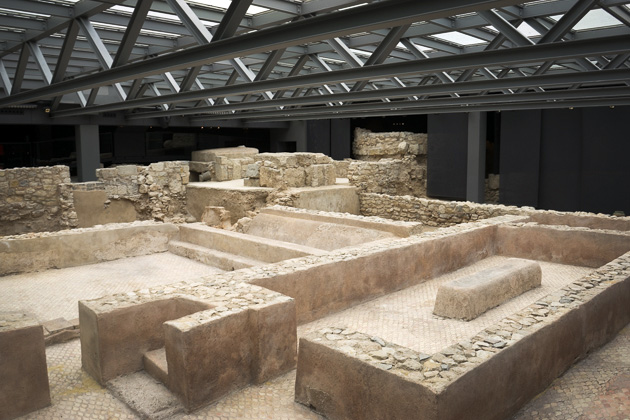 |
| The baths of Roman Valentia Underneath the present city. Naturally |
The Romans were prepared to go to great lengths to help them attain civilisation, even if that meant massacring them in large numbers to attain that noble goal.
To be fair, the Romans were enlightened enough to settle quite a few of Viriathus’s soldiers in Valentia. After all, they were veterans too, weren’t they? Besides, as a boss of mine once told me when I mentioned we were buying our first house, “the best way to make a man a conservative, is to give him something to conserve”.
It didn’t work with me, I’m glad to say. We sold that house, anyway.
It didn’t work that well for the early Valentians either, or at least not for that long. 75 years later the city was razed in the Civil War that raged throughout the Roman possessions, to decide which of two power-hungry autocrats, backed by big money and large armies, should rule over them.
Can you imagine? A state of the world in which ordinary people have their lives wrecked because plutocrats are fighting each other for power. How sad it would be if the same kind of thing happened today.
It took half a century, but eventually the city was rebuilt, on top of the Roman ruins and sometimes using stones from them, as is traditional. Eventually it morphed into Spanish Valencia.
Which is just as well, as we might have found it difficult to live here otherwise.
In between, it spent a time under Arab rule. After Marisa had shown us some of the Roman remains under the modern-day city, she asked whether we’d like to visit the fragments of Arab wall that can still be seen in certain basements.
Well, we decided we would, so we did. In particular, she took us to the place where, back in the 1980s, there was a patch of wasteland with a slowly collapsing house at the back of it. At that time, Marisa was a student at the art school, then called the Royal Academy of Saint Charles.
 |
| The Fallas are the great festival of Valencia They're about to come around again A latter-day Valencian tries the traditional costume |
It was full of rubbish that people had been throwing there for years, if not decades. The first job was a long and tedious clean-up of the whole site. In particular, they had to clear the stairs that led down into a basement where they were planning to sell their drinks. When they got there, they found that one side of the basement was made of what looked like old, strongly cemented and thick walls.
They thought little of it and went ahead selling soft drinks, along with Agua de Valencia, which looks like orange juice but isn’t, and is certainly not soft. It all went well, in general. Their only problem was that this was the eighties and there were still a lot of unreconciled Fascists around, who hadn’t accepted the return to democracy after the death of the dictator Franco.
Sadly, some of these people are making a comeback again today, with the hard right surging in the polls. That’s one of the biggest issues that Spain, like many other countries, now has to face.
Back then, some of these Fascists identified, correctly as it happens, the students on the drink stand as left-wing and decided that they would make a great target for violent attacks. Ultimately, the students had to hire a security guard to protect them.
I’ve worked on drink stands before, but I’m glad to say I’ve never needed to protect myself from physical injury.
What was most remarkable, however, was the wall. Eventually, the students decided that it might be rather more significant than they had originally imagined. They mentioned it to the council.
It turned out that what they’d stumbled across was one of the best-preserved segments of the old Arab wall around the city, significantly bigger in Arab than in Roman times, lying under the newer buildings.
 |
| Marisa, with the Arab wall she helped uncover, behind her |
It just goes to show. Facing down Fascist violence can have some remarkable consequences. Though this has to be one of the least expected.


