Showing posts with label Fallas. Show all posts

Monday, 16 March 2020

Coronavirus lockdown and last time enjoyments

Our local sports club, usually a centre for people and pleasure
Now abandoned for the duration
The streets are emptying here in Spain.

We had two friends from France staying with us last week and took them to Valencia’s main station on Sunday, for the first leg of their trip home. That was the day before the start of the full Coronavirus lockdown across the country, but already the streets were deserted.
Valencia, capital of the fiesta, now nearly a ghost tow
Particularly striking was the five-mile long park that runs along the old riverbed. It is one of the city’s most impressive resources, with its football pitches, its rugby ground, its baseball diamond, its running tracks, its cycling paths, its athletics stadium and, above all, its green spaces where people meet to dance or to chat, to party or to sunbathe.

This time there was no one.

That was the culmination of a strange week. Circumstances changed gradually, day by day, but anything but slowly. And we had to adapt to stay in step.

On Monday, we were still expecting the great Fallas fiesta to start on the following Sunday, though anxiety and anger was climbing against the authorities for not cancelling it. Hundreds of thousands thronging the streets? It seemed irresponsible at best.

On Tuesday, the fiesta was cancelled.

Then we had a whole string of ‘last time’ moments. Obviously, we hope they won’t be truly last times, that the epidemic will end and we’ll get through it, so that we can start doing all these things again. But these were the last times before the lockdown.

At that time, Danielle was in the Madrid region. Shes been travelling there weekly for some time now, to look after our new granddaughter Matilda so that her parents could go back to work. What we didn’t know was that last week would be the last time she’d do that until the end of pandemic.

She came home on Wednesday with our French friends. Her last railway trip for the foreseeable future.

On Thursday, we took our friends around Valencia, wandering the streets and popping into various places we felt they ought to see. That might mean somewhere cultural or just pleasurable, such as the Museum of Modern Art, or a restaurant we’ve come to know and love, or the main square with its masked Fallas sculpture, or our final port of call, the glorious Café de la Horas which serves the best Agua de Valencia in the city.
Fallas sculpture dedicated to women
now with an anti-virus mask
Danielle disagrees that it’s the best, but she admits it’s pretty close to the top. And, for those who may not know this fine beverage, let me say that the word ‘agua’ (water) is misleading, as is the fact that it’s made mostly of orange juice. It isn’t the orange juice that provides the kick.
The Cafe de las Horas
Not just splendid for its kitsch but for its outstanding Agua de Valencia
All these visits were last times.

On Friday, we took our friends on a walk with the Community Walks group we belong to, partly for the exercise though mostly for the company. We even began planning another walk for the following Friday, not realising that this too had been a last-time occurrence.

On the way back, we decided to have lunch in a local restaurant. I phoned ahead to book a table. “For now?” they asked and when I confirmed that it was, “oh, then, no problem,” they replied. I realised later why they’d hesitated. The local government authorities had closed all bars, cafes and restaurants throughout the region, from that evening. Lunch had been our last chance to eat out.

And finally, on Saturday we took our friends to one of the local beaches. That was something I didn’t expect to be forbidden any time soon. I was so wrong. The axe of the nationwide lockdown fell the following day, so our walk along the beach – which I’m delighted we enjoyed – turned out to be the last of our last time pleasures.
Last beach walk.
We even had a pair of acrobats to admire
Our friends are back home in France, just in time to beat the lockdown. We took advantage of taking them to the station to pause a moment in the old city. For the last time.

We’re now adapting to an indefinite period of confinement. Apart from work, medical needs or basic shopping including food, the only reason we’re allowed out at all is to walk the dogs, and we’ve even had a loudspeaker van touring the area to warn us that it’s one person with dogs, and it’s take them out, take them back, no more.

It looks like we’ll be catching up on a lot of reading over the next few weeks, and binge-watching a few series. We just have to hope we don’t go stir crazy.

Still, if it minimises the impact of the pandemic and helps us through it, that’ll be a price worth paying. 

Even though it’s a pretty high price.

Tuesday, 10 March 2020

Tackling the epidemic

My good friend Fabio is Milanese. As a native of the great city of Rome, I tend to think of Milan as South Austrian. You know, things happen on time, the streets are clean, and where there is bustle there is also a sense of purpose. None of these charges can be levelled against Rome.

Rome to me is the essence of Italy. Milan is northern Europe.

Still, I suppose technically Fabio is, nonetheless, Italian. And as a resident of the region of Lombardy, he was already subject to the coronavirus lockdown even before the Italian government extended it to the entire country. The “situation,” he wrote to me, “is surreal. Unimaginable.”
Top left: deserted arcade in Milan. Bottom left: Fallas crowd in Valencia
Right: two women fighting over toilet rolls in an Australian supermarket
Certainly, if Milan maintains its sense of purpose – as I’m sure it does – the bustle is gone. Places usually thonged by crowds of both locals and tourists are now deserted. The atmosphere must be eerie, to say the least.

Most recently, Fabio has gone still further, calling for the deployment of the army. Why? People have been breaking curfew rules, kids have been getting together out of doors to have drunken parties, the lockdown isn’t being respected.

I have to say that this doesn’t entirely surprise me, and it may strengthen the sense that the Milanese are, after all, truly Italians. One of my college lecturers was Catholic and she told me of a conversation she once had with an Italian bishop.

“Why,” she asked him, “does the Pope issue instructions that are so strict it’s almost impossible for English Catholics to follow them?”

“Ah,” he replied, “The Pope is Italian.”

This was the time before we started to get Popes from other parts of the world.

“The problem with England,” the bishop went on, “is that its culture is Puritan. This even affects the Catholic community. They try to follow Papal instructions to the letter. But the Pope’s Italian, and he knows Italians will ignore 90% of what he says. So he deliberately makes his decrees particularly strict. I can see how this makes for problems in England.”

As with spiritual instructions, so it seems with government ones: total compliance isn’t the first reaction of all Italians.

Still, it seems Fabio’s plea didn’t fall on deaf ears. He tells me the army is indeed being deployed. Maybe, with bad grace, and under the baleful stare of men with guns, more Italians will now begin to take the lockdown seriously.

Meanwhile, where we’re living, near Valencia in Spain, we’re in the runup to the great fiesta of the Fallas. Celebrations are already under way, with thousands of people thronging the streets. Rather like the marches for International Women’s Day at the weekend. It’s hard not to admire such a tenacious attachment to traditions, particularly to joyous ones. On the other hand, we’re now up to 1600 infections across the country, 10% of the total in Europe. That’s still far behind Italy, with over 9000, but we’re catching up…

Some are beginning to question just how responsible our devil-may-care attitude may be.

Interestingly, it was announced only today that the Fallas would, even at this late stage, be cancelled. Or at least postponed. I haven’t asked Fabio, but I suspect I know what his reaction would be… For my own part, I wasn’t going to be going to any of the major events.

It strikes me that we need to take the epidemic seriously. Which isn’t the same as panicking about it. The women fighting over toilet rolls in an Australian supermarket strikes me as at best an over-reaction. At worst, it’s a reversion to the worst instincts of man.

But claiming that nothing much is happening, as Donald Trump has? Or not cancelling major public events? Or simply not keeping contact between people to the minimum absolutely necessary? That doesn’t strike me as healthy either.

The Italian government’s action may, as Fabio says, create a surreal atmosphere. But I really can’t see how else you limit the spread of a virus.

The saddest aspect of all this? It’s the lack of an internationally coordinated response. In a time of nationalism, individual countries seem to have decided that they must simply do their own thing.

That’s a pity. Although I was encouraged to see a suggestion that the virus itself might provide a solution to the problem. Will Hutton, in the Observer, the sister paper of the British Guardian, argued that the infection might drive us to improve what globalisation means.

Meanwhile, Fabio, hang on in there! This won’t go on for ever. And, unimaginable though the short term results are, the actions of the Italian government may well turn out to be the most effective response to the problem.

I certainly hope so.

Thursday, 5 March 2020

Fiesta in the time of coronavirus

Here in Valencia, we’re taking the Coronavirus threat seriously.
It may not be a lot of use, but maybe a mask says you're taking it seriously
OK, so we weren’t too pleased when the ruling came down from Madrid that the much-anticipated Champions League match between Valencia and Atalanta had to be played behind closed doors.

Bad news. Valencia has a 4-1 deficit to make up from the first leg and needs its fans to support the team at the home game. But, hey, we understand the precautionary principle. Atalanta’s stadium isn’t far from Milan, and it was a journalist attending the away match there that brought Coronavirus back to us in the first place.
Valencia-Atalanta will be behind closed doors
Can’t be too careful.

In the same way, we’ve no objection to the cancellation of major medical events and conferences. Well, we’re terribly sorry for the people involved, since doctors are pretty smart about where they organise their conferences. I mean, they don’t tend to be in Birmingham or Düsseldorf, do they? More like Sicily or the Canaries.

Seems a pity to deprive them of their trips, but I guess we do need them around. Again, being careful. Just in case.

Besides, not many of us are medics, so we’re only moderately bothered about the measures. I mean, the rest of us wouldn’t have been going to that major cardiology conference in Lisbon or that research meeting in Dubrovnik, would we, so how much are we really supposed to care?

All in all, then, we’ve no real complaints. So far. Good to see the government taking an interest. Putting appropriate measures in place and all that.

Just as long as they don’t go over the top. There are limits, aren’t there? There has to be moderation in all things, including public health precautions.

So – don’t touch our fiesta.

Our fiesta? You don’t know what our fiesta is? The Fallas? Why, it’s only the biggest in Spain.

Honestly, you should get up to speed.

Four days – and nights – of firecrackers in the streets. Some of them capable of making the noise of heavy artillery pieces. The mascletas – when we let off hundreds of these damn things in various designated spots around the city (or sometimes outside them) – can make the bombing of Baghdad sound like a kid’s birthday party.

Really, if you want to know what it sounds like to live in a war zone, there’s nothing better than to be near a mascleta when it goes off.

Then we parade around the streets in traditional costumes and take a look at the hundreds of fantastic sculptures set up at street corners all over the city.

What am I saying? All over the city? All over the all the little towns around the city too. Thousands of people. Getting their costumes ready and then parading in them. Collecting their crackers and their fireworks, and then letting them off. Building their sculptures, and then burning them on the last night (all but one which gets a prize).
Men and women in the traditional costume
And this group had travelled up from Murcia (over 200 km away)
No one’s going to cancel that. I realise that Venice cancelled its carnival, but that’s small beer compared to the Fallas. I mean, think of all those people. Think of the dozens of hours they’ve put in to preparing for this grand party. And you want to cancel it? Think again, pal.

OK. I get it. It means huge crowds surging through the streets. Cheek by jowl. Cough by face. Not perhaps the most sanitary conditions. Maybe not exactly the precautionary principle sagaciously applied.

But, hey. Surviving’s important, I know. But isn’t living even more important? And a fiesta’s all about living, which is what surviving is for.

Besides, if things are so miserable, don’t we need a party all the more, just to console ourselves?

So a Valencian might reason. These thoughts were going through my mind as I walked across the Town Hall Square (or Plaza del Ayuntamiento) the other day, and saw the crowds gathering for a pre-mascleta of the Fallas. The Fallas proper don’t start until the 15th, which you might think apt: it’s the Ides of March. But some events happen beforehand.
Crowd gathering for an early mascleta
In the background, the cage where the pyrotechnics would happen
I looked at the crowd. I looked at the cage where the colossal firecrackers were hanging, ready to be set off. And I thought, “congratulations, Valencians, on your courage in the face of adversity, and on your determination to have a good time whatever the threat bearing down on you”.

Courageous they certainly seem to be. But only time will show whether that was wise or not.

For my part, I hurried on home. Partly because I really don’t think hanging around in crowds is all that wise these days. But mostly because, while I wouldn’t question anybody else’s taste, the experience of being in a war zone certainly isn’t mine.

But, if Madrid doesn’t step in to cancel them at the last moment, I wish Valencia a happy and virus-free Fallas, all the same.
A Mascleta going off
Creating the true party feeling. At least, if your idea of a party is a civil war

Saturday, 22 February 2020

Romans, Arabs, Fascists and hard drinks

Organising events is something a great many of us have done at some time. 

It might be a bring-and-buy-sale. It might be some worthy public meeting, or a concert, or a festival stand, perhaps raising money to defend women’s rights, or protect the polar bear, or prepare the overthrow of capitalism. It might just be an amateur dramatics evening.

What I think few of us are likely to have done is organise a stand at risk of being attacked by Fascists, or to make a major archaeological discovery as we do so. But that’s what our friend Marisa did.

The thing about Marisa is that she’s extremely bright and frighteningly well-informed. She also happens to be a Valencia City guide, by which I don’t mean that this is what she really is in any essential way, only that among the many things she does is act as an official guide around Valencia. In either English or Spanish, naturally, as monolingualism would be far too limiting.

Her brightness and depth of information make her tours particularly fun, so we join them whenever we can.

Regular readers of this blog will know that Terry Pratchett is one of my favourite writers. Ankh Morpork is the biggest city in his fictional Discworld. In Men at Arms, he says of it:

Technically Ankh-Morpork is built on loam, but what it is mainly built on is Ankh-Morpork; it has been constructed, burned down, silted up, and rebuilt so many times that its foundations are old cellars, buried roads and the fossil bones and middens of earlier cities.

As with most of Pratchett’s comments about the Discworld, this one is equally true of a lot of the world we inhabit. Especially its older cities. What the centre of the city of Valencia is built on is Valencia. Or, more accurately, Valentia.
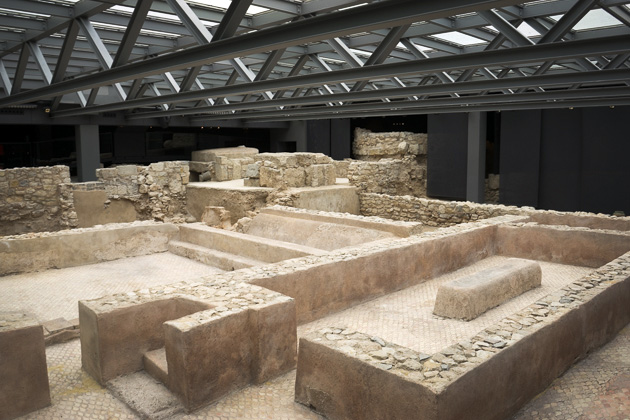
The baths of Roman Valentia
Underneath the present city. Naturally
Valentia was founded by the Romans and, as Marisa explained, it was used to settle former soldiers of the legions that had fought the Lusitanians under their iconic commander Viriathus. Those Lusitanians had been too benighted to appreciate that the Romans were there to liberate them from their primitive way of life and initiate them into the wonder and glory of life as Roman citizens.

The Romans were prepared to go to great lengths to help them attain civilisation, even if that meant massacring them in large numbers to attain that noble goal.

To be fair, the Romans were enlightened enough to settle quite a few of Viriathus’s soldiers in Valentia. After all, they were veterans too, weren’t they? Besides, as a boss of mine once told me when I mentioned we were buying our first house, “the best way to make a man a conservative, is to give him something to conserve”.

It didn’t work with me, I’m glad to say. We sold that house, anyway.

It didn’t work that well for the early Valentians either, or at least not for that long. 75 years later the city was razed in the Civil War that raged throughout the Roman possessions, to decide which of two power-hungry autocrats, backed by big money and large armies, should rule over them.

Can you imagine? A state of the world in which ordinary people have their lives wrecked because plutocrats are fighting each other for power. How sad it would be if the same kind of thing happened today.

It took half a century, but eventually the city was rebuilt, on top of the Roman ruins and sometimes using stones from them, as is traditional. Eventually it morphed into Spanish Valencia.

Which is just as well, as we might have found it difficult to live here otherwise.

In between, it spent a time under Arab rule. After Marisa had shown us some of the Roman remains under the modern-day city, she asked whether we’d like to visit the fragments of Arab wall that can still be seen in certain basements.

Well, we decided we would, so we did. In particular, she took us to the place where, back in the 1980s, there was a patch of wasteland with a slowly collapsing house at the back of it. At that time, Marisa was a student at the art school, then called the Royal Academy of Saint Charles.
The Fallas are the great festival of Valencia
They're about to come around again
A latter-day Valencian tries the traditional costume
One year, when the great annual festival of the ‘Fallas’ came around, she and some of her friends decided to organise a drink stand to raise a little money. The Council gave them permission to use the wasteland.

It was full of rubbish that people had been throwing there for years, if not decades. The first job was a long and tedious clean-up of the whole site. In particular, they had to clear the stairs that led down into a basement where they were planning to sell their drinks. When they got there, they found that one side of the basement was made of what looked like old, strongly cemented and thick walls.

They thought little of it and went ahead selling soft drinks, along with Agua de Valencia, which looks like orange juice but isn’t, and is certainly not soft. It all went well, in general. Their only problem was that this was the eighties and there were still a lot of unreconciled Fascists around, who hadn’t accepted the return to democracy after the death of the dictator Franco.

Sadly, some of these people are making a comeback again today, with the hard right surging in the polls. That’s one of the biggest issues that Spain, like many other countries, now has to face.

Back then, some of these Fascists identified, correctly as it happens, the students on the drink stand as left-wing and decided that they would make a great target for violent attacks. Ultimately, the students had to hire a security guard to protect them.

I’ve worked on drink stands before, but I’m glad to say I’ve never needed to protect myself from physical injury.

What was most remarkable, however, was the wall. Eventually, the students decided that it might be rather more significant than they had originally imagined. They mentioned it to the council.

It turned out that what they’d stumbled across was one of the best-preserved segments of the old Arab wall around the city, significantly bigger in Arab than in Roman times, lying under the newer buildings.
Marisa, with the Arab wall she helped uncover, behind her
It was a privilege to have one of the people responsible for its discovery showing us that stretch of wall, now well-preserved and set up for visitors to admire. Especially as they’d uncovered it in order to sell Agua de Valencia, a drink it strikes me as particularly apt for celebrating such a find.

It just goes to show. Facing down Fascist violence can have some remarkable consequences. Though this has to be one of the least expected.

Sunday, 26 January 2020

More on the life of Immigrants in Valencia: cleaning the woods, revelling with the ‘Chinese’

It has been quite a learning experience, since we became immigrants in Spain and moved to a house near woodland. 

I had no idea how much work it takes to keep it clean and tidy. We’d been out once before, with a bunch of volunteers, picking up litter. On Saturday, we were in the La Vallesa woods near where we live, shifting branches and small trees.
Tidying up the woods at La Vallesa
Professionals had been in before us, with their chainsaws, thinning and pruning. Now we were doing the grunt work of shifting the branches down to paths where they could easily be reached by trucks with equipment to turn them into chips, to be fed back into the ground. Which sounds like a good plan.

Taking some of the trees out lets the others grow more strongly, with less competition for the scarce resources in this not hugely fertile soil. Then, using the felled branches to provide further feed, strengthens them still further. Besides, and this is one of the main aims, the organisers reckon that thinning the woods reduces the danger of disastrous fires. These woods have had plenty of them, even if nothing on the scale of Australia, but then that’s just the fate we’re trying to avoid.
The relatively small fire at La Vallesa in 2014
As has been the case every time we’ve joined a group around here in Valencia, the people we met were immensely welcoming and friendly. One of the organisations, of the six behind the initiative (which naturally meant six, mercifully brief, speeches at the beginning, as each had to have its say), one was an association providing mental health support for young people. Some of their users were there, and it was a great pleasure to see how much they enjoyed being out with the group and doing work that was so useful.

Some were helping us, but others were with the group of children who'd come with their parents and who were planting other trees, oaks and chestnuts, in the hope of introducing a little more diversity in the woods. 

That was the start of the day. In the evening, we went to see the celebration of the Chinese New Year in Valencia city itself. There’s quite a large Chinese community in the region, including a small but growing Chinatown with some excellent restaurants and shops, and an area out by the airport where Chinese companies line up along the road with their warehouses.
The Chinese New Year parade
working its way through the Valencia Chinatown
Still, the parade was by no means exclusively Chinese. I wouldn’t even say that Chinese people were in the majority. But the celebrations involved letting off firecrackers and fireworks around a parade which included at least a dozen groups of drummers, hammering their drums with tremendous energy and enthusiasm. Nothing could possibly appeal to Valencians more. Their great festival each year involves wandering the streets and letting off firecrackers, in two varieties: one that sounds like machinegun fire, and the other like heavy artillery.

The streets in which they do that are decorated with large sculptures in highly inflammable material. So, if it’s inflammable, what do you reckon they do with it? Yep, that’s right. On the last night they set fire to them, while filling the sky with fireworks and the ground, naturally, with yet more crackers.
A sculpture burning at the Valencia ‘Fallas’
With that background, Valencians were bound to take to the Chinese New Year with unbounded enthusiasm. As we discovered when we stood in the crowd in the little Chinatown to watch the parade go by. “Let’s get ourselves some Chinese costumes,” they must have said, “join an appropriate association and go out to beat our drums.” And they did just that, with obvious and infectious joy.
Valencian drummers in Chinese costume, enjoying the parade
A fun way to spend a day, in the woods in the morning, at the parade in the evening.

Afterthought

There were a few, very few, face masks being worn by people in the crowd at the Chinatown parade. I’m not quite sure what they were trying to protect themselves against. Did they think that merely being at a Chinese New Year event would expose them to coronavirus?

At any rate, I’m glad to say that, to my knowledge, there wasn’t a single case of infection from Wuhan at the celebrations in Valencia.

Tuesday, 15 October 2019

Of pyrotechnic maniacs, modern-day troglodytes, the purpose of castles and Spanish bureaucracy (redux)

Although we live in Valencia these days, our house isn’t in the city itself. We live away from the centre, within the administrative area of the town of Paterna. This is a place with quite a few remarkable features.
The Cordà: when Paterna goes crazy
Probably the most unusual is the Cordà, the local annual fiesta. Fireworks loom large in it. Now, those who have followed my comments on our Spanish life won’t need to be told that fireworks are central to many celebrations in Valencia. In particular, when I found myself having to live through the citys biggest fiesta, the Fallas, ironically pronounced to rhyme fairly closely with ‘Fires’, what struck me most was that an otherwise attractive city was turned for several days into a war zone. Firecrackers of normal dimensions sounded like small arms fire in Beirut, whereas every now and then the detonation of crackers the size of rocket-propelled grenades suggested that Israel had sent its heavy artillery to join in.

Well, Paterna goes one step further even than Valencia. Their tradition is to dress up in heavy, more-or-less fireproof clothing, including a helmet with a metal gauze mask at the front, and go around throwing fireworks at each other. This got so dangerous that eventually a mayor set up a large cage in the middle of town and only allowed people inside its wire mesh, surrounded with water hydrants ready to extinguish anything too awful, to engage in this terrifyingly threatening pastime.
The cage in Paterna to which a sensible mayor decided to banish
all the insane firework throwers
Monument to madness?
Paterna's statue of a Cordà reveller
He has a cracker in his right hand and
his metal gauze-fronted helmet under his left arm
As well as the lunatic fiesta, Paterna also has the distinction of having hundreds of inhabitable caves. These days, most have been abandoned, but there are a few that have been converted into often quite desirable housing. Their chimneys and ventilation shafts still form a strange environment of eerie structures in one of the central squares.
Entrance to the desirable home of a modern cave dweller
Note the castle tower in the background
Weird landscape of cave chimneys and ventilation shafts
The caves were an answer to problems of homelessness that, fortunately, are now long behind the local population. They might be worth considering in England where homelessness, far from being long gone as it should be, is growing daily. With a government that seems to care little about the poor as long as they’re out of sight, holes in the ground could be just the solution.
Another cave entrance and the Castle Tower
with its flags proudly fluttering

Dominating the square with the ventilation shafts is the city tower, initially built by the Arabs at the time of Moorish rule in most of Spain, later used by the Christian regimes that followed the reconquest. I’m always amused by these military structures. As a child I was taught that they existed to protect the town below. It was much more recently that I learned they were there to keep an eye on those towns and make sure the residents weren’t getting uppity. If anyone was being protected, it was the powerful who employed the garrisons.

All those fine Norman castles in England? Put in by Normans to make sure turbulent Anglo-Saxons wouldn’t trouble their overlords. Incidentally, if you’re wondering why they’re all ruins these days, it isn’t because of the effect of the weather or because they were badly built. It’s because many became centres of royalist resistance to parliamentary rule during the English civil war, and Oliver Cromwell made sure they were ruined afterwards to stop that ever happening again.

Just like the lake I talked about last time, the most interesting aspect of some of these places is below the surface, and pretty different from the superficial beauty.

Why am I writing about Paterna now? Because I had to go there for the latest round in our ongoing battle with Spanish bureaucracy. The local Social Security office is handling some of my pensions matters, and they wrote to me recently. The address they use started out just fine but, halfway through the street name, they switched to part of the address we left this summer in Valencia itself. The postcode, which came next, they got right, but the town was wrong.

“You need to sort this,” the postman told us, “it was difficult to find where we had to deliver the letter.”

Sensible advice, I thought. So I went to see the people in the office, on the basis that the only reliable way to solve a problem with the Spanish administration is, as I’ve said before, face-to-face. Phone? Forget it. Online? Not a chance.

The woman I saw first pronounced the dread words ‘cita previa’, suggesting I needed a ‘prior appointment’. But then she looked at the address on the letter, and the address I actually live at. To her credit, the struggle between her better and more bureaucratic demons was short.

“No,” she said, “this was our error. Just fill in this form and I’ll get you in to see someone immediately.”

It all went smoothly. So quickly, in fact, that I nearly missed the appointment. I was third in line so thought there was plenty of time for what these days we quaintly refer to as a ‘comfort break’. However, I was already being called when I came out.

This was because to get into the toilet in the Social Security building, you need to ask the security guard to unlock it for you. And to do that, he has to take a note of your residence card number. I’ve heard of providing identification to get into a country, or onto a plane, but into a toilet? Spain is the first place where I’ve had to do that.

And the real beauty of this particular incident? When the guard came to unlock the door, he found it was already open. A fact he recognised with a winsome smile.

Ah, yes. It’s one of the great lessons of life. Things are seldom as you think they are but, greeted with a smile, it often doesn’t matter.

Sunday, 10 March 2019

Immigrants: the problems

One of the most difficult tasks an immigrant faces is adapting to a new culture.

For instance, since we’ve arrived in Valencia, we’ve had to learn about shop opening times. Shopkeepers like to open in the morning until a late lunch, of impressive length, followed by a second opening in the evening.

That wasn’t a problem, in principle, until we discovered that the reality doesn’t always correspond to the theory.

It’s particularly confusing with restaurants and bars. You look them up on Google. It tells you comfortingly that the place is open right now. You walk thirty minutes to get there only to find a firmly locked door. You look at the sign next to it. “Open”, it says, “from 10:00 till 22:00 without interruption”. You check your watch. It’s 15:00. But the door is indisputably locked.

Sometimes you’ll find a little handwritten sign saying something like “we’ll be back at 19:30” which at least tells you what’s happened – the staff needed a break and, hey, who’s going to let a mere notice of opening hours dictate their lives? I mean, such notices aren’t posted under oath. They’re not a commitment or anything.

I particularly enjoyed the visit to a pet shop I made. I wanted some chews for the poodles who’d been looking at me pathetically all morning. What did they want? I’d wondered. And, since we were out of chews, I decided that this mght be what they were missing.

At the pet shop, I pushed at the door but it wouldn’t yield. I looked inside. It was a bit dim but there were lights on. Alongside the door was a sign proclaiming that the shop was open from 10:00 till 14:30 and from 17:30 till 20:00. My watch was unambiguously clear: it was 11:30. The shop should have been open.

And then my eye was caught by a large sign in the middle of the door, one it was hard to believe I’d missed before. “ABIERTO” it proclaimed in letters that filled an A4 page. “OPEN”. No mistaking it.

I don’t know what I was expecting, but having read the word I tried the door again. I suppose unconsciously I assumed it was enough to have read the statement that the shop was open for it to prove, indeed, open.

Unsurprisingly, the door remained locked.

A terrible picture of two disappointed poodles was beginning to form in my mind. In my desperation, I looked around again and saw – oh, joy! – a doorbell. I rang. Moments later a woman appeared from the back of the shop and, smiling at me through the glass, opened the door, let me in and sold me some chews. She didn’t apologise or even explain what had happened. But I noticed as I was walking away that she was busily locking the shop door again.

The poodles were happy, anyway.

Fallas sculpture on a Valencia street
As it happens, we’re not just immigrants, but refugees. And, at the moment, twice over. Firstly, from the whole sorry mess of Brexit, where Britain has given in to its worst xenophobic instincts to inflict a terrible wound on itself. But secondly, we have taken refugefrom the Fallas in Valencia.

The Fallas are probably one of the greatest fiestas in Spain. Men, women, children, the old and the young, parade through the streets in glorious traditional costumes. Great sculptures appear on many street intersections, only to be burned in a huge series of bonfires accompanied by fireworks on the final night. And, throughout, the city is filled with firecrackers being let off in all sorts of places by all sorts of people.

I don’t just mean the ordinary firecrackers that sound like a cap gun. Oh, no. In Valencia, one kind of cracker sounds like a pistol being fired. And then there’s the other kind, in the form of a tube about as long as a coke can and a half, which explodes with the sound of a heavy artillery piece. And it wouldn’t be so bad if there were only one of these at a time, but Valencians like to hang up garlands of the damned things so that ten or twenty of them fire in rapid succession.

Did I say they were let off by all sorts of places by all sorts of people? I should have added “at all sorts of time”. There is no quiet moment, day or night. Oh, no. This goes on 24 hours a day. The firecrackers turn Valencia from a pleasant, welcoming, friendly city into a simulation of Beirut at the height of the Lebanese civil war.

I have to confess to a certain wimpishness over these matters. While some people travel great distances just to take part in the Fallas, I do appreciate having a certain amount of sleep each night. Valencia in the Fallas is not a place to encourage such ludicrous aspirations.

We suffered the Fallas experience last year and decided that once was enough. So this year we’ve taken refuge in the Madrid area. We’ve rented a flat. That proved an interesting exercise when we first arrived.

Danielle told me to approach the porter at the gate into the complex and explain which flat we were taking, so he would hand over the keys and raise the barrier.

“We’re looking for the Radinslov place,” I told him.

He looked at me completely blankly.

“The Radinslov place?” I tried again, hesitantly.

How was I going to explain this in my broken Spanish? After all, the name suggested something Slavic, and how many Slav families could there be in an apartment complex outside a small village some kilometres from Madrid?

“Do you mean the Radins?” he asked.

It turns out I did. When I explained the misunderstanding to Danielle, she showed no sympathy with my predicament.

“We’ve rented the Radin family’s loft,” she explained, and to rub the point in, “Radins’ loft not Radinslov.”

The whole business particularly tickled her. On two nights in succession, she’s woken up laughing at the memory of my discomfiture. I don’t see what’s so funny about it myself but, hey, I suppose it’s better to spread laughter than tears.

Even unintentionally.

Tuesday, 20 March 2018

A festival like a war zone

Ah, the joy of waking up to a morning of utter stillness!

Sometimes pleasure doesn’t need anything particular to happen. Sometimes it’s enough that something cease. Simple absence can do as much as any presence.

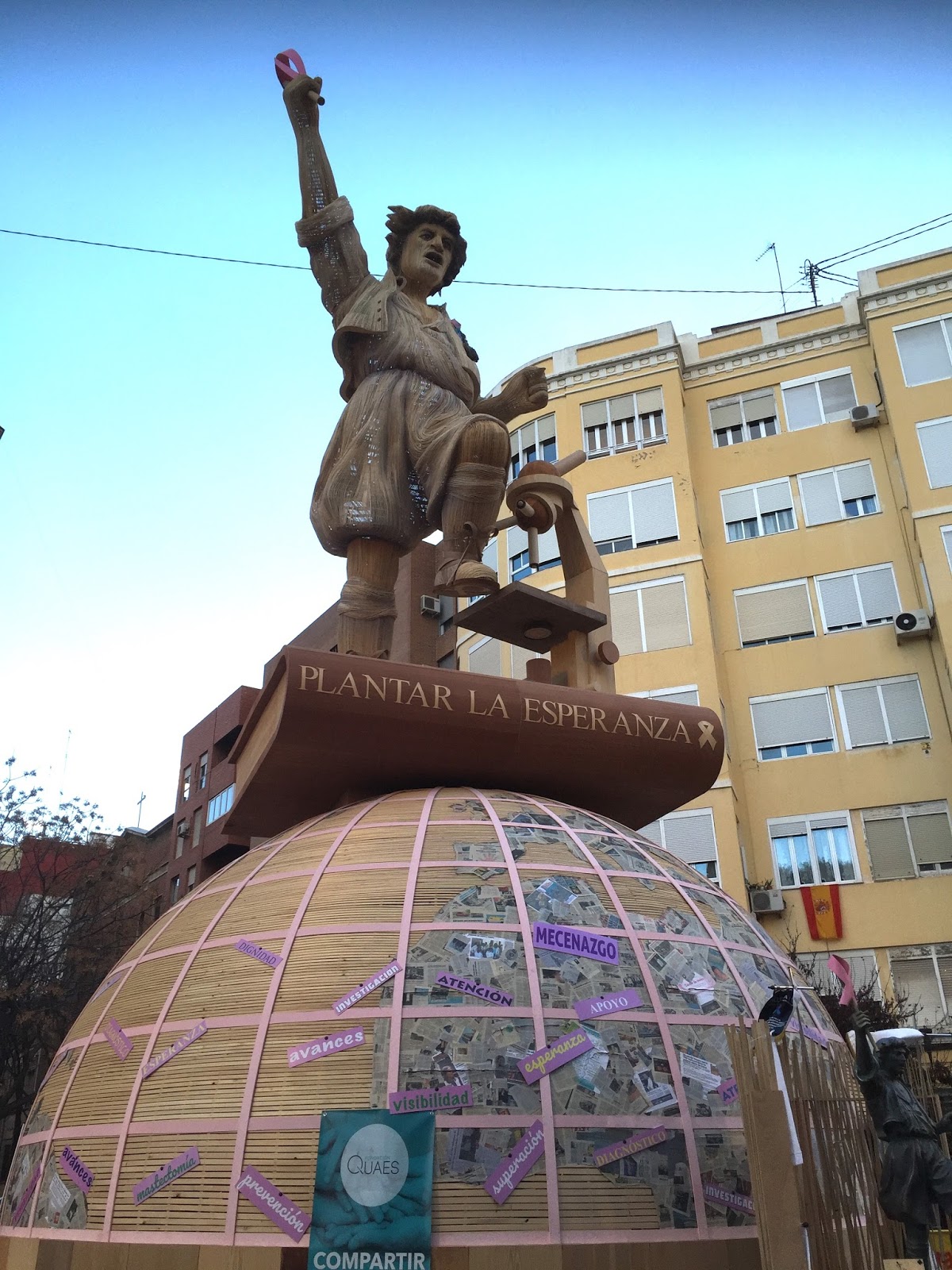
By sheer accident, and without either intending it or knowing about it, we took possession of our flat in Valencia at the time of the annual Fallas festival. A ‘falla’ is a wooden structure built in the street – often at an intersection, presumably as a means to optimising traffic flow – usually on some an amusing theme, or at any rate an uplifting one, such as the seven deadly sins, loneliness or breast cancer.

A powerful falla for breast cancer


Falla outside the town hall
A touching falla to loneliness
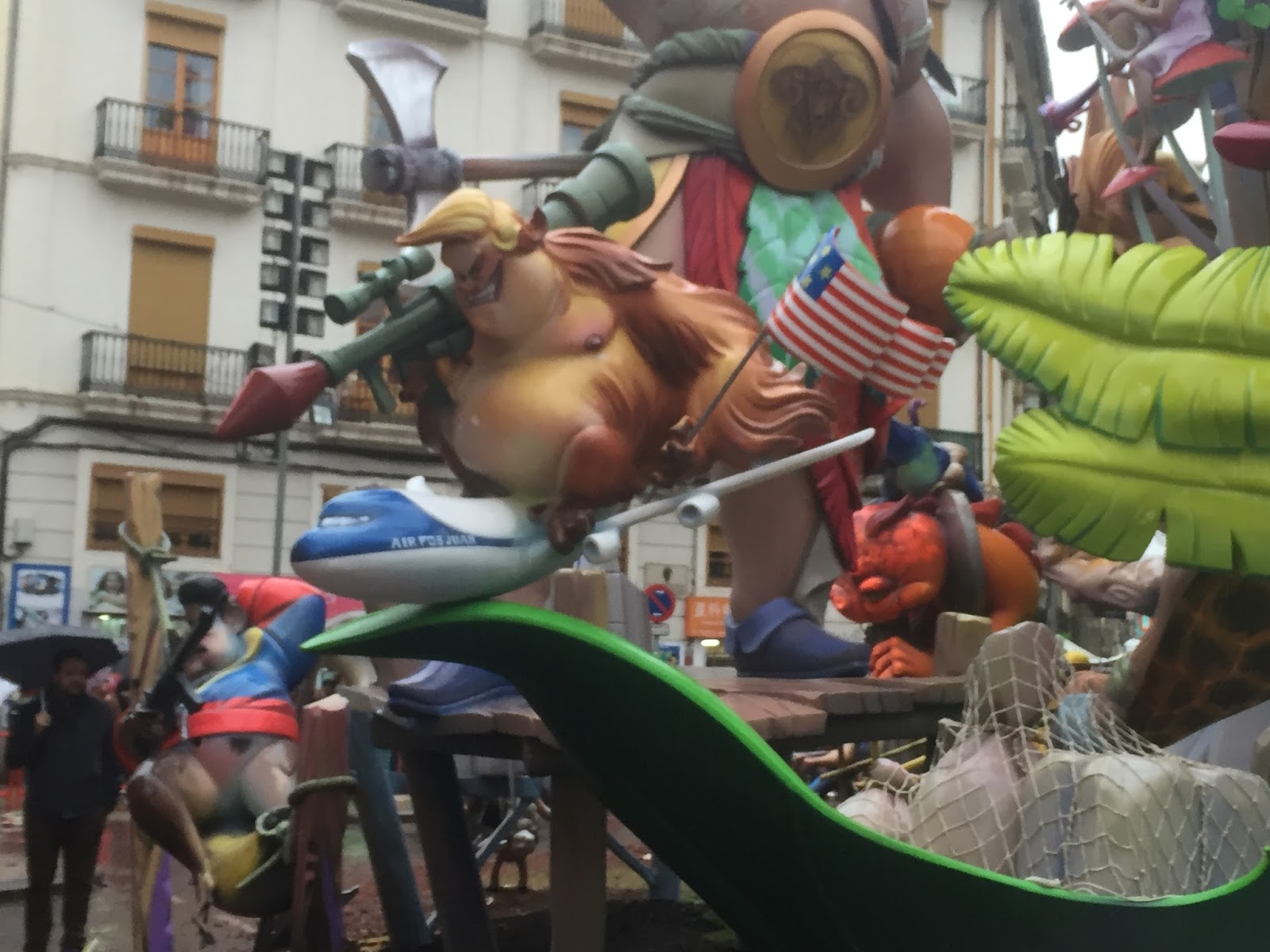
Several of the ones we saw reflected a theme of our day – a caricature of that fine President the US electorate voted against but the US constitution put into office. I suppose laughing at him is a reasonably healthy response. The alternative would be crying, which would be more effective and a great deal less encouraging.

A familiar figure clutching a US flag
With apologies for the poor focus. But then his is just as uncertain
While the Fallas are up, many Valencians don traditional dress and process through the streets, often accompanied by a brass band. This is a charming sight, as old and young, men and women, girls and boys, the able-bodies and the disabled all take part. They look wonderful and they reflect a powerful sense of community, embracing all walks of life, although to be quite truthful, the costumes in the city centre do contain just a tad more silk and are more luxuriously embroidered than the ones in the less well-heeled (or well-skirted) outer suburbs.

Members of a Fallas procession
The costumes are complex. A friend can be a great help
The only trouble is that once you have seen fifteen of these processions, the charm tends to wear off a little. At number fifty or sixty, even though they embrace old and young, men and women, girls and boys, able-bodied and disabled, they start to spread a sense of sameness, brass band or no. One starts to long for a little variety, provided in my case by a helpful pickpocket, in a dense crowd, who freed me of the burden of carrying my (brand new) work phone any further. 

That certainly broke the monotony for me and left me some far livelier feelings.

Those feelings were principally directed against myself. As Danielle pointed out, “why on earth were you carrying your work phone with you on a Sunday in the first place? And how often do I have to tell you not to put a phone in an outside pocket? Don’t you learn?”

It’s true that I’ve twice been relieved of phones by pickpockets, and the previous time it was in Madrid. Now, I’ve spent a great deal of time in Spain and intend to spend a great deal more, and it is not my experience that the country is any less honest than any other. However, it does seem to be endowed with more than the usual quota of pickpockets, and they seem particularly deft at their work. A lesson I need to learn. As my wife likes to remind me.

“She seems very wise,” my HR colleague Laura told me when I reported the loss.

“She is,” I replied, “and keeps telling me it’s a shame I don’t listen to her enough.”

“How odd!” said Laura, “that’s exactly the kind of conversation I keep having with my husband.”

The other custom associated with the Fallas is the throwing of fire crackers. There are even fenced off areas devoted to the practice, though that doesn’t seem to stop people chucking them wherever they like. There seems to be a particular variety that has been volume-enhanced, so to speak, so they let of a fearful retort. They’re the heavy artillery of crackers, where the usual ones are just small arms.

Now, I love fireworks. Arching up in the sky, bursting far above our heads, raining down multi-coloured and beautifully patterned collections of sparks, they’re a joy. The noise they make is clearly just a secondary characteristic, contributing little if anything at all to the spectacle.

Crackers, on the other hand, are just noisy, providing only the secondary effect. And, in my view, contributing little to the spectacle.

In fact, during the Fallas, the seem to convert the otherwise delightful city of Valencia into a latter-day version of Beirut at its worst. After a brief silence, new volleys of small crackers will suddenly start again. Palestinians are exchanging fire with regular Lebanese soldiers. Then, as the firing intensifies, it’s clear that the Druze militias have opened up against Falangists. Finally, as the heavy-artillery crackers start up in another sustained roll of thunder, you can hear Hezbollah exchanging cannon fire with Israeli missile emplacements.

Of course, it’s nothing like as bad as Beirut. There’s no fear, for instance, of being hit and maimed or killed oneself, for instance. No risk of anything much worse than having your phone lifted. But, in my judgement, not being quite as terrifying as Beirut, is a low bar to set for any form of popular entertainment.

Eventually the whole thing ends in a literal blaze of glory. All the fallas, being made of wood, are inflammable and, as midnight strikes at the end of the four-day festival, they are all set alight. The Fallas are destroyed by Fi-re (that at least should tell you how to pronounce it). Strings of bonfires stretch out across the city while fireworks (at last) burst overhead. A fitting end for essentially ephemeral art.

Cremà de Fallas.
A blazing end for truly ephemeral art
And then – peace returns. As though the militias had laid down their arms. The Israeli Defence Forces had withdrawn to their borders. Hezbollah had decided that it was time to transform itself into a social service group and held a mass destruction of its weapons.

A quiet morning dawns. The citizens can sleep again. Until they go about their business in calm with no further fear of an explosion behind them to startle them out of their tranquillity without warning at any moment.

At least for another year.