Showing posts with label Fascists. Show all posts

Wednesday, 27 May 2020

The Spanish fighters who changed my views

After four years of Nazi occupation, Paris was finally liberated by Allied armies on 24 August 1944. Units of the mythic French force, the ‘Deuxième DB’, the Second Armoured Division, led the way into the city. They had raced there to support the population that had risen against the occupying forces.
In the evening, the first half tracks pulled into the square outside the Paris town hall. As in all such units, the vehicles had all been given names by their crews, names that were painted on their sides:
Gudalajara
Brunete
Ebro
Santander
Teruel
If you’re thinking “those don’t sound like French names”, you’d be right. They were great battles of the Spanish Civil War. And the language the crews were talking was Spanish.
These were the men of the ‘Nueve’ (‘nine’ in Spanish), the ninth company of the Deuxième DB, almost exclusively Spanish. Their commander, the French Captain Raymond Dronne, wrote of them later:
The Spaniards fought remarkably. Commanding them is a delicate matter but they have enormous courage and experience of combat.
That ‘delicate’ is a glorious piece of French understatement. It chimes with what Dronne was told when he was first given command:
Everyone’s afraid of them. They’re good soldiers. They won’t give you any problems.
The halftrack Guernica of the Nueve in Paris in 1944

Moving to a new country certainly gives you a new perspective on many things you thought you knew.
For instance, I’ve had to rethink some of the most elementary facts I felt I knew about the Second World War. I’ve long accepted that it didn’t start on 1 September 1939 with the Nazi invasion of Poland, as is generally taught in schools. The first shots were fired on 19 September 1931, when Imperial Japanese forces invaded the Chinese territory of Manchuria.
OK, you might think, but that was the Pacific Theatre. In the European theatre, the war started in September 1939, surely? Well, that too is an idea I’ve had to revise, under the gentle guidance of Marisa, a friend we’ve met out here in Spain, who’s frighteningly well-informed on history.
My view was always that the Spanish Civil War, which started in July 1936, was a sort of preamble to the World War. In reality, however, with the Soviet Union supporting the Spanish Republic, while Nazi Germany and Fascist Italy backed the military uprising that brought Franco to power, it offered a first opportunity for three of the major powers of the coming World War to test each other’s strengths and weaknesses and, indeed, to expose some of their forces to combat.
That feels more like the first Act of the wider war rather than merely a preamble to it.
In any case, it wasn’t just the Germans and Italians, or to a smaller extent the Russians, who emerged from the Spanish Civil War with trained and battle-hardened veterans ready for the next stage of the conflict. There was also quite a lot of the Spanish Republican army. The Republic itself had been defeated and overthrown, but many of the soldiers survived.
Large numbers joined the flood of over 450,000 refugees fleeing across the Pyrenees into France. They rightly feared the retaliation that Franco’s victorious regime would exact from them if they were caught. The regime proved they were right by what it did to those it did in fact catch.
In France conditions were, however, not particularly better. They were held in what the French called “internment camps”, but the Spanish, especially the ones who were there, unequivocally referred to as “concentration camps”. Lack of food, poor sanitation and inadequate housing led to huge numbers of deaths. This was 1939, after all, when France and Britain still hoped that their policy of appeasing Hitler might avoid war. That desire, combined with the xenophobia and right-wing beliefs of a significant current amongst Frenchmen, conspired to ensure the refugees were shockingly badly treated.
Offered the option of returning home, about 100,000 chose to go, mostly women and children. Few of the combatants, understandably, took up that offer, however. Some paraded in front of French officers hoping to be taken into the army, but the generals, who were to be humiliatingly defeated the following year, decided they didn’t need these experienced troops whose political loyalties they weren’t sure of (they were generally left wing, some extremely).
Some 10,000, however, were recruited into the Foreign Legion. And, once war with Germany broke out, others were taken into ‘Foreign Labour Companies’ who were set to work on the Maginot line, the great string of bunkers and fortresses along the border with Germany. Life there was certainly preferable to the camps, though in the end it worked out little better. After defeating France, the Nazi authorities captured many of the Spanish workers. Refusing to treat them as prisoners of war, and working with the Franco government’s agreement, they transferred them to concentration camps. Over 7000 were sent to the Mauthausen camp and fewer than 2500 were released at the end of the war.
Chillingly, some of the survivors later said that their experience in the French camps helped them to prepare for the Nazi ones.
Those who were able to avoid capture, joined the resistance. And among those who had taken part in the fighting, many decided to carry on the battle. One Spaniard in the Foreign Legion, Manuel Fernandez, described his feelings on the defeat of France to a 2017 television documentary:
“It was the greatest disappointment of my life. There were moments when I cried like a child. I’d fled Spain and here I was going to fall into the hands of the Germans.”
One answer was to join General de Gaulle who was setting up Free French forces in London. Of his initial 2000 men, 300 were Spanish.
Alternatively, those who were in the Foreign Legion could cross the Mediterranean with their units. In North Africa, however, they were under the orders of the government in Vichy, a puppet regime of the Nazis, set up after the defeat of France. There they were left to wonder how they’d managed to escape Franco, only to find themselves in a military unit whose orders were dictated by a government collaborating with Franco’s most powerful ally, Hitler.
It would take over two years. Though then things would change dramatically.
But more of that in another post. Just click here...

Saturday, 22 February 2020

Romans, Arabs, Fascists and hard drinks

Organising events is something a great many of us have done at some time. 

It might be a bring-and-buy-sale. It might be some worthy public meeting, or a concert, or a festival stand, perhaps raising money to defend women’s rights, or protect the polar bear, or prepare the overthrow of capitalism. It might just be an amateur dramatics evening.

What I think few of us are likely to have done is organise a stand at risk of being attacked by Fascists, or to make a major archaeological discovery as we do so. But that’s what our friend Marisa did.

The thing about Marisa is that she’s extremely bright and frighteningly well-informed. She also happens to be a Valencia City guide, by which I don’t mean that this is what she really is in any essential way, only that among the many things she does is act as an official guide around Valencia. In either English or Spanish, naturally, as monolingualism would be far too limiting.

Her brightness and depth of information make her tours particularly fun, so we join them whenever we can.

Regular readers of this blog will know that Terry Pratchett is one of my favourite writers. Ankh Morpork is the biggest city in his fictional Discworld. In Men at Arms, he says of it:

Technically Ankh-Morpork is built on loam, but what it is mainly built on is Ankh-Morpork; it has been constructed, burned down, silted up, and rebuilt so many times that its foundations are old cellars, buried roads and the fossil bones and middens of earlier cities.

As with most of Pratchett’s comments about the Discworld, this one is equally true of a lot of the world we inhabit. Especially its older cities. What the centre of the city of Valencia is built on is Valencia. Or, more accurately, Valentia.
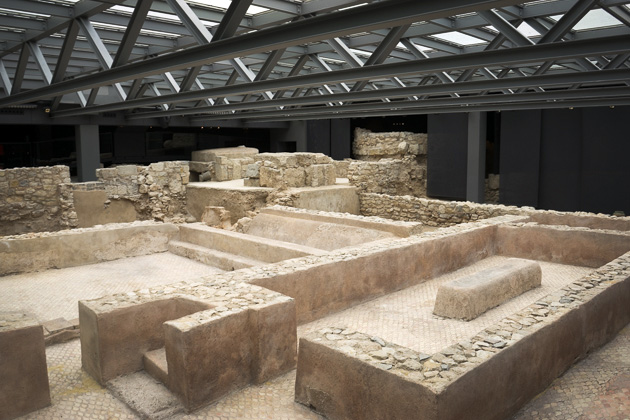
The baths of Roman Valentia
Underneath the present city. Naturally
Valentia was founded by the Romans and, as Marisa explained, it was used to settle former soldiers of the legions that had fought the Lusitanians under their iconic commander Viriathus. Those Lusitanians had been too benighted to appreciate that the Romans were there to liberate them from their primitive way of life and initiate them into the wonder and glory of life as Roman citizens.

The Romans were prepared to go to great lengths to help them attain civilisation, even if that meant massacring them in large numbers to attain that noble goal.

To be fair, the Romans were enlightened enough to settle quite a few of Viriathus’s soldiers in Valentia. After all, they were veterans too, weren’t they? Besides, as a boss of mine once told me when I mentioned we were buying our first house, “the best way to make a man a conservative, is to give him something to conserve”.

It didn’t work with me, I’m glad to say. We sold that house, anyway.

It didn’t work that well for the early Valentians either, or at least not for that long. 75 years later the city was razed in the Civil War that raged throughout the Roman possessions, to decide which of two power-hungry autocrats, backed by big money and large armies, should rule over them.

Can you imagine? A state of the world in which ordinary people have their lives wrecked because plutocrats are fighting each other for power. How sad it would be if the same kind of thing happened today.

It took half a century, but eventually the city was rebuilt, on top of the Roman ruins and sometimes using stones from them, as is traditional. Eventually it morphed into Spanish Valencia.

Which is just as well, as we might have found it difficult to live here otherwise.

In between, it spent a time under Arab rule. After Marisa had shown us some of the Roman remains under the modern-day city, she asked whether we’d like to visit the fragments of Arab wall that can still be seen in certain basements.

Well, we decided we would, so we did. In particular, she took us to the place where, back in the 1980s, there was a patch of wasteland with a slowly collapsing house at the back of it. At that time, Marisa was a student at the art school, then called the Royal Academy of Saint Charles.
The Fallas are the great festival of Valencia
They're about to come around again
A latter-day Valencian tries the traditional costume
One year, when the great annual festival of the ‘Fallas’ came around, she and some of her friends decided to organise a drink stand to raise a little money. The Council gave them permission to use the wasteland.

It was full of rubbish that people had been throwing there for years, if not decades. The first job was a long and tedious clean-up of the whole site. In particular, they had to clear the stairs that led down into a basement where they were planning to sell their drinks. When they got there, they found that one side of the basement was made of what looked like old, strongly cemented and thick walls.

They thought little of it and went ahead selling soft drinks, along with Agua de Valencia, which looks like orange juice but isn’t, and is certainly not soft. It all went well, in general. Their only problem was that this was the eighties and there were still a lot of unreconciled Fascists around, who hadn’t accepted the return to democracy after the death of the dictator Franco.

Sadly, some of these people are making a comeback again today, with the hard right surging in the polls. That’s one of the biggest issues that Spain, like many other countries, now has to face.

Back then, some of these Fascists identified, correctly as it happens, the students on the drink stand as left-wing and decided that they would make a great target for violent attacks. Ultimately, the students had to hire a security guard to protect them.

I’ve worked on drink stands before, but I’m glad to say I’ve never needed to protect myself from physical injury.

What was most remarkable, however, was the wall. Eventually, the students decided that it might be rather more significant than they had originally imagined. They mentioned it to the council.

It turned out that what they’d stumbled across was one of the best-preserved segments of the old Arab wall around the city, significantly bigger in Arab than in Roman times, lying under the newer buildings.
Marisa, with the Arab wall she helped uncover, behind her
It was a privilege to have one of the people responsible for its discovery showing us that stretch of wall, now well-preserved and set up for visitors to admire. Especially as they’d uncovered it in order to sell Agua de Valencia, a drink it strikes me as particularly apt for celebrating such a find.

It just goes to show. Facing down Fascist violence can have some remarkable consequences. Though this has to be one of the least expected.

Monday, 16 December 2019

While at war: courage in admitting you were wrong

Picture a lecture theatre in an old and prestigious university. You know, wooden panelling, a lofty ceiling, rows of wooden benches reaching up to the top and back of the hall, where the students sit.
Karra Elejalde as Miguel de Unamuno
But these aren’t students. There are some teachers and local worthies, mixed with armed soldiers and Fascist Party storm troopers. For this is 1936 at the university of Salamanca in Spain. Specifically, it is the 12th of October, and the military uprising that is going to lead to three years of civil war and the overthrow of the second Spanish Republic, is a few months old.

The 12th of October. That’s no random date. Even today, it’s Spain’s national day. It was chosen to mark the moment that Spain, through Christopher Columbus, ‘discovered’ America. That’s not an event much celebrated by the descendants who were already there and quickly learned to regret being discovered.

Back in 1936, it had been baptised the ‘Day of the Race’. That’s nothing to do with trying to run faster than others. It’s to do with celebrating the Spanish race above all others. If it weren’t so ugly, and hadn’t cost so many lives, this notion of race would be laughable: the Spanish are descendants of Celtic Iberian villagers, mixed with Carthaginian traders, followed by Roman legionaries, and then Germanic tribesmen who came marauding and stayed to settle before being overrun in turn by Arab adventurers; somewhere Jewish merchants and administrators joined the mix, along no doubt with Catholics from England and Ireland or exiles from Italy, to say nothing of the many ‘Indians’ from the Americas who came back along the shipping lanes that Columbus opened in the other direction.

In other words, the Spanish even in 1936 were about as racially pure as any street mongrel. Just like the English, with their Celtic roots, their smattering of Latin speakers, overrun by Anglo-Saxons and later by Norsemen of various types, to which have been added Jews from all over Europe and North Africa or Indians – not the American variety, but the kind that includes the whole of the Asian subcontinent covering Pakistan too – Nigerians, Jamaicans, Poles and Russians, and a glorious, rich mix of every nation on earth.

Still, to Spanish Fascists of 1936, the race was something to celebrate. And they did so in the great lecture theatre of the University of Salamanca.

One of those present that day was Miguel de Unamuno, philosopher, writer, poet and then rector of the University. He had been disgusted with the disorder and chaos of the Republic and had welcomed the military uprising as a way to bring back peace and order to his country. The Republic dismissed him. The rebellion restored him.

For a while he thought he could count on Franco’s support, if only to save the lives of friends of his who had been arrested. It was a vain hope. Two of his closest companions were murdered despite his entreaties.

On the 12th of October, he wasn’t due to speak. So he listened to speeches extolling the greatness of Spain, and of the holy war now being fought to save it.

Finally, he could stand it no more. He rose and began to speak:

I know you must be expecting my words, because you know me and you know that I am incapable of remaining silent in the face of what is being said. Saying nothing can, sometimes, mean acquiescing… I had said that I didn’t want to speak, because I know myself. But… I have to. There has been talk here of an international war in defence of Christian civilisation… But this one is only an uncivil war… To win is not to convince, and above all one has to convince. But there is no convincing through hatred that leaves no place to compassion…

Another presence on the platform was that of General Millan Astray, founder of the Spanish Foreign Legion. After Unamuno spoke, there were cries from the audience of the Legion’s slogan, “¡Viva la Muerte!”, “Long live Death!” Unamuno replied:

I have just heard the cry “long live death!” That sounds the same as “death to life!” And I, who have spent my whole life creating paradoxes that annoyed those who didn’t understand them, have to say to you, as an expert in the matter, that this paradox strikes me as ridiculous and repellent… Whatever the proverb may say, I have always been a prophet in my own country. You will win, but you will not convince. You will win because you have superior brute force, but you will not convince because convincing means persuading. And to persuade you need something that you are missing in this struggle, reason and right.

The words “you will win but you will not convince” work better in Spanish: “Venceréis, pero no convenceréis”.

This is the scene to which Alejando Amenábar’s latest film, While at War, builds.

There’s controversy about the film. It’s far from certain that the words traditionally attributed to Unamuno are exactly the ones he spoke: there’s no recording or transcript available. There is even a school of thought that suggest the words were embellished by a left-wing Spanish journalist who took refuge in London after the war, Luis Portillo. In a neat irony, he had a son in Britain, Michael, who became a Conservative politician and a minister in Margaret Thatcher’s cabinet.

There are also mixed views of the film. Amenábar has a tendency to distance himself perhaps a little too much from his characters, and that makes it difficult to empathise with them, and to feel their tragedy ourselves, viscerally. I did, but my two companions, one of my sons and my daughter-out-law, didn’t: the film left them cold and unengaged.

It didn’t leave me cold. I was fascinated by its depiction of Franco as a truly little man, in moral as well as physical stature, worming his way towards power. Millan Astray came across as just the monster I’ve always believed he was. But I was particularly fascinated by the depiction of Unamuno, as a man who got the politics wrong at the beginning and had, slowly and with enormous pain, to admit his error and put it right with what was, after all, an immensely courageous public statement repudiating the Fascists and all they stood for.

It didn’t happen exactly as in the film. The audience didn’t mob him or threaten to lynch him. He wasn’t rescued by Franco’s wife. But it’s true that immediately afterward, he was dismissed as rector for the second time and definitively. He was also placed under house arrest. He died two months later.
The aftermath of Unamuno’s speech was no lynching
He’s surrounded by Fascists, but Millan Astray is shaking his hand

There’s plenty wrong with the film, but plenty right too. I enjoyed it, partly because it’s the first time I’ve seen a film in Spanish without subtitles. It means I shall watch it again as soon as I can, if only to be able to say again and again, “oh, that’s what he was saying.”

I will, however, also be watching it again because for me, at least, it’s well worth seeing twice.