Showing posts with label United States. Show all posts

Tuesday, 3 June 2025

A life worth celebrating

It must have been a pretty formative experience for an eleven-year-old:

I can still see myself standing on the west bank of the Mississippi looking over into East St. Louis and watching the glow of the burning of Negro homes lighting the sky. We children stood huddled together in bewilderment ... frightened to death with the screams of the Negro families running across this bridge with nothing but what they had on their backs as their worldly belongings... So with this vision I ran and ran and ran

The running took the writer of these words to Paris. There, according to a French scholar, Pap Ndiaye, she made an unexpected discovery:

When she arrived, she was first surprised like so many African Americans who settled in Paris at the same time…at the absence of institutional racism. There was no segregation … no lynching. (There was) the possibility to sit at a cafe and be served by a white waiter, the possibility to talk to white people, to (have a) romance with white people

Much later in her life, she took part in the 1963 March on Washington and spoke from the same platform that Martin Luther King used to make his ‘I have a dream’ speech. Among other things she told the quarter-million strong crowd:

You know, friends, that I do not lie to you when I tell you I have walked into the palaces of kings and queens and into the houses of presidents. And much more. But I could not walk into a hotel in America and get a cup of coffee, and that made me mad. And when I get mad, you know that I open my big mouth. And then look out, ’cause when Josephine opens her mouth, they hear it all over the world.

So there you have it – her name. Josephine. Josephine Baker, in fact, as she’s best known, from the surname of one of her husbands, though originally she was Josephine McDonald.

She was born in St Louis, Missouri in 1906. A singer and dancer, she got into the chorus line at a couple of New York shows before travelling to Paris in 1925 and getting a real break. She starred first in the ‘Revue Nègre’, the Black Review. The very title reveals that France was hardly free of racism. Baker danced near-naked there and in other reviews, including the Folies Bergères night club, playing to, but also poking fun at, stereotypical white views of black women. Still, at least the racism, as Ndiaye makes clear, didn’t expose her to violence or deny her service in restaurants and hotels.

Josephine Baker, 1930
She really did have a pet cheetah
In any case, those performances turned her into an international superstar and the first black woman to land a starring role in French films. ‘I became famous first in France in the twenties,’ she would say, and the country that made her feel safe and allowed her to shine became her home of choice. Her best-known song, ‘J’ai deux amours’, ‘I have two loves’, was dedicated to her love of her country and of Paris. She took out French nationality, renouncing her US citizenship to do so.

Nor was her relationship to her adopted country a one-way arrangement. During World War Two, she served France just as she’d benefited from it: she worked as a spy, passing information about troop movements and military preparations that she was able to gain thanks to her freedom to move, as an international celebrity, in some elite circles. When northern France was occupied, she moved to the southern, unoccupied area, living in a chateau where she stored weapons for the French resistance, provided shelter for its fighters and for Jews escaping persecution, and continued to collect and pass on any intelligence she could.

When that part of France fell too, she moved to North Africa, where she provided entertainment to troops at concerts to which she offered free entrance.

Her wartime service won her the Resistance Medal awarded by the French Committee of National Liberation, the Croix de Guerre from the French military and the Légion d’Honneur, France’s top honour, awarded to her by Charles de Gaulle.

Baker in French Air Force Uniform, 1948
She also adopted twelve children from around the world, bringing them up in different religions, to prove that kids could live together harmoniously despite ethnic and religious differences.

She never gave up fighting for the rights of black people back in the United States, as her presence at the March on Washington shows. But she could never live there again, infuriated as she told the crowd that day at the contemptuous behaviour to which the colour of her skin exposed her. She fell on hard times at the end of her life, but was taken in by her friend Grace Kelly, the film star turned Princess Consort of Monaco.

She died in 1975 and was buried in Monaco. In 2021, she became only the sixth woman to be honoured by a tomb in the Panthéon in Paris, reserved for the greatest figures France produces. Her grave remains in Monaco, but a casket containing earth from places where she’d lived, including St Louis, Paris, the south of France and Monaco, was brought with full honours to the Panthéon, and a plaque set up to her.

Why am I writing all this today?

Because she was born on 3 June. So today I’ll raise a glass to what would have been her 119th birthday. And I thought I’d share that moment with you.


Friday, 11 October 2019

Treason in the White House

The price of not being prepared for war can be an end to peace
Syrian Kurds flee the fighting as Turkey invades
Oh, say can you see,
By the dawn's early light,
What so proudly we hailed,
At the twilight's last gleaming?


The words of Francis Scott Key’s poem, which became the lyrics for the US national anthem, refer the American flag flying over Fort McHenry in Baltimore, Maryland, after a night’s bombardment from ships of the British Royal Navy in September 1814. The image of the flag still flying proudly in the dawn, despite such a battering from what was then the world’s leading naval power, is a tribute to the pluck of a still small nation standing up to the oppression of a far more powerful one.

I don’t believe that war is glorious, even less that it should be fought for glory. It should be fought as a last resort, and only because the principle at stake is so vital that even deliberately killing others is a price worth paying to protect it. That was the case in Fort McHenry, for instance.

Even better, however, is to be able to use the threat of military force to protect the principle, without actually activating it. The Principal of my first college was a former General, Sir John Hackett. He once told me that a military commander who has to give the order to open fire has already failed. The perfect military engagement, in his view, was one where the winning side deploys such overwhelming force that the other backs down without firing a shot.

Sometimes, indeed, the mere presence of a powerful nation’s soldiers in a potential war zone can deter other nations even contemplating military action.

These are principles known well in the United States. Let’s see what a few presidents have said on the subject.

George Washington declared that “being prepared for war is one of the most effective ways of preserving peace”. It wasn’t an original thought. The Romans had a similar saying, “si vis pacem, para bellum”, “if you wish for peace, prepare for war”, and the Greeks and Chinese voiced the same idea earlier still.

To be a great nation requires certain qualities. “We must dare to be great; and we must realise that greatness is the fruit of toil and sacrifice and high courage”. That’s true even without war, but it’s certainly true of war in particular. Being prepared for war requires being ready to engage in toil, to make sacrifices and to display high courage.

That was Teddy Roosevelt.

There’s another quality that great nations, like great individuals, enjoy and display. “I need loyalty. I expect loyalty,” as another President put it. And he’s right: without loyalty, high courage, toil and sacrifice will produce little worth having.

Who was that President? Why, Donald Trump. Interesting, isn’t it, that he talked about “I need loyalty”? He needs it from others. He doesn’t need to show any himself.

Which is why he’s suddenly pulled out of Syria, leaving his allies, the Kurds, at the mercy of Turkey. Which has prompted invaded.

The American presence was the classic case of simply being present. They weren’t there to fight the Turks. But their mere presence meant that an invasion couldn’t be launched – it might have led to American losses and a massive American retaliation. Trump could have preserved peace by being ready for war. Instead he claimed:

WE WILL FIGHT WHERE IT IS TO OUR BENEFIT, AND ONLY FIGHT TO WIN. Turkey, Europe, Syria, Iran, Iraq, Russia and the Kurds will now have to figure the situation out…

Figuring the situation out for the Kurds sounds like getting themselves massacred by the Turks. Which, incidentally, means they won’t be able to guard prisoners from the ISIS terrorist movement, now poised to escape and start their campaign again. After three years of US effort against them. That doesn’t sound like “FIGHT TO WIN” but much more like “FIGHT TO LOSE”.

The loss will be down to a failure to show precisely the loyalty Trump himself demands.

Let’s end with some other words from a US President, on the day after the Japanese attack on Pearl Harbor:

Yesterday, December 7, 1941 a date which will live in infamy the United States of America was suddenly and deliberately attacked by naval and air forces of the Empire of Japan.

We can add another date to the roster of infamy: 8 October 2019.

The day Donald Trump decided to pull out of Syria, without notice, betraying his Kurdish allies to the invading Turks.

Sunday, 21 July 2019

There are immigrants and immigrants

It’s curious being an immigrant again.

Queuing to get into Valencia
I mean, it’s not the first time. That’s not counting my childhood in Rome, where I wasn’t an immigrant but an expat. If you don’t think that’s an important distinction, think again. Expats are people who never really belong. They’re usually in the country for a relatively short time, maybe on a limited contract, often with an embassy or a research institution or some kind of international organisation.

They tend to congregate with others of their kind, talking their own language, and have the sense that they’ll be gone within a while anyway, once their tour of duty is up. They tend to talk about the local people with a definite article, as in “the Italians do such-and-such”, where such-and-such is usually something that the person talking about it doesn’t like much.

The first time I was a real immigrant was when I moved to France in the late nineties. I was on a French contract with a company incorporated in French law. In fact, when it all fell through, it was great to have French law to fall back on with its generous approach to unemployment benefit. A lot more generous than, say, Britain’s. You can actually live on French unemployment pay.

Still. France was a bit special. As the husband of a Frenchwoman, I had a right to French nationality. Once I’d started work again, I set about securing it as quickly as I could. When it came through, I wasn’t an immigrant any more, but in my home country. My second home country, indeed, but a home country nonetheless.

But then we moved just across the border – a short car drive from the superb eastern French city of Strasbourg – into Germany. There we were truly immigrants once more, and it was fun. Discovering how things were done. Struggling, in my case (Danielle is a fluent German speaker), with a different language. Learning to enjoy different foods and pastimes. A great experience.

And now we’ve started all over again. Immigrants to Spain. Without Spanish citizenship or any right to claim it. Truly foreigners making a new home for ourselves in a different country.

It’s proving just as enjoyable as Germany. It helps, I suspect, that though our Spanish is execrable, we let ourselves go and speak it anyway. Far from reacting with horror at the way we’re massacring their language, they seem pleased, relieved even at not having to struggle with English to communicate with us.

So they just talk Spanish at us and, if we only understand two words in three, it doesn’t matter because they’re more than happy to explain what they meant. Making friends has proved surprisingly easy and, even among those who haven’t become friends, we’ve found people gratifyingly friendly.

There have naturally been a few problems. Civil servants tend to be a pain. Some of them take a perverse delight in telling you that you haven’t got the right document and need to come back in six weeks’ time when you’ve got it. However, in some cases we’ve found that even those can become quite pleasant if we persevere, trying to talk Spanish, until smiles eventually replace the frowns and rudeness.

We’ve also discovered that there’s no point thinking you can do anything in a single meeting. It will always take two or even three. The first may be where they tell you’ve gone to the wrong place. But even if that isn’t the case, it’s where they tell you that you don’t have the right documents. Generally, though, when you get there for the final meeting, having booked the appointment correctly, with the right papers, it all goes smoothly and even cordially

Nor is it only in the public sector that it all takes so long. Any big institution seems hopelessly sclerotic with bureaucracy. The banks, for instance, as well as ministries or local councils. Most organisations here have websites these days, and online procedures for doing administrative jobs. But again and again, you get to the final stage, when you’ve filled in page after page of information and uploaded half a dozen scanned documents, and you press the ‘Submit’ button, only to get an error message that tells you helpfully that ‘there is an error with your application’.

The only solution seems to be to go to the place in person, because they certainly don’t answer emails or return calls in response to voicemail. That’s what I generally do these days, without even attempting the online route. It may take a little longer but, in the end, you get smiles and your case dealt with – even the people in the bank are charming if you go and see them yourself – and that was the aim of the exercise, wasn’t it?

So we’re enjoying our status as immigrants.

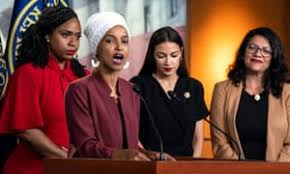
Still, I know we’re immigrants who get an easy ride. We’re not Muslim or dark in skin colour. We’re not the ones who get told to go back home. I can’t begin to compare my achievements with those of Ilhan Omar, who has risen from refugee roots to become a US Congresswoman. That only makes it all the more shocking that she has been the target of racist attacks from her president.

And think of Alexandria Ocasio-Cortez, perhaps one of the most impressive performers in the US House of Representatives, agree with her or not, also called on to go back home – though she isn’t an immigrant at all, but US born and bred.
The 'squad' of awkward women of colour in Congress, attacked by Trump
Ilhan Omar is speaking. Alexandria Ocasio-Cortez is next to her in black

No. There are immigrants and immigrants. Some are treated gently. Others are the butts of aggression from people who draw encouragement from such as Trump. They face attack even if they are merely descended from immigrants (and how many of us aren’t?) and only distinguished by the colour of their skin or their faith.

We’ve seen that there can be joy in being an immigrant. Oh, how I wish we lived in a world where that was true for all of us.

Wednesday, 29 August 2018

Transatlantic travel and comparisons

One of the pleasures of my job is that it gets me to the US from time to time. Specifically, to Boston and Massachusetts generally, which is great, not least because they’re pretty much the antithesis of Trumpland.

It was great flying across. The trip was uneventful, as flights generally are these days, out of Russian missile range. Air travel has become routine, with neither much sense of risk (thank God) or of luxury (small price to pay).

We landed half an hour early, which was no benefit at all. Traffic at Boston is so heavy there are never any gates free so arriving early means waiting for the previous plane to leave your designated gate. Half an hour early? You get half an hour wait on the tarmac.

The Americans have massively improved entry into the country. It used to be a painful process. But I’ve managed to get myself on to the Global Entry programme, so I glided through with ease. Besides, the officials at Boston are friendly, which isn’t the case at every US airport, so arriving here’s unusually pleasurable.

Getting through passport control quickly means you get to the baggage hall sooner. I know I should learn to travel with hand luggage only, especially for just three nights like this trip. But I hate having only tiny tubes of toothpaste or micro-bottles of shampoo, and I love getting rid of my case, so I check it in, small though it is.

The airlines have a great system so that if you travel with them often enough, they grant you certain privileges. My bag now gets a ‘priority’ tag when I check it in. This is a huge boon, since it means it’s now hardly ever the last case offloaded.
The great privilege of a 'Priority' label
Which does... pretty well nothing
On this occasion, about three-quarters of the luggage had appeared before my priority case. That unfortunately meant that it didn’t make the cut: it didn’t reach the carousel before the entire luggage belt broke down. This is the land of superfine, superfast technology, so when it fails, it fails spectacularly.

Ah, well. We went from super-early to pretty late, but who cares? At least I had the chance to go for a rest, where rest is what Americans take in a restroom. I loved the symbolism used though, I have to confess, I couldn’t conform since my bag still hadn’t arrived and I couldn’t put a bowtie on.
Tough dress conventions for this 'rest' room
After that, all I had to do was head for the hotel. Which was on the waterfront, so I was able to have a relaxing walk before crashing out. That was quite an experience: I associate Boston with bitter cold, but on my walk just before midnight, it was 30 Celsius rather than 30 Fahrenheit.

A pleasant walk on a balmy night
At 30 C, nearly barmy
Breakfast is one of the better US institutions. I enjoyed it over a copy of the New York Times. That’s the ‘failing New York Times’, according to the President of this fine country. The fact that the hotel provided that paper and no other was in keeping with what happened the previous evening, when I checked in. The clerk gave me instructions for logging on to WiFi. After selecting the service, the suggestion was that I call up CNN.com to get the hotel login page. That’s quite amusing, because I always use BBC.co.uk for the same purpose. Of course, both CNN and the BBC are just the kind of news outlets Trump detests.

Not just Trump. I notice that Jeremy Corbyn’s supporters use much the same language as the Trumpists to denounce the media and its supposed unfair hounding of the blessed leader. Interesting how people at the centre of personality cults, whether of Left or Right, always hate anyone who questions them. And as for dissent, that can only come from traitors. I recently read these edifying words:

We know who the conspirators are; who their backers are; where they are and why they want to destroy [our man and our movement].

Was the writer talking about Trump or Corbyn? It’s hard to tell. The threatening tone of ‘we know where they are’ is like Trump whipping up hatred against journalists at a rally. In this case, the words were a Corbynista’s.

Breakfast also reminded me of the meal on the flight over. It included ‘Butler’s Secret’ Cheddar. Sounds enticing, doesn’t it? Marketing people love the notion of secrecy. Odd, seeing as their work is all about publicity. Somehow, nothing’s so exciting as the notion of secret ingredients.

What turned up was something that looked, felt and, I can testify, tasted like perfectly ordinary Cheddar. And since its wrapping stated what it was, I couldn’t really see anything secret about it.
Butler's Secret. Proclaimed on the packaging.
Which was a relief, to be honest. After all, if I want transparency in anything, it has to be about what I’m eating. Why would I want the producers to keep what they’re putting in my food secret?

Still. At least I don’t suspect them of engaging in collusion. Which is a lot more than I can say for Trump.

Friday, 1 June 2018

Trump playing Napoleon? It could end in tears

Is it to be war, then?

Not, thank God, the shooting kind. But something almost as damaging. The enlightened Trump seems to have decided that the best way of dealing with the economic problems of the United States is a trade war with his allies. He’s poised to impose tariffs on imports from his two neighbours, Mexico and Canada, and on the world’s biggest trading bloc the European Union, which still includes Britain for now.

Trump: a latter-day Napoleon?
Without quite the genius...
By coincidence, I’ve just finished reading a biography of Napoleon, recommended to me by a French friend because, though written by an Englishman, it provides a superbly balanced view of the man. Andrew Roberts’ Napoleon the Great is well worth reading, whichever side of the Channel your sympathies lie, since its meticulous research and lucid analysis punctures a lot of myths, of Napoleon as either the greatest of leaders or as a tyrannical monster.

As the Napoleonic wars progressed, both sides attempted to use economic weapons against the other. Britain, then undisputed master of the seas, used the Royal Navy to blockade the ports of France and the nations it had occupied, and even went so far as to wage war against the United States to try to enforce its embargo.

Equally, Napoleon tried to impose the Continental System on France and its occupied territories, to keep out all British trade. He was prepared to go so far as to invade Russia to impose respect of the embargo, a move which would lead to the catastrophic retreat from Moscow and ultimately the loss of his throne.

Describing the impact of these two competing trade boycotts, Roberts writes:

The year 1811 saw the start of a continental economic crisis that lasted two years and that also engulfed Britain, which was beset by bad harvests, wage cuts … and food shortages. Mulhouse in eastern France saw two-thirds of its workforce of 60,000 unemployed, and over 20,000 were unemployed in Lyons. Napoleon needed to stimulate economic growth, but his [adoption of eighteenth-century economic views], which rejected the idea of competition and free exchange as positive phenomena, sent him back to attempting to enforce ever more strictly the Continental System, even if it might eventually mean fighting Russia again…

By 1812 Napoleon believed that the Continental System was working, and cited the bankruptcies of various London banks and commercial enterprises to support this…


The system was, indeed, causing considerable harm to Britain’s economy.

Napoleon was not wrong in assuming that Britain was suffering very seriously as a result of his Continental System… Trade declined rapidly… the bad harvests of 1811 and 1812 led to food shortages and inflation, and war expenditure increased budget deficits from £16 million in 1810 to £27 million in 1812. Some 17 per cent of Liverpool’s population was unemployed during the winter of 1811/12, and the militia had to be deployed against potential rioters … across the Midlands and North of England, with ringleaders sentenced to transportation to Australia, or even in some cases death.

The parallels are striking, aren’t they? We can be sure that Trump will be as convinced as Napoleon that his trade measures are working. But the only certain consequence they’ll have is hardship on all sides – the eighteenth-century rejection of ‘the idea of competition and free exchange as positive phenomena’ is a dangerous illusion, a truth that both Trump supporters in the US and Brexiters in Britain would do well to learn.

The big difference is that, though he came badly unstuck at the end, Napoleon was a political genius as well as a military one. Even if we bend over backwards to be generous towards him, its hard to classify Trump as a genius of any kind. Indeed, I find it hard to believe that he has the mental capacity to learn the lessons of Napoleon’s final failure.

Retreat from Moscow
Crushing, immensely costly defeat - not least in lives
Because ultimately, Napoleon’s attempt to impose his system took him to war with Russia, leading to a crushing defeat and his downfall. That Trump suffers the same fate as Napoleon may seem highly desirable. However, Napoleon led an army of 500,000 into Russia and returned with just 50,000. Let’s hope that this isn’t the kind of price we pay for Trump’s failure to learn that adventures with trade weapons are as dangerous as the adventures with firearms he seems so keen to defend in the US.

Especially as the damage done by any such disaster in the twenty-first century is likely to be far greater than even on the retreat from Moscow in the nineteenth.

Wednesday, 9 May 2018

Obama Trumped

The Donald has torn up the Iran nuclear arms agreement. On the basis that it was a rotten deal and shamefully one-sided. He’s probably right on the second point: it has led to Iran dropping its military nuclear programme, but few of the promised economic benefits in the way of foreign investment into Iran have materialised.

But maybe Trump didn’t mean that the deal was one-sided against Iran.

The worry seems to be that Iran has never abandoned a policy of extending its influence throughout the region, by manipulating puppet governments and backing deeply unpleasant groups. In particular, Irans friend Hezbollah has shown itself perfectly ready to take terrorist action or use violence generally to advance its political agenda.

What’s curious, though, is that it’s the states of the region most inclined to use such violence who are leading the charge against the Iran deal.

Saudi Arabia, for instance, seems intent on pummelling Yemen back into the Stone Age, as it uses its military to starve the Yemeni people and leave it victim to disease as well as injuries without the means to fight them. It also regularly kills large numbers of civilians – for instance, at weddings or funerals – always it claims unintentionally, which means the Saudis are either lying and therefore committing war crimes, or telling the truth and therefore so utterly inept that they shouldn’t be allowed anywhere near a weapon.
Saudi Arabia teaching Yemen to appreciate peace
Israel, too, has long established the principle of a hundred eyes for an eye, reacting to any attack on its people by one tens of times more powerful and more murderous. It also regularly intervenes militarily in Syria, in just the same way as Iran or Russia does, with the same callous indifference to the wellbeing – or even survival – of the citizens or the hopes for peace.

But these two nations proclaim their commitment to ending terrorism as their reason for wanting the nuclear deal with Iran ended.

Meanwhile, in the greatest irony of all, it is the United States itself that has done most to ensure the growing power of Iran across the Middle East. It was Dubya Bush, after all, slavishly supported by Tony Blair, then British Prime Minister, who invaded Iraq to bring down Saddam Hussein. Saddam was a deeply unpleasant character and no one deserved to overthrown more than he did, but he was also deeply hostile to Iran. Why, he even fought an eight-year war against his neighbour.

His overthrow left a power-vacuum in Iraq into which flowed the Shia groups who, precisely because they represented the majority of the people, he had always oppressed and prevented holding power. They were enthusiastic supporters of Iran, ruled by fellow Shiites. So in place of Saddam, we now have a puppet-government of Iran’s holding sway over Iraq and its oil.

The West itself set the trap in which it was then caught.

And it looks as though Trump wants to do exactly the same thing again. The Iran nuclear deal was by no means perfect, but it was the only deal we had. Whatever Benyamin Netanyahu of Israel may say, all the evidence points to a huge reduction in Iran’s nuclear programme. In addition, we now have observers from the International Atomic Energy Agency regularly checking Iran’s installations, which we didn’t have before. But just as the UN inspectors were disbelieved when they reported that Saddam didn’t have weapons of mass destruction, before the Iraq invasion whose declared goal was to deprive him of them, so Trump refuses to believe the IAEA inspectors today.

What is certain is that if the agreement fails, Iran will return to preparing and stockpiling nuclear weapons. The reformist government may well fall and be replaced by something far less accommodating. Iran may turn from an uncertain partner in peace into an enemy all the more dangerous for thinking itself threatened.

Like Dubya and Trump before him, but at far greater scale, Trump is creating precisely the monster he claims to be acting against.

An ignorant man turns his own weapons against himself. Sadly, he turns them against the rest of us too. Something for which we have to thank the equally deluded minority of US voters who thought they would somehow benefit from putting him in a position to do the damage.

Just as with Brexit, if your answer is Trump, you’re asking the wrong question.

Monday, 16 April 2018

Baseball Trumping Patriots

It was odd to discover that some colleagues from the US wouldn’t be able to join a meeting I’d called, because it was ‘Patriots’ Day’.

That’s not Patriots’ Day in the US, you understand. It’s not even Patriots’ Day in Massachusetts. It’s Patriots’ Day in the City of Boston and in that city alone.

It’s the day the population of that fine city celebrates the moment when its English inhabitants showed, with valour and tenacity, that it would not be denied the rights of Englishmen, forcing out the troops sent there by the English King.

A man increasingly crazed, of limited intellect and devoured by his autocratic inclinations

Although one of my colleagues seemed to blame me personally for the misdeeds of the British troops (apparently, I should have been nicer to the colonists – I promise to do better next time), I am fully in sympathy with the rebels. They set a fine example and one we latter-day Englishmen would surely do well to emulate. In fact, I only regret that all their courage and self-sacrifice have only been crowned, sadly, by their descendants being saddled with a Trump as head of state.

A man increasingly crazed, of limited intellect and devoured by his autocratic inclinations.

That being said, I’m fond of Boston. I’ve not been there that often but each time I’ve got to know it better and the experience has only reinforced by initial liking of the place.

On my last visit, my boss took several us to see a Red Sox baseball game. Now, I’m not going to say that was the high point of the visit, since naturally it was the work we did at our meetings that formed the true high point. Perhaps I’ll just say that had there not been those meetings, it would have been right up there at the pinnacle.

I’d never been to a baseball game before so it was a great educational experience. It’s a bit like cricket, only the advantage lies far more with the man with the ball in his hand, rather than the poor unfortunate holding the bat. Things are rather the other way around in cricket.

Apart from that, and a slight truncation in the time it takes to complete a match, much of the spirit of the game is similar to that fine English game. As, I suppose, befits a nation founded by fine Englishmen.

It wasn’t just the game itself that amused me, however. I’ve always liked the film Field of Dreams. You know, “if you build it, they will come”. You may remember the moment when Kevin Costner talks James Earl Jones into accompanying him to a game at Fenway Park, home of the Red Sox.


A scene from the film. 
With the green monster - the wall at the back - clearly in view
It was a joy to sit in the stands and look out at the same scene that they saw. Nothing surprising maybe – the filmmakers shot the scene on location. But still it sent a tingle up my spine just to be where those characters had sat and see much the same sights that they saw.


A scene from (my) real life
Ditto
Wonderful. It wasn’t on Patriots’ Day, as it happens. Still, from a purely personal point of view, it was just as worthy of celebration in my eyes.

Of course, as it happens Patriots’ Day is also the day of the Boston Marathon. Which was run this year in temperatures down to -1 (that’s -1 in real money – Celsius). Making it a pretty miserable experience.

But then, since we’ve already sad that the legacy of the original patriots is now in the hands of the Donald, that may not be wholly inappropriate.

Friday, 12 January 2018

How can others trust me if I don't trust myself?

Trust. It’s impossible to live without. And yet it’s so hard to win.

This all came to mind recently as part of the process I’ve been going through to try to make it easier to get into the United States on visits. Honestly, if a European want to understand how ghastly it is for non-Europeans to get into, say, Britain – you know, those demoralizingly long queues at immigration full of unhappy people combating boredom and jetlag – you need to try to get into the US as a non-citizen or resident. You wind backwards and forwards in long lines between stretched ribbons and, as often as not when you finally get to the front of one, you just go through one process – having your retina scanned and fingerprints checked, say – only to step into the next queue.

Which is what happened to me when I arrived in Boston last Sunday.
Smiles, but not that comforting
Trump and Pence: the men whose trust I need
I have therefore applied for inclusion in the US Trusted Traveller Program. This allows you to use a shorter queue and therefore, one hopes, to get in a little more quickly. It does, however, require winning the trust of the United States government.

Now I appreciate that the US only needs convincing that I don’t plan to engage in any criminal activity. It’s not my intention to carry weapons: I own rather fewer than most Americans (none at all). Nor do I plan to smuggle any banned substances, such as drugs – really not my scene: “drugs cause cramp”, Dorothy Parker assures us, and there are some fairly unpleasant penalties associated with carting them around too. Indeed, I won’t even be bringing in simple foodstuffs: we did travel with bananas once, which we’d forgotten to eat in the plane and dutifully handed over the customs officer when we arrived, by which time they’d been reduced to an unappealing brown mass anyway.

In that limited sense, I think I’m worthy of the US government’s trust, even one headed by the notoriously paranoid Trump.

Trust, though, must cover more than simply a reasonable endeavour to avoid downright criminal behaviour. One can’t help feeling that a trustworthy individual can also be relied on in everyday life. And there, sadly, I’m not wholly convinced I can even wholly trust myself.

For instance, when I was waiting to check in my bags for the flight to Boston, the thought occurred to me that I really didn’t need a winter coat for the flight. I took it off, emptied the pockets into my laptop bag, and packed the coat. That left me feeling pleased with myself for being so farsighted, but only until I got through security and decided to buy something.

That’s when I discovered that my wallet wasn’t in my bag. What’s worse, the pouch where I’d put the other things wasn’t properly closed. I cursed my carelessness.

Doubts assailed me. Had I left my wallet in the coat? Or had it fallen out of the laptop bag without my noticing? Worse still, how could I possibly find out?

The answer, of course, was that there was no way. I just had to spend the next eight or nine hours, until I got my case back, combating the ever-returning fear that I’d lost the wallet. An easy flight turned into a far less pleasant experience.

As it happened, the wallet was indeed still in my coat. I needn’t have worried. But it rather undermined my trust in myself – after all, had I concentrated a little more for a minute or two, I could have spared myself several hours of pain.

Not my idea of a trusted traveller.

Still, I’m glad to say the US has agreed to award me that status despite my own doubts. On the other hand, another shock awaited me as I walked into the building when my interview was to take place. Up there on the wall were portrait photos of Donald Trump and Mike Pence.

It’s odd. I’ve naturally seen Trump on TV again and again since he was sworn in. Practically every day there’s some new appalling revelation about the man. Inevitably, I knew perfectly well that he was President.

And yet, somehow, it was seeing those portraits that really brought it home. I’ve seen Federal buildings with portraits of Obama and Biden before. I’ve seen photos of many presidents. They strike me as entirely mundane sights, just what one would expect. But to see Trump up there – well, it really forced me to realise the ghastly truth: that hideous clown really had succeeded Obama in the White House.

In the short term, it wasn’t as chilling a realisation as the discovery that my wallet was apparently missing.

In the longer term, though, it may have far more frightening consequences.

Thursday, 30 November 2017

Poor little Britain

It’s cold out there at the moment.
Sean Bean in Game of Thrones: “winter is coming”
Still, it is November, in the Northern Hemisphere, so we have to expect temperatures to be pretty uncomfortable. And at least we know that there are only three weeks to go before the days start to grow longer again. While the cold will be even more bitter, at least the lighter evenings will contain a promise of better times to come.

So much, at least, for the physical weather. When it comes to its status in the world, the cold has only just started to grip Britain. It will deepen a great deal further in the coming years, and not start to recede until British people at last emerge from the illusions behind which they prefer to hide.

Most central among these is the sense that their country is still a world power. A lion whose roar is heard around the globe. Some will cling on to that belief for a long time, but others are beginning to take the tough object lessons reality is delivering to them.

For many months, the hard Brexiters in government have been insisting that they will not move on the amount Britain will have to pay the EU on leaving. This is the so-called ‘divorce bill’. While a member of the EU, Britain entered into a number of commitments many of which involved the payment of money. Among other things, there are people who have retired from the EU Civil Service, to whose pensions Britain pledged to contribute. There is a sense in Brussels that these commitments have to be honoured despite Britain’s departure.

The hard Brexiters have been insisting that the figure should be low.

Take the case of Priti Patel. She had to resign from her post as International Development minister earlier this month, having demonstrated her humility in public service by conducting her own foreign policy while on holiday in Israel, where she had meetings with senior ministers including Benjamin Netanyahu, without reference to any other member of the government including the Foreign Secretary. Demonstrating the diplomatic self-control which make her such a loss to foreign affairs, she announced at the weekend that the EU could just “sod off” with their demands for a divorce bill.

It must have come as quite a blow to find that her erstwhile boss, the Prime Minister Theresa May, is now talking about paying as much as £50bn, perhaps twice the sum many had hoped. Ultimately, of course, there will be a compromise and a sensible figure will be agreed, whether near the £50n level or not. The key point is that Britain blinked first, and had to. In a doubtless unwelcome reminder to Brexiters, May had to admit that Britain is not in the driving seat, it can’t call the shots, it has to move towards the EU before the EU will move towards us.

Then came the affair of the Trump far-right Tweets. When Britain leaves the EU, it will be more dependent than ever on the US. President Trump (it still feels slightly unbelievable to write those two words together) early on made it clear that he was keen to offer Britain a trade deal, a piece of news Brexiters reacted to with glee. Sadly, Wilbur Ross, Trump’s Commerce Secretary was in the UK at the beginning of this month. He stressed that the US was ready to give Brexit Britain a trade deal, but we might just have to make a few minor accommodations. Like giving up on European-style regulation – shorthand for our having to abandon our unreasonable demands for our food to be edible.

Just over two weeks later his boss, the President himself, decided that it would be judicious to retweet three tweets with Islamophobic videos attached.

Even the most elegant of houses has to have a sewage system. All nations have to have their political cesspools. Britain’s is called ‘Britain First’, a neo-Fascist grouplet of no significance in our politics. Indeed, the woman who put up the tweets the President chose to pass on, chalked up the triumphant total of 56 votes in a run for parliament. Just to give some perspective on that figure, the winner of the election took 16,897 votes.

She is now facing criminal charges for religiously aggravated harassment and for using threatening and abusive language.

This is the person whose views the President decided to endorse.

In another example of our unreasonable attachment to certain standards, many of us in Britain rather resented this behaviour. The Prime Minister isn’t famed for her courage in standing up to Trump – she was the first head of government to visit him in the White House and issued him with an invitation to a State visit immediately, without the customary waiting period we generally like to take to see what kind of a President we are dealing with.

Yet even she felt she should speak out this time, telling Trump explicitly that he had been wrong. His reaction? To tell her to mind her own business.

When Home Secretary Amber Rudd spoke to the House of Commons about the Trump row, she repeated her boss’s rebuke to Trump. But then she went on to remind her listeners that the relationship with the States is vital. Which is true, and particularly now. But does she mean that we have to be careful what we say about him – even when he endorses our Fascists?

Many have been asking whether the invitation to Trump for the State Visit would be cancelled. It looks as though what Britain’s going to do is leave the invitation out there, but simply fail to set a date for it. Which, if you’re feeling generous, is a classic British compromise; if you’re feeling a little more severe, you might view it as something more like moral cowardice.

But what choice does Britain have? We’ve chosen Brexit which means we’ve chosen dependence on the States. Even under Trump.

Game of Thrones got it right. Winter is coming, and it’s going to be cold. For a very long time.

Thursday, 23 November 2017

Black Friday and our sad mindset this side of the Atlantic

Black Friday is upon us.

It’s particularly remarkable on this side of the Atlantic. The Friday is black in the US because people are recovering from the excess of the Thanksgiving celebration the day before, or just need their morale boosted in the down that follows the high of a feast. Though behind that worthy goal lurks also the rather baser desire to make a lot of money by a day of sales in the shops.

In England, we don’t have the feast. We just have the Black Friday. The depression, in other words, without the celebration that led to it. But it’s still a wonderful commercial opportunity. Or at least shopkeepers hope so.

The problem arose because of the increasing disappointment of Christmas. This is the second most important feast of the Christian year. Believers worship the birth of Christ in December just as at Easter they celebrate the redemption of man through his agonising death followed by the miracle of his resurrection. Birth at Christmas, the even more glorious rebirth at Easter. .

Clearly, celebrating the birth of the Prince of Peace is a time for quiet reflection on the nature of God’s relationship to Man, the sacrifice of his incarnation and later death in pain for us all, and so forth. Where “so forth” covers over-indulgence in food and, above all, drink as well as the commercial miracle of a splurge of spending in the shops. Why, a great many retailers depend on Christmas for the bulk, if not the entirety, of their profits for the year.

Such are the benefits of a profound immersion in the spirit of Christian charity and restraint. An excellent arrangement. Serving God and Mammon, otherwise known as win-win.

Although it’s not that wonderful any more.

Britain has seen earnings falling for a decade already. There’s no sign of that ending any time soon, particularly following Brexit. Eventually, inevitably, loss of earnings power had to have an impact on spending patterns. Christmas just isn’t what it once was. Shops can’t count on it any more.

The answer was to find a way of incentivising expenditure at another time of year. And why not just a few weeks before? Adopting Black Friday seemed the obvious solution.

But we took it over without Thanksgiving. Meaning we have the depression not the celebration. The hangover without the party. 

What’s more, we don’t seem to be satisfied with just a single day of it, which after all is what the word ‘Friday’ would seem to imply. Oh, no. Ocado, which kindly delivers us our groceries, has gone for a long weekend of Black Friday. 

Ocado:
Black Friday from the 23rd to the 27th
And Debenham’s, the great department store, has gone for a whole week.

Black Friday week at Debenham's
This all seemed terribly British. After all, we are a nation steeped in the Protestant tradition. That teaches us that we are all, or nearly all, damned whatever we do, and life is a vale of tears. So when we take on a tradition from the US, why not take on the bleak and dismal bit, leaving out the part that might actually lift our mood?

But it’s not just British. I was in Italy over the last few days, and I noticed that even that great bastion of Catholicism has caught the Black Friday bug. Indeed, they too, perhaps out of increasing desperation over sales falling there as they are here, are wildly extending the understanding of ‘Friday’. In Turin, they’re going for a Black weekend.

Black Weekend in Turin
Maybe it’s a European phenomenon, not just a British one. Are we so short of confidence in our ability to emulate transatlantic flair and dynamism that we punish ourselves by taking on their harsher customs, and use them to try to dig ourselves out of our economic difficulties? Seems a bit of an indictment.

A sad thought. One to while away a Black Friday. As an alternative to spending the day in the shops.

Wednesday, 21 June 2017

The lesson of dutifully paying my duty

What a tiresome experience it was!

Phoning a number and being told I needed to speak to someone else. Being kept on hold while trivial music played, only be told after a twenty-minute wait that I was being transferred to another department. Giving a credit card number only to have to repeat it and then being told the card had been declined, though it worked the time before and the next time too. The whole tedious business of trying to settle a bill – or rather three bills – over a telephone: never easy, certainly never pleasant, but in this case, urgently necessary.

Why was the need so great?

My work involves presentations to staff in NHS hospitals. After seven years of austerity policies of Britain’s enlightened government, many of them are close to bankruptcy. It’s good to be able to distribute a few gifts, from time to time, when we turn up: pens, say, or post-it notes, now officially banned for purchase anywhere in the NHS though still much in demand.

We get these things sent to us by our colleagues in the US. Before a series of meetings back in March, we asked them to send out a few batches to several hospitals we were about to visit, which they duly did.

Our visits and presentations went well and the gifts were gratefully received. At first. But then, a small number – for some strange reason not all – received bills from the carrier company. Duty was payable on these (free) gifts and it was up to the recipient to pay it.

A bureaucracy to free ourselves from
If only Britain were
They didn’t, of course. They raised the matter with us. Politely at first.

We were abject. Can you imagine? Clients of ours. To whom we’d made gifts. Which naturally means free of charge. And now they were being charged.

My colleagues set about contacting the carrier service to see what could be done. But these things grind slowly. Long before we’d got to the bottom of the problem, the hospitals had reached the next stage of the exercise: letters that not only demanded that they pay up, but warned of dire legal consequences to come if they didn’t.

One of the hospitals had even gone a stage further. It had reached the point of a letter with a big red banner across the top. “Do not ignore this matter, it will not go away”. You could almost hear the guillotine blade being wound up. As for our embarrassment, well, you can imagine. It was crushing.

There was consternation within the company on both sides of the Atlantic. Nothing we’d tried had worked. We couldn’t get the carrier company to re-bill us instead of our clients. And the wolves were closing in on them. Broke hospitals. Being chased for payment of sums only incurred because we tried to give them something.

Fortunately, they’d sent us their dunning letters. And they had phone numbers on them. Into the breach I stepped: “I’ll ring and make the payments by credit card, over the phone”. Hence the appalling, tiresome experience. The waiting on hold. The explanations of why I was paying, not the client. The card payments that generally worked, if slowly, but sometimes didn’t. The well-meant but time-consuming apologies from the other end of the line. My requests to be sure to provide me with receipts. On and on and on. And all for a sum which, taking three cases together, barely topped £90.

But all bad experiences teach lessons. 

What did I learn from this one? Well, I didn’t need to be taught that NHS organisations were being driven to the wall by a government which regards public service as an inexcusable imposition on its paymasters right to make huge sums of money. I knew that already.

No, what I learned was how painful it can be to try to deal with transporting goods across the Atlantic. The petty regulations, sloppily applied: after all, not all our clients were even charged duty. The dead hand of the bureaucracy involved. The impossibility of making anyone listen unless it was to meet their immediate, monetary demands.

And yet Britain is about to throw itself into hugely increased dependency on transatlantic trade as it withdraws from the European Union. And, while it will no doubt keep trading with the EU, it will be under terms that face the same kind of bureaucratic meddling that already affects trade with the States.

Brexit will bring us back control and free us from bureaucracy? Don’t make me laugh. It will allow Britain to become a major world trading power? I wonder who the people who claim that think they’re kidding. It’s going to be a tiresome pain and source of costly inefficiency?

You bet it is.

Sunday, 19 February 2017

A month in, Trump tells us what to think of him

Of the many bosses I’ve had the privilege to meet over a long career, one of the more memorable impressed me particularly when he called his entire team together and announced to us that, “I’m very good at what I do”.

Most of my fellow-attendees seemed to agree with him. They were smiling and nodding, their eyes shining with admiration. My own different sentiments probably left me in a minority of one, making me something of a jarring note in a company that was otherwise no doubt entirely to his taste.

It may be old-fashioned of me, but I feel that if someone needs to tell me he’s good at his work, he probably isn’t. I’ve worked with a great many people who do a good job and generally you can see from the results of their efforts. You don’t need them to point it out.

We hadn’t worked together long by then and I realised in the meeting that we wouldn’t be working together much longer. At the time, this man who was so good at his work had been twelve months without winning a single sale of his inadequate, defect-ridden product. By the time I left, he’d been eighteen months without sales of that same inadequate product.

At least I came away with a clear measure of the impressive quality of a man good at his work.

All this came back to me when I heard Trump’s words in Florida, where he went to address an audience who felt for him as my colleagues had felt about my boss.

…you've seen what we've accomplished in a very short period of time. The White House is running so smoothly. So smoothly. And believe me, I and we inherited one big mess. That I can tell you, but I know that you want safe neighborhoods where the streets belong to families and communities, not gang members and drug dealers who are right now as I speak being thrown out of the country and they will not be let back in.

Trump in Florida,  with his star-struck fans
The accomplishments have been spectacular indeed. His choice for national security adviser had to stand down, as did his nominee for Secretary of Labor. He orered the exclusion of all visitors from seven Muslim-majority countries, even if they were innocent of any offence against the United States, even though no one from those countries has ever launched a terrorist attack on US soil. As well as being unjust, the measure was probably illegal, and judges threw it out of court.

If these are accomplishments, it’s hard to imagine what failures would look like. And if this smooth-running, it’s hard to imagine what inept amateurs would do.

It’s as though the White House was in the hands of a braggart whose capacity for narcissistic self-delusion was rivalled only by his incompetence.

Or as though my ex-boss had been become President of the United States.