Tuesday, 4 September 2018

Corbynism acts against antisemitism. And trips over its own feet

Many Brexiters believe that the world is watching Britain, expecting it once more to roar so the whole world not only hears it, but heeds it.

My own view is that there may be people out there who don’t follow every detail of British political news. For their sake, here’s a little context.

The Conservative Party, which tends to be in power most of the time, is in power right now. Just. Clinging on by its fingernails as it tries to prepare for Brexit. Since there’s no formula for Brexit that finds favour even across the Conservative Party, let alone the nation, the government is one of the most unpopular for decades.

In Opposition is my own party, Labour. It ought to be 15 or 20 points ahead in the polls. Instead it languishes stubbornly two points behind. Why?

Two years ago Labour elected one Jeremy Corbyn to the office of leader. It was then flooded by new members principally committed to keeping him in that role. It’s all ‘Jeremy for Prime Minister’, ‘Jeremy, man of integrity’, ‘Jeremy: the second coming of JC’, and so on.

I may have made up that last one, but you get the drift.

These new members, or Corbynistas as they are technically known, are turning Labour from a party into a cult, in which they can follow not a leader but a guru, offering him not so much support as worship.

They may not have noticed how lamentable our position is in the polls. So they certainly aren’t asking the obvious question, ‘why?’

The answer is the same as the explanation for why the Conservatives tend to be in power most of the time. Conservatism is deeply anchored in Britain. It is strongly helped by a firmly right-wing press that looks for any stick with which to beat Labour. That means Labour leaders start off at a disadvantage, so where a Conservative merely needs to be competent, a Labourite has to be brilliant.

Sadly, only a worshipping Corbynista could be persuaded that the blessed Jeremy displays such brilliance.
Corbyn: out of his depth
The current stick with which the media are beating Labour is an accusation of antisemitism. The revered Jeremy promised to do something about it as soon as it was advanced. And then did practically nothing.

The leading instance of the party, the National Executive Committee or NEC, did adopt the definition antisemitism produced by the International Holocaust Remembrance Alliance (IHRA). It wouldn’t, however, adopt all eleven the examples of antisemitism that accompany that definition. It balked at four, which it felt would stifle legitimate criticism of Israel.

This was a matter of principle. Corbynism could not tolerate this limitation on its freedom of speech. There was no way those four examples could be endorsed.

Suddenly the stick got far bigger and far more hands came forward to wield it. So Corbynism gave way. ‘Well, OK, we’ll accept three more of the examples. But not the fourth. Oh, no, that would be a step too far, a red line crossed, that we will die in the trenches to oppose.’

Then came 4 September 2018. On that date, the Corbynist NEC decided that, well, after all, on mature reflection, it could accept that final example too. Though it has come up with a little statement about how it still asserts its right to free speech about Israel, which, funnily enough, no one had challenged in any case.

Margaret Hodge, who is both a Labour MP and Jewish, summed up the problem just two days earlier. Had Labour adopted the entire IHRA definition with all the examples immediately, it would have defused the attack from the outset. Now it’s too late, and the dispute will fester on. In my view, an incompetent leadership has made it look as though Labour was unwilling to confront antisemitism seriously until forced to do so. By only caving in under pressure, it appears nasty, curmudgeonly and at the same time spineless – the worst of all possible worlds.

That’s not to say that early adoption of the full IHRA definition would have won the wholehearted support of the entire Jewish community. Many British Jews support the Conservatives. Many are more than happy to work with the right-wing press to hammer Labour. All we could have hoped for was to win the argument with the non-aligned and detoxify the accusation. But to do that would have required political professionalism, not at all the hallmark of the Corbynista.

Outside the NEC meeting where the IHRA definition was finally adopted in full but far too late, were protestors with placards proclaiming ‘for the many, not the Jew’. That’s a neat riff on the Corbynist slogan, ‘for the many, not the few’.

In reply to a recent tweet of mine, expressing my annoyance over some new Corbynist cockup or other, I was offered an even better riff: ‘for the many sheep, not the thoughtful ewe’. I liked the reference to thoughtfulness, because a failure to think things through is the central characteristic of Corbynism. As it wends its way from blunder to blunder, making our party look nasty and incompetent.

Leaving us adrift in the polls, behind a deeply unpopular government that should be trailing in our wake.

Saturday, 1 September 2018

US Railways. Or Railroads. Oh, how are the mighty fallen

The United States didn’t invent the railways. That was Britain. It’s like football, where Brits invent something and then watch foreigners do it better.

The Americans don’t even call them railways, instead using the word railroads, but hey, they didn’t invent the things so why should they get the name right?

When Abraham Lincoln first emerged from crushing poverty, he made some money as a railroad lawyer, as did Clarence Darrow who later became one of the best defence lawyers ever. And major fortunes were made in the sector – one thinks of Cornelius Vanderbilt or EH Harriman, for instance.

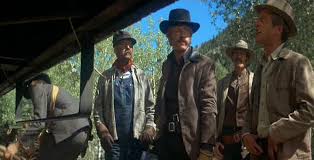
Actually, I have to say that when I think of EH Harriman, what comes to mind is the classic film Butch Cassidy and the Sundance Kid. Do you remember the pathetic figure of Woodcock, the train guard Butch calls on to open the door of the freight car carrying the money, so his gang can take it? Butch warns him that he could get blown up when they dynamite the car, and Woodcock explains:

… you gotta understand that Mr E H Harriman himself of the Union Pacific Railroad gimme this job and I never had such responsibility before and since he entrusted me to get the money through, I got to do my best, don’t you see?

Sundance and Butch trying to persuade Woodcock to open the door
rather than be blown up
It didn’t work out well for him. Or for the money. But fine for Butch and Sundance.

Today, that’s all gone. US trains, where there is a service at all, are infrequent, shabby and slow. As I discovered, or rediscovered, during the trip to Boston from which I’ve just returned.

It was when I travelled to the town of Framingham. That’s ‘Framing’ to rhyme with ‘naming’, not with ‘hamming’. I had some trouble explaining where I was going before I understood that one.

It was dark when I headed back. The station was deserted bar two or three sinister-looking young men, but I suppose that when you’re 65 any large young man looks a bit sinister at night. There was no cafĂ© or waiting room. Or staff.

Framingham Station in the gloom
with the painfully high footbridge in the background
There are two platforms (or tracks, as they say) at the station. When I arrived from Boston, I left the train at one of them, so I thought the train back might arrive at the other. But a metal sign suggested that trains from that platform only travelled away from Boston. And a similar sign on the other platform suggested it was for ‘Inbound’ trains. Which was odd, since I’d arrived at it from an outbound one.

They like those metal signs. There was another which said ‘stand back, train approaching’. Since it was a permanent sign, it didn’t seem to be particularly helpful. After all, I can testify that there were long periods when trains were anything but imminent. Unless that includes half an hour away.

There were also scrolling LED signs. They might have told me where the next train was heading and when it would arrive. Not at Framingham. There they just informed us that the car park charges had ‘changed’.

Don’t you love that euphemism for ‘gone up’?

Destinations? Times of trains? Possible delays? Nothing. Nada. Zilch.

The problem at Framingham is that the only way across the tracks was over a high bridge. I decided to position myself at the bottom of the stairs on the side I guessed the train might use, ready to tear up, over and down if I had to.

As it happens, the train did come in on the platform I chose, though I had to do some tearing all the same, because the train stopped a long way from the footbridge.

To give credit where it’s due, the train was bang on time. But that’s all the credit it deserved. The interior was unprepossessing. Minimalist. Barely utilitarian.

Boston suburban trains. Not the height of luxury
I sat across the aisle from a young woman sleeping stretched out over three seats. We trundled uneventfully through the Massachusetts night for several stops. But then the young woman woke up. She decided to listen to music on her phone. But, it seems, she either didn’t have, or didn’t want to use, earphones. And she liked her music loud.

I wouldn’t have liked her music if it had been soft. Loud it was painful.

But I was tired and didn’t feel like a confrontation. The train had several other carriages. Moving would be easy.

Or so I thought.

I had no sooner tried to enter another carriage than the guard called out, ‘Hey, sir!’

Isn’t it odd how disrespectful the word ‘sir’ can sound if you really want it to?

‘The other carriages are closed,’ she told me severely. Which was manifestly not physically true, since the doors were wide open. I suppose I have to admire her fine grasp of metaphor.

The result was that I spent the last few stops hearing, though I tried not to listen to, that objectionable young woman’s music.

Eventually we arrived into Boston, much to my relief. A little late despite being so punctual at Framingham. Not even in that respect was the service impressive.

Lincoln wouldn’t have been proud. Nor Clarence Darrow. And I don’t imagine even Woodcock would have found much to celebrate in that sad little descendant of the fine trains Butch Cassidy used to rob as he tried unavailingly to defend them.

Wednesday, 29 August 2018

Transatlantic travel and comparisons

One of the pleasures of my job is that it gets me to the US from time to time. Specifically, to Boston and Massachusetts generally, which is great, not least because they’re pretty much the antithesis of Trumpland.

It was great flying across. The trip was uneventful, as flights generally are these days, out of Russian missile range. Air travel has become routine, with neither much sense of risk (thank God) or of luxury (small price to pay).

We landed half an hour early, which was no benefit at all. Traffic at Boston is so heavy there are never any gates free so arriving early means waiting for the previous plane to leave your designated gate. Half an hour early? You get half an hour wait on the tarmac.

The Americans have massively improved entry into the country. It used to be a painful process. But I’ve managed to get myself on to the Global Entry programme, so I glided through with ease. Besides, the officials at Boston are friendly, which isn’t the case at every US airport, so arriving here’s unusually pleasurable.

Getting through passport control quickly means you get to the baggage hall sooner. I know I should learn to travel with hand luggage only, especially for just three nights like this trip. But I hate having only tiny tubes of toothpaste or micro-bottles of shampoo, and I love getting rid of my case, so I check it in, small though it is.

The airlines have a great system so that if you travel with them often enough, they grant you certain privileges. My bag now gets a ‘priority’ tag when I check it in. This is a huge boon, since it means it’s now hardly ever the last case offloaded.
The great privilege of a 'Priority' label
Which does... pretty well nothing
On this occasion, about three-quarters of the luggage had appeared before my priority case. That unfortunately meant that it didn’t make the cut: it didn’t reach the carousel before the entire luggage belt broke down. This is the land of superfine, superfast technology, so when it fails, it fails spectacularly.

Ah, well. We went from super-early to pretty late, but who cares? At least I had the chance to go for a rest, where rest is what Americans take in a restroom. I loved the symbolism used though, I have to confess, I couldn’t conform since my bag still hadn’t arrived and I couldn’t put a bowtie on.
Tough dress conventions for this 'rest' room
After that, all I had to do was head for the hotel. Which was on the waterfront, so I was able to have a relaxing walk before crashing out. That was quite an experience: I associate Boston with bitter cold, but on my walk just before midnight, it was 30 Celsius rather than 30 Fahrenheit.

A pleasant walk on a balmy night
At 30 C, nearly barmy
Breakfast is one of the better US institutions. I enjoyed it over a copy of the New York Times. That’s the ‘failing New York Times’, according to the President of this fine country. The fact that the hotel provided that paper and no other was in keeping with what happened the previous evening, when I checked in. The clerk gave me instructions for logging on to WiFi. After selecting the service, the suggestion was that I call up CNN.com to get the hotel login page. That’s quite amusing, because I always use BBC.co.uk for the same purpose. Of course, both CNN and the BBC are just the kind of news outlets Trump detests.

Not just Trump. I notice that Jeremy Corbyn’s supporters use much the same language as the Trumpists to denounce the media and its supposed unfair hounding of the blessed leader. Interesting how people at the centre of personality cults, whether of Left or Right, always hate anyone who questions them. And as for dissent, that can only come from traitors. I recently read these edifying words:

We know who the conspirators are; who their backers are; where they are and why they want to destroy [our man and our movement].

Was the writer talking about Trump or Corbyn? It’s hard to tell. The threatening tone of ‘we know where they are’ is like Trump whipping up hatred against journalists at a rally. In this case, the words were a Corbynista’s.

Breakfast also reminded me of the meal on the flight over. It included ‘Butler’s Secret’ Cheddar. Sounds enticing, doesn’t it? Marketing people love the notion of secrecy. Odd, seeing as their work is all about publicity. Somehow, nothing’s so exciting as the notion of secret ingredients.

What turned up was something that looked, felt and, I can testify, tasted like perfectly ordinary Cheddar. And since its wrapping stated what it was, I couldn’t really see anything secret about it.
Butler's Secret. Proclaimed on the packaging.
Which was a relief, to be honest. After all, if I want transparency in anything, it has to be about what I’m eating. Why would I want the producers to keep what they’re putting in my food secret?

Still. At least I don’t suspect them of engaging in collusion. Which is a lot more than I can say for Trump.

Sunday, 26 August 2018

Leatrice: hankering for more

When I last wrote about my mother, Leatrice, I mentioned the strange circumstance that my parents’ wedding took place in Genoa.

Nothing strange about that for the Genoese, of course. Just unusual for a young English couple. Except that they’d met in Paris and were travelling to Rome, where Leonard, my father, was about to take up a new job with the United Nations’ Food and Agriculture Organisation. Genoa was on the way. So maybe getting married there wasn’t really that odd after all.
July 1951: my parents get married in Genoa
It was a moment of transition for Leatrice. Years later, she wrote several letters to contacts from the forties, asking for testimonials of the time when she’d worked for them. John Parker, Labour MP and leading member of the Fabian Society, one of the oldest progressive organisations in Britain, wrote one of them. He explained that she had worked for him from 1942 to 1945, when he had been General Secretary of the Fabian Society and MP for the seat of Romford in Essex:

… then the largest Parliamentary Constituency in Britain … which was divided into 4 Parliamentary seats at the time of the 1945 General Election… She also assisted me in the work of the Fabian Society… In particular she did a very useful job in our India Committee at a time when [India’s] future was very much in the melting pot… Much useful organizing work was also carried out for the Fabian Society particularly in connection with the running of the Summer Schools.

She already had a testimonial from August 1947 by Woodrow Wyatt, later an admirer of Margaret Thatcher’s but back then a Labour MP in his first term. He worked with the British Commission in India and in particular handled relations with the Muslims, who were preparing not only for independence from Britain but also independence from India, as Pakistan.

Wyatt had known Leatrice for two years and she had:

…acted as Minutes Secretary of the Indian Affairs Group of the Fabian Society when I was Secretary of the Group and during that time she was most energetic and capable, and showed a high sense of responsibility.

Another of the testimonials she collected in 1974 came from David C. Williams, Chairman of the International Affairs Committee of Americans for Democratic Action. He’d been sent to London in July 1946 on behalf of the Union for Democratic Action, its predecessor organisation.

One of my first actions was to engage Miss Leatrice Bannister, now Mrs. Beeson, as my assistant. Her knowledge of the principles and programs of the Labour Party and the Fabian Society and of many of their leading personalities proved invaluable to me… It enabled me to get into the swing of things much more promptly than I would otherwise have done.

She had worked with him until January 1948, when she left for Paris.

It must have been quite a heady atmosphere for a woman in her twenties. The India committee of the Fabian Society must have been particularly gratifying: Labours Clement Attlee was in office and, in foreign affairs, overseeing Indian independence remains his most significant achievement.

1951, the year of her wedding, definitively closed that period of Leatrice’s life. I was born in 1953, my brother in 1956. Leatrice, who’d worked for her own living since becoming an adult, became a wife and mother with no job of her own but dependent on her husband’s earnings.


Leatrice with my brother Nicky in 1956
One of my lasting memories of our time in Italy was the yearly summer holidays in Porto Ercole, in Tuscany. At the time, the place was a small fishing port, where my brother or I could wander off, and local people would be able to tell my parents where we were. Today, it’s a heaving mass of tourists. But what remains is Feniglia, outside the town, with its kilometres-long golden beach, where we’d spend hours in the warm water and then roll in the baking hot sand to get warm again, with barely another person in sight.

Nicky on the rocks (literally not metaphorically)
at one end of the Feniglia beach

Me on the edge of beach

My father would join us when he could
Leonard would come up and join us at weekends, and generally spent a week or two at some point. Eventually we’d head back to Rome, where we lived in a converted farm building on the edge of the city. It was part of a baronial estate which still had a large cement-walled pond where two local families would do their washing, the wives using bars of soap and cold water, wringing and beating the clothes in a sink fed from the pond.


Nicky on the edge of the pond at Via Casale San Pio V in Rome
Not the first place we lived in but the last
and where we stayed the longest
Leatrice in the garden
We lived on the top floor of the building beyond the gate
My father had work. My mother had us. Those long summers at Feniglia – did she enjoy them as much as we did? Or did she miss the intellectual stimulation of her English life? John Parker mentioned her role in organising the Fabian summer schools, at Dartington in Devon, where my parents eventually sent my brother and me to school. Another of the testimonials she solicited in 1974 came from a close friend from those times – I suspect they’d had at least a fling – and he wrote as a Professor from the University of British Columbia at Vancouver.

Did she ever wonder wistfully whether that was the world to which she should have belonged? That all the international travel had been exciting, but that she might have been more at home in academe or politics – or possibly both? Did she ever entirely recover from her pain at not getting the university education she had wanted in 1942 but passed up to go straight to work?

There’s a hint in the reason why she was asking for all those testimonials.

In 1974, Leonard was working at the headquarters of the United Nations Development Programme in New York. Leatrice decided that this was the opportunity to undertake the studies she’d missed before. She enrolled at Queens College of the City University of New York. The testimonials won her some credits for her course, but she hardly needed them: she took A grade after A grade, disappointed on the rare occasions when she fell as low as a B.

She was admitted to Phi Beta Kappa, the oldest and arguably the most prestigious of the American academic honour societies. That was something of which she was profoundly proud, and for many years she would wear the gold Phi Beta Kappa key around her neck.


Badge of pride: Leatrice's Phi Beta Kappa key
One of her papers was graded by a Professor Zvi Yavetz at Tel Aviv university. A Holocaust survivor, he was one of the founders of the university and a major figure in history studies in Israel for several decades. He wrote to her to say:

The following cable has been sent to the department of History, Queens College: ‘Grade Beeson Leatrice’s superb paper A+…

I would also like to tell you that only students like yourself can make a course interesting, because only they can stimulate a teacher to prepare his class.


It’s ironic today, with the Labour Party embroiled in a long drawn out dispute over antisemitism, to read this forty-year old praise from an Israeli academic for a lifelong, Jewish Labour supporter.

In June 1976, at the age of 52, she graduated in History with the top class of a US degree, Summa Cum Laude.


Leatrice's degree certificate
A proud achievement. But - three decades late?
It must have been a valediction for her. But perhaps also a source of regret. 

There’s no doubt that my mother took great satisfaction from most of her life and wouldn’t have wished to change much in it for anything else. On the other hand, her results in 1976 demonstrated just how much she could achieve. She must have wondered at times whether she’d missed the opportunity to fulfil her potential. Had she won such success three decades earlier, when she’d wanted to, how much more might she have accomplished?
-->

Friday, 24 August 2018

The Empress, the Wit and the Disappointed

When I first went to university, it was to study Maths and Physics. It didn’t work out. I spent a rather purgatorial time immersed in the politics of the far left – all about ‘having faith in the working class’ which always left me a little uneasy, as I felt the left ought to be about evidence not faith – and even became president of my college students’ union, but at the end of the process I had no degree.

This struck me as annoying, so I immediately signed up to study something completely different. French. That gave my mother a wonderful told-you-so moment: she pointed out that I had always been temperamentally far more suited to the humanities than the sciences. And she was right.

Fortune favours the bold. Sometimes, I find it favours the downright impertinent. At the end of my first year of French studies, I let my professor know that I wanted to do a PhD.

‘Come and see me at the beginning of your fourth year,’ he sagely told me. 

After all, I had a failed degree behind me, and I certainly had something to prove before I could be considered for postgraduate studies. Like graduating, for instance.

Well, I stuck it out. At the beginning of my fourth year, a message trickled through to me that Professor William Barber would like to see me. I made an appointment and dropped in for a chat.

It seemed that he was now open to the idea of my doing a PhD. I was delighted. Why, I’d even chosen the extraordinary man I wanted to study. Denis Diderot, the son of a craftsman, had emerged in the eighteenth century as one of the leading figures of the French enlightenment. He was the prime mover of the EncyclopĂ©die: at a time when the belief was that driving knowledge forward was the most important endeavour of mankind, what could be more valuable than to bring all available knowledge together in one easily accessible place – the first Encyclopaedia ever?

Denis Diderot: an extraordinary brain and a delightful wit
But what appealed to me most about Diderot was his extraordinary wit. If you don’t know his Jacques the Fatalist, you should try to find it and read it: it’s rich in lessons about tolerance and decency, and is also one of the funniest novels I’ve ever read.

William Barber, my Professor, invited me to sit down.

‘Subject to your getting a sufficiently good degree, I’d be happy to supervise you doing a PhD, he told me.

I was delighted.

I’d like you to work on Pierre Louis Moreau de Maupertuis.’

I was disappointed.

Maupertuis was someone I’d heard of, but only because he appeared in two footnotes of a work of Diderot’s. It was a bit of a come down. And yet – William was right. Maupertuis was a scientist as well as a philosopher. My failed studies of science had at least equipped me with enough knowledge to understand his work.

‘Of course,’ William had assured me, ‘you don’t have to choose Maupertuis. But if you want me to supervise you, that’s who I’d like you to work on.’

Since I did want to work with William, I accepted his suggestion. For the next ten years, Maupertuis would dominate my life, as I wrote his Intellectual Biography. He may have been obscure and I may have done little to shine much light on his life, but I enjoyed what I did. There’s also a little pride in having been, however briefly, the world’s leading authority on Maupertuis, which I never would have been on Diderot. That’s big fish in a small pond thinking, I know, but hey, that’s not without its satisfaction.

So, I have no complaints about William’s decision.

On the other hand, I do still sometimes regret not having worked on Diderot. He was so much more attractive a character than Maupertuis. If nothing else, he didn’t take himself half so seriously - Maupertuis had what was no doubt to his mind an accurate estimate, to everyone else a wildly overblown one, of what was due to him.

So it was a pleasure to come across an anecdote about Diderot I was unaware of while reading a biography of Empress Catherine the Great of Russia. Well, I say reading, but in reality I was listening to it: these days I often find it easier to listen to books than read them

Catherine was a great fan of Diderot’s, and even had him come to Russia as a guest for several months.

Diderot did outstanding work but it wasn’t well paid. He was never wealthy. He was devoted to his daughter, the only child he and his wife had after a series of miscarriages. When the daughter reached adulthood, he was anxious to raise a dowry for her. With little material wealth, he decided that all he could do was sell his library. He went looking for 15,000 French pounds (yes, the pound was a French currency too at one time) for it.

Catherine decided to offer him 16,000. But then she attached a condition to the sale. On the grounds that it was wrong to separate a scholar from his books, she insisted that he should keep them for her during his lifetime.

In effect, she had made him a librarian of hers. So she decided to pay him 1000 pounds a year to play that role. That worked fine in the first year, but his pay failed to show up in the second. Catherine, much embarrassed, made up for the oversight, by sending him fifty thousand pounds.

As she told him, that was fifty years’ salary, paid in advance.

Ah, yes. He was a special man, our Diderot. And, to be fair, Catherine was a pretty remarkable woman too.

Catherine the Great
As keen a fan of Diderot as I am. But with the means to prove it

Wednesday, 22 August 2018

Brexit exit: first step. With a stumble

There’s always one thing that goes wrong, isn’t there? Still, as long as it all works out in the end, it’s hardly worth complaining. And I call an excellent unplanned Chinese meal a good ending.

Some time ago, I mentioned that my wife Danielle and I have brought forward our plans to move to Spain. That’s our exit from Brexit and if we’re reasonably quick, we can probably pull it off before the UK leaves the EU.

The first concrete step was selling Danielle’s car. It was a small car and already second hand when we bought it so we knew it couldn’t be worth much. In fact, a little online searching suggested the best we could hope for would be around £3100.

So she advertised it for £3200.
First step towards the Brexit exit:
a bit of a wrench but we had to part company with Danielle’s Aygo
She also contacted one of those online organisations that buy cars for the trade. Once she’d given all the details, they suggested they might pay £3100. That sounded fair enough, so we agreed they could send someone round to check out the car.

‘Don’t get your hopes up,’ Danielle said, ‘these guys are well known for always finding reasons to knock a price down after an inspection.’

The character from the company showed up on Saturday. A large cheerful man, all hail-fellow-well-met, with lots of jokes, and an open, friendly countenance. So naturally I decided I couldn’t trust him any further than I could kick him, and given his size, I certainly wouldn’t have been able to kick him far.

He checked out the car and expressed himself satisfied with its state. He liked the fact that the service record was bang up to date. He liked the fact that Danielle had all the documentation ready for him. So he phoned his head office. Then turned to us and cheerfully announced, ‘we can offer you £2300.’

Danielle looked shocked.

‘Down from £3100?’

‘What’s the least you’d accept?’

‘Not less than £3000,’ she said, firmly.

He rang his office again.

‘The best we can do is £2600,’ he told us.

We said goodbye.

Danielle immediately re-advertised the car. Again at £3200.We weren’t best pleased with the trader, so we were delighted that it was the very next day, on Sunday, that someone expressed an interest in it.

It was a family from Milton Keynes, about 40 minutes away from where we live in Luton. They wanted the car for their daughter. All three turned up to see it.

They too were impressed. By the state of the car. By the service record. By the fact that all the documentation was available.

So we reached the key moment.

‘Are you OK with our making an offer?’ said the father.

‘Please do,’ said Danielle.

‘Would you take £3000?’ he said.

Danielle looked at me.

‘What do you think?’ she asked.

‘It’s your car,’ I said, which was a copout, I know. But I’ve cocked up this kind of negotiation more than once in the past.

A silence fell. I’ve learned the power of silence so I certainly wasn’t going to be the one to break it.

‘What about if we split the difference?’ he said. ‘Would you take £3100?’

Since that was exactly the figure she’d first thought of, Danielle didn’t hesitate. ‘Yes, that’ll be fine,’ she said.

Given we’d been offered £2600 the day before, that had to represent about the quickest £500 we’d ever made.

Everything had gone smoothly up to then. Now we just had to manage the financial side of things. That, sadly, involved a bank.

‘I’ll send you a pound first,’ said the buyer, ‘to check that the details are right.’

Minutes later a pound showed up in Danielle’s account.

‘Excellent,’ he said, ‘now for the £3100.’

‘3099,’ I corrected him.

‘The pound’s on me,’ he said, jovially, as he pressed Submit on his phone.

And then his face fell.

There was another silence. Not a powerful one this time. More distraught, really.

‘Is there a problem?’ asked his wife.

‘They’ve blocked the transfer.’

Well, I’m not going to bore you with the details. Let me just say that twenty minutes later he was still arguing with his bank.

‘I know it’s a security question,’ he said repeatedly, ‘but how can I possibly tell you how much the last payment from my account was for, since I’m not at home and don’t have access to any statements?’

His wife had been able to access the account, and she showed us that the £3100 had already been debited from their account. It just hadn’t reached out ours.

We could hear the bank representative talking to her husband.

‘That’s fine now, sir,’ they were saying, ‘the payment will go through. It shouldn’t take more than two hours.’

‘Two hours? But I’m sitting in someone else’s house. And trying to buy a car we were going to drive home. You expect us to sit here for two hours?’

We suggested that we could take them out for dinner somewhere. They didn’t like that idea, since their dog was at home and no doubt getting sad.

‘No,’ he said, looking defeated, ‘we’ll just have to come back tomorrow.’

We weren’t keen, particularly as it would mean we were looking after someone else’s car overnight. What if some moron scratched it? It wouldn’t have been the first time.

And then an idea dawned on us. The Taipan restaurant in Central Milton Keynes is one of the best Chinese I’ve ever been to. We hadn’t eaten there for ages.
The Taipan in Milton Keynes:
one of my favourite Chinese restaurants. Anywhere
‘We’ll go and have a Chinese in Milton Keynes,’ we told them, ‘and you can pick up the car there when the money comes through.’

Which is how things worked out.

They were pathetically grateful.

‘It’s so good of you to have come up here with the car,’ the father told us.

‘No,’ I said, ‘I’m indebted to you for a great dinner I wouldn’t otherwise have had.’

‘Oh, yes. I suppose I made that possible.’

‘You and your bank.’

‘Right. I can’t take all the credit.’

So things all worked out fine in the end. Everyone was happy.

And I enjoyed the object lesson as much as the meal: things go well while people of good will are working with each other. But that doesn’t include professional car dealers. And once a bank gets involved – watch out. They don’t make those massive profits for nothing – they’re world-class champions at turning a simple transaction into a major inconvenience.

Monday, 20 August 2018

A mighty will in a tiny body

Ah, poor Toffee. And poor Danielle, for that matter. Poor me too, perhaps, though I had less to put up with – just a brief interruption of sleep.

Why poor Toffee? One of the reasons we wanted a second toy poodle is that we thought it would be fun to breed from her. We found Luci, our first toy poodle, such fun that we thought a second one, and then some puppies, would just multiply the pleasure. It’s certainly turned out that just adding Toffee to the household took the poodle amusement level up several notches.

The thing about Toffee is that she has a personality that completely compensates for her lack of physical size. She knows what she wants. She likes to make sure she gets it. You should see her if she’s found some awful mouldy piece of meat in the park: we can chase her all over the place, but she’ll never drop it or even let us lay a finger on her.

Another example is breakfast. She and Luci like to take their time over it. It’s dog biscuits rather than soft food, so they don’t wolf it down the way they do with food they like better. They leave some of it in their bowls.

But just let Misty, our cat, get anywhere near it. Toffee will be out there like a shot and growling ferociously. I watched her this morning, and saw how Misty, twice her weight, backed away intimidated by her ferocity.

The heart of a lion in a teeny-weeny body.

Because that’s the other thing about Toffee. She really is minuscule. Which rather spoiled the second part of her plan. Breed from her? Would she be able to handle a pregnancy? Where would we find a male small enough for a pregnancy not to cause her harm?

That all came to a head a few weeks ago. We’re beginning to plan for a move to Spain rather sooner than we’d originally planned – Brexit oblige and all that – and another move probably means we don’t need a litter of puppies to complicate things. Given we were already in two minds about it, that really rather killed the plan to breed from Toffee.

So that was it. Toffee went under the knife and came back wombless.
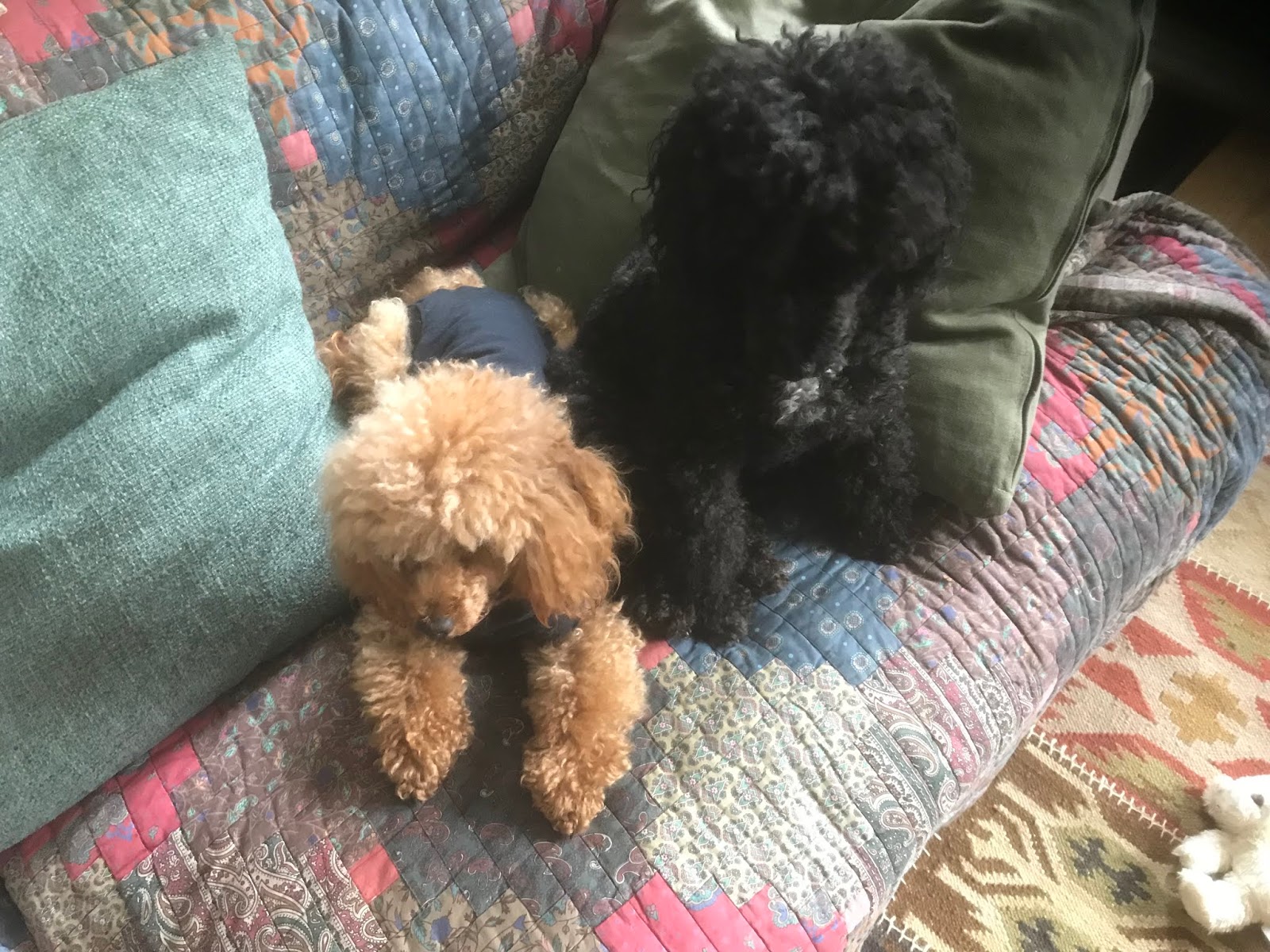
Toffee with her mate, on their couch
She's in her blue post-op coat, poor thing
Though it's much better than those ghastly cones....
Now Toffee is lively, active and carefree. But neutering is a serious operation for a female. When she got back from the vet’s, she was far from herself. She was lying on the couch and clearly in pain, poor thing.

We’d had clear instructions that she wasn’t to run and she wasn’t to jump for a while. And let’s be clear: jumping includes using the stairs, for a little dog who has to leap from step to step.

‘I think I’ll sleep down here,’ Danielle said, ‘on the couch. That way Toffee can sleep next to me and, if she needs a pee during the night, I can take her out in the garden.’

It seemed a little rough on her to have to sleep on the couch but, in the circumstances, it made some sense. So I went up to our bedroom on my own while Danielle settled down on our (quite comfortable) couch, with both dogs next to her.

And so things might have stayed had Toffee not once more exercised her mighty will and her inalienable right to freedom of choice.

At 4:30 in the morning I was awoken by Danielle bursting into our room, distraught and panic-stricken. Though I’m glad to say that her first words suggested things were less bleak than they seemed.

‘Oh, thank God,’ she said.

Danielle was wearing an outdoor coat over her nightdress.

‘I’ve been hunting around the garden, looking behind every bush. I thought the pain had got too bad for Toffee and she’d crawled away to die somewhere quiet.’

‘But she hadn’t?’ I enquired, not yet fully conscious.

‘No. There she is.’

I looked where Danielle was pointing. And there lay Toffee, curled as always into a little ball, lying against my leg. She had doubtless been asleep not long before, but she’d lifted her head to look and Danielle as though asking, ‘what’s all the commotion about?’

The explanation was simple. Toffee views the couch as a fine place to lie on, during the day, or even in the evening when we’re watching TV. It isn’t where we, and in particular Toffee, sleep. That happens two floors up, on a proper bed.

So, doctor’s orders or not, she’d jumped off the couch, made her way to the stairs and quietly but determinedly jumped up from step to step till she reached the top.

Where she’d made the further leap onto the bed and fallen asleep next to me. In what she clearly regarded as the right place for it.

‘Well, if she’s sleeping up here, so am I,’ said Danielle. And climbed into bed.

Onto which Luci also promptly leaped. So we all four slept for the rest of the night on our communal bed. As we usually do.

Order had been restored to the universe. Things were once more the way Toffee likes them. And the way, ill or not, she was going to make sure they remained.